Build a topical map with Claude, then check every row
I ran this for real: one Claude conversation, seven short prompts, the made-up dog grooming salon from the by-hand lesson and a keyword export I gathered myself. Here is every prompt, what came back, where it went wrong and how I caught it.

Key takeaways
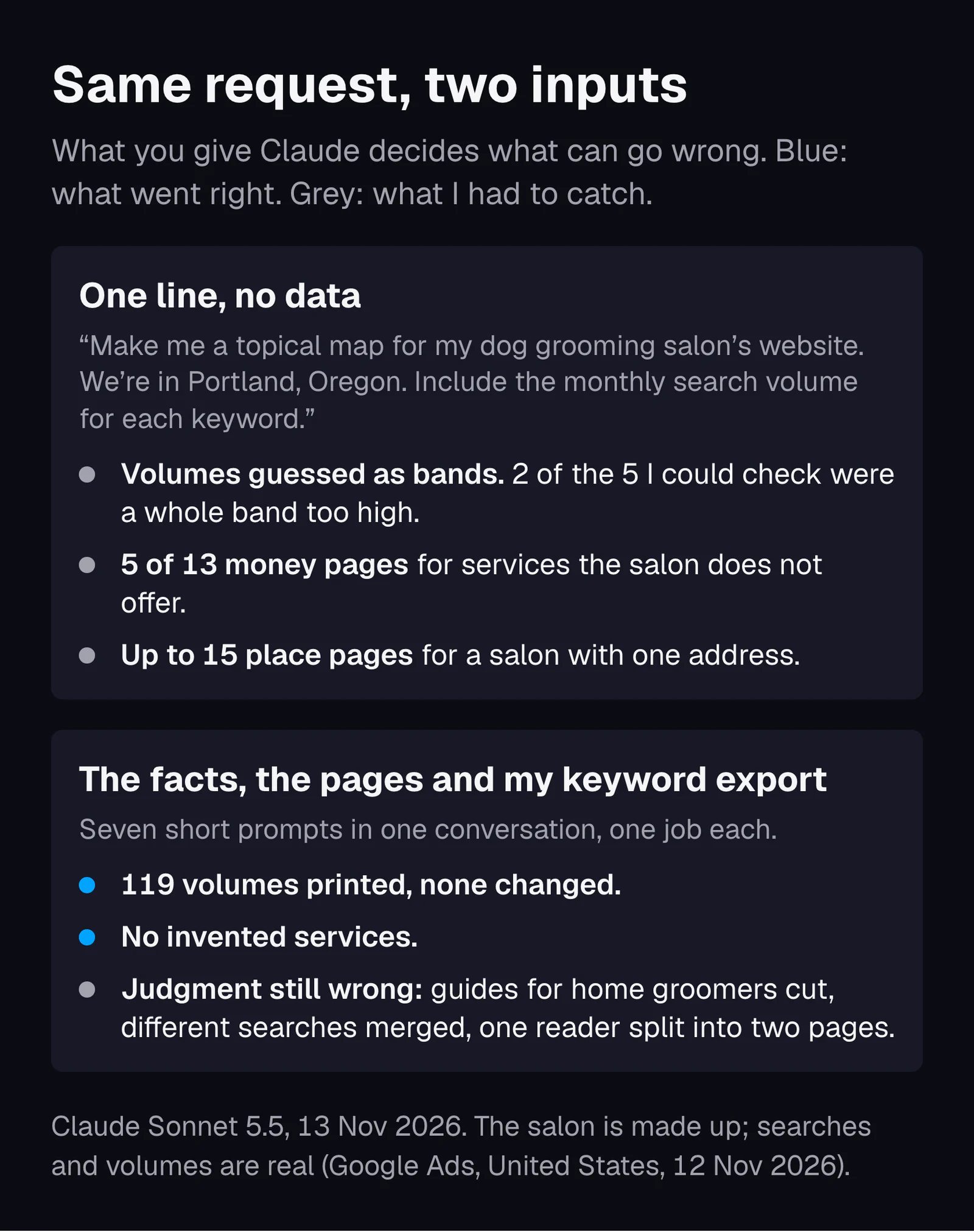
- Asked for a topical map in one line with no data, Claude marked its search volumes as estimates, and still put two of the five I could check a whole band too high.
- Given my own keyword export, Claude printed 119 search volumes across five replies and changed none of them; its mistakes were in the sorting, not the arithmetic.
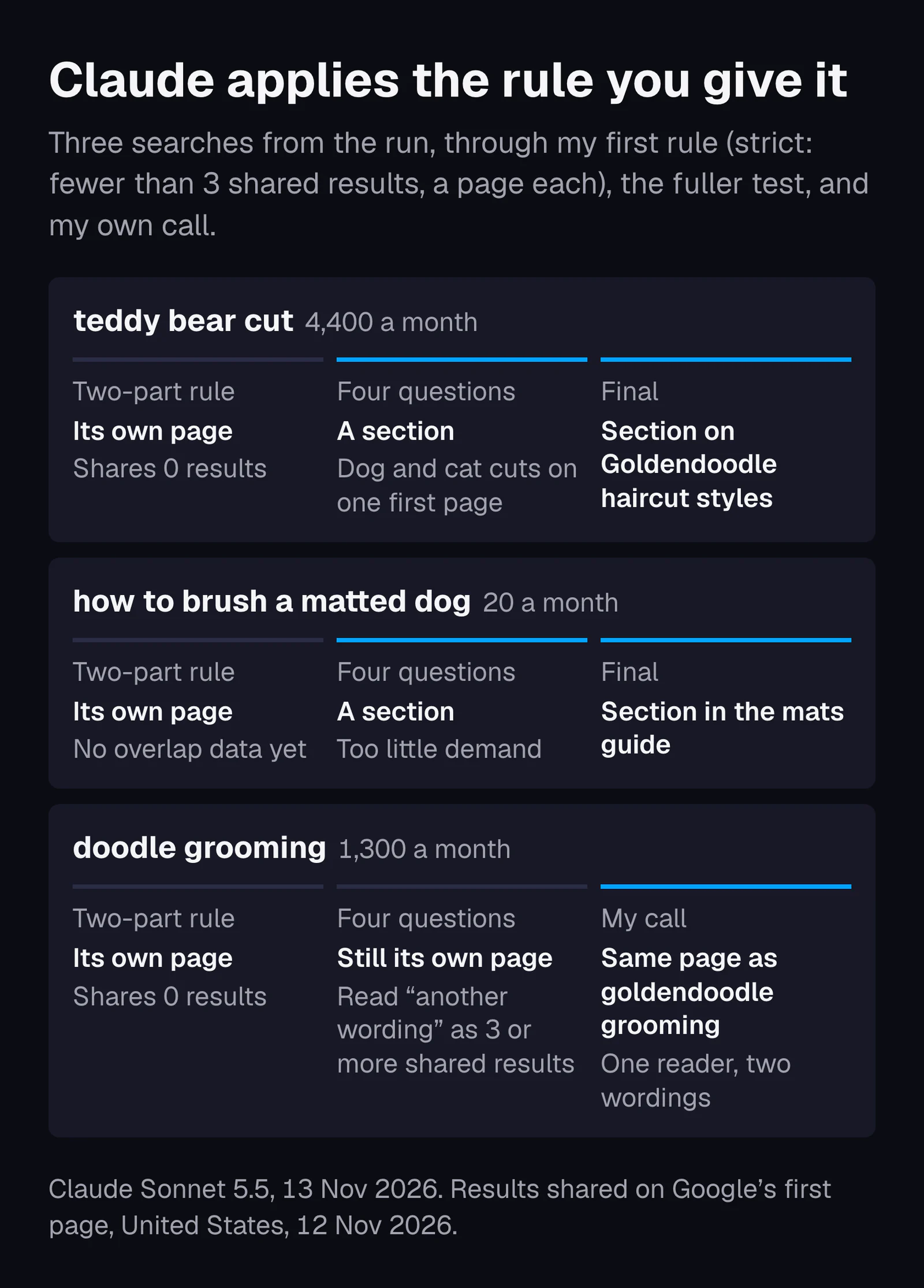
- Claude applies the rule you give it, holes included: a two-part page test made it split one reader's search into two pages, and only a fuller rule plus my own call fixed it.
- Links and a publishing order came back only when I asked, and Claude said plainly it could not judge how strong Google's results were, so that count has to come from you.
- The checked draft holds the same 23 pages as the map built by hand from the same searches, plus two guides the hand build had left out; Claude's seven replies took about five minutes, and the checking was the real work.
What Claude does in this method, and what stays with you
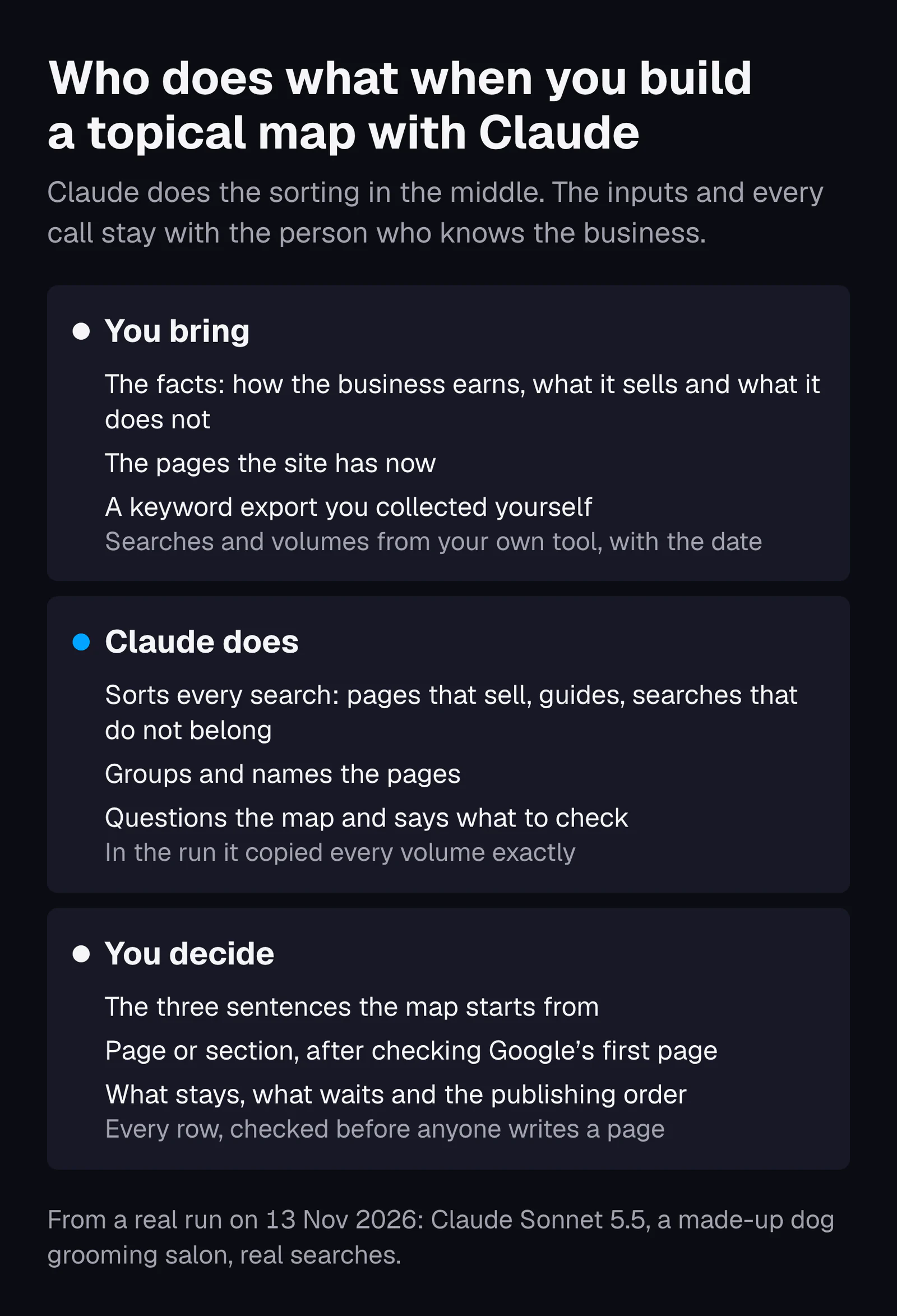
In this method Claude sorts, groups, names and questions. You bring the business facts, the pages the site has now and a keyword export you gathered yourself. You check every row against Google and make every call. Done that way, a small site gets a usable first draft of its topical map in an afternoon.
A topical map is the plan of every page a site needs, grouped, linked and put in the order to publish them. The steps are the same ones I use by hand in How to build a topical map. This lesson hands the sorting work to Claude and keeps the decisions with you.
The run behind this lesson
- Claude: Claude Sonnet 5.5, in a fresh conversation with no project files, no custom instructions and web search off, on 13 November 2026. With search off, every number in the replies came from my file or from Claude itself, so I could tell which was which.
- The business: the made-up dog grooming salon in Portland, Oregon, from the by-hand lesson. One address, six services: full groom, bath and brush, nail trims, de-shedding, dematting and puppy grooming. The salon is made up. Everything I checked it against is real.
- The keyword export: 42 searches I collected with the grid from the by-hand lesson, with US monthly volumes from Google Ads data (the numbers Keyword Planner shows), pulled on 12 November 2026. Five came back with no number.
- The checks: Google's first page for all 42 searches on 12 November 2026, once from the United States and once from Portland. When I say two searches "share" results, I counted the same pages on both first pages. The forum counts for 14 of the guides come from the by-hand lesson's own check that same day. Results move between checks, even on one day, so treat every count as a reading, not a constant.
I sent eight prompts in all: one test of the one-line request most guides teach, then seven in one conversation. Every prompt is below, word for word. The full set is in a file at the end. If you want the wider picture of where Claude helps with SEO and where it does not, start with Claude for SEO.
What happened when I just asked Claude for a topical map
The one-line request returned a map for a generic salon, not for this one. It had guessed search volumes, services the salon does not sell and pages for neighborhoods it does not serve. This is the prompt, in a separate fresh conversation:
Make me a topical map for my dog grooming salon's website. We're in Portland, Oregon. Include the monthly search volume for each keyword.
To its credit, Claude said up front: "I don't have access to a keyword tool (Semrush, Ahrefs, Google Keyword Planner), so I can't give you verified monthly search volumes." It gave "rough estimated ranges" instead: High for 1,000 or more a month, Med for 100 to 1,000, Low for 10 to 100. Six of its keywords match my export word for word, so I could check them:
| Search | Claude's guess | My export (US a month) | Right? |
|---|---|---|---|
| dog groomer portland | High | 880 | No, that is Med |
| dog nail trim portland | Med | 70 | No, that is Low |
| goldendoodle haircut styles | Med-High | 12,100 | Undersold: High by a wide margin |
| how much does dog grooming cost | High | 1,600 | Yes |
| how often to bathe a dog | High | 5,400 | Yes |
| puppy grooming portland | Low-Med | No number in the tool | Cannot tell |
Two of the five I could check were a whole band too high: an 880-a-month search guessed at 1,000 or more, and a 70-a-month search guessed at 100 to 1,000. A third, at 12,100 a month, was undersold as Med-High. Guesses like these change which pages a plan puts first.
Pages for a salon that does not exist
Claude did not know the services, so it filled the gap with a typical salon. Of its 13 pages that sell (it called them money pages), five were for services this salon does not offer: teeth brushing, ear cleaning, senior dog grooming, flea and tick baths and spa add-ons. A sixth, Haircuts and styling, is part of the full groom it already sells.
It also offered up to 15 pages for places: 8 Portland neighborhoods ("only if you serve them"), 4 nearby cities and 3 quadrants of Portland. For a salon with one address, that is the pattern Google calls doorway abuse: pages made to catch searches and send everyone to the same place. Its spam policies list "pages targeted at specific regions or cities that funnel users to one page".
Why a model guesses
A language model gives an answer even when it has no data, unless you stop it. Adam Tauman Kalai and colleagues at OpenAI and Georgia Tech explain why. Models "sometimes guess when uncertain", they write, because "the training and evaluation procedures reward guessing over acknowledging uncertainty" (2025). Claude flagged its guesses, which helps. A flagged guess is still a guess, and on a map it sits in the same column as a real number.
Koray Tuğberk Gübür's work made the topical map a standard SEO deliverable. In 2024 he put this in one line: "Asking ChatGPT for 20 types of X won't give you a topical map about X." The same holds for Claude. What the tools that generate maps in one go can and cannot decide is in Topical map tools and generators.
Give Claude the three things only you have
Before any page is planned, give Claude three things: the facts of the business, the pages the site has now and your keyword export. Then ask for the three sentences a map starts from, and ask what it needs to know. Here is the first prompt of the real conversation:
I want to build a topical map for my dog grooming salon's website. Your job is to help me sort, group, name and question things. I make the final calls, and I'll check every row myself.

About the business:
- One salon in Portland, Oregon. One address.
- We make money from booked grooms. We don't sell products.
- Six services: full groom, bath and brush, nail trims, de-shedding, dematting, puppy grooming.

The pages the site has now:
- / (home page: a list of services and a phone number)
- /prices (a price list)
- /about (two paragraphs about the owner)
- /contact (address, hours, a form)
- /blog/summer-shave (an old post about shaving dogs in summer)
- /blog/new-tub (a news post about our new bathtub)

First step only: write three short sentences. 1) Why the site exists and how it makes money. 2) The one thing the site is about. 3) The main thing visitors come to the site to do. Then ask me up to five questions you need answered before we plan any pages. Don't plan pages yet.
The three sentences are the first three foundations in Koray Tuğberk Gübür's framework: the source context, the central entity and the central search intent. He defines the source context as "the perspective and function of the website and the brand on the open web that involves monetization, and existing purpose" (2023). In plain words: why the site exists and how it earns. Every page added later is checked against these sentences. The full framework is in Koray Tuğberk Gübür's topical map framework. The three sentences have their own lesson: Source context, central entity and central search intent.
What came back
Claude's three sentences, word for word:
1. "The site exists to bring pet owners to your Portland salon and turn them into booked grooms, which is the only way it earns money (no product sales)."
2. "The site is about professional dog grooming at one salon in Portland, Oregon."
3. "Visitors mainly come to decide whether to trust the salon with their dog and to book a groom (or find out how to)."
The first two were right. The third mixed two jobs, so I rewrote it: "Visitors come to book a dog groom in Portland." That edit is the point of this step. Claude drafts the source context. You decide it.
Then it asked five questions, and they were good ones: how people book, which areas to draw from, which services matter most, which dogs the salon takes, and what to keep from the current pages. My answers went into the next prompt. Two of them shaped the whole map: "Only Portland, from the one salon. No pages for other cities or neighborhoods", and "Dogs only, all sizes."
The keyword export comes from you
Claude has no search data of its own unless you connect a source. With web search off it has none at all. So the export is yours. Collect the searches with the grid in the by-hand lesson, pull their volumes from Keyword Planner or any keyword tool, and paste them in as lines of search and number. Keep the blanks: a blank means the tool had no number, not that nobody searches.
Anthropic, the company that makes Claude, gives the same advice for any task with facts in it. Its guide to reducing made-up answers says to "explicitly instruct Claude to only use information from provided documents and not its general knowledge" (2026). It also says to let Claude say "I don't know". My prompt 2 did both: "Use only my searches and my numbers," plus a separate place for anything it added.
Related research on clustering points the same way. Vijay Viswanathan and colleagues found that a language model guided by a person's structure, used "before clustering" and "during clustering", "can routinely provide significant improvements in cluster quality" (2023). You give the structure and the data. Claude groups. For the columns of a finished map, start from the topical map template.
Let Claude sort the export, then check the sort against Google
Claude sorted all 42 searches in one reply, and it changed none of the 42 numbers. Across the whole conversation it printed 119 volumes from my export across five replies, and I checked every one with a script: all 119 matched. In a spreadsheet, a lookup of each search against your export does the same check. The mistakes were in the sorting. This is the prompt:
Answers:
1. Online booking, or by phone.
2. Only Portland, from the one salon. No pages for other cities or neighborhoods.
3. Full grooms are most of our work. We'd like more puppy grooms.
4. Dogs only, all sizes. No cats. Puppies once they've had their shots.
5. Rewrite the summer-shave post. Drop the new-tub post. The price list is right and stays public.

I'm keeping your first two sentences. Change the third to: "Visitors come to book a dog groom in Portland."

Here's my keyword export: 42 searches I collected myself, with US monthly searches from Google Keyword Planner, pulled on 12 November 2026. A blank means the tool had no number.

[The 42 rows of the export, one per line: search, US monthly searches]

Sort every search into one of three groups:
A) Pages that sell: one per service I offer, plus the price page and the about page.
B) Guides: pages that answer a question and feed one page from group A. Name the page each guide feeds.
C) Doesn't belong, with a one-line reason.

Use only my searches and my numbers. If you think a page is missing, add it at the end under "Suggested, no data". Give me one table.
It returned one table of 42 rows, each with a group, the page it belongs to and a reason, plus two suggested pages marked "no data". A guide "feeds" the one page that sells it sends its readers to. Here are ten of the rows, word for word, with Claude's arrows written as "feeds":
| # | Search | US a month | Group | Page | Claude's note |
|---|---|---|---|---|---|
| 1 | dog grooming portland | 880 | A | Full groom | Same intent as rows 2-4, so one page. |
| 4 | dog grooming near me | 450,000 | A | Full groom | Same page as row 1. Google adds the location, but the number is US-wide. |
| 19 | goldendoodle grooming | 2,400 | B | Same doodle guide, feeds Full groom | |
| 20 | goldendoodle haircut styles | 12,100 | B | Same doodle guide, feeds Full groom | Style browsing, so weaker booking intent. |
| 22 | teddy bear cut | 4,400 | B | Same doodle guide, feeds Full groom | Could stand alone if you want. |
| 30 | how much does dog grooming cost | 1,600 | B | Guide: what affects grooming cost, feeds Prices | Close to row 12. You may prefer to fold it into /prices. |
| 34 | dog nail trimming | 14,800 | C | None | Mostly do-it-yourself, and not local. Borderline, because some people want a service. |
| 35 | how to trim dog nails | 22,200 | C | None | The searcher wants to do it at home. |
| 37 | dog nail bleeding | 2,400 | C | None | First aid after a home nail trim, not a booking. |
| 42 | dog grooming kit | 6,600 | C | None | Shopping search, and you don't sell products. |
Related research suggests naming and grouping is where these models are strong. In a 2023 study, a prompt-based method called TopicGPT matched human topic labels better than older methods: a purity of 0.74 against 0.64 (Pham and colleagues). The groups Claude named were tidy. Three things in them were wrong.
It gave the city searches to a service page
Claude put "dog grooming portland" and its two other wordings on the Full groom page. It asked whether they should go on the home page instead. Left as it was, the home page and Full groom would both answer the same search: two pages for one search, which is keyword cannibalization. It also put "dog grooming near me" on that page, with its 450,000 searches. Claude noted the number was national, which is right, but a page cannot win that search: Google answers it with map listings. I moved the city searches to the home page as the main page, and took "near me" off the map.
It threw out the guides for people who try it at home
Ten searches went to "doesn't belong". Two were right: "dog grooming" (too broad) and "dog grooming kit" (a shopping search, and the salon sells no products). Seven of the other eight are on the hand-built map: as guides, as a section or as a second search on a service page. Among them are "how to trim dog nails" at 22,200 a month and "dog nail bleeding" at 2,400. The eighth, "how to groom a dog at home", comes back later in this run.
Claude's reason was that these readers want to do it themselves. That is a real view, and it is the wrong one for this map. A topical map has a core section of pages that sell. Around it sits an outer section of guides that answer the buyers' wider questions and send readers toward the core. The person whose home nail trim just went wrong is a likely nail trim customer. The split is explained in Core section and outer section.
One of the eight was not a guide at all. When I searched "dog nail trimming" from Portland, the first result was a Portland groomer's page, "Dog grooming in Portland OR". People searching it locally want the service, so it belongs on the Nail trims page.
It merged searches Google keeps apart
Claude put five doodle searches into one guide, among them "goldendoodle grooming" (2,400), "goldendoodle haircut styles" (12,100) and "teddy bear cut" (4,400). It put "shih tzu haircut styles" and "poodle haircut styles" into another. Then I counted the shared results. Every pair among the five doodle searches shares 0 or 1 pages on Google's first page. The two breed searches share 0. Google treats them as different needs.
To count shared results, search both in a private window and count the same addresses on both first pages. My working line, from the by-hand lesson: 3 or more shared first-page results is a strong sign of one need and one page. Fewer is only a hint: read the results twice and check what kind of page ranks before you give a search its own page. The idea is older than SEO. Doug Beeferman and Adam Berger grouped search queries by the pages people clicked for them in 2000.
Claude also hedged on one call that was right. It kept the cost guide apart from the price page, then said "You may prefer to fold it into /prices." In my check the two searches share 0 first-page results from the United States and 1 from Portland; the by-hand lesson's check that day found 1 of 8. Either way they stay two pages.
The fix, as one prompt
I sent the three corrections together, with the data and the rule behind each:
Three changes. I checked these against Google myself.

1. Rows 1 to 4 go on the home page, which becomes the main page: "Dog grooming in Portland". Take "dog grooming near me" off the map. Google answers that search with map listings, and the 450,000 is a national number.

2. My rule for guides: a guide belongs if the person reading it is likely to need one of my services, even if they plan to try it at home first. Re-sort group C with that rule. Also: when I search "dog nail trimming" from Portland, a Portland groomer's page comes first.

3. Your doodle guide (rows 18 to 22) and breed-styles guide (rows 23 and 24) mix searches that Google treats as different. Every pair in those rows shares 0 or 1 results on Google's first page. My rule: 3 or more shared results is a strong sign they belong on one page; fewer is only a hint, so flag those pairs for a second look instead of deciding. A search with too little demand to stand alone becomes a section on the closest page. Re-split rows 18 to 24.

Show me only the rows that changed.
The run below used my stricter first wording of the rule, which said fewer than 3 shared results meant a page each. The prompt above is the softer version I would send now.
Claude moved all eight searches back, put "dog nail trimming" on Nail trims and split the doodle and breed rows. It also said where it lacked data: "I don't have first-page overlap for these pairs. I left each row as its own page for now." That is the behavior you want. Two of its splits were still wrong, and the next section is why.
Claude follows your rule, holes included
Claude applied my rule exactly, and my rule had holes. It said a search gets its own page when it shares fewer than 3 first-page results with its neighbor, unless its demand is too low. That was my stricter wording at the time; I have since softened it. By that rule, two searches got their own page and should not have.
- "teddy bear cut" (4,400) got its own guide. Its first page mixes dog cuts with cat cuts: from the United States the third result is "Teddy bear cuts for cats". A page for it would chase two meanings. My rule never asked about meaning.
- "doodle grooming" (1,300) got its own guide next to "goldendoodle grooming" (2,400). The two share no results, so the rule split them. But the same owners search both, and a goldendoodle is the doodle most people mean. Two guides for one reader is the same problem as two pages for one search.
So I gave Claude the full test. It follows the four questions in the by-hand lesson, which build on Koray Tuğberk Gübür's Query Deserves a Page test: high demand, different entities, low similarity and a pattern (Search Engine Land, 2026).
Two of those splits are wrong, and that's my fault: my rule was missing questions. Use these four, in order, for every search:

1. Does it feed a page that sells? If not, it's off the map.
2. Is it another wording of a search already on the map? Then it goes on that page.
3. Does Google's first page show one settled meaning? If not, it becomes a section on the page where the right meaning lives.
4. Does it have enough demand? If not, it becomes a section on the closest page. Does it share 3 or more first-page results with that page? That is a strong sign it belongs there; fewer is only a hint, so flag those pairs for a second look instead of deciding.

Four yeses: it gets its own page, and any flagged pair is noted.

Facts for you: Google's first page for "teddy bear cut" mixes dog cuts and cat cuts. "How to brush a matted dog" and "how to get mats out of dog hair" share 1 result.

Re-run rows 18 to 24 and 35 to 41 with the four questions. Show only the rows that changed, and say which question decided each one.
Claude fixed the teddy bear cut: a section on the goldendoodle haircut styles page. Its "Decided by" column read "Q3: no". It folded "how to brush a matted dog" (20 a month) into the mats guide on demand. It left "doodle grooming" as its own page, and said why: "I treated 'another wording' as sharing 3 or more first-page results, as in your earlier rule."
That sentence is the lesson of this whole run. Claude did not miss my instruction. It read "another wording" through the only definition I had given it. Whether two searches come from one reader is a judgment about people, and the shared-results count cannot make it. I made the call in the next prompt and put "doodle grooming" on the goldendoodle grooming page. The four questions, with more cases, are in When a search deserves its own page.
Links and an order for your pages come only when you ask
Through four replies, Claude never planned a link or an order for this salon's pages. Both came only when I asked, in prompt 5, with the rules from the by-hand lesson. The one-line request had come back with generic advice, and it told me to use "keyword-rich anchor text": the opposite of rule 4 below.
One more fix. Row 21, "doodle grooming", is another wording of "goldendoodle grooming". They share no results, but the same owners search both, and a goldendoodle is the doodle most people mean. Put it on row 19's page.

I checked rows 35 to 41 myself: every pair shares 0 results, so your calls stand.

Now the links and the order. Rules:
- The main page links to every page that sells.
- Each page that sells links to the guides that feed it, back to the main page, and to the price page.
- Each guide links to the page it feeds and to one other guide that helps the same reader.
- The words on a link are the name of the page it points to, the same words every time.
- Pages that sell go live first: the main page, then Full groom, then the rest. Then the guides, weakest Google results first.
- A guide never goes live before the page it feeds.

Give me the whole map as one table in publishing order: order number, page name, type, main search, US monthly searches, the page it feeds, and the pages it links to.
The links followed the rules. The order did not, and Claude said so before the table: "You asked for guides in order of weakest Google results first, but I have no data on how strong the results are. Orders 10-28 are a stand-in, sorted by main-search volume from lowest to highest."
That is honest, and it is the right refusal. Claude could not see Google, so it would not pretend to. A stand-in sorted by volume is not an order, though. It put "How to choose a dog groomer", at 10 searches a month, first among the guides.
The order needs your own count
I counted the forum and social posts (Reddit, Facebook, Quora, Instagram and forum threads) on each guide's first page, the way the by-hand lesson does. More of them suggests few pages answer the question well, so that guide can win sooner. I sent the counts in prompt 7, and Claude reordered the guides by them. The stand-in listed 19 guides and the final map has 16, because three became sections or moved to Later, so part of each move comes from that. Five guides show how far the stand-in was off:
| Guide | Forum and social posts on page one | Claude's stand-in place | Place by my count |
|---|---|---|---|
| How much to tip a dog groomer | 5 of 9 | 22nd | 10th, the first guide |
| Your puppy's first groom | 3 of 7 | 12th | 18th |
| How to cut black dog nails | 2 of 6 | 24th | 19th |
| How to trim dog nails | 0 of 8 | 28th, the last | 23rd |
| How often to bathe a dog | 0 of 9 | 23rd | 25th, the last |
Reading forum results is a judgment call. Google does not publish it, and a strong thread can hold its place. Why the order matters, and what to do when a page stalls, is in Publishing order.
Page types and photos Claude could not know about
Claude typed every guide as "Guide". Two of them are not. Google's first page for "goldendoodle haircut styles" is pins and photo lists, so that page is a gallery of the salon's own cuts. In the by-hand lesson's check, 5 of the 8 results for "how to trim dog nails" were videos, so that guide is built around the salon's own video. And the shih tzu and poodle style pages wait in a Later list, because this salon has no photos of its own of those cuts yet. Only the owner knows that.
A reason for every link
Last, I asked for one line of reason behind each link from one guide to another, and told Claude to drop any link it could not justify. A planned link needs a reason. In concept map research, the words on a link "specify the relationship between the two concepts" (Novak and Cañas, 2008). Koray calls the shared idea a contextual bridge, and warns that "without a proper contextual bridge, the internal links can't pass relevance" (2023).
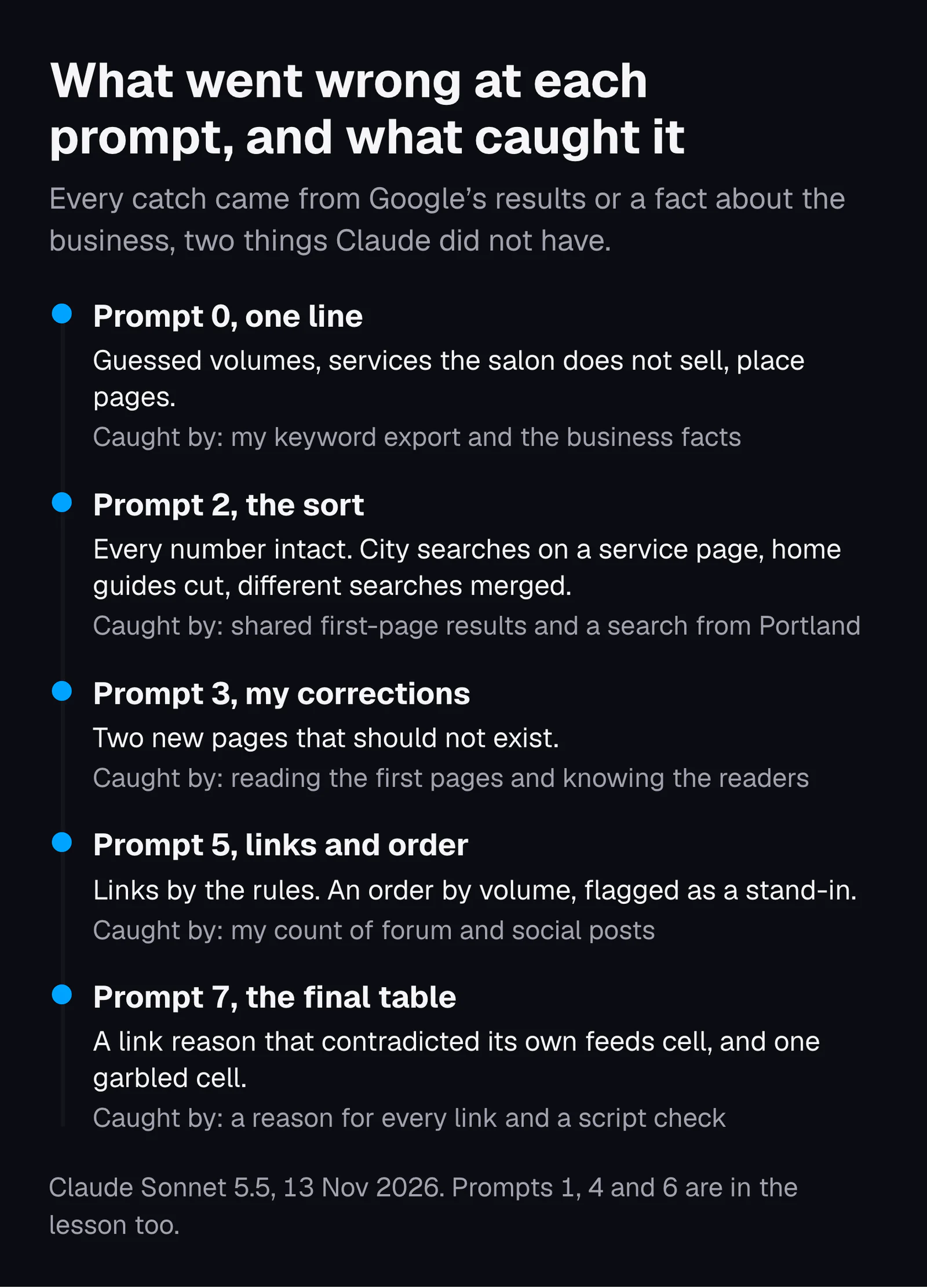
Prompt 6, which asked Claude to question its own map, came before this one and has its own section below. Prompt 7 sent my calls, my counts and the request for reasons:
Good questions. I checked them. Here are my calls:

- Cost guide and Prices share 0 first-page results: keep both. Full groom and the main page share 0: keep both.
- "dog nail trimming" and "dog nail trim portland" share 0, but both are people looking for a nail trim in Portland. Keep both on Nail trims.
- Shih tzu and poodle haircut styles: not yet. We have no photos of our own of those cuts. Put them in a "Later" list.
- How to choose a dog groomer: 10 searches is too few. Make it a section on About, and rename About to "Meet the groomers".
- Goldendoodle haircut styles is a photo gallery of our own cuts. Google's first page is pins and photo lists.
- How to trim dog nails is a guide built around our own video. Google's first page is mostly videos.
- I was wrong about /blog/new-tub. Move its one useful line to Bath and brush and redirect the old address there.

For the guide order, here's how many forum and social posts (Reddit, Facebook, Quora, Instagram) I counted on Google's first page for each main search. More posts means weaker results, so those go first. Break ties by searches a month.

[16 lines, one per guide, from "how much to tip dog groomer: 5 of 9" to "how often to bathe a dog: 0 of 9"]

Last thing: for every link from one guide to another, give the reason in one line. If you can't give a real reason, drop the link.

Give me the final table in publishing order, then the Later list.
The reasons caught two things.
- A wrong cell. Claude gave this reason for linking the shaving guide to the deshedding guide: "Many people consider shaving a double coat to stop the shedding, and this covers the alternative." Its own reason says the guide's reader is fighting shedding, yet the table had the guide feeding Full groom. I changed it by hand to feed De-shedding, which moves its links too: De-shedding now links to it, and Full groom no longer does.
- A weak link. Claude flagged two of its own: "their link reasons are the weakest, since they rest on my guess about the reader." One was the link from the nervous dogs guide to the guide on how long a groom takes.
It also broke one table cell and said so: "I garbled the Links cell for Full groom (order 2)", with the right list underneath. Then, after my one hand edit, I checked the final table with a script: 25 pages and 71 planned links, every page linked from at least one other, every guide live after the page it feeds, and every guide linking to that page and linked back from it. In a sheet you can do the same check by hand: count the links into each page, and confirm each guide links to the page it feeds and back. Anchors, counts and links between clusters are covered in Internal links inside a topical map.
Ask Claude to question its own map
Before I accepted the map, I asked Claude to argue with it. This prompt did more for the map than any other line in the conversation:
Before I accept this map: question it. List the rows you're least sure of, why, and exactly what I should look at on Google or in my own business to settle each one. Don't change the map.
It listed 11 doubts, ordered by what a wrong call would cost, each with what to check. Some I could settle with the results I already had:
- "Full groom ... may have no reason to exist apart from Home." "full dog grooming" and "dog grooming portland" share 0 first-page results. Both pages stay.
- The cost guide against the price page. 0 shared from the United States, 1 from Portland. Both stay.
- The four puppy first-groom wordings. From the United States they share 1 to 3 results pair by pair, and all four ask what happens at a puppy's first groom. One guide stays.
- "dog nail trimming" and "dog nail trim portland" on one page. From Portland they share 0. I kept them together anyway, because both are someone looking for a nail trim in Portland, and one offer gets one page.
Three doubts only the owner could settle: the salon's policy on shaving double coats, whether it has its own photos of each cut, and how many puppy bookings it gets. And one doubt caught Claude's own inconsistency: "I applied that line unevenly". It had given a 10-a-month search its own page while folding a 170-a-month search into a section. I fixed that in prompt 7 by making the 10-a-month search a section on the about page.
The checked map against the one built by hand
The map Claude and I ended with has 25 pages: 9 that sell and 16 guides. The map built by hand from the same searches in the by-hand lesson has 23. All 23 are in the checked draft, and the two extra are guides the hand build had left out. "Grooming a dog at home", at 720 a month, passes the four questions. "Nervous dogs at the groomer" has no measured volume. I kept it because 5 of the 8 results on its first page are forum and social posts: owners ask it, and few pages answer it.
Here are the 16 guides in publishing order. Orders 1 to 9 are the pages that sell, main page first.
| Order | Guide | Main search | US a month | Feeds | Forum and social on page one |
|---|---|---|---|---|---|
| 10 | How much to tip a dog groomer | how much to tip dog groomer | 3,600 | Prices | 5 of 9 |
| 11 | Shaving double-coated dogs | can you shave a husky | 720 | De-shedding | 5 of 7 |
| 12 | Nervous dogs at the groomer | dog anxiety at groomer | No number | Full groom | 5 of 8 |
| 13 | How long a dog groom takes | how long does dog grooming take | 590 | Full groom | 4 of 8 |
| 14 | How often to groom a dog | how often should a dog be groomed | 480 | Full groom | 4 of 8 |
| 15 | Getting mats out of dog hair | how to get mats out of dog hair | 1,000 | Dematting | 3 of 6 |
| 16 | How to deshed a dog | how to deshed a dog | 880 | De-shedding | 3 of 7 |
| 17 | Grooming a dog at home | how to groom a dog at home | 720 | Full groom | 3 of 8 |
| 18 | Your puppy's first groom | puppy first groom | 210 | Puppy grooming | 3 of 7 |
| 19 | How to cut black dog nails | how to cut black dog nails | 8,100 | Nail trims | 2 of 6 |
| 20 | Dog nail bleeding | dog nail bleeding | 2,400 | Nail trims | 2 of 7 |
| 21 | How much dog grooming costs | how much does dog grooming cost | 1,600 | Prices | 2 of 8 |
| 22 | Goldendoodle grooming | goldendoodle grooming | 2,400 | Full groom | 1 of 7 |
| 23 | How to trim dog nails (our video) | how to trim dog nails | 22,200 | Nail trims | 0 of 8 |
| 24 | Goldendoodle haircut styles (our photos) | goldendoodle haircut styles | 12,100 | Full groom | 0 of 9 |
| 25 | How often to bathe a dog | how often to bathe a dog | 5,400 | Bath and brush | 0 of 9 |
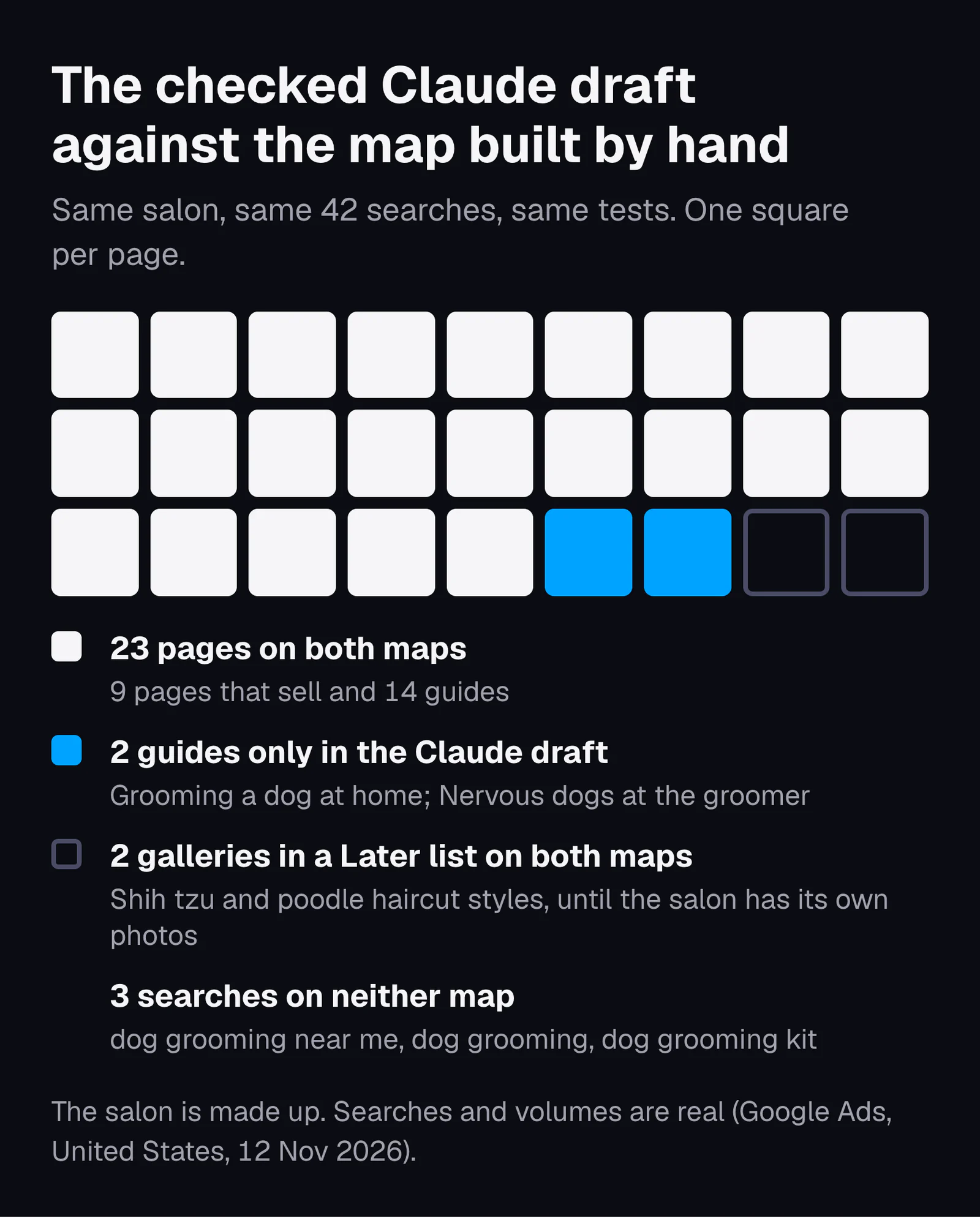
Claude's seven replies took 313 seconds in all, about five minutes. I did not time the checks between them, but they took far longer: counting shared results, searching from Portland, counting forum posts and deciding the calls only the owner can make. That ratio is the honest picture. The prompting is fast. The checking is the work.
Download the checked mapCSV, 25 pages in publishing order after every check: type, main search, US searches, the page each guide feeds, links, the searches folded in as sections, the Later list and what stayed off the map.
A checklist for any topical map an AI drafted
Run this list on any map Claude, ChatGPT or a generator drafted, before anyone writes a page. Each line is a mistake I saw in this run.
The inputs
- The three sentences (how the site earns, what it is about, what visitors come to do) were decided by you, not accepted as drafted.
- Every volume on the map comes from your export, with a source and a date. Any number the AI added is marked or deleted.
- No search on the map is "near me" or a broad head term that Google answers with map listings or shops.
The pages that sell
- Every page that sells is something the business sells today. No extra services filled in from a typical business.
- One address means no pages for neighborhoods or nearby cities with only the name changed.
- The main page holds the city searches. No service page answers the same search as the main page.
The guides
- Every guide names the one page it feeds, and its link reason agrees with that page.
- Guides for people who try it at home are kept when their readers are likely buyers. Check what the AI threw out, not only what it kept.
- Every search that Google answers with a local business first sits on a page that sells, not in a guide.
Page or section
- Every merged group was checked by shared first-page results. 3 or more shared is a strong sign they belong on one page; fewer is only a hint, so those pairs were read twice and the kind of page that ranks was checked before any got its own page.
- Every split was checked for one reader in two wordings. Those go back on one page.
- Every search with more than one meaning on its first page is a section, not a page.
- The demand line is one number, applied to every row the same way.
Types, links and order
- Every page type matches what Google ranks for its main search: a gallery where Google shows photos, a video guide where it shows videos.
- Every page that needs something you do not have yet (photos, a video, a policy) waits in a Later list.
- Every page has at least one link in. Every link has a one-line reason, and links without one are gone.
- The words on a link are the target page's name, the same every time.
- The order comes from your own count of the results, not from volume. No guide goes live before the page it feeds.
- Every old address has a decision: rebuilt, kept, or merged with a redirect. None is simply dropped.
Download the checklistPlain text, 19 checks in five groups, the same as above. Paste it into your notes or under your map.
Download the eight promptsPlain text: all eight prompts word for word, with the 42-row export and the forum counts in full. Swap the salon's facts for yours.
Where this method stops
This method gets a small site with a short service list to a usable first draft. It does not replace the research. In this run Claude never saw Google, the salon's photos or its policies, and every fix that mattered came from one of those. With 42 searches and six services, I could check every row in an afternoon. With 400 searches and a shop of 3,000 products, the checking is the project.
Turning web search on does not move the checks to Claude. Anthropic's developer docs for its web search tool say "Citations are always enabled" (2026), so a developer can see what Claude read. You still have to count the shared results, read the meanings and make the calls.
The same goes for ChatGPT or any other chat model. The method is the inputs, the rules and the checks, and none of them depends on the model. I ran it in Claude only, so I can vouch for Claude's output and no other.
We built our own system for this, which is how a 159-page map, our median as of 5 November 2026, takes us about 2 to 2.5 hours instead of a week or two by hand. Maps run from about 50 pages to over 20,000, depending on the business. If you would rather have the whole map built and checked for your site, that is what our growth plan is.
To go further on your own: the full by-hand method is in How to build a topical map, and the next step after a map, briefing each page, is in Content briefs with Claude.
Sources
- 3 Suggestions about Topical Authority, Koray Tuğberk Gübür, Medium, 2024
- How to Expand a Topical Map for Higher Topical Authority?, Koray Tuğberk Gübür, Holistic SEO, 2023
- Reduce hallucinations, Anthropic, Claude docs, 2026
- Web search tool, Anthropic, Claude docs, 2026
- Why Language Models Hallucinate, Adam Tauman Kalai, Ofir Nachum, Santosh S. Vempala and Edwin Zhang, arXiv, 2025
- Large Language Models Enable Few-Shot Clustering, Vijay Viswanathan and colleagues, arXiv, 2023
- TopicGPT: A Prompt-based Topic Modeling Framework, Chau Minh Pham and colleagues, arXiv, 2023
- Lost in the Middle: How Language Models Use Long Contexts, Nelson F. Liu and colleagues, arXiv, 2023
- Agglomerative clustering of a search engine query log, Doug Beeferman and Adam Berger, ACM KDD, 2000
- The Theory Underlying Concept Maps and How to Construct and Use Them, Joseph D. Novak and Alberto J. Cañas, IHMC, 2008
- Spam policies for Google web search, Google Search Central, 2026