Semantic SEO in plain words: entities and query fan-out
Semantic SEO is making pages that a search engine can read as things and the relations between them, so each page covers one clear subject, its facts and the follow-up questions people ask about it.
Search engines stopped matching only your words years ago. They read the things your words name, how those things relate, and the smaller questions hidden inside a search. Here is what that means for a site, in plain words, with dates and sources, and what it changes on every page you publish.

Key takeaways
- Semantic SEO is an old problem with a new name: a patent filed in 1988 at Bell Communications Research already said people search by meaning but type words that do not express it.
- Google launched its Knowledge Graph in May 2012 with more than 500 million things and 3.5 billion facts about them, and a page that names its main thing clearly leaves the engine less to guess.
- Query fan-out is Google's 2025 name for an old retrieval idea, rewriting and expanding a search: AI Mode splits one question into subtopics and runs many searches, so a site wins by answering the smaller questions in clean sections.
- Meaning sits on top of words: the 2024 ruling in US v. Google found the newer AI ranking signals did not replace Navboost and QBST, and a 2025 interview note says RankEmbed can do poorly on rare searches.
- There is no such thing as LSI keywords: the method dates from a 1988 patent, SEO forums pinned it on a Google update in February 2005, and Google's John Mueller dismissed the term in July 2019.
What semantic SEO means: from matching strings to understanding things
Semantic SEO is making pages that a search engine can read as things and the relations between them, not only as a row of words. A page built this way can match the meaning of a search even when its exact words differ. "Semantic" simply means "about meaning".
Think of the index at the back of a book. It lists every page where a word appears, and nothing more. A good librarian works differently. Ask for something on Marie Curie and she knows which books are about her, and that radium, Pierre Curie and the Nobel Prize come with the subject. Search engines have spent decades moving from the index toward the librarian.
The problem is older than Google
The clearest statement of the problem is in a patent, not a blog. Bell Communications Research filed US patent 4,839,853 on 15 September 1988. Its authors wrote that "people want to access information based on meaning, but the words they select do not adequately express intended meaning". They cited an earlier finding as proof. Any two people choose the same main keyword for a well-known object "less than 20% of the time on average".
So a page that only matches words misses the searchers who use other words for the same thing. That is the gap semantic search tries to close, and the gap semantic SEO writes for. Semantic SEO is not a separate kind of SEO. It is the part of SEO that deals with meaning, beside technical work and links.
Things, not strings
Google put the idea in four words on 16 May 2012. Amit Singhal, then Google's SVP of Engineering, announced the Knowledge Graph in a post titled "things, not strings". He described a model "that understands real-world entities and their relationships to one another". His example was the search [taj mahal], which can mean a monument, a Grammy-winning musician, a casino in Atlantic City or the nearest Indian restaurant.
Koray Tuğberk Gübür, the practitioner whose case studies made semantic SEO a working method for many SEOs, gives the site owner's side. On his semantic SEO page from 2020 he writes: "Semantic SEO is to create a content network in a relevant and meaningful structure for each entity within a subject." Google's line says what the engine does. Koray's line says what you build for it. I learned this method from Koray, and his full framework comes later in this lesson.
One search, read three ways
Take one made-up search sent to a coffee gear store, the same made-up store I use in what a topical map is: "best burr grinder for espresso under $300". An engine can read it three ways. As seven strings, it matches any page with those words. As things, it names a burr grinder, espresso and a price limit, and says how they connect. As smaller questions, it hides at least five: what grind espresso needs, burr or blade, flat or conical burrs, stepped or stepless settings, and which grinders cost under $300.
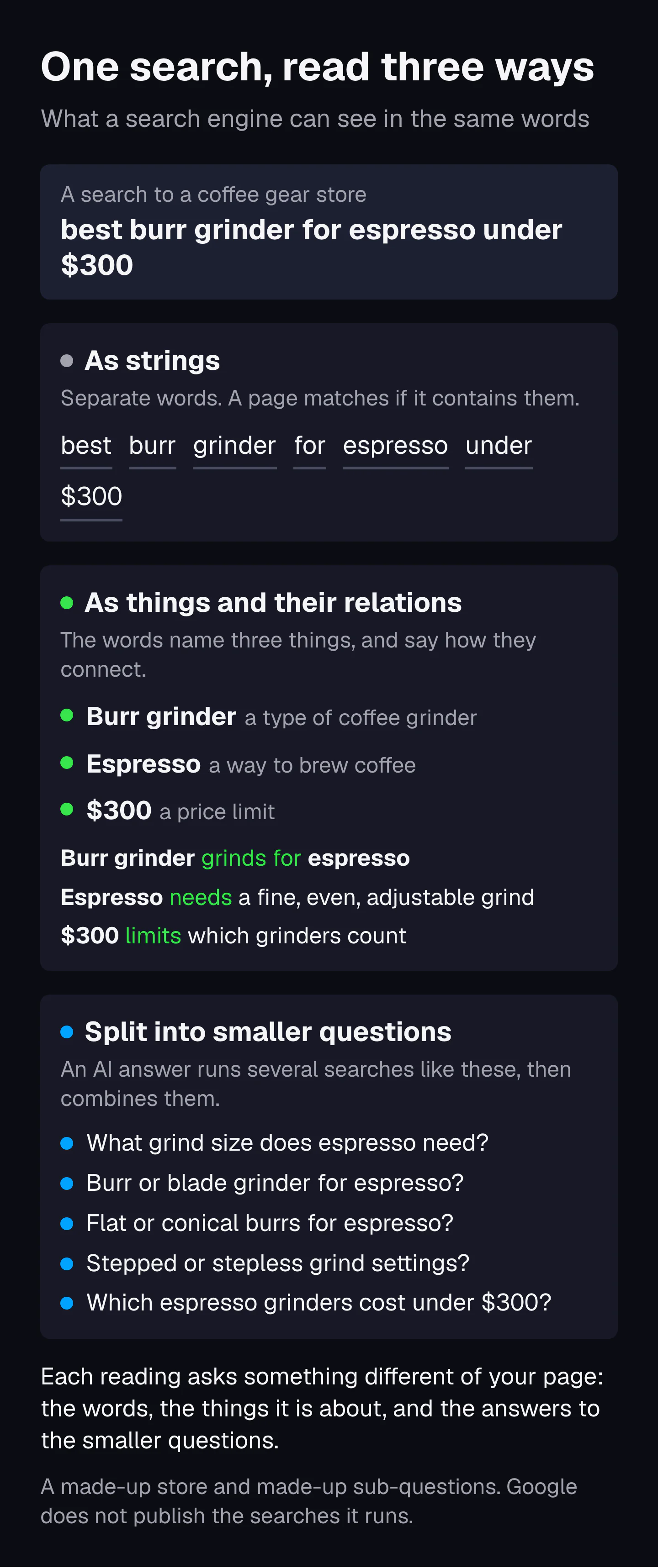
The rest of this lesson follows those three readings. Things are entities, the smaller questions are query fan-out, and the sections that answer them are passages. After that come the limits, what it all changes on a page, and what semantic SEO is not.
Entities and the knowledge graph: how a search engine stores things
An entity is a thing with its own identity, such as a person, a place, a product type or an idea, that a search engine can tell apart from other things with the same name. A knowledge graph is the engine's store of those things, their facts and how they connect.
Google's Knowledge Graph held "more than 500 million objects, as well as more than 3.5 billion facts about and relationships between these different objects" at its launch in May 2012. Singhal named three public sources it grew from: Freebase, Wikipedia and the CIA World Factbook. His example of a relation was Marie Curie, linked to her husband Pierre and to one of her children, who also won Nobel Prizes.
What an entity has
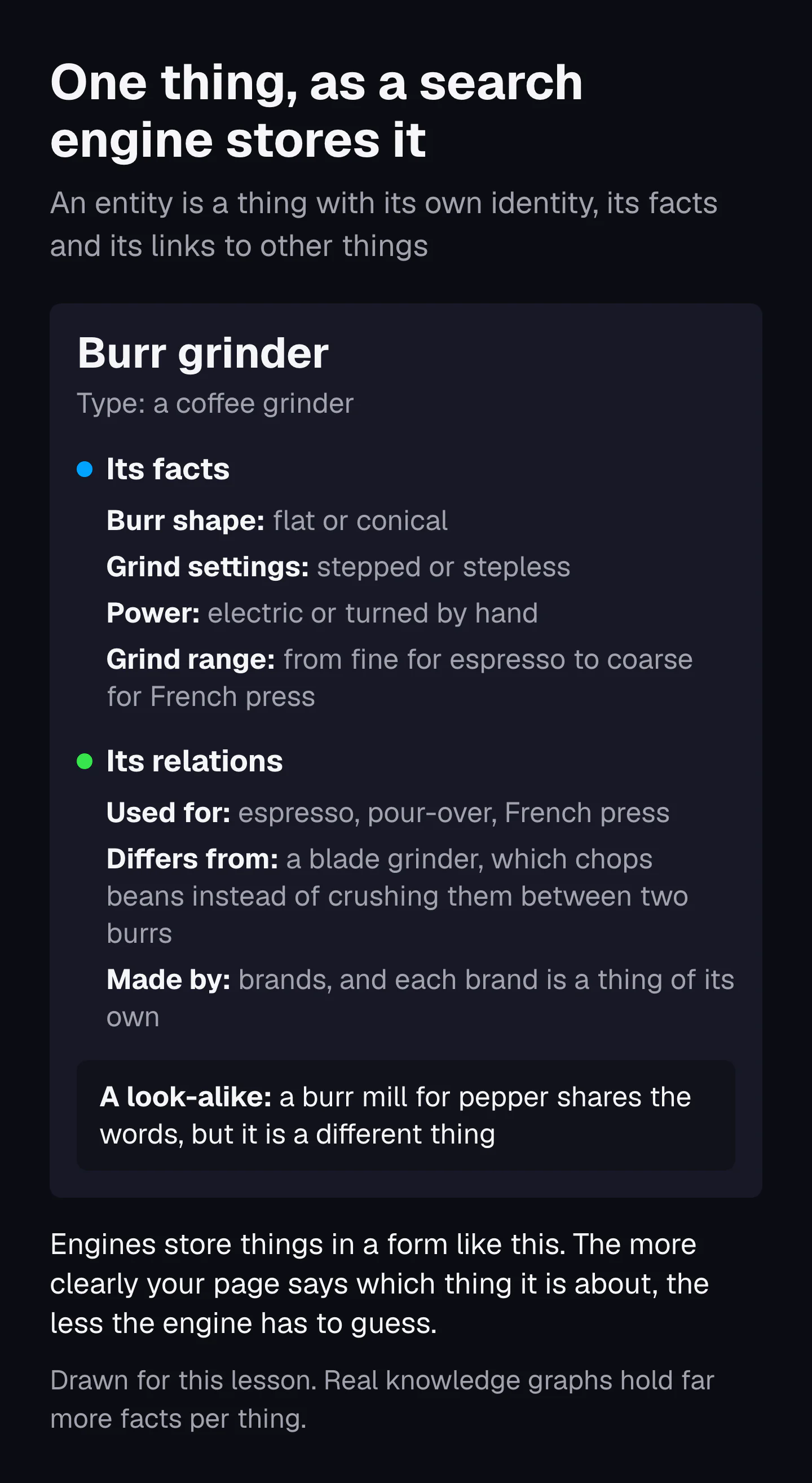
Every entity carries four kinds of information: a type, facts, relations, and the look-alikes it must be told apart from. Here is the burr grinder from our made-up search.
| Part | In plain words | For "burr grinder" |
|---|---|---|
| Type | What kind of thing it is | A coffee grinder |
| Facts (attributes) | The properties people ask about | Burr shape (flat or conical), grind settings (stepped or stepless), power (electric or by hand), grind range |
| Relations | How it connects to other things | Used for espresso and pour-over; differs from a blade grinder; made by brands |
| Look-alikes | Other things with the same words | A burr mill for pepper |
How a page gets tied to a thing: entity linking
None of this helps a page until the engine decides which things the page is about. Researchers call that step entity linking, and it has a dated history. In 2007, Rada Mihalcea and Andras Csomai described Wikify!, a system that finds the important concepts in a text and links each one to its Wikipedia page. Its links were "hardly distinguishable from manual annotations". A year later, David Milne and Ian Witten reported "recall and precision of almost 75%" for the same job. Krisztian Balog's open-access book Entity-Oriented Search (Springer, 2018) collects the field.
That was a research system in 2008, not Google, and recall and precision measure different things. It still shows the shape of the problem. When a page is vague about which grinder, which brand or which "Jaguar" it means, a machine has less to go on. It has to guess which thing the page is about.
Google is not the only engine with a graph
A 2014 Google research paper lists several of these stores. The Knowledge Vault paper by Xin Luna Dong and eight colleagues names Wikipedia, Freebase, YAGO, "Microsoft's Satori, and Google's Knowledge Graph", so Microsoft has a store of its own. The same paper describes a research system that learned facts from "text, tabular data, page structure, and human annotations". In plain words, researchers already pulled facts from tables and layout in 2014, not only from sentences.
What the leaked documents show about a page
In 2024, Google's internal API documentation leaked, and Google confirmed the documents were real while warning against "inaccurate assumptions". One record, called RepositoryWebrefWebrefMustangAttachment, stores "the entities in the document sorted by topicality score". So Google has a field that keeps a ranked list of things per page. How much that list weighs in ranking is not public.
A Google patent adds that things are not judged alike. "Ranking search results based on entity metrics", granted in 2019, describes weighting its scores by the type of entity searched for. A person is judged differently from a place or a product. A patent shows what Google invented, not what runs today. Read together with the leaked field, it is a reason to make your page's main thing obvious, not proof of how much that counts. How a whole site builds up that focus is the subject of topical authority.
How one search is rewritten and split: query fan-out, old and new
Query fan-out is when a search engine turns one question into several smaller searches, runs them, and combines what comes back. Google named it in March 2025. The idea behind it, rewriting and expanding a short search, has a long history in retrieval research.
What Google said in 2025
Robby Stein, Google's VP of Product for Search, introduced AI Mode on 5 March 2025. He wrote that it "uses a 'query fan-out' technique, issuing multiple related searches concurrently across subtopics and multiple data sources". On 20 May 2025, Elizabeth Reid, Google's Head of Search, went further. AI Mode is "breaking down your question into subtopics and issuing a multitude of queries simultaneously", and Deep Search "can issue hundreds of searches".
What classic search did before the name
My reading: query fan-out is query expansion run at AI scale. Google has not put it that way. Claudio Carpineto and Giovanni Romano opened their 2012 survey of automatic query expansion with the reason it exists. Short searches suffer from "the inaccuracy with which a query formed by a few keywords models the actual user information need". They called query expansion a technique with "a long history in the information retrieval community".
Google's classic search rewrites searches too. In notes of a January 2025 interview with Google's Pandu Nayak, filed in US v. Google, one debug demo rewrites "umass" as University of Massachusetts during query expansion. Understanding the words of a search matters as much. When Google added BERT to Search in 2019, Nayak's announcement said it would help Search understand one in 10 searches in the US in English. His example: in "2019 brazil traveler to usa need a visa", the word "to" decides who is traveling where.
Researchers have names for splitting a question before searching. Self-Ask (Press and colleagues, 2022) has a model ask itself follow-up questions. Rewrite-Retrieve-Read (Ma and colleagues, 2023) rewrites the question before retrieval. And a Google patent application filed in February 2024, "Search with stateful chat", has a generative model write "synthetic queries". It then picks documents that answer them as well as the original question.
Classic and AI rewriting, side by side
| What happens | Classic search | AI search (fan-out) | Chatbot search (ChatGPT) |
|---|---|---|---|
| The search is rewritten | Short forms expanded, words weighed ("umass" becomes University of Massachusetts) | The question is restated as several targeted searches | The prompt becomes one or more targeted searches for its search partners |
| How many searches run | One results page per search | Many at once; Deep Search "hundreds" | One at first, then narrower ones after reading results |
| What comes back | Ten ranked pages | One written answer built from parts of several pages | A written answer with links to its sources |
| What you can see | Your queries in Search Console | Google shows none of its sub-queries; Bing shows a sample | None of its searches |
| Coffee example | "burr grinder" also matches "conical burr coffee grinder" | "What grind size does espresso need?" runs as its own search | The prompt might become "espresso burr grinder under 300" (made up) |
Two things are new: the scale, and the fact that AI search writes the answer itself. Classic search rewrote your words to find better pages. AI search rewrites your question into a set of smaller ones. For a site, that means the head term is no longer the only door. Each smaller question is a door too.
Find the smaller questions for your own search, by hand
You cannot see Google's sub-queries, but you can collect the questions people really ask around your search. These five sources are the place to start.
- People also ask. Search your phrase, open every question box, and note the new questions each one adds.
- The suggestions as you type. Type your phrase followed by "for", "vs", "or" and "how", and note what Google offers to finish it.
- Your own customers. Emails, chat logs, return reasons and the questions your staff answer on the phone. No tool sees these, which is why they are worth the most.
- The headings of the top results. Every question two or more of them answer is one readers expect. Every question none of them answers is a chance to add something new.
- Bing's Grounding queries report, if your site is verified in Bing Webmaster Tools. It shows a sample of the searches Bing's AI ran when it cited your pages.
Then sort the list. Questions that share an answer go into one section. A question with its own set of results and enough people asking it may deserve its own page. The rest are a sentence each. Grouping searches this way is clustering, and how a cluster differs from a full plan is in topical map vs topic cluster.
How to get pages picked by AI answers once you cover the smaller questions is its own lesson: getting a topical map cited in AI answers.
Passages: why engines judge a section, not only the whole page
A passage is one section of a page that answers one question on its own. Search engines score passages as well as whole pages. That is why a smaller question from a fan-out can be answered by a single section of your page.
Google announced passage understanding on 15 October 2020, in Prabhakar Raghavan's Search On post. Google said it was "now able to better understand the relevancy of specific passages", and that this "will improve 7 percent of search queries across all languages". Google's current guide to its ranking systems still lists it. Passage ranking is used "to identify individual sections or 'passages' of a web page to better understand how relevant a page is to a search".
The patents point the same way. Google's "Scoring candidate answer passages", granted in April 2018, takes passages from top pages. It scores each one on how well it matches the question and how much it looks like an answer. Microsoft says the same about its assistant. In an October 2025 post, Krishna Madhavan wrote that "Assistants like Copilot break content down, a process called parsing, into smaller, structured pieces". Headings, he added, "act like chapter titles that define clear content slices".
Where fan-out and passages meet
Put the two ideas together and you get the practical rule of semantic SEO, as I read it. A fan-out turns one search into smaller questions. Engines can score single sections. Google has not said passage ranking runs on each sub-query, but the safe bet follows: write each section so it names its subject and answers in its first lines. A section that opens with "this" or "it" leans on the paragraph above. Lifted out alone, it means nothing.
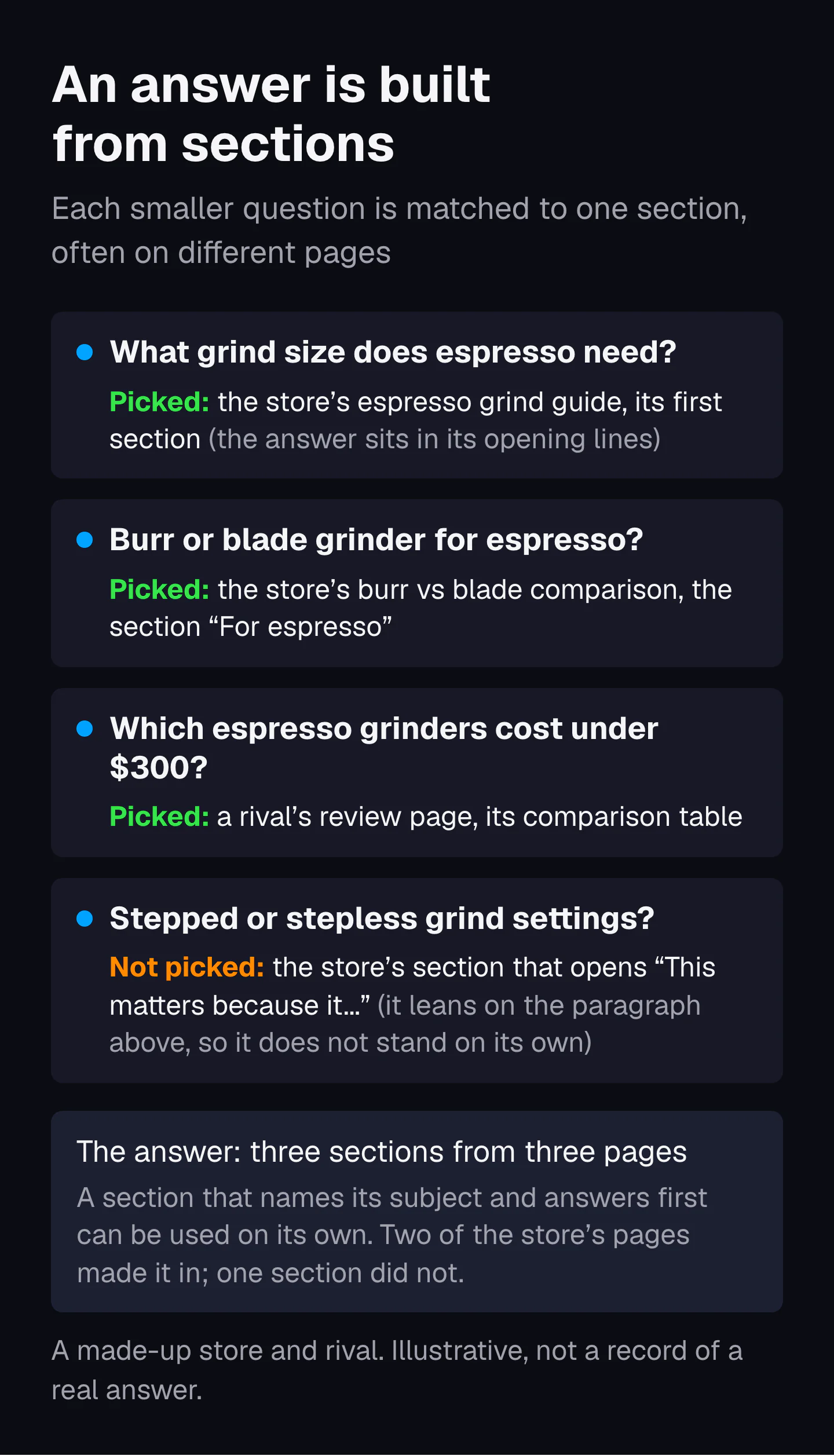
Some smaller questions deserve a page of their own, and most deserve a section. The test for telling them apart is in when a search deserves its own page.
How Bing, ChatGPT, Perplexity and Claude describe the same idea
The other engines describe the same ideas in their own documentation. Bing tells site owners to define things clearly and keep each URL on one topic. ChatGPT, Perplexity and Claude describe turning a question into several searches. Bing is also the only engine I found that shows site owners a sample of the searches its AI ran.
| Engine | In its own words | What it means for a page |
|---|---|---|
| Bing | Guideline 16, "Define Entities Clearly and Consistently"; guideline 17, "Focus Each URL on a Single Topic" | One main thing per page, named the same way everywhere |
| Bing Webmaster Tools | "Grounding queries": the key phrases its AI used to find the pages it cited in an answer | The closest thing to a window on fan-out: a sample of the phrases its AI used (a public preview since February 2026) |
| Copilot (Microsoft) | Content is broken into "smaller, structured pieces" | Each section must stand alone |
| ChatGPT search (OpenAI) | When it uses outside search providers, it "typically rewrites your query into one or more targeted queries" | The smaller searches decide which pages are read |
| Perplexity | Searches the web in real time; research mode "performs dozens of searches" | Coverage of follow-ups matters more as the search goes deeper |
| Claude (Anthropic) | Claude decides when to search; "This process can repeat multiple times throughout a single request" | One question can trigger several searches |
The Bing Webmaster Guidelines now cover "Bing search experiences, Copilot, and grounding API results". Grounding is Bing's word for feeding web pages to an AI answer. Guideline 17 says "URLs focused on a primary topic are more likely to be selected for grounding results". It tells owners to "Avoid mixing unrelated concepts on a single URL". Guideline 18, "Surface Key information early", is the passage rule in other words.
In February 2026 Bing added an AI Performance report to its Webmaster Tools. Its Grounding queries view "Shows the key phrases the AI used when retrieving content that was referenced in AI-generated answers", from "a sample of overall citation activity". If you want to see fan-out on your own site, that report is the closest thing to a window.
OpenAI's help page on searching the web says that when ChatGPT uses outside search providers, it "typically rewrites your query into one or more targeted queries". Its example: a researcher asks about drugs that target CCR8 for cancer. ChatGPT "might" first search "CCR8 immunotherapy drug development 2025". After reading the results, it may send narrower searches such as "CHS-114 conference 2025". Perplexity says its research mode "performs dozens of searches automatically". Anthropic's web search documentation says Claude decides when to search and that the process can repeat within one request.
Meaning sits on top of words: what the Google court record shows
Semantic systems were added on top of word matching and click data. They did not replace them. As of the 2024 ruling in US v. Google, Google ran word-based and click-based systems beside its AI models.
Judge Amit Mehta's liability opinion of 5 August 2024 describes these systems in its findings on ranking. QBST finds words that "should appear prominently on web pages that are relevant to that query". Navboost "pairs queries and documents through memorizing user click data". RankBrain, DeepRank, RankEmbed, RankBERT and MUM are "generalization" systems that fill holes in that click data. The court found the newer language-model signals "did not replace Navboost and QBST".
| System | What it does, in the record's words | Source |
|---|---|---|
| QBST | Finds words that "should appear prominently" on relevant pages (a list of words a good page should show) | Mehta opinion, 2024 |
| Navboost | Pairs searches and pages by "memorizing user click data" (a memory of what people clicked) | Mehta opinion, 2024 |
| RankEmbed | "A dual encoder model that embeds both query and document into embedding space" (it turns both into numbers and compares their meaning) | Nayak notes, 2025 |
| Before RankBrain | Ranking "in the style of Okapi BM25", a classic word-matching formula | Nayak notes, 2025 |
The Nayak interview notes add the most useful line for a site owner. RankEmbed is "high quality on common queries but can perform poorly for tail queries". Tail queries are the rare, specific searches that each get few searches a month. The notes do not say what fills the gap there. My advice is to be safe: put the exact words of those searches on the page.
So write for meaning and keep the words people type. Use the search's own words in the title, the h1 and the headings. Then cover the thing so the meaning systems have something to work with. Bing's guidelines ask for the same alignment: "Align titles, heading, and content intent".
What semantic SEO changes on a page: five habits, one worked page
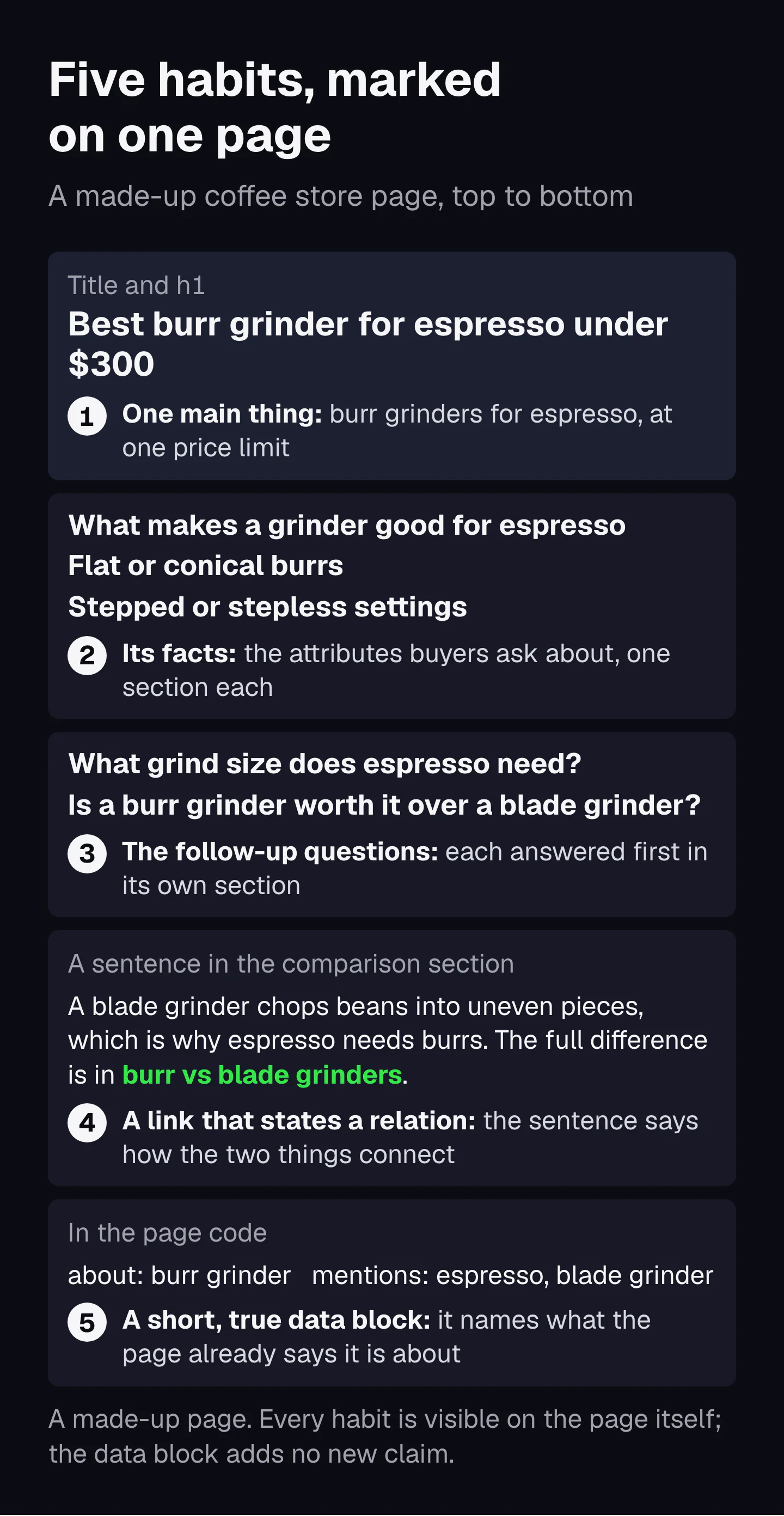
Semantic SEO changes five habits on a page. Give each page one main thing. Cover the facts people ask about that thing. Answer the follow-up questions in their own sections. Link with sentences that say how two things relate. Add a short, true block of structured data naming what the page is about.
1. One main thing per page
Each page should be about one thing, at one angle. The title and the h1 (the page's main heading) name it in the same words. Bing's guideline 17 asks for exactly this. Google's leaked documents also show a field that keeps a ranked list of things per page, though what that list does in ranking is not public. Koray calls the one main subject the page's macro context, and the smaller angles inside it micro contexts. How that works across many linked pages is the subject of semantic content networks.
2. Cover the facts people ask about
A thing's facts are its attributes: for a burr grinder, its burr shape, its grind settings, its power and its grind range. Write each one as a fact, with a subject, a verb and a number where there is one. Where do you find the list? People also ask, your own customer emails, your returns reasons, and the facts every top result covers. Koray calls this approach entity, attribute and value. Things of one type share the same attributes. Once you know a grinder's list, you know what every grinder page needs.
3. Answer the follow-up questions
The follow-ups are the smaller questions a fan-out runs. Give each its own heading, phrased the way people ask it, and answer it in the first one or two sentences below. A follow-up that needs a full page of its own gets a link to that page instead of a thin section.
4. Links that state a relation
A link joins two things, so the sentence around it should say how they relate. "A blade grinder chops beans into uneven pieces, which is why espresso needs burrs." Put a link to the comparison page after that sentence, and a reader and a machine both see why the two pages belong together. "Click here" tells them nothing. Koray calls the shared idea behind such a link a contextual bridge. Where links sit and what words they use is in internal links inside a topical map.
5. A short, true block of structured data
Structured data is code in the page that tells engines what the page is (also called schema). Two schema.org properties fit semantic SEO exactly. about means "The subject matter of an object", and schema.org lists Dublin Core's subject as its equivalent. mentions means the work "contains a reference to, but is not necessarily about a concept". So about names the one main thing, and mentions names the others the page discusses. A sameAs link (a pointer to the same thing on another site) to its Wikipedia or Wikidata page removes the guesswork about which thing you mean.
Google's introduction to structured data calls it "explicit clues about the meaning of a page". Google has not said it ranks pages by about or mentions, and neither earns a rich result. Treat the block as a small, factual summary of what the page already says, never as a place for claims the page does not make.
A worked page
Here is the made-up store's page for our search, with the five habits marked. Nothing on it is a product fact you should copy; it shows where each habit sits.
The page check to keep
The table covers the five habits plus one check from the court record section: the searcher's own words. The download adds a last check, for something new on the page.
| Habit | Ask of the page | A yes looks like |
|---|---|---|
| One main thing | Can you name what the page is about in five words? | The title and h1 name the same thing in the same words |
| Its facts | Does it cover the facts buyers ask about? | Each common question has a sentence or section |
| Follow-up questions | Does each section answer in its first lines and name its subject? | No section opens with "it" or "this" |
| Relation links | Does each link sit in a sentence that says how two things relate? | The link uses the target page's own name |
| Words still count | Are the searcher's exact words in the title and headings, said once? | No phrase repeated in five variants |
| Data block | Does about name the main thing, and is every claim visible on the page? | Nothing in the code a reader cannot see |
Download the semantic page checklistCSV, 14 checks: the five habits, the searcher's words and something new, each with what a yes looks like, what to do with a no, and the source
Download the about and mentions exampleJSON-LD, the usual format for this code, for the made-up grinder page; replace the two placeholders before you use it
Covering the facts every top result covers gets a page to the same level as the rest. To rank above them, a page has to add something they lack. That is information gain, and it is the step most pages skip.
What semantic SEO is not: synonym stuffing and LSI keywords
Semantic SEO is not adding synonyms or a list of "LSI keywords" to a page. LSI is a retrieval method patented in 1988 that SEO forums attached to a Google update in 2005. Google's John Mueller said in 2019 that there is no such thing as LSI keywords.
Where the LSI myth came from
LSI stands for latent semantic indexing. It is the method in the 1988 Bell Communications Research patent from the first section of this lesson. Its inventors, Scott Deerwester, Susan Dumais, George Furnas, Richard Harshman, Thomas Landauer, Karen Lochbaum and Lynn Streeter, got the patent in June 1989. Five of them published the method as "Indexing by latent semantic analysis" in the Journal of the American Society for Information Science in 1990. It finds words that tend to appear together across a collection of documents. The patent has been expired since 2008, according to Google Patents.
The SEO version started in February 2005. On 3 February, Search Engine Roundtable reported a forum theory that a shift in Google's results came from latent semantic analysis. The evidence was Google's tilde search, which bolded related words in results. A follow-up the next day said "many believe that this has a lot to do with Latent Semantic Indexing". By 2019 "LSI keywords" was common enough in SEO talk for Google to answer it in public.
On 30 July 2019, Mueller wrote on Twitter: "There's no such thing as LSI keywords", and anyone telling you otherwise is mistaken. A related-word list is not semantic SEO, whatever it is called.
A 2009 patent on too many related phrases
Google patented a way to spot pages with too many related phrases. Its phrase-based spam patent was granted in October 2009 and has since expired. Its abstract opens: "A spam document is identified based on the number of related phrases included in a document." It compares the related phrases a page has with the number a normal page on the subject would have. A patent shows what was invented, not what runs today. Still, it shows that Google thought about pages packed with related phrases more than fifteen years ago.
Koray says the same about the newer version of the habit. In the BKMKitap case in his January 2023 topical map article, he writes: "There is no difference between keyword stuffing and entity stuffing." His writers gave "a different fact per sentence" instead. Naming twenty things on a page without saying anything about them is stuffing with nouns.
What to do instead
Say the main phrase plainly, once, where readers look first. Then spend the words on facts: how the thing works, why it matters for the search, what to check. Variants of a phrase add little an engine does not already know. Facts add something.
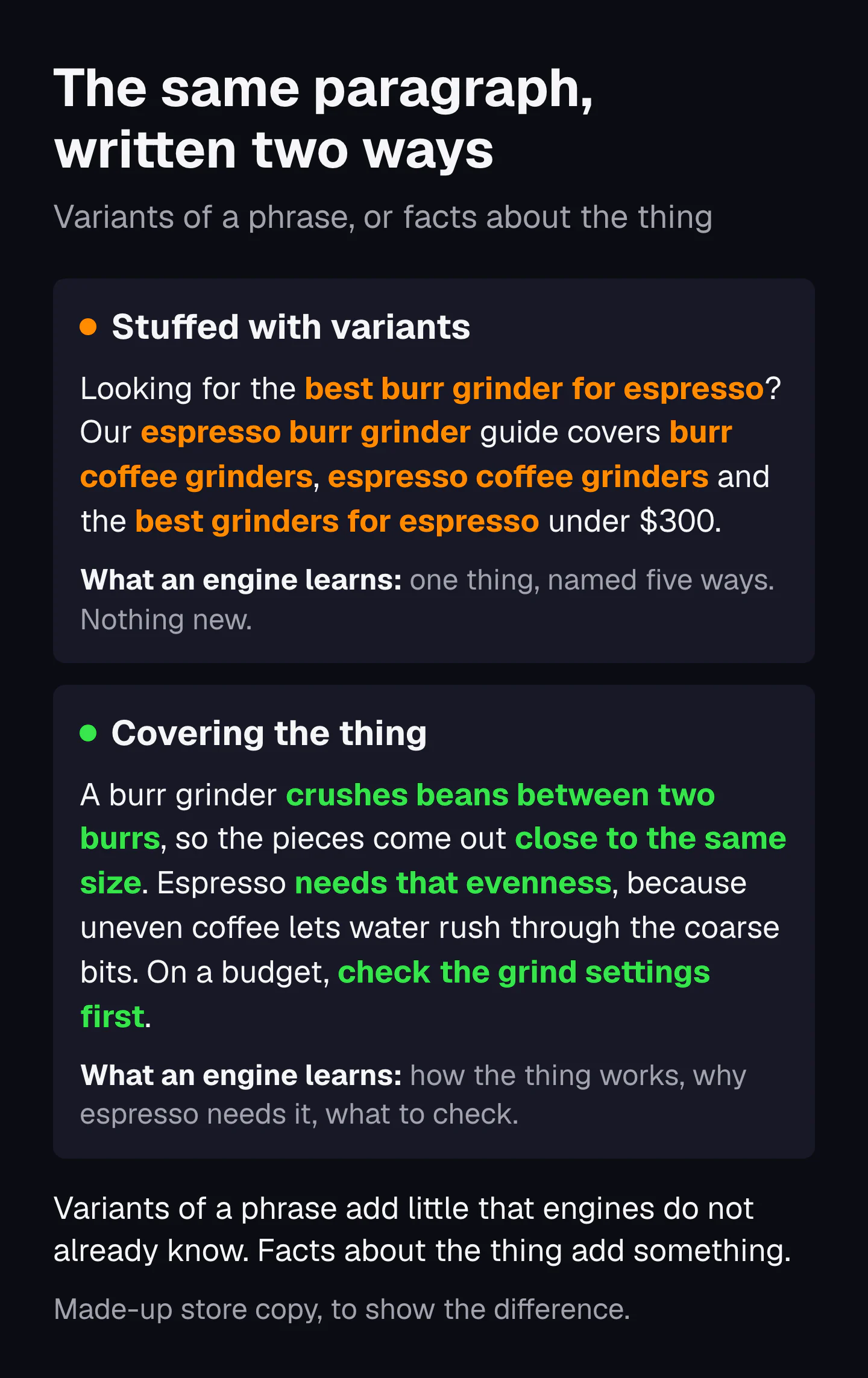
Semantic SEO also borrows older ideas from library science than LSI: one term per concept, broader and narrower subjects, related subjects. That longer history is in where the topical map came from.
Holistic SEO, and where Koray Tuğberk Gübür's framework fits
Holistic SEO is Koray Tuğberk Gübür's name for working on every part of a site at once: content, technical, links, local and brand. His topical map framework is, in my view, the most complete public method for doing semantic SEO across a whole site, not one page at a time.
Holistic SEO, in his words
Koray named his agency Holistic SEO & Digital, which his bio dates to 21 September 2020. His holistic SEO case study on Encazip, a Turkish energy price comparison site, opens with the project's rule: "Every pixel, millisecond, byte, letter, and user matters for SEO". In that case, page speed work, content, local listings and digital PR ran as one project. The phrase is not only his: Yoast, the WordPress SEO plugin, uses "holistic SEO" for the same idea of improving every part of a site. What Koray adds is a method that ties it to meaning.
Where his framework sits inside semantic SEO
Semantic SEO is the field: how engines read meaning, and how pages answer it. Koray's framework is a method inside the field for planning a whole site. It starts from why the site exists, decides which pages it needs, and orders and links them. He put the terms topical map and topical authority in front of the industry with a case study published in February 2021. My plain-words walk through every part of it is Koray Tuğberk Gübür's topical map framework.
| Koray's idea | In plain words | Lesson |
|---|---|---|
| Source context, central entity, central search intent | Why the site exists, what it is about, what visitors come to do | Source context and central entity |
| Core and outer section | The pages that sell, and the pages that explain | Core and outer sections |
| Semantic content network | The map built into pages, headings and links | Semantic content networks |
| Information gain | What a page adds that the top results lack | Information gain |
| Cost of retrieval | Why fewer, clearer pages can beat more pages | Cost of retrieval |
| Topical authority | Being the site an engine trusts on a subject | Topical authority |
Where to go next in semantic SEO
The next lesson depends on what you are about to do. Each question below has a lesson of its own in this category or the topical maps one.
| Your question | Read |
|---|---|
| What is the plan of pages that semantic SEO is built on? | What is a topical map? |
| How does a whole site become the one an engine trusts on a subject? | Topical authority |
| What exactly did Koray Tuğberk Gübür teach, term by term? | Koray's topical map framework |
| What should I decide before planning any page? | Source context, central entity and central search intent |
| How do I turn a plan into linked pages, heading by heading? | Semantic content networks |
| How do I make a page add what the top results lack? | Information gain |
| How do I get pages cited in AI Overviews, AI Mode and ChatGPT? | Getting a topical map cited in AI answers |
| Where did these ideas come from before SEO? | Where the topical map came from |
You can do all of this by hand, and these lessons show how. If you would rather have the plan of pages built for your site, that is the growth plan.
Common questions
What is semantic clustering?
Semantic clustering is grouping searches by meaning, often by checking which searches show the same results, so one page can serve the whole group. A cluster says which searches belong together; a topical map also decides each page's angle, its links and its place in the publishing order. The lesson on topical map vs topic cluster covers the difference.
What is AI-powered semantic search?
It is search that matches the meaning of a question rather than only its words, using language models that turn text into numbers that can be compared. In AI answers it also rewrites the question into several smaller searches. Google's court record shows it runs beside word matching and click data, not instead of them.
Is semantic SEO different from regular SEO?
Semantic SEO is the part of SEO about meaning: which things a page is about, what it says about them and how pages connect. It does not replace technical work, page speed or links. A clear page on a slow, unlinked site still struggles.
Sources
- Computer information retrieval using latent semantic structure (US4839853A), Bell Communications Research (Deerwester, Dumais, Furnas, Harshman, Landauer, Lochbaum, Streeter), 1989
- Indexing by latent semantic analysis, Journal of the American Society for Information Science, 1990
- Introducing the Knowledge Graph: things, not strings, Google (Amit Singhal), 2012
- Semantic SEO, Koray Tuğberk Gübür, Holistic SEO & Digital, 2020
- Wikify!: linking documents to encyclopedic knowledge, Rada Mihalcea and Andras Csomai, CIKM, 2007
- Learning to link with Wikipedia, David Milne and Ian H. Witten, CIKM, 2008
- Entity-Oriented Search, Krisztian Balog, Springer, 2018
- Knowledge Vault: A Web-Scale Approach to Probabilistic Knowledge Fusion, Xin Luna Dong and colleagues, KDD, 2014
- Google confirms the leaked Search documents are real, The Verge (Mia Sato), 2024
- RepositoryWebrefWebrefMustangAttachment (leaked Content Warehouse API documentation), hexdocs.pm copy of google_api_content_warehouse v0.4.0, 2024
- Ranking search results based on entity metrics (US10235423B2), Google LLC, 2019
- Expanding AI Overviews and introducing AI Mode, Google (Robby Stein), 2025
- AI in Search: Going beyond information to intelligence, Google (Elizabeth Reid), 2025
- A survey of automatic query expansion in information retrieval, Claudio Carpineto and Giovanni Romano, ACM Computing Surveys, 2012
- Interview with Pandu Nayak notes, remedies exhibit PXR0357, US v. Google, US Department of Justice, 2025
- Understanding searches better than ever before (BERT), Google (Pandu Nayak), 2019
- Measuring and Narrowing the Compositionality Gap in Language Models (Self-Ask), Ofir Press and colleagues, arXiv, 2022
- Query Rewriting for Retrieval-Augmented Large Language Models, Xinbei Ma and colleagues, arXiv, 2023
- Search with stateful chat (US20240289407A1), Google LLC (application, pending), 2024
- How AI is powering a more helpful Google (passages), Google (Prabhakar Raghavan), 2020
- A guide to Google Search ranking systems, Google Search Central, 2026
- Scoring candidate answer passages (US9940367B1), Google LLC, 2018
- Optimizing Your Content for Inclusion in AI Search Answers, Microsoft Advertising (Krishna Madhavan), 2025
- Bing Webmaster Guidelines, Microsoft Bing, 2026
- Introducing AI Performance in Bing Webmaster Tools (public preview), Microsoft Bing, 2026
- Searching the web with ChatGPT, OpenAI Help Center, 2026
- How does Perplexity work?, Perplexity Help Center, 2026
- Web search tool, Anthropic, 2026
- Memorandum opinion (liability), US v. Google LLC, Document 1033, US District Court for the District of Columbia (Judge Amit P. Mehta), 2024
- about (a Schema.org property), Schema.org, 2026
- mentions (a Schema.org property), Schema.org, 2026
- Introduction to structured data markup in Google Search, Google Search Central, 2026
- Latent Semantic Analysis (LSA): Crawl into the Google Algorithm?, Search Engine Roundtable (Barry Schwartz), 2005
- More On Latent Semantic Indexing, Search Engine Roundtable (Barry Schwartz), 2005
- Google: There Is No Such Thing As LSI Keywords, Search Engine Roundtable (Barry Schwartz), 2019
- Detecting spam documents in a phrase based information retrieval system (US7603345B2), Google LLC, 2009
- How to Expand a Topical Map for Higher Topical Authority?, Koray Tuğberk Gübür, Holistic SEO & Digital, 2023
- Holistic SEO case study (Encazip), Koray Tuğberk Gübür, Holistic SEO & Digital, 2022