How to build a topical map, step by step
This lesson builds a topical map by hand, in the order the decisions depend on each other. It follows Koray Tuğberk Gübür's framework, takes one made-up business through all nine steps, and ends with ten rows from a real client map.

Key takeaways
- Start with three sentences, the source context, the central entity and the central search intent, because every page you add later is checked against them.
- Split the map into a core section of pages that sell and an outer section of guides, and give every guide the one page that sells which it feeds.
- When 3 or more of the same pages rank for two searches on page one, that is a strong sign they share a page; fewer is only a hint, so read twice and check what kind of page ranks. In the worked example the cost search and the prices search shared 1 of 8 and showed different kinds of page, so they became two pages.
- Publish the pages that sell first, then the guides whose results are weakest; in the worked example the biggest search, at 22,200 a month, goes live 21st of 23.
- The three mistakes I see most in maps owners build themselves are pages that do not build on each other, off-topic pages that belong inside another page, and searches given a page they do not deserve.
What you need, how long it takes, and the business we build for
To build a topical map by hand you need a spreadsheet, Google in a private window, monthly search volumes, Search Console if the site is live, and time. A topical map is the plan of every page a site needs, grouped, linked and put in the order to publish them. If that is new to you, start with What is a topical map? This lesson is the build.
- A spreadsheet. One row per page. By the end each row holds the page, its section, its type, its main search, the page it feeds, its links and its place in the order.
- Google in a private window. Your own search history changes what you see. A private window gets you closer to what a new visitor sees.
- Search volumes. Google's Keyword Planner works, and so does any keyword tool. You need the number and the exact wording people use.
- Search Console, when the site exists. It shows the searches each page is already seen for, and those pages are the ones you protect.
How long it takes
By hand, a map of about 159 pages with all the research behind it is a week or two of work. That is the size of our median growth plan on 5 November 2026. We build a map that size in about 2 to 2.5 hours with AI, because of the system we built for it. This lesson is the by-hand version, and it needs none of that.
159 is a median, not a target. A map can run from about 50 pages to over 20,000, depending on the size of the company, how much ground its subject covers and how many services it has.
The method and the two examples
The order follows Koray Tuğberk Gübür's framework. His first topical authority case study, in February 2021, made building the map step one, before the first article goes live. His later work sets out where a map starts: the site's source context, central entity and central search intent, then a core section and an outer section. The framework in full is in Koray Tuğberk Gübür's topical map framework.
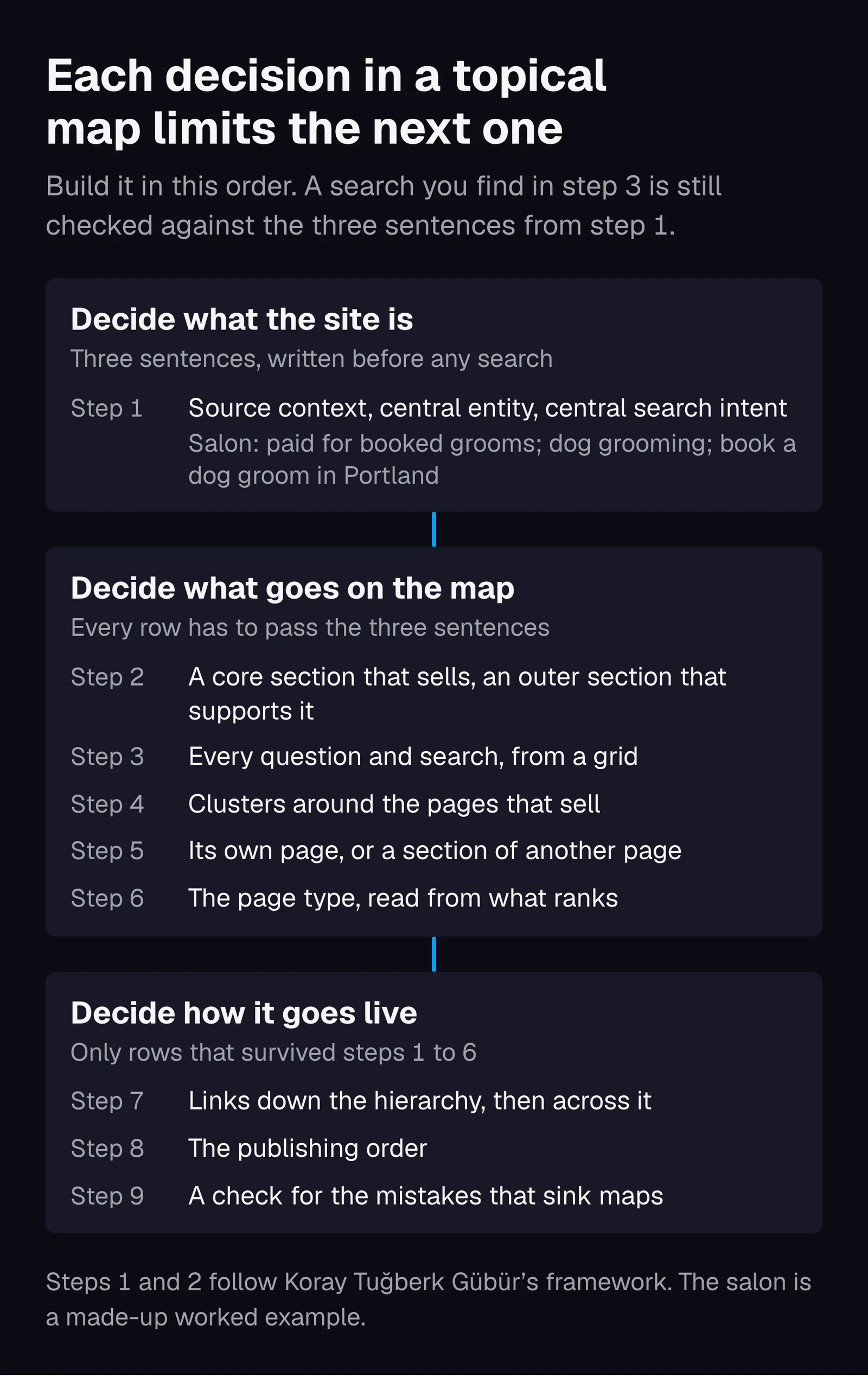
Our worked example is a made-up dog grooming salon in Portland, Oregon. One address, six services: full grooms, bath and brush, nail trims, de-shedding, dematting and puppy grooming. Its site has four pages (home, prices, about, contact) and two old blog posts.
The salon is made up. Everything around it is real. Every search volume is Google Ads data for the United States, read on 12 November 2026. Every "Google shows" is what Google's first page showed for that search on the same day. At the end you also get ten rows from a real client map, so you can see the same build at full size.
Step 1: Write down the source context, central entity and central search intent
Before you collect a single search, write three sentences: why the site exists and how it earns, the one thing it is about, and the main thing its visitors come to do. These are the first three of the five foundations in Koray's framework, and every row you add later is checked against them.
| Foundation | What it means | The salon |
|---|---|---|
| Source context | Why the site exists and how it makes money | A one-location salon in Portland, paid for booked grooms |
| Central entity | The one thing the whole site is about | Dog grooming |
| Central search intent | The main thing visitors come to do: a verb plus the central entity | Book a dog groom in Portland |
Koray defines source context as "the perspective and function of the website and the brand on the open web that involves monetization, and existing purpose" (2023). His point is that one search gets a different page on a different site. In his example, "what is an electronic bicycle" should be answered one way by an electric car site and another way by an energy or engineering site.
Read the site to find the three sentences
On a site that exists, read the home page, the menu, the price list and the contact page. Then ask how money comes in: a booking, a sale, a lead or ads. For the salon it is a booked appointment, so every page that sells has to lead to a booking.
Concept map research calls this the focus question. Joseph Novak and Alberto Cañas write that "every concept map responds to a focus question". Learners who drift from it, they write, "build a concept map that may be related to the domain, but which does not answer the question" (2008). The three sentences are your map's focus question.
Google asks every site the same thing. Its guide to creating helpful, reliable, people-first content asks "Does your site have a primary purpose or focus?" The three sentences are that focus, written down.
Fuller definitions, with more examples, are in Source context, central entity and central search intent. The thinking behind them is semantic SEO, explained in Semantic SEO in plain words.
Step 2: Split the map into a core section and an outer section
The core section is the pages that sell, the ones closest to how the site earns. The outer section is the supporting pages that answer the buyers' wider questions and send readers, and links, toward the core. In Koray's words, the source context decides "the topical map's core and outer sections" (2023).
The two sections follow different rules:
- The core holds only what the business really sells. Service pages, a price page, product and collection pages for a store. No offer, no page.
- The outer section covers the whole subject for the people who buy, including topics the business does not sell, as long as each page can feed a core page. The salon sells no first aid. A guide on a bleeding dog nail still belongs, because its reader is a likely nail trim customer.
The salon's core section has nine pages:
- Dog grooming in Portland (the main page)
- Six service pages: Full groom, Bath and brush, Nail trims, De-shedding treatment, Dematting, Puppy grooming
- Grooming prices
- Meet the groomers, the trust page that says who handles your dog
Give every existing page a place or an action
Now place the pages the site already has. Each address goes into the core, into the outer section, or gets an action. A page that already ranks keeps its address, because moving it puts its rankings at risk for no gain.
Every page needs a job. When one has none, first check whether it can be merged into a page that is more relevant. Only then think about removing it. For the salon, the six addresses come out like this:
| Address | What it is today | Place on the map |
|---|---|---|
| / | Home page with a list of services and a phone number | Core: rebuild in place as the main page, "Dog grooming in Portland" |
| /prices | A price list | Core: rebuild in place as "Grooming prices" |
| /about | Two paragraphs about the owner | Core: rebuild in place as "Meet the groomers" |
| /blog/summer-shave | An old post on shaving dogs in summer | Outer: rebuild in place as the guide on shaving double-coated dogs |
| /contact | Address, hours, form | Keep as it is: a utility page, not part of the plan |
| /blog/new-tub | A news post about a new bath | Merge: its one useful line moves to Bath and brush, and the old address redirects there |
How to judge a core page against an outer one, and why the outer section matters for the whole site, is in Core section and outer section. Merging and removing pages has its own lesson: Pruning and merging.
Step 3: Collect every question and search from a grid
Collect searches from a grid, not from one tool export. A keyword tool returns what sits close to the words you typed in. A grid makes you look in every direction a buyer comes from.
The grid is older than SEO. Librarians have split subjects into facets for almost a century. S. R. Ranganathan's Colon Classification, first published in 1933, settled on five kinds of facet by its 1952 edition: personality, matter, energy, space and time, known as PMEST. Each one is a question you ask of the subject. Asked of dog grooming, they find searches a seed list misses.
| Facet | The question it asks | The salon's searches |
|---|---|---|
| Personality | Who or what is it about? | Breeds and coats: goldendoodle grooming, can you shave a husky |
| Matter | What is it made of, or done to? | Nails, mats, coat: how to get mats out of dog hair |
| Energy | What do people do? | Trimming, bathing, de-shedding: how to trim dog nails, how to deshed a dog |
| Space | Where? | dog grooming portland; at home or at the salon |
| Time | When, and how often? | how often should a dog be groomed, how long does dog grooming take, puppy first groom |
Add three rows the facets do not force on you: cost (how much grooming costs, how much to tip), audiences (new puppy owners, doodle owners) and comparisons (two cuts, or doing it yourself against booking it). Facet analysis is still how library science splits a subject into parts that do not overlap.
Where the searches come from
- Google's "People also ask" box and the suggestions Google makes as you type
- the pages that already rank
- Search Console's queries, when the site is live
- other search engines: Koray's 2021 case study told readers not to study Google alone
- the questions customers ask at the desk or on the phone, the source no competitor can copy
Ask the follow-up questions too
One question to a search engine now becomes several. Google says AI Mode "uses our query fan-out technique, breaking down your question into subtopics" and runs many searches at once (2025). Researchers built the same move into language models: in the self-ask method, the model "explicitly asks itself (and answers) follow-up questions before answering the initial question" (Press and colleagues, 2022).
So for each page that sells, write down what a buyer asks next. Nail trims brings "how do I cut black nails", "what if the nail bleeds" and "how often". Each follow-up needs a page or a section somewhere on the map.
For the salon the grid gave 42 searches. Five of them came back with no measured volume. Here are ten, with US searches a month:
| Search | US searches a month |
|---|---|
| how to trim dog nails | 22,200 |
| goldendoodle haircut styles | 12,100 |
| how to cut black dog nails | 8,100 |
| dog grooming kit | 6,600 |
| how often to bathe a dog | 5,400 |
| dog grooming prices | 3,600 |
| how much to tip dog groomer | 3,600 |
| dog grooming portland | 880 |
| puppy first groom | 210 |
| puppy grooming portland | No measured volume |
Keep a search with no measured volume when a real buyer asks it. A blank in a keyword tool means the tool has no number, not that nobody searches. "Puppy grooming portland" shows no volume, and it stays: it is an offer the salon sells.
Step 4: Group the searches around the pages that sell
Group the searches into clusters, and build each cluster around one core page. The service page sits in the middle. The outer guides that answer its buyers' questions sit around it and point to it.
Dog grooming in Portland
Nail trims
- How to trim dog nails
- How to cut black dog nails
- Dog nail bleeding: what to do
Full groom
- How often should a dog be groomed?
- How long does dog grooming take?
- Goldendoodle grooming
Grooming prices
- How much does dog grooming cost?
- How much to tip a dog groomer
The salon ends up with seven clusters, one per page that sells. Full groom has 4 guides and Nail trims has 3. Grooming prices and De-shedding treatment have 2 each. Dematting, Bath and brush and Puppy grooming have 1 each. The main page sits above all seven, and Meet the groomers stands on its own.
A store works the same way with other names. The collection page is the middle of the cluster, and the buying guides and how-tos around it feed that collection.
One column does three jobs
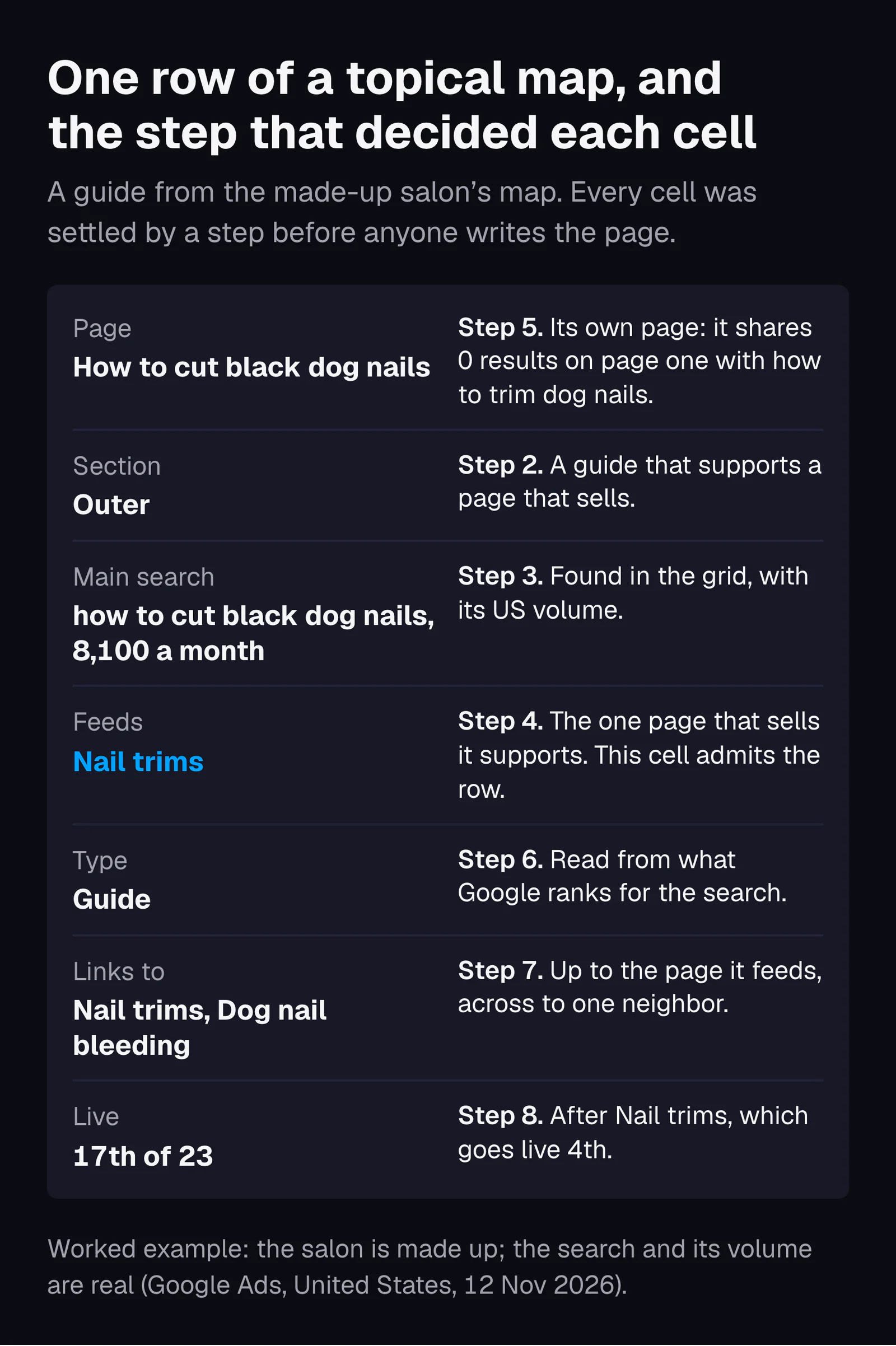
Give every guide a column called "feeds", and write in it the one core page the guide supports. That column decides whether the guide belongs, what it links to and when it goes live.
Check the clusters with people as well as with Google. Card sorting is a research method in which people group topics written on cards into the categories that make sense to them (Nielsen Norman Group). Hand a few customers the guide titles and see which service they put each one under. Where they disagree with your feeds column, look again.
Step 5: Decide which searches get a page and which become a section
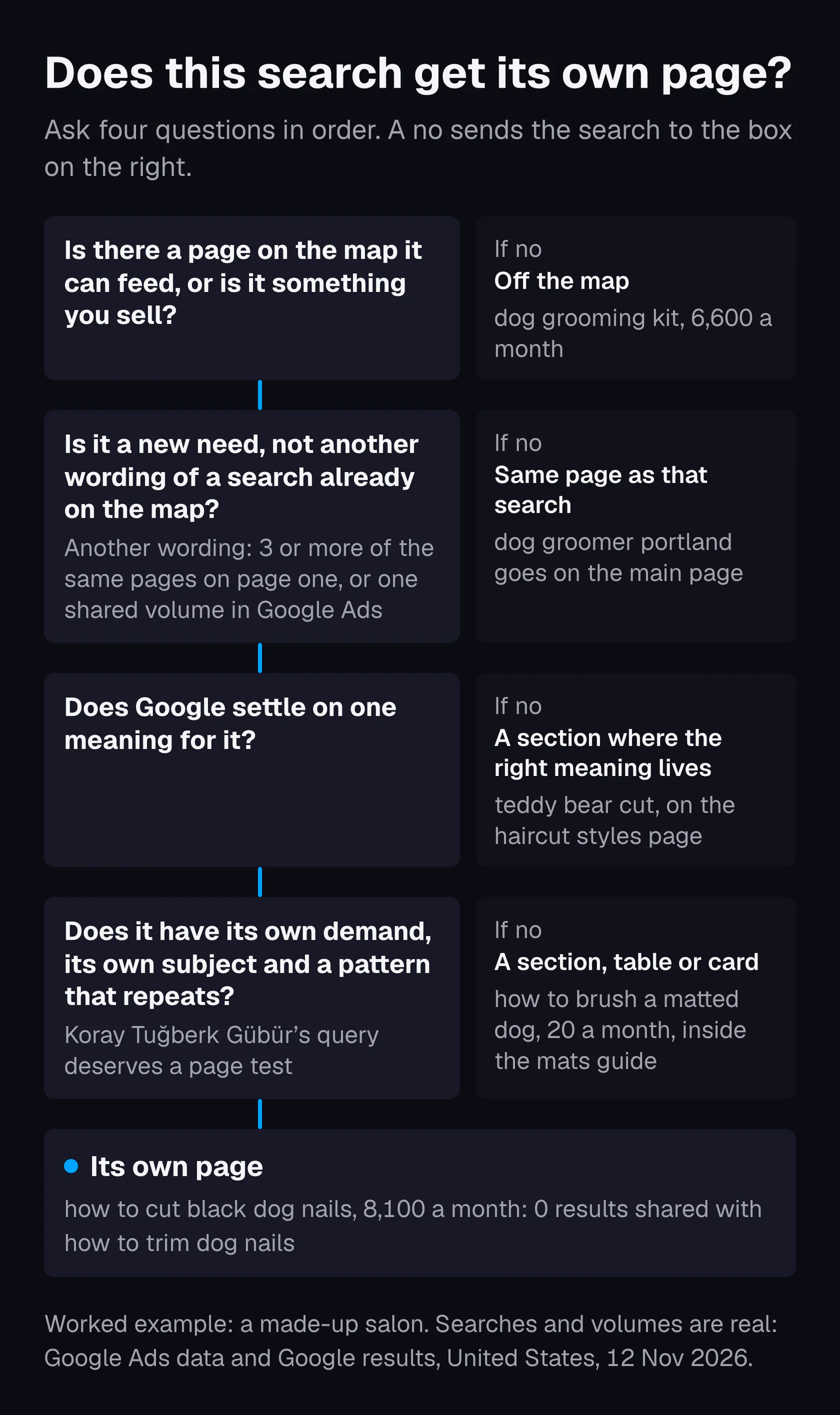
A search gets its own page only when it is a different need from every search already on the map. Otherwise it goes on the page that already answers it, as a second search or a section. Two pages on one need compete with each other, which is called keyword cannibalization.
The shared results test
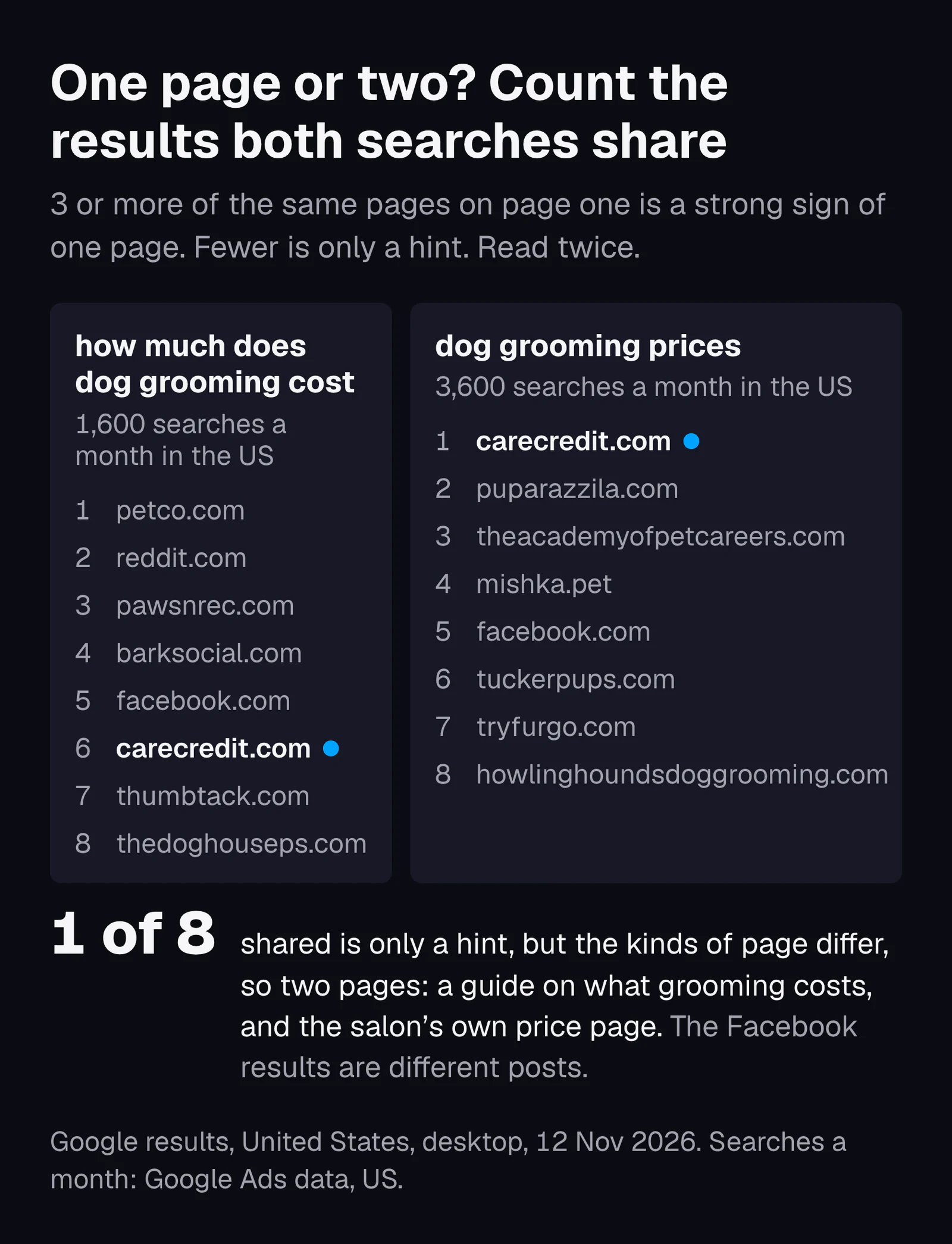
Search both and compare Google's first page. When 3 or more of the same pages rank for both, treat them as one need and give them one page. Fewer than 3 is a weaker signal, not a verdict: the same search read twice a few minutes apart can keep only about a third of its pages, so search both again and look at what kind of page ranks before you split them. Count the same addresses, not the same sites. Three is a working line, not a number Google publishes. The full method is in when a search deserves its own page.
The test has a research history. Doug Beeferman and Adam Berger grouped search queries by the pages people clicked for them, without reading the words at all (2000). Google later patented a way to cluster the searches people type next by the documents they click, one cluster per intent (granted 2013). Both share a limit: they need results to compare, so rare searches still need judgment.
The test is worth running because instinct is often wrong. "How much does dog grooming cost" and "dog grooming prices" sound like one question. On 12 November 2026 they shared 1 page out of 8. The cost search showed Reddit, Facebook and price guides. The prices search showed price guides on groomers' own sites. So the salon gets two pages: a guide on what grooming costs, and its own price page.
The salon's other tests came out like this:
| Searches compared | What Google showed | Decision |
|---|---|---|
| how to trim dog nails / how to cut black dog nails | 0 shared pages (the YouTube results are different videos) | Two guides |
| goldendoodle grooming / goldendoodle haircut styles | 0 shared pages (one breeder ranks with two different pages) | A guide and a photo gallery |
| how often should a dog be groomed / how often to bathe a dog | 0 shared pages | Two guides |
| dog grooming portland / dog groomer portland / dog grooming portland oregon | Google Ads reports one volume, 880, for all three: the same request in three wordings | One page, the main page |
When the results cannot decide
Koray adds four tests for whether a query deserves a page: high search demand, different entities, low similarity and a pattern. A search that fails them lives as a section, a table or a card on an existing page. He calls the test Query Deserves a Page, in a 2026 article for Search Engine Land.
Two of the salon's searches went that way. "Teddy bear cut" (4,400) fails on meaning: Google shows dog cuts, cat cuts, craft cutouts and a song, so a page of its own would chase four meanings. It becomes a section on Goldendoodle haircut styles. "How to brush a matted dog" (20) fails on demand and is the same subject as the mats guide, so it is a section there.
One engine says the same from its side. Bing's Webmaster Guidelines tell site owners to "Focus Each URL on a Single Topic", because "URLs focused on a primary topic are more likely to be selected for grounding results", the sources Copilot and Bing's AI answers draw on. The full test, with more cases, is in When a search deserves its own page.
Step 6: Let the results decide each page's type
Each page's type comes from two places: what the business is, and the kind of page Google already ranks for that search. A guide planned for a search where Google ranks product listings starts with the odds against it.
The business decides the families. A service business gets service pages and a price page. A store gets collection and product pages. Both get guides.
The results decide the page inside the family. Search the page's main search and look at what wins. Five of the made-up salon's searches show the range:
| Search | Google shows | On the map |
|---|---|---|
| dog grooming kit (6,600) | 4 product carousels, then shop pages and best-kit lists | No page. Shoppers want products, and the salon sells no kits, so a guide would have nothing to feed. |
| goldendoodle haircut styles (12,100) | Pinterest pins and photo lists | A photo gallery of the salon's own cuts |
| how to trim dog nails (22,200) | 5 videos among 8 results | A guide built around the salon's own video |
| dog nail trimming (14,800), searched in Portland | A Portland groomer's page first, then how-to videos | A second search on the Nail trims service page |
| dog grooming prices (3,600) | Price guides, 3 of them on groomers' own sites | The price page |
The kit search is the one to remember. It is on topic and it has volume. It still gets no page, because the results are built for shopping and the salon has nothing to sell there. The source context from Step 1 and the results agree, and both say no.
Step 7: Plan the links down the hierarchy, then across it
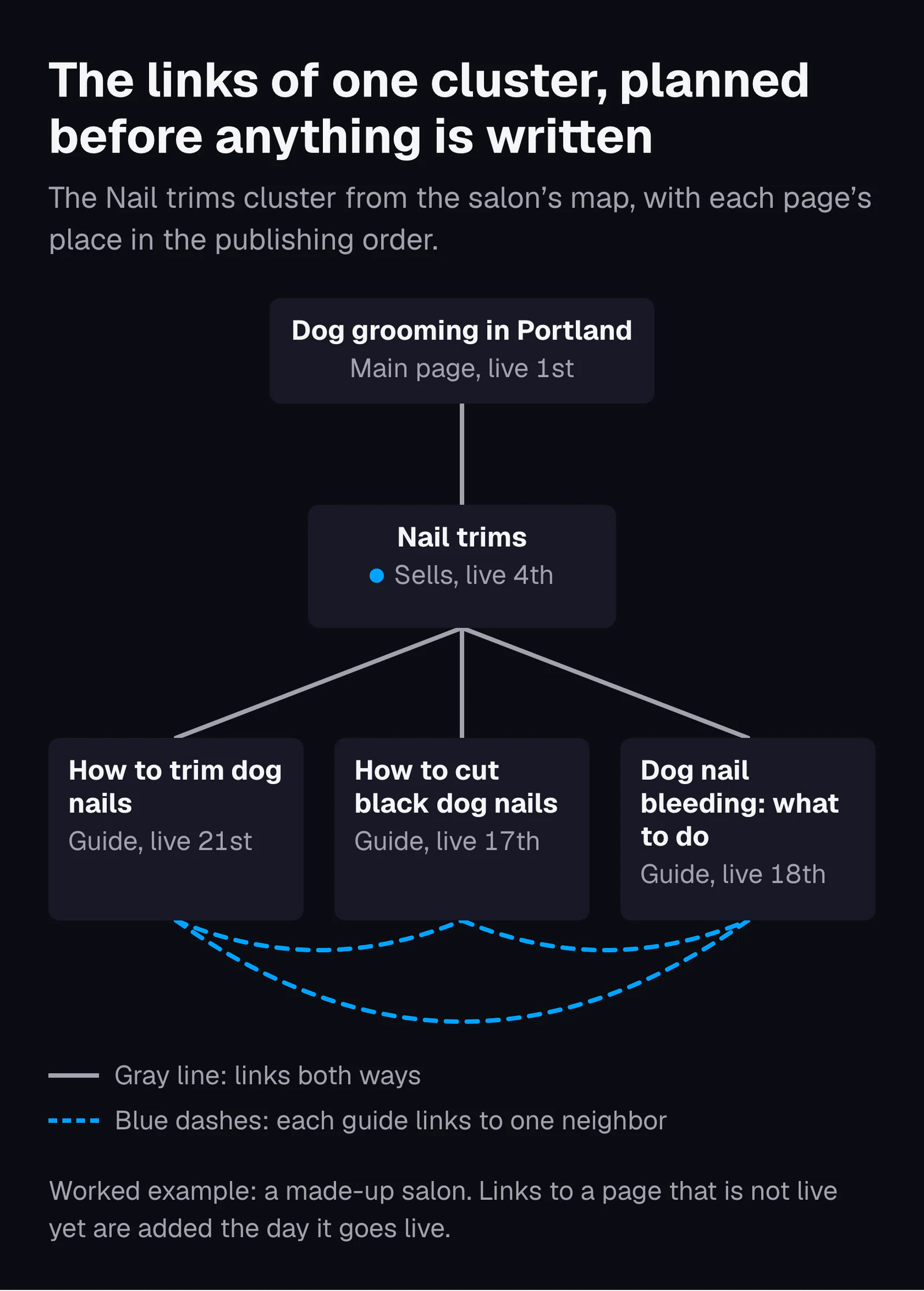
Plan the links before anyone writes a word, starting from the core. Four rules cover most of a small map:
- The main page links to every core page. For the salon that is the six services, the price page and Meet the groomers.
- Each core page links to the guides that feed it. It also links back to the main page, to the price page and to one related service.
- Each guide links to the page it feeds. This is the guide's main link, read straight from the feeds column.
- Each guide links to one neighbor, another guide that helps the same reader.
Two pages get a few more links. The price page links to every service it prices, and Meet the groomers links to the main page, Full groom and the price page.
The words on a link are the target page's name, and they are the same words every time any page links to it. Every guide that points to Nail trims says "nail trims". That way both the reader and Google learn one name for one page.
Write down why each link exists
Give every planned link a one-line reason. In a concept map, "words on the line, referred to as linking words or linking phrases, specify the relationship between the two concepts" (Novak and Cañas, 2008). A link between two clusters is what they call a cross-link, and Koray calls the shared idea behind it a contextual bridge. For the salon: Dog nail bleeding links to How to cut black dog nails, because cutting too short is what makes a nail bleed. If you cannot write the reason, drop the link.
Then check that no page is left without a link in. Google's link best practices (updated December 2025) say it plainly: "Every page you care about should have a link from at least one other page on your site." The salon's map plans 78 links across 23 pages. Every page gets at least one.
A planned link to a page that is not live yet waits. It goes in on the day that page goes live. The map holds the list, so nobody has to remember it. Anchors, link counts and links between clusters have their own lesson: Internal links inside a topical map.
Step 8: Set the publishing order
Set the order in three groups, in this sequence. One rule sits above all three: a guide never goes live before the page it feeds.
- Pages already close to page one. A page that already shows on Google's second page for its search has the shortest way to go. Search Console shows these. The made-up salon has none.
- The core pages. The main page first, then the services in the order the business most wants to sell them. For the salon that means Full groom second, because full grooms are its main job (we made that up with the rest of the salon).
- The guides, weakest results first. Count the Reddit, Facebook, Quora and Instagram posts, forum threads and Q&A pages on the search's first page. The more of them, the weaker the competition. Break ties by searches a month.
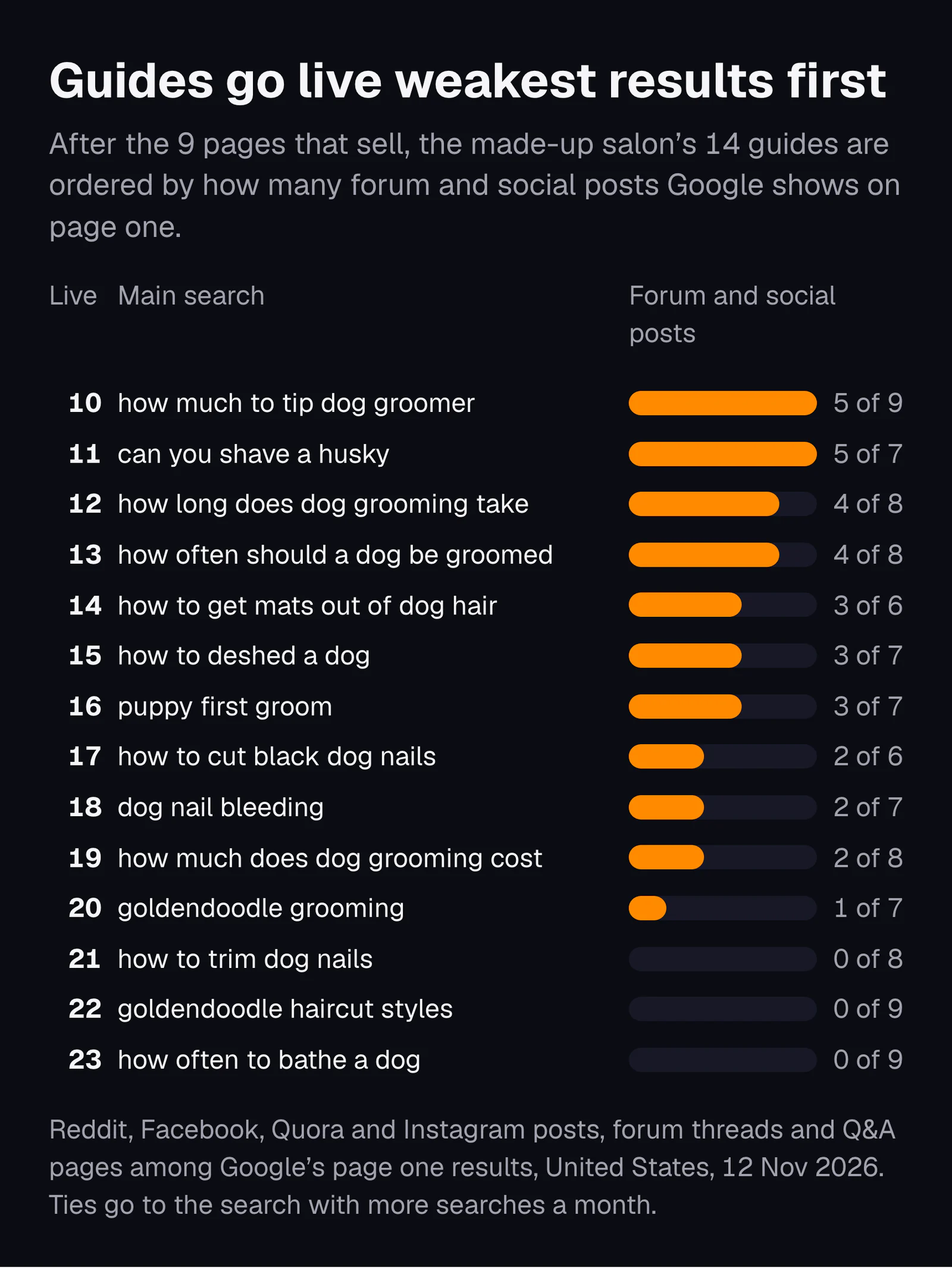
Look at where the big searches land. "How to trim dog nails" has the most searches on the whole map, and it goes live 21st. Its first page holds five videos and no forum posts, so it is among the hardest pages on the map to win. "How much to tip a dog groomer" has a sixth of the searches and five forum posts on page one, so it goes live 10th.
The order is not a pace. Publish as fast as you can do each page properly. A thin page is worse for the site than a gap in the schedule. Seasons, refreshes and what to do when a page stalls are in Publishing order.
Step 9: Check the map for the mistakes that sink home-built maps
Before anyone writes a page, read the map row by row against the mistakes below. A mistake costs one spreadsheet cell now and a live page later.
The three I see most
When owners show me a map they built themselves, three mistakes come up again and again.
- Pages that do not build on each other. Each page is planned as if it stood alone: no page it feeds, no links to the pages it supports, and an order that puts a guide live before the page it should send readers to. Check that every outer row names a core page in its feeds column, and goes live after it.
- Off-topic pages that should have been part of another page. Any site that worked with a bad agency before tends to have a lot of these, because the agency published as much as the retainer asked for. That is not how SEO is done properly: every page on a site needs a purpose, and a page without one does not deserve to be there. Check every row against the three sentences from Step 1. A row that fails is first merged into a more relevant page; see Pruning and merging.
- A search that does not deserve its own page. Many searches are a section of a page, not a page. Check that every row passed the four questions in Step 5, and read When a search deserves its own page for the harder cases.
Off-topic pages may weigh on more than themselves. Google's internal API documentation, leaked in 2024, describes a field called siteRadius: "The measure of how far page_embeddings deviate from the site_embedding." Nobody outside Google knows its weight. It does show that Google stores how far each page strays from what the site is about.
What else to check for
| Mistake | How to check for it |
|---|---|
| A core page for an offer the business does not have | Every core row is something the business sells today |
| City-swapped pages | One location means no page per suburb with only the name changed |
| A page type the results do not support | Every type matches what Google ranks for its main search |
| A page with no link in | No row has an empty "linked from" cell |
| An old address with no decision | Every existing page is rebuilt, kept, merged or redirected |
| A list pasted from a generator | Every row was decided by a person against the three sentences |
| Numbers typed from memory | Every volume has a source and a date |
The city check comes straight from Google. Its spam policies list as doorway abuse "pages targeted at specific regions or cities that funnel users to one page". A salon with one address and twelve neighborhood pages is the kind of site that policy describes.
The generator check comes from Koray himself: "Do not believe auto-generated topical maps." And: "Asking ChatGPT for 20 types of X won't give you a topical map about X" (2024). A list of topics becomes a map only when each row has a section, a page it feeds and a place in the order.
The salon's check left these decisions on the map:
| Search or page | Decision | Why |
|---|---|---|
| teddy bear cut (4,400) | A section | Mixed meanings; it lives on Goldendoodle haircut styles |
| dog grooming kit (6,600) | Out | A shopping search, and the salon sells no kits |
| Neighborhood pages | Out | One salon, one address: they would look like the doorway pages Google warns about |
| /blog/new-tub | Merge | No search and no job of its own; its one line belongs on Bath and brush |
| poodle haircut styles (14,800), shih tzu haircut styles (12,100) | Later | One gallery per breed, once the salon has its own photos of those cuts |
| dog grooming near me (450,000) | Not a page | The main page carries the address; the map pack runs on the Google Business Profile |
The "later" row matters as much as the cuts. A map is not finished when it stops growing. It grows when the business can back a new page with something real.
The finished map, and ten rows from a real one
Here is the made-up salon's whole map: 9 core pages and 14 outer guides, in publishing order. Each guide names the page it feeds. Volumes are US searches a month.
| # | Page | Type | Main search | US a month | Feeds |
|---|---|---|---|---|---|
| 1 | Dog grooming in Portland | Service page (main page) | dog grooming portland | 880 | This page sells |
| 2 | Full groom | Service page | full dog grooming | 50 | This page sells |
| 3 | Grooming prices | Price page | dog grooming prices | 3,600 | This page sells |
| 4 | Nail trims | Service page | dog nail trim portland | 70 | This page sells |
| 5 | Bath and brush | Service page | dog bath and brush | 30 | This page sells |
| 6 | De-shedding treatment | Service page | dog deshedding treatment | 480 | This page sells |
| 7 | Dematting | Service page | dematting dog | 260 | This page sells |
| 8 | Puppy grooming | Service page | puppy grooming portland | No measured volume | This page sells |
| 9 | Meet the groomers | About page | None of its own | Trust for every page | |
| 10 | How much to tip a dog groomer | Guide | how much to tip dog groomer | 3,600 | Grooming prices |
| 11 | Should you shave a double-coated dog like a husky? | Guide | can you shave a husky | 720 | De-shedding treatment |
| 12 | How long does dog grooming take? | Guide | how long does dog grooming take | 590 | Full groom |
| 13 | How often should a dog be groomed? | Guide | how often should a dog be groomed | 480 | Full groom |
| 14 | How to get mats out of dog hair | Guide | how to get mats out of dog hair | 1,000 | Dematting |
| 15 | How to deshed a dog | Guide | how to deshed a dog | 880 | De-shedding treatment |
| 16 | Puppy's first groom: what to expect | Guide | puppy first groom | 210 | Puppy grooming |
| 17 | How to cut black dog nails | Guide | how to cut black dog nails | 8,100 | Nail trims |
| 18 | Dog nail bleeding: what to do | Guide | dog nail bleeding | 2,400 | Nail trims |
| 19 | How much does dog grooming cost? | Guide | how much does dog grooming cost | 1,600 | Grooming prices |
| 20 | Goldendoodle grooming | Guide | goldendoodle grooming | 2,400 | Full groom |
| 21 | How to trim dog nails | Guide with the salon's own video | how to trim dog nails | 22,200 | Nail trims |
| 22 | Goldendoodle haircut styles | Photo gallery | goldendoodle haircut styles | 12,100 | Full groom |
| 23 | How often to bathe a dog | Guide | how often to bathe a dog | 5,400 | Bath and brush |
Download the worked example mapCSV for the made-up salon (real searches and volumes): 23 pages plus 7 decision rows, with order, core or outer section, type, main search, US searches, the page each guide feeds, forum count and every link. Opens in Google Sheets or Excel.
The file holds what the table cannot fit: the section of each row, every planned link in and out, the forum count behind the order, and the existing address each rebuilt page keeps. Copy it, swap the salon's rows for yours, and keep the columns.
Ten rows from a real client map
The salon map is small so it fits on one screen. Here is the same build at full size: ten rows from a real map for a US water and fire damage restoration company, a US English map of 173 pages. The business name and its state are replaced with [brand] and [state]. No other word is changed.
P is the page's place in the publishing order across the whole map, so the numbers jump. Role says where a page sits: a hub gathers a group, cluster pages sit under it, and support pages answer questions and feed the others.
| P | Page | Type | Role | Main search | US a month | Feeds |
|---|---|---|---|---|---|---|
| 3 | Water Damage Restoration in [state] | [brand] | service | hub | water damage restoration | 90,500 | Water, Fire & Storm Damage Services | [brand] |
| 4 | Water Damage Cleanup in [state] | [brand] | service | cluster | water damage cleanup | 2,900 | Water Damage Restoration in [state] | [brand] |
| 5 | Flooded Basement Cleanup in [state] | [brand] | service | cluster | flooded basement cleanup | 1,600 | Water Damage Restoration in [state] | [brand] |
| 6 | Burst Pipe Water Damage Cleanup in [state] | [brand] | service | cluster | burst pipe cleanup | 1,000 | Water Damage Restoration in [state] | [brand] |
| 8 | Does Homeowners Insurance Cover Water Damage? | blog | support | does homeowners insurance cover water damage | 1,600 | Water & Fire Damage Insurance Claim Help | [brand] |
| 19 | Water Mitigation Services in [state] | [brand] | service | cluster | water mitigation | 5,400 | Water Damage Restoration in [state] | [brand] |
| 32 | How to Tell if a Pipe Burst in Your House | blog | support | how to tell if a pipe burst | 1,300 | Burst Pipe Water Damage Cleanup in [state] | [brand] |
| 107 | Flooded Basement: What to Do in the First 24 Hours | blog | support | flooded basement what to do | 1,000 | Flooded Basement Cleanup in [state] | [brand] |
| 127 | Dehumidifier for Water Damage: How Long to Run It | blog | support | dehumidifier for water damage | 6,600 | Water Mitigation Services in [state] | [brand] |
| 142 | Restoration Company vs General Contractor | comparison | support | restoration company vs general contractor | None recorded | Water & Fire Damage Reconstruction in [state] | [brand] |
It is the salon's build with more rows. The service pages sit at the front of the order: P3 to P6 and P19 are services, and the first two are existing pages being rebuilt. Each question sits under the one service page it feeds: the burst pipe question feeds the burst pipe service, the dehumidifier question feeds water mitigation. The last row has no recorded volume and is on the map anyway, because it feeds the reconstruction service.
Map size follows the business, not a rule. This one has 173 pages and the salon's has 23. Our median growth plan was 159 pages on 5 November 2026, and maps run from about 50 pages to over 20,000. More maps, opened up, are in Topical map examples.
For the next one
The nine steps stay the same whatever you build with. A template gives you the columns from day one: Topical map template. Tools speed up collecting and grouping searches; what they can and cannot decide is in Topical map tools and generators. To draft one with an AI assistant, read Build a topical map with Claude.
No tool writes the three sentences in Step 1 or makes the calls in Step 5 for you. Someone has to look at the site, the market and Google's results with their own eyes. If you would rather have the whole map built for your site, that is what our growth plan is.
Sources
- How to Expand a Topical Map for Higher Topical Authority?, Koray Tuğberk Gübür, Holistic SEO, 2023
- 3 Suggestions about Topical Authority, Koray Tuğberk Gübür, Medium, 2024
- The Theory Underlying Concept Maps and How to Construct and Use Them, Joseph D. Novak and Alberto J. Cañas, IHMC, 2008
- Colon Classification, M. P. Satija, ISKO Encyclopedia of Knowledge Organization, 2017
- Facet analysis, Birger Hjørland, ISKO Encyclopedia of Knowledge Organization, 2013
- Agglomerative clustering of a search engine query log, Doug Beeferman and Adam Berger, ACM KDD, 2000
- Clustering query refinements by inferred user intent (US8423538B1), Google LLC, patent, 2013
- Measuring and Narrowing the Compositionality Gap in Language Models, Ofir Press and colleagues, arXiv, 2022
- Card Sorting: Uncover Users' Mental Models, Nielsen Norman Group, 2024
- Bing Webmaster Guidelines, Microsoft Bing, 2026
- QualityAuthorityTopicEmbeddingsVersionedItem (leaked Content Warehouse API documentation), hexdocs.pm copy of the 2024 leak, 2024
- AI in Search: Going beyond information to intelligence, Google, 2025
- Creating helpful, reliable, people-first content, Google Search Central, 2026
- Link best practices for Google, Google Search Central, 2025
- Spam policies for Google web search, Google Search Central, 2026