Topical maps for local and service businesses
A local topical map is the plan of every page a service business needs, built around its service pages and the places it serves, with each question page placed to send readers to the one service that answers it.
A service business has no collections and no products. Its map is built around the services it sells and the places it serves, and most of its pages answer the questions people ask before they call. Here is how I plan one: which town pages deserve to exist, what the map pack decides that a map cannot, how to handle emergencies and licensed trades, and a real restoration map read as decisions.

Key takeaways
- In the 73 service-business maps we delivered in October and November 2026, a median 18% of pages sell (service and location pages), against 37% on store maps, and 95% of the guide and question pages link to a service page, a location page or the homepage.
- A town page deserves to exist only with two kinds of warrant: people search for the service in that town, and you can write facts that are true only there; a page with only the town name swapped sits close to what Google's spam policy calls doorway abuse.
- Google says local results are mainly based on relevance, distance and prominence; a topical map can feed relevance and earn some of the links behind prominence, but no page changes the distance between a searcher and your business.
- When I pulled two urgent searches, both opened with the map pack, so an urgent trade's emergency page goes live in the first batch and every "what to do first" guide feeds the one service that fixes the problem.
- Across those 73 maps, a town page carries a median of 20 recorded searches a month and 31% carry none, so a service map grows with its services and questions first and with its towns second.
How a service business's topical map differs from a store's
A service business's topical map is built around service pages and the places it serves. There are no collection pages and no product pages. Fewer pages sell, and most pages answer the questions people ask before they pick up the phone.
A store sells a thing you can put in a cart. A plumber, a clinic, a law firm or a restoration company sells work done for you, often in your home, often by a stranger. People buy that on trust, and trust is built by answers. So the map has a small core of pages that take the call, and a large ring of pages that earn it.
What our service maps show
I counted the 73 service-business maps we delivered in October and November 2026. That is every map with five or more service pages, from trades and clinics to consultancies that sell online. The median map is 160 pages. Across the maps, a median 18% of pages sell, meaning service pages and location pages, and the median map has 20 service pages.
The store maps in topical maps for ecommerce stores sit at 37%. A store with forty product types gets forty collections. A plumber with eight services gets eight service pages, and then a long list of questions about leaks, water heaters, permits and prices.
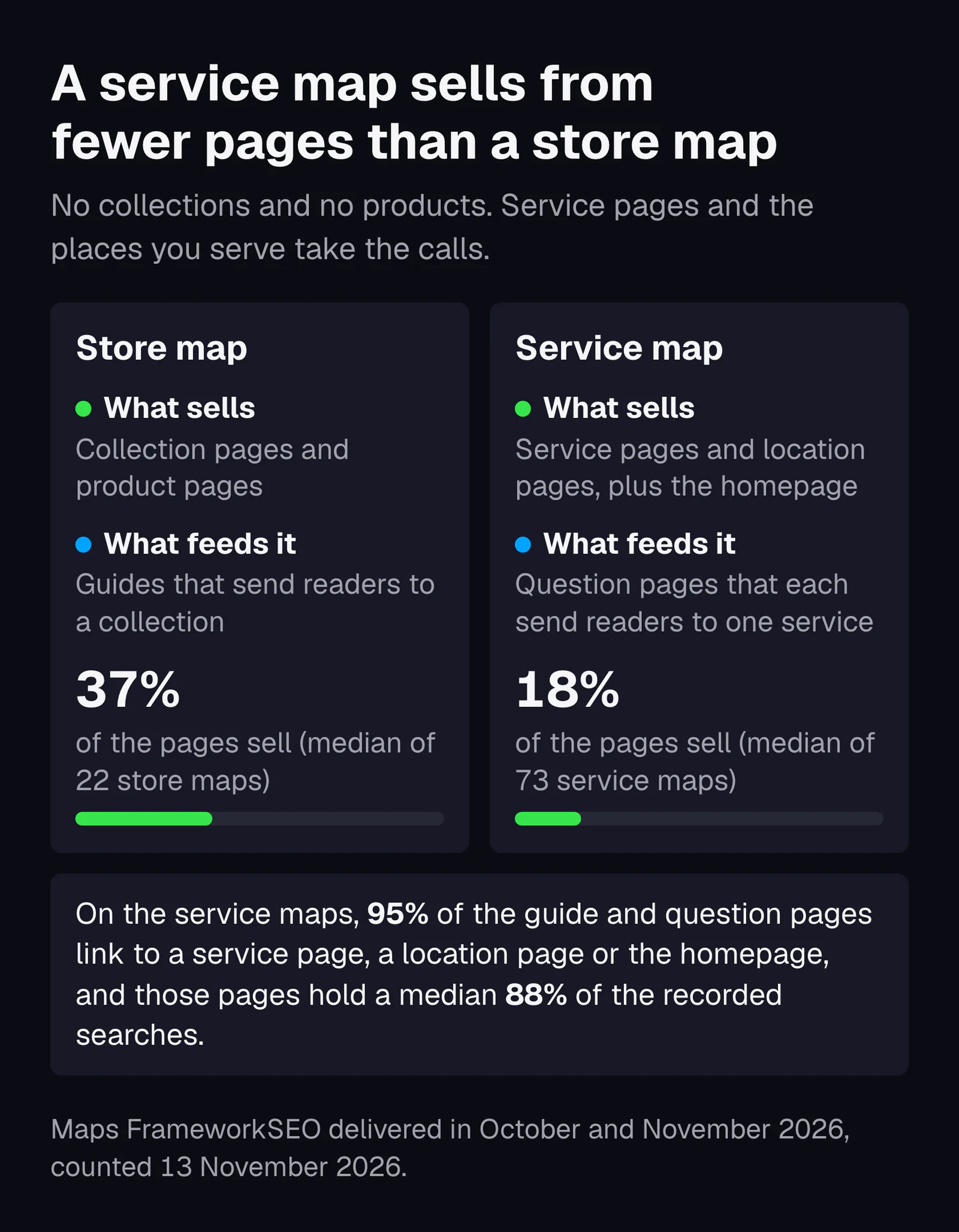
The questions are where the searches are. Guide and question pages hold a median 88% of each service map's recorded searches, meaning the US monthly Google search volume the map records for each page. And 8,516 of the 8,949 guide and question pages in those maps, 95%, link to a service page, a location page or the top page of the map (the homepage on most maps), directly or through the page they sit under.
The general method for building any map is in how to build a topical map, which uses a made-up dog grooming salon as its worked example. This lesson covers what changes when the business sells a service in a place.
What sits in the core section and the outer section of a service map
The core section of a service map holds what you are paid for and what a buyer checks before paying. That is the homepage, the service pages, the service area page, the town pages that earn a place, prices, the emergency page, booking and the trust pages. The outer section holds the questions around each service.
Koray Tuğberk Gübür, whose case studies put the term topical map into SEO, wrote in 2023 that the source context, why the site exists and how it makes money, "determines the macro contexts of the documents, and the contextual direction of the content briefs, along with the topical map's core and outer sections." For a service business the source context is a booked job. Every page has to lead to one. The full theory of the two halves is in core section and outer section.
| Section | Pages | Example from a restoration company | Its job |
|---|---|---|---|
| Core | Homepage, service pages, service area page, chosen town pages, prices, emergency page, booking | Water damage restoration; flooded basement cleanup; burst pipe cleanup | Take the call |
| Core (trust) | License and insurance page, the team, guarantees, reviews | A page a homeowner opens before letting a crew in | Remove the reason not to call |
| Outer | Questions, "what to do first" guides, cost guides, comparisons, claim and permit explainers | How to tell if a pipe burst in your house; restoration company vs general contractor | Answer the question, then send the reader to one service |
The homepage takes the strongest service and place
Koray's 2026 case study on local SEO gives one rule I follow too: "The most important location-service pair should be targeted from the most important page, usually the homepage." The homepage is usually the page with the most links, the most crawls, and the address your Business Profile (your listing on Google Maps and Search) points to.
In the same article he names the failure that rule prevents: in many local projects "the homepage, About page, or main service pages cannibalize each other". On a service map, the homepage owns the main service in the main place. Each service page owns one service. The About page owns the company. More of his model is in Koray Tuğberk Gübür's topical map framework.
Service pages, location pages and service-in-location pages: what each one is for
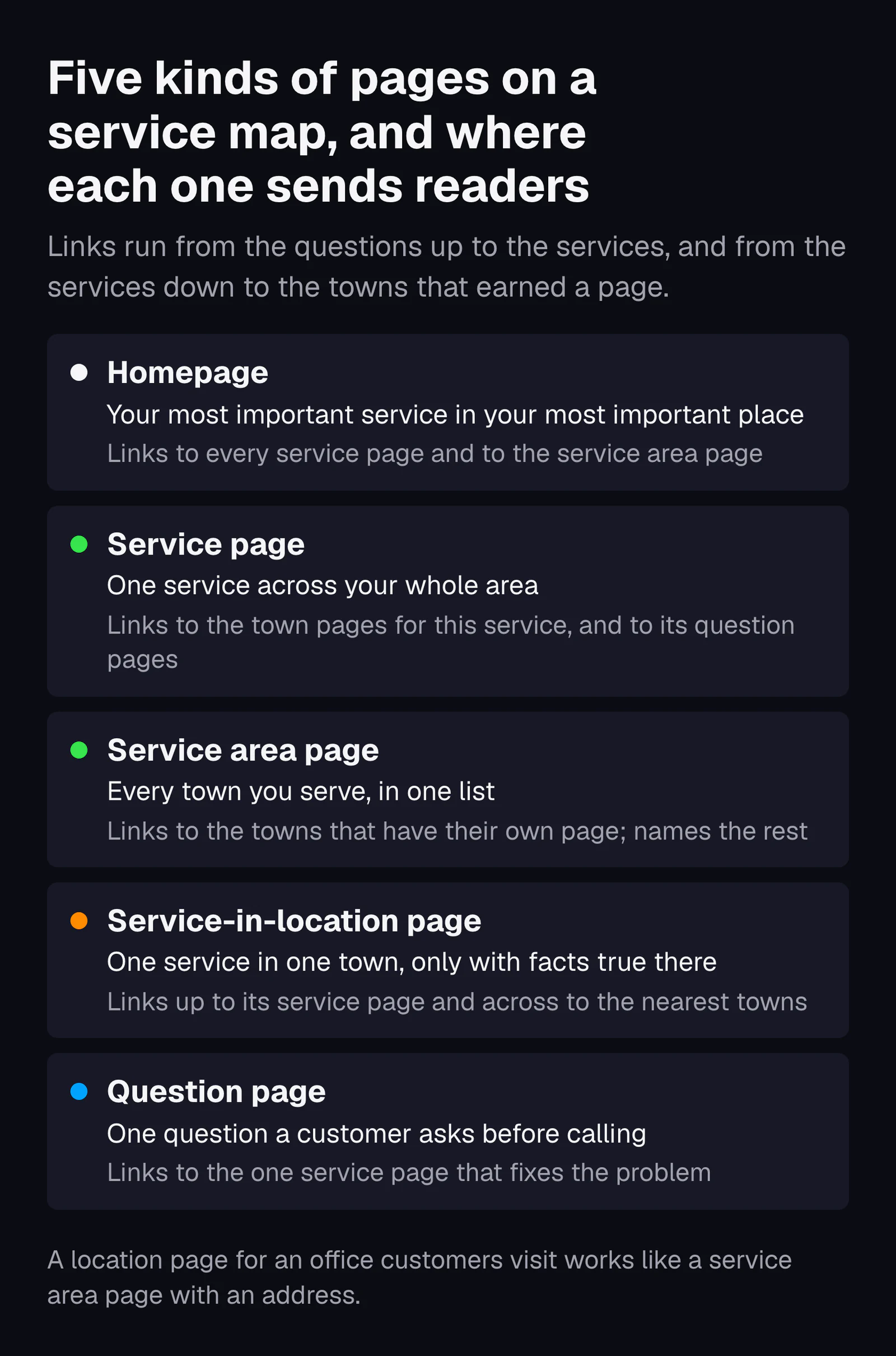
A service page sells one service across your whole area. A location page is about one place: an office customers visit, or the service area page that lists every town you cover. A service-in-location page, also called a town page, sells one service in one town, and it exists only when that town has facts of its own.
| Page type | Its job | Exists when | Must carry |
|---|---|---|---|
| Homepage | Your most important service in your most important place | Always | What you do, where, the phone number, links to every service page and the service area page |
| Service page | One service across your whole area | For every service you sell that people search for or ask about | What the service fixes, how it works, what changes the price, the area, proof |
| Service area page (a location page) | Every town you serve, in one list | When you travel to customers in more than one town | The towns, your response time, links to the towns that have their own page |
| Office page (a location page) | One place customers visit | For each staffed office or clinic with its own address | Address, hours, the staff there, how to get there, the services offered there |
| Service-in-location page | One service in one town | Only when the town passes the warrant test below | At least three facts true only in that town |
| Question page | One question a customer asks before calling | When the question has its own job and is not a section of a service page | The answer, then a link to the one service page that fixes the problem |
How the restoration map uses them
The real map in this lesson is a 173-page US map we delivered to a water and fire damage restoration company. Its service pages are statewide: "Water Damage Restoration in [state] | [brand]" covers the whole area the company works in, not one town. The brand and the state are replaced; every other word is as delivered.
The map has 22 location pages. One is the service area page. The other 21 are service-in-location pages, each built for a town where the company works. Their recorded searches are small: 0 to 210 a month, and 5 of the 21 have no recorded searches at all. They go live after the service pages they link to, at positions 33 to 48 and 96 to 110 in the publish order. A business that works in one town needs no town pages at all: its homepage and service pages already name the town.
That order is the point. A town page links up to its service page. Published first, it links to a page that does not exist yet. The logic for the whole map is in publishing order.
Links between town pages
Each town page links up to its service page and across to the nearest towns that also have a page. SearchPilot, an SEO testing company, tested the second link on about 8,000 regional pages of one US multi-location site. Each page got links to its six nearest regional pages. The linked-to pages gained 7% organic traffic (test published 2021, summarised in their 2024 roundup). In a test SearchPilot reported in 2025, removing the embedded map from multi-location pages cost 7%. These are single sites, so treat them as direction, not law. The full rules for links are in internal links inside a topical map.
When a town page deserves to exist, and when it is a doorway page
A town page deserves to exist when people search for the service in that town and you can write facts that are true only there. A page with only the town name swapped sits close to what search engines describe in their spam rules.
What the engines say
Google's spam policies (last updated 28 August 2026) define doorway abuse as pages "created to rank for specific, similar search queries". Two of its four examples sit close to the swapped-name town page: "Having multiple domain names or pages targeted at specific regions or cities that funnel users to one page" and "Creating substantially similar pages that are closer to search results than a clearly defined, browseable hierarchy".
Bing's Webmaster Guidelines (2026) say it without the word doorway: "Publishing the same or substantially similar content across multiple URLs reduces confidence in selecting a preferred version." They add that large-scale content made "without oversight, quality control, or editorial review" may be excluded from indexing. Fifty town pages that differ only in the town name fit the first line, and the second applies when they are churned out at scale without review.
The test librarians have used since 1911
Library science met this problem long before SEO did. In 1911 the English librarian E. Wyndham Hulme wrote that "a class heading is warranted only when a literature in book form has been shown to exist". Librarians call that literary warrant: you open a heading only when there is something to file under it. In 1977 F. W. Lancaster argued for user warrant as well, the requests users actually make. Mario Barité traces both in his entry on literary warrant in the ISKO Encyclopedia of Knowledge Organization (version 2, 2026).
The same entry gives two details that fit town pages closely. Under a 1999 editorial rule Barité reports, the editors of the Dewey Decimal Classification considered a new class when they found "twenty or more works" on a topic. Topics without enough warrant are not thrown away. They stay as "standing room terms", named in a note under a broader class until the literature grows.
Put in a service business's words: a town page needs both warrants. People search for the service in that town or ask you for it there, and you can write facts that are true only there. A town that fails either is a standing room term. It goes on the service area page as a name in the list, and it waits. My rule of thumb for the second warrant is three facts; one fact is a sentence, not a page.
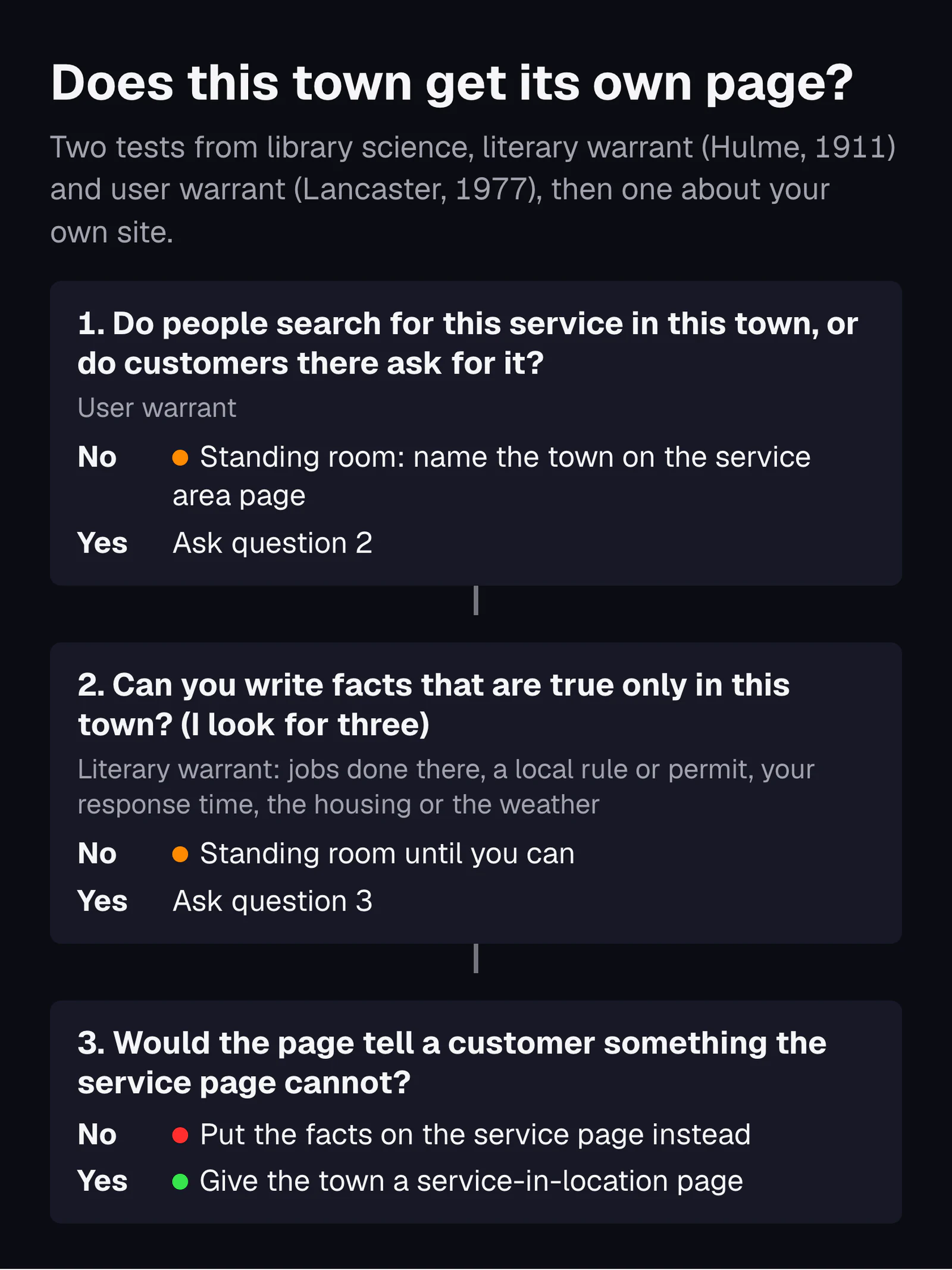
Recorded volume misses small towns. A town with no recorded searches can still pass the first test when customers there call you for the service. Five of the 21 town pages in the restoration map have no recorded searches, which is why the first test asks about customers as well as searches.
What counts as a fact true only in that town
- Jobs you did there. How many, which kinds, which streets or neighborhoods, with photos you took.
- A local rule. A permit the town requires, an inspection it runs, a utility you deal with there. Link the town's own page.
- Your response time from the office. A real number you can keep.
- The housing and the weather. Old houses with basements below the flood line, a coastal town with salt air, a suburb of slab houses with no basements at all.
- Reviews from customers in that town. Word for word, with permission.
A sentence like "we proudly serve the residents of Springfield" is not a fact. Swap the town and it is still true. That is the test: if a sentence survives a find-and-replace of the town name, it is not local.
Koray's numbers, and his Query Deserves a Page test
Koray asks the same question from the engine's side. In his 2026 local SEO case study he takes a car accident attorney in California. Does the firm need a page for every city, district and type of accident? "That would mean at least 300 pages." His answer is his Query Deserves a Page test, four checks on demand, different entities, low similarity and a pattern. The full test is in when a search deserves its own page.
He reports one merge. An injury attorney in Melbourne had "around 19 different location-specific pages" for close places such as Melbourne Beach and Melbourne Center. None met his demand or similarity checks. After the merge, "More than 232 new queries came in, and 60 queries gained better rankings." That is his number from his own screenshots, not an audited result. The reason it works is in cost of retrieval: every unneeded page is work for the engine and a rival for your own pages.
What the map pack shows that a topical map cannot win for you
The map pack is the block of local businesses with a map that Google shows above the normal results for many service searches. It ranks Business Profiles, not web pages. A topical map can help the website the profile links to. It cannot move your address, and it does not hold your reviews, hours or categories.
Google's three factors, in its own words
Google's Business Profile help page on local ranking (checked 13 November 2026) says "Local results are mainly based on relevance, distance, and popularity", and then describes them as relevance, distance and prominence. Relevance is how well a Business Profile matches the search. Distance is how far the business is from the person searching. Prominence is how well known the business is, "based on info like how many websites link to your business and how many reviews you have". The same page says: "There's no way to request or pay for a better local ranking on Google."
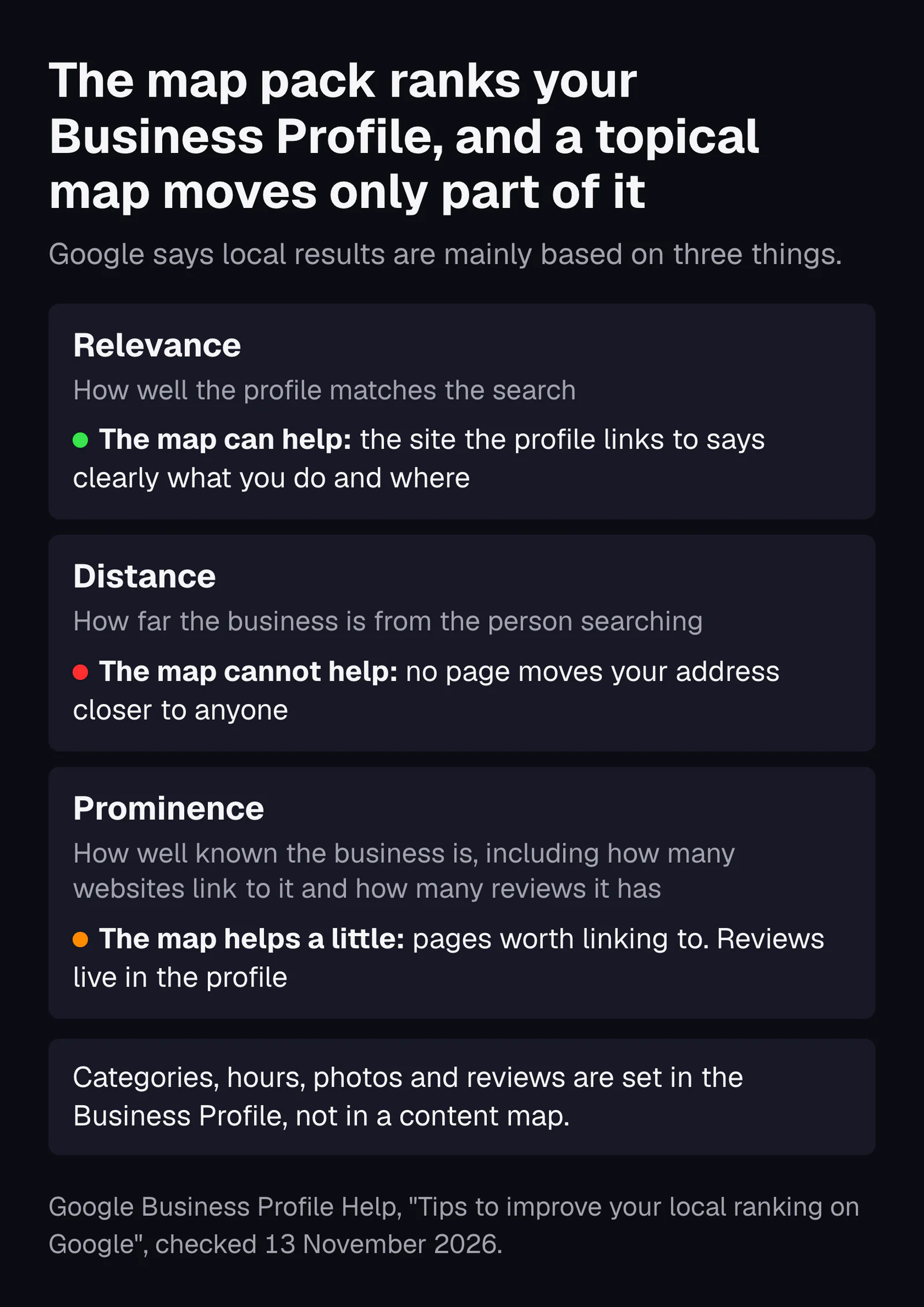
| What decides the map pack | Where it lives | What a topical map can do |
|---|---|---|
| Relevance | The profile's categories and details, and the site it links to | Make the homepage and service pages say clearly what you do and where |
| Distance | Your verified address or service area | Nothing |
| Prominence: links | Other websites | Give them pages worth linking to; the earning is covered in links and mentions |
| Prominence: reviews | The Business Profile | Nothing, beyond showing real reviews on your own pages |
| Hours, photos, categories | The Business Profile | Nothing |
A town page does not put you in that town's map pack
Google's guidelines for representing your business (checked 13 November 2026) set the limits. A service-area business should have "one profile for the central office or location with a designated service area". That area "shouldn't extend farther than about 2 hours of driving time from where your business is based", though Google adds that larger areas may suit some businesses. A rented address you do not work from, a virtual office, is not eligible. And a business that serves customers at their homes, with no storefront, should hide its address.
So no page changes the distance between a searcher and your business. A town page may help you in the normal results for a search with that town's name in it. It does not change where Google places your business.
Google's leaked documentation has a site-level locality field
Two documents from outside Google's help pages add context. Google's Content Warehouse API documentation, leaked in 2024, has a site-level field called localityScore, described as the "Locality score of the site, i.e. the locality component of the LocalAuthority signal". Its weight is unknown. A 2018 Google deck shown in the US antitrust trial, exhibit UPX0204, lists "localization" among the aspects of search quality, next to relevance, freshness and authority.
Neither proves how ranking works today. The leaked field suggests that Google has, at some point, scored how local a whole site is, not only single pages. That is one more reason to plan a coherent map rather than a pile of town pages.
What I saw when I searched
On 12 November 2026 I pulled three Google mobile results pages set to Denver. "Emergency plumber" opened with a map pack of four listings, one of them paid, before any normal result. "Water damage restoration" opened with a map pack, then an AI Overview. "What to do if basement floods" showed no map pack at all: an AI Overview, a restoration company's ad, then seven "what to do" guides.
That is the split in one picture. The service searches are partly won outside the website. The question searches are won by pages a map plans, and a restoration company was paying to appear on one.
How to plan pages for urgent and emergency searches
In my pull, both urgent searches opened with the map pack, and the person searching wants to call, not read. Plan one emergency page that leads with the phone number, the hours and the area, publish it in the first batch, and give each "what to do first" guide the one service that fixes the problem.
The demand is real. "Emergency plumber" gets 90,500 US searches a month (Google Ads data, 12 November 2026). The website's job is to confirm at a glance that you do the job, now, in that place.
Many service businesses do not need a separate emergency page: a dentist's cleaning or a consultant's audit is booked ahead. Where the trade is urgent, the page goes first. In the restoration map, the 24/7 emergency service page is the second page in the publish order.
| Page | The reader's moment | What it leads with | Where it links |
|---|---|---|---|
| Emergency service page | Water on the floor right now | Phone number, "open now" only if it is true, the area, how fast a crew arrives | The service pages for each kind of damage |
| "What to do first" guide | Waiting for help, or deciding whether to call | The first steps, in order, and the point where they should call a professional | The one service that fixes this problem |
| "What to expect" guide | The crew is booked | What happens hour by hour, what to move, what to photograph for the insurer | The service page, and the insurance help page |
The restoration map has 15 page titles with "what to do" in them. One is in the rows below: "Flooded Basement: What to Do in the First 24 Hours", 1,000 searches a month, feeding the flooded basement cleanup page.
Put the official figure on the page, with its source
An urgent page earns trust with facts a homeowner can check. For water damage the official one is from the US Environmental Protection Agency. Its guide to mold and moisture (last updated 18 February 2026) says "dry water-damaged areas and items within 24-48 hours to prevent mold growth." Quote the agency, link it, and never round it into a claim of your own.
Build question pages that each feed one service page
Each question page on a service map sits under the one page that fixes its problem, usually a service page, and links to it in the paragraph that names the problem. The question names what went wrong. The service fixes it. A question page never sits under a town page.
The restoration map shows both halves of that rule. Of its 122 guide and question pages, 103 sit under a service page and most of the rest under a help page or hub, like the insurance claim page. None sits under a town page. Town pages are leaves: they take the call for one town, and they are not hubs for knowledge that is true everywhere.
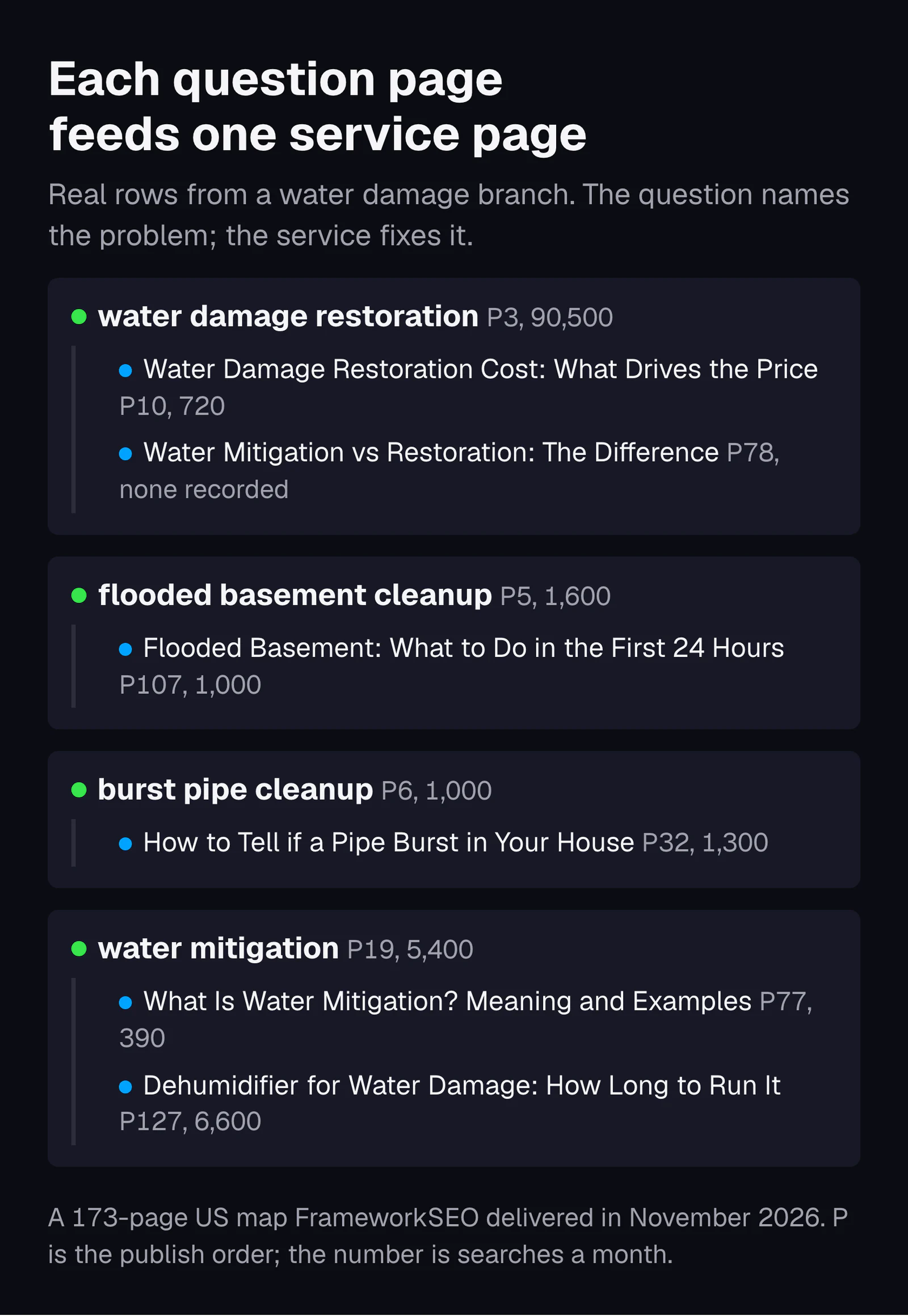
These 12 rows come from that map's water damage branch. The brand and the state are replaced; no other word was changed. P is the publish order across the whole map, and the searches are US monthly searches the map records. The same branch is read as an example in how to build a topical map; here it is read as service decisions.
| P | Page | Type | Main search | Searches a month | Feeds (links up to) |
|---|---|---|---|---|---|
| 3 | Water Damage Restoration in [state] | [brand] | service | water damage restoration | 90,500 | Water, Fire & Storm Damage Services | [brand] |
| 5 | Flooded Basement Cleanup in [state] | [brand] | service | flooded basement cleanup | 1,600 | Water Damage Restoration in [state] | [brand] |
| 6 | Burst Pipe Water Damage Cleanup in [state] | [brand] | service | burst pipe cleanup | 1,000 | Water Damage Restoration in [state] | [brand] |
| 8 | Does Homeowners Insurance Cover Water Damage? | blog | does homeowners insurance cover water damage | 1,600 | Water & Fire Damage Insurance Claim Help | [brand] |
| 10 | Water Damage Restoration Cost: What Drives the Price | guide | water damage restoration cost | 720 | Water Damage Restoration in [state] | [brand] |
| 19 | Water Mitigation Services in [state] | [brand] | service | water mitigation | 5,400 | Water Damage Restoration in [state] | [brand] |
| 32 | How to Tell if a Pipe Burst in Your House | blog | how to tell if a pipe burst | 1,300 | Burst Pipe Water Damage Cleanup in [state] | [brand] |
| 77 | What Is Water Mitigation? Meaning and Examples | blog | water mitigation meaning | 390 | Water Mitigation Services in [state] | [brand] |
| 78 | Water Mitigation vs Restoration: The Difference | blog | water mitigation vs restoration | none recorded | Water Damage Restoration in [state] | [brand] |
| 107 | Flooded Basement: What to Do in the First 24 Hours | blog | flooded basement what to do | 1,000 | Flooded Basement Cleanup in [state] | [brand] |
| 127 | Dehumidifier for Water Damage: How Long to Run It | blog | dehumidifier for water damage | 6,600 | Water Mitigation Services in [state] | [brand] |
| 142 | Restoration Company vs General Contractor | comparison | restoration company vs general contractor | none recorded | Water & Fire Damage Reconstruction in [state] | [brand] |
What the rows teach
- The service pages come first. In this branch the hub and its service pages sit at P3 to P19. The questions follow, so each one has a live page to send readers to.
- A question can be bigger than its service. "Dehumidifier for water damage" has 6,600 searches a month and feeds a service with 5,400. It still links up, because the reader running a dehumidifier for three days is the reader who needs water mitigation.
- Questions sort by the service, not by the topic. "How to tell if a pipe burst in your house" could feed water damage in general. It feeds burst pipe cleanup, the narrowest service that fixes it.
- Some pages stay with no recorded searches. "Restoration Company vs General Contractor" and "Water Mitigation vs Restoration: The Difference" have none. Both are questions homeowners ask before choosing who to hire, so both stay.
- Insurance questions get their own hub. "Does Homeowners Insurance Cover Water Damage?" feeds an insurance claim help page, which links on to the services.
A service page with many questions under it becomes a pillar page for its corner of the map. Link it from the homepage, and link each question to it with the service's own name, the same words every time.
Regulated trades: link the official source and never invent a figure
In licensed and regulated trades, every rule, fee, threshold and coverage claim comes from the regulator's own page. Link it in the sentence and give the date you checked it. Where the answer depends on a policy, a state or a case, say what it depends on and where the reader can look it up.
Contractors, electricians, plumbers, roofers, clinics, therapists, lawyers and anyone touching insurance claims work under rules that differ by state and change by year. A made-up permit fee is worse than none. So is a coverage percentage that sounds official and is not.
| Claim on the page | Where it must come from | Example of the source to link |
|---|---|---|
| You are licensed | The state license lookup, with your license number | CSLB contractor license check (California); TDLR license search (Texas trades such as electricians and air conditioning contractors) |
| A safety or health figure | The agency that sets it | EPA guide to mold and moisture for the 24 to 48 hour drying window |
| A permit or inspection rule | The town or county page that issues it | Your local building department's permit page |
| Insurance coverage | The customer's own policy and the state insurance department | Say coverage depends on the policy and the cause; print no percentage |
| A price | Your own records | A range with what changes it, and the date |
The insurance row in the restoration map shows how. "Does Homeowners Insurance Cover Water Damage?" gets 1,600 searches a month. The honest answer is that it depends on the policy and on how the water got in. The page explains what decides it and sends the reader to the policy and the insurer, then to the company's claim help page. It never states a figure the company cannot stand behind.
How big a service business's map gets, one town to many locations
Our median growth plan is 159 pages (as of 5 November 2026). A map can be anywhere from about 50 pages to over 20,000, depending on the size of the company, what central entity they have that needs that sort of coverage, how many services they have, and so on. For a service business, size grows with services and questions first and with places second.
Our 73 service maps run from 61 to 554 pages, with a median of 160 (the 159 is across all our maps on 5 November; the 160 is the service maps alone). Grouped by how many location pages they have, the middle map grows from 145 to 202 pages, but every group is mostly services and questions.
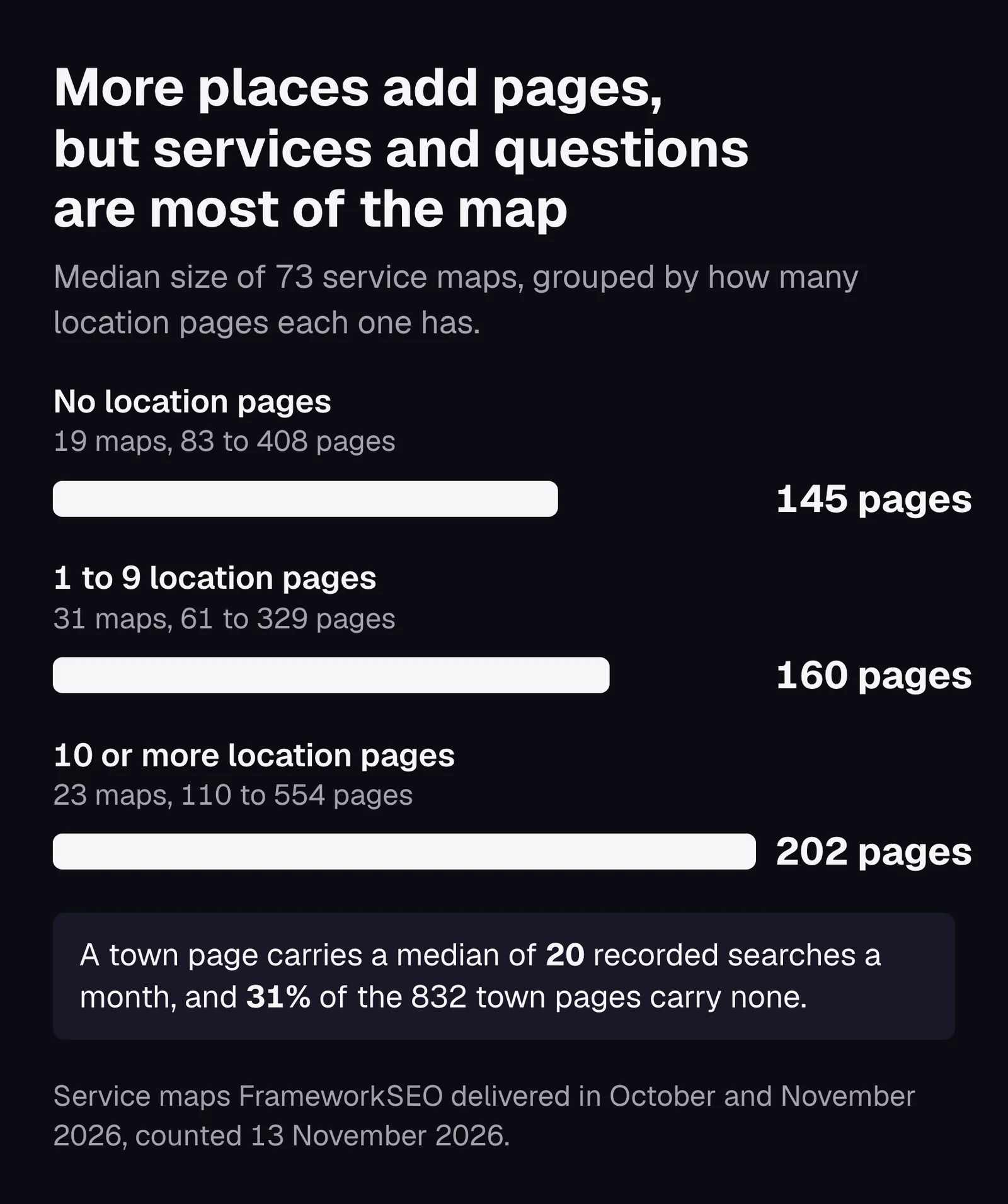
| Location pages in the map | Maps | Median size | Range |
|---|---|---|---|
| None | 19 | 145 pages | 83 to 408 |
| 1 to 9 | 31 | 160 pages | 61 to 329 |
| 10 or more | 23 | 202 pages | 110 to 554 |
The town pages themselves are small. Across the 832 location pages in those maps, the median carries 20 recorded searches a month, counting pages with no recorded volume as zero. 61% carry 50 or fewer, and 31% carry none. Among the 54 maps that have location pages, the middle one has 7.
What sets the size of a service map
- Services. Each service people search for is a page. A plumber with eight services and a restoration company with twenty start from different places.
- Questions per service. Water damage carries dozens of questions. A niche consulting service may carry six.
- Offices. Each staffed office with its own address is a location page, and often its own Business Profile.
- Towns with warrant. Only the towns that pass the test add pages. A one-town business needs no town pages at all: its homepage and service pages already carry the town.
We built our own system for this, which is how a map of about 159 pages takes us about 2 to 2.5 hours.
The mistakes we check for in service business maps
Three mistakes show up in the maps buyers build themselves. The pages do not build on each other. There are off-topic pages that do not deserve to be there when they could have been part of another post. And a query does not deserve its own page: many searches are a section of a page, not a page. On a service map, each of those has a local form, and these are what we check for:
- Town pages with only the name swapped. The doorway pattern. Run every town through the warrant test, and keep the rest as names on the service area page.
- Every service in every town. The grid of all combinations. Most cells have no searches and nothing local to say.
- Town pages published before the service pages. They link up to pages that do not exist yet.
- Question pages under town pages. A question true everywhere belongs under its service, not under one town.
- Question pages that feed nothing. A guide with no service to send readers to is a dead end. Give it one, or merge it into a page that has one.
- Homepage, About page and service pages competing. Give the homepage the main service in the main place, each service page one service, and the About page the company. The repair for pages that already compete is in keyword cannibalization.
- Pages for services you do not offer. Search volume is not a reason to promise a job you do not do.
- Invented local and legal figures. Permit fees, coverage percentages and response times that nobody checked.
- Off-topic blog posts. Any website that has worked with a bad agency before has a large share of off-topic posts, published because the retainer counted posts. Every page needs a purpose. Before deleting one, check whether it can be merged into a page that is more relevant; the method is in pruning, merging and updating.
A planning sheet you can keep for your service map
The sheet below holds the decisions in this lesson as columns. Each row is one page, with its type, its main search, the service it feeds, both warrants for a town page, the official source and its publish order. The real restoration rows are filled in, plus three made-up town rows that show a page, a standing room town and a merge.
Download the service map planning sheetCSV, one row per page: type, search, searches a month, section, feeds, user warrant, three local facts, publish order, official source, decision
How to fill it in
- List every service you sell and give each one a row of type "service".
- Add the homepage, the service area page, each staffed office, and the trust pages.
- For each town you serve, fill in the two warrant columns. A town with a "no" in either goes in the service area page's list, not on its own row.
- List the questions customers ask, from searches, calls and reviews. Give each one the single service it feeds.
- Add the official source for every rule, license or figure a page will state.
- Order the rows: homepage and services first, then the questions and the town pages that link to them.
If you sell products instead, the same logic runs with collections in place of service pages: see topical maps for ecommerce stores. And if you would rather have your service map built and checked for all of the above, that is the growth plan.
Common questions
Are location pages important for SEO?
Yes, when they carry facts true only for that place. An office page with its address, hours and staff helps customers and search engines. A town page with only the town name swapped sits close to what Google's spam policy calls doorway abuse and does not help.
Do service area businesses show up on Google Maps?
Yes. Google allows a service-area business one Business Profile for its central office with a designated service area, which should not extend farther than about 2 hours of driving time for most businesses, and it should hide its address if customers do not visit it.
How many location pages should a service business have?
As many as pass two tests: people search for the service in that town or ask you for it there, and you can write facts true only there (I look for at least three). In the 73 service maps we delivered in late 2026, the median map with location pages had 7, and 19 maps had none.
Sources
- How semantics and topical authority improve local SEO, Koray Tuğberk Gübür, Search Engine Land, 2026
- How to Expand a Topical Map for Higher Topical Authority?, Koray Tuğberk Gübür, Holistic SEO & Digital, 2023
- Literary warrant (version 2), Mario Barité, ISKO Encyclopedia of Knowledge Organization, 2026
- Spam policies for Google web search (doorway abuse), Google Search Central, 2026
- Bing Webmaster Guidelines, Microsoft Bing, 2026
- Tips to improve your local ranking on Google, Google Business Profile Help, 2026
- Guidelines for representing your business on Google, Google Business Profile Help, 2026
- QualityNsrNsrData (localityScore), Content Warehouse API documentation, hexdocs.pm copy of the leaked Google API documentation, 2024
- UPX0204, Ranking for Research (trial exhibit), U.S. Department of Justice, United States v. Google LLC, 2018
- A Brief Guide to Mold, Moisture and Your Home, U.S. Environmental Protection Agency, 2026
- Check a Contractor License or Home Improvement Salesperson Registration, Contractors State License Board, California, 2026
- TDLR License Data Search, Texas Department of Licensing and Regulation, 2026