Getting a topical map cited in AI answers
An AI answer citation is a link that an AI search feature, such as Google's AI Overviews or ChatGPT search, attaches to a source page that supports a part of its answer.
AI answers now sit above the blue links, and they quote a handful of pages. Here is what each engine documents about choosing those pages, what the studies on writing for them actually tested, the work a topical map does, the crawler rules, how to see your citations, and what being cited cost one store we worked with.

Key takeaways
- AI answer engines pull pages from a search index and show citations to source pages; Google documents the whole chain, and one of its patents links each part of a summary to the document that verifies that portion.
- The best-known study on writing for AI answers, the 2023 GEO paper, found that adding quotations, statistics and cited sources raised a page's share of a lab engine's answer by about 27 to 41%, but a 2025 benchmark found most such rewrites largely ineffective, and weaker still as more sites used them.
- A nicotine pouch store we worked with was quoted in 3 of 6 head-question AI Overviews in November 2026: the practical questions it answered best, while hospitals and health bodies took the health question and brands took the product lists.
- Blocking a training crawler such as GPTBot, ClaudeBot or Google-Extended does not remove a site from AI answers; blocking a search crawler, or its IP ranges at your CDN, does.
- Being cited is not being visited: the same store's click rate fell from 5.85% to 1.81% between its September 2024 peak and July 2025 while Google showed it more often, so judge the work on brand searches and sales.
How AI answers choose the pages they cite
AI answers retrieve pages from a search index, often after splitting the question into several searches. They then write the answer and attach a link to each part from a page that supports it. What differs by engine is whose index it searches, what makes a page eligible, and how a citation is shown.
How one question becomes several searches, and why a section can be matched on its own, is covered in semantic SEO in plain words. This lesson starts where that one stops: which page gets the link.
The three steps Google documents
Google's guide to generative AI features, last updated in July 2026, names the two techniques plainly. Retrieval-augmented generation, also called grounding, means the engine looks pages up first and writes the answer from them; Google's version relies "on our core Search ranking systems to retrieve relevant, up-to-date web pages from our Search index". Query fan-out is "a set of concurrent, related queries generated by the model". Google's own example turns "how to fix a lawn that's full of weeds" into "best herbicides for lawns", "remove weeds without chemicals" and "how to prevent weeds in lawn".
The third step is the one that decides citations. In a 2023 patent, US11769017B1, "Generative summaries for search results", Google describes attaching a source to each part of a generated summary. A source identifier beside a portion "can indicate that the SRD, corresponding to the source identifier, verifies the portion. As a result, a link to the SRD can be provided in conjunction with the portion." SRD is the patent's term for a search result document. A patent shows what Google invented, not what runs today. But it matches what you see on the page: a page is cited for the part of the answer one of its sentences can verify, not for being a good page in general.
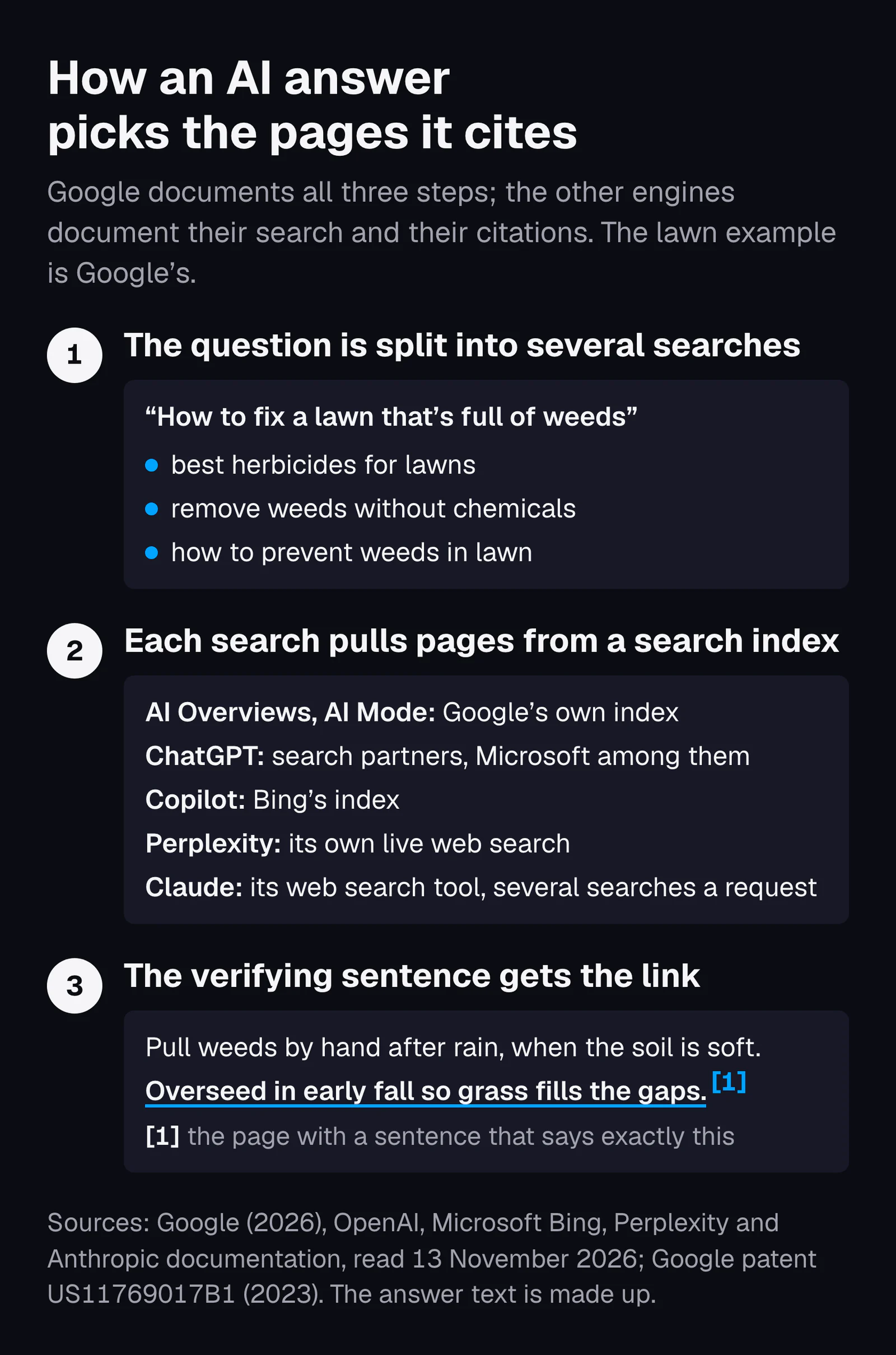
Two more Google patents describe the split in step one. "Search with stateful chat" (application filed February 2024) has a language model generate "synthetic queries" and select documents that respond to the query and to those synthetic queries. "Generating query variants using a trained generative model" (granted May 2023) does the same with query variants. Neither tells you how to make your page the one selected, and no engine publishes that.
What each engine documents about eligibility and citations
| Engine | Where it finds pages | What makes a page eligible | What a citation looks like |
|---|---|---|---|
| Google AI Overviews and AI Mode | Google's own search index | Indexed and "eligible to be shown in Google Search with a snippet"; "no additional technical requirements" | Links beside the answer; AI Overviews show only when Google judges them additive and "often don't trigger" |
| ChatGPT search | Third-party search providers, with Microsoft's privacy statement listed among them, plus content from partners | OAI-SearchBot allowed, and OpenAI's published IP ranges not blocked at the host or CDN | Citations and a Sources panel; "Placement is not guaranteed" |
| Microsoft Copilot | Bing's index: "the same core crawling, indexing, and ranking foundation as traditional search" | Indexed by Bing and not marked NOARCHIVE | Citations to grounding pages, reported to owners in Bing Webmaster Tools |
| Perplexity | Its own real-time web search | PerplexityBot allowed, with its IP ranges | "Each answer includes numbered citations linking to the original sources" |
| Claude | Its web search tool, which can run several searches in one request | Claude-SearchBot allowed for search indexing | Each citation carries a URL, a title and "Up to 150 characters of the cited content" |
Sources for the table: Google's AI features and your website, OpenAI's help page on web search and its October 2024 launch post, the Bing Webmaster Guidelines, Perplexity's help center and Anthropic's web search tool documentation, all read on 13 November 2026.
One thing follows from the second column. Copilot uses Bing's index, and ChatGPT search often sends its searches to a partner engine, so a page that is not indexed and ranking there is hard to find. Classic indexing is still the main way in.
What the studies on writing for AI answers actually tested
The studies that tested how to write for AI answers ran lab engines, not live ones, and a 2025 benchmark undercut the best-known one. Read each for its method before its number. How often AI Overviews cite pages outside the top 10, and why those overlap figures disagree, is in links, mentions and reputation.
| Study | What it tested | Finding | Weakness |
|---|---|---|---|
| GEO paper, Aggarwal and colleagues (Princeton and others), 2023, published at KDD 2024 | Nine rewrites of a source page, on the 1,000-query test split of a 10,000-query benchmark; an engine that read the top 5 Google results and answered with gpt-3.5-turbo; also tried on Perplexity with the sources uploaded as files | Adding quotations (27.2 against a 19.3 baseline), statistics (25.2) or cited sources (24.6) raised a page's share of the answer; keyword stuffing lowered it (17.7) | A lab engine on an older model with five sources; one page rewritten while the rest stayed the same; visibility counted as words in the answer, never clicks |
| C-SEO Bench, Puerto and colleagues, 2025 | The same kind of rewrites across six domains, with more and more sites adopting them at once | Most methods were "largely ineffective" and often hurt, even with one adopter; gains fell further as adopters rose; ranking the source higher worked better | A benchmark, not a live engine |
| Liu, Zhang and Liang, Stanford, 2023 | Whether four generative engines' citations support their sentences | "A mere 51.5% of generated sentences are fully supported by citations and only 74.5% of citations support their associated sentence" | Engines of early 2023 |
| Kirsten and colleagues, 2025 | Five generative search systems against Google results | Outputs "can vary across time and executions" | A snapshot of systems that change monthly |
| Pfrommer and colleagues, UC Berkeley, 2024 | Adversarial text added to product pages | The attack "reliably promotes low-ranked products" and transferred to perplexity.ai | Shows a weakness engines now ban, not a tactic |
The GEO paper is where the term generative engine optimization comes from. Its most quoted figure, a lift of up to 40%, is real for its lab. Its own Table 2 holds a detail most summaries leave out. Adding cited sources lifted a fifth-ranked source by 115.1% and cut a first-ranked one by 30.3%, so the effect depends on where a page starts. And an answer has room for only so many sources. C-SEO Bench tested what happens when many pages use the same rewrite at once: the gains shrank.
Three things survive every study. First, a page has to be retrieved before any wording can help, and ranking for the smaller searches is what gets it retrieved. Second, sentences with a named source, a quotation or a number are easier to use as evidence, which is why they helped in the lab. Third, answers move from run to run and citations are often wrong, so one check of one answer proves nothing.
Why a topical map fits the way AI answers are built
A topical map already lists the smaller questions an AI answer splits into, with one page assigned to each. So the engine finds a page built for each part of the answer. A map also tells you which of those questions your site can win, and which belong to someone else.
One page per question, not one per wording
Koray Tuğberk Gübür, who made the topical map a standard SEO deliverable from 2021, made the link to AI search in a September 2025 interview. A long question about loan repayment for divorced veterans over 40 with a serious illness has to be parsed "into overlapping contextual domains": repayment plans for veterans, for seniors, for people with urgent health needs, for divorced couples. In his words, "LLMs require structured semantic coverage to perform effective query expansion and fan-out, and Semantic Content Networks give them exactly that." His framework is laid out in Koray Tuğberk Gübür's topical map framework.
Google draws the line on the other side. Creating separate content for every variation people search, "for example, by focusing on other queries that people have asked, or fan-out queries", mainly to manipulate rankings or AI responses, "violates Google's scaled content abuse spam policy" (Google, 2026). So the map has to decide which smaller questions earn a page and which are a section on a bigger page. That call is the subject of when a search deserves its own page.
Which questions your site can win
On 13 November 2026 we checked six head-question searches for a nicotine pouch store we worked with, in the US on desktop. All six opened with an AI Overview. The store was quoted in three, while it ranked 10th or lower in the blue links under them.
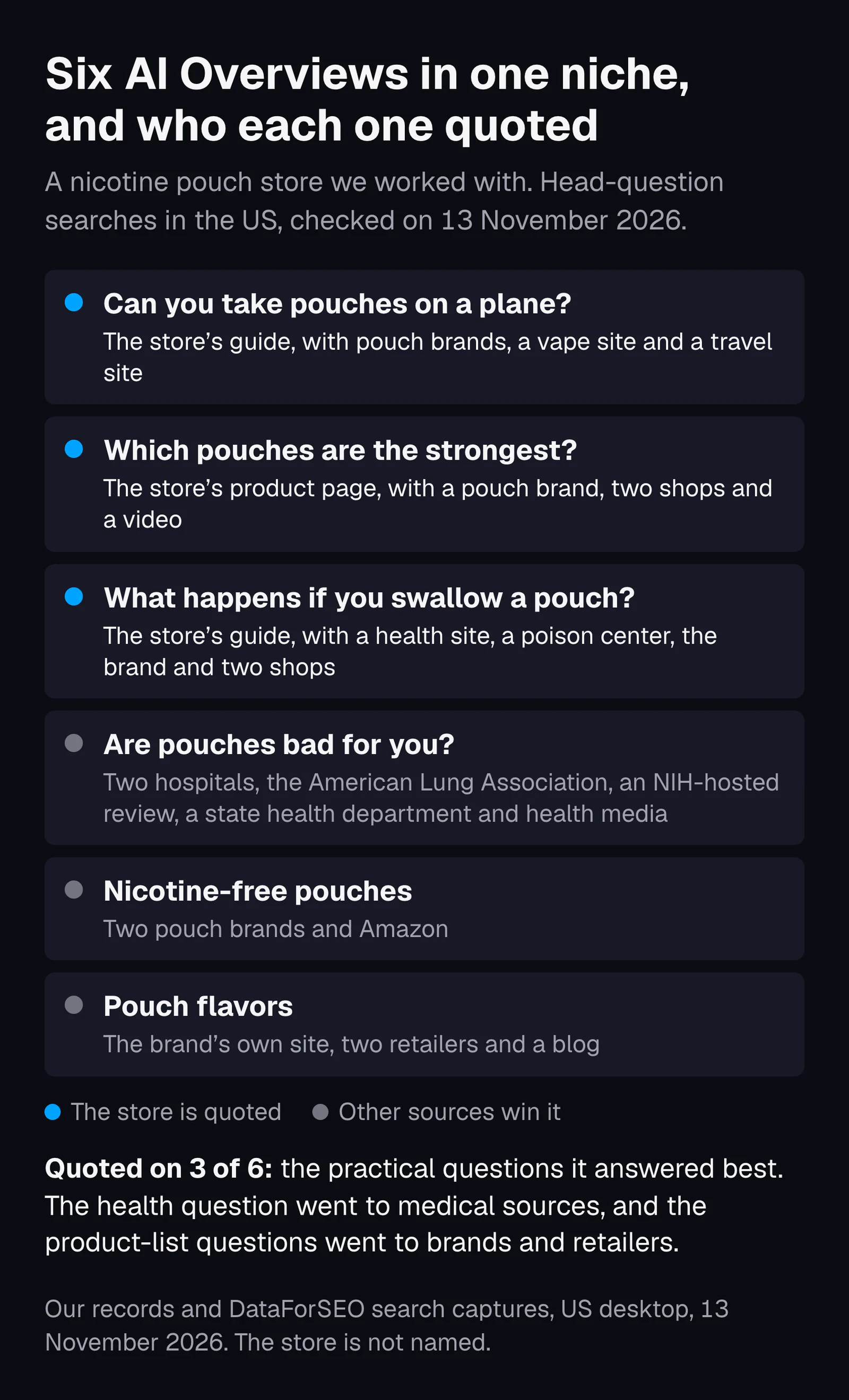
The three it won were practical questions it had answered better than anyone: taking pouches on a plane, which pouches are strongest, and what happens if you swallow one. One of the three citations went to a page that sells, the store's collection of its strongest pouches.
The three it lost went to a different kind of source. "Are pouches bad for you?" was answered from Houston Methodist, Michigan Medicine, the American Lung Association, a review hosted by the US National Institutes of Health and the Rhode Island Department of Health. No store appeared. The product-list questions, nicotine-free pouches and flavors, went to the brands themselves, Amazon and other retailers. Pew Research Center saw the same tilt in the March 2025 browsing of 900 US adults: .gov sites were 6% of the sources in AI summaries against 2% in standard results (Pew, 2025).
That gives every row of a map one more question: who is the natural source for this question? Where it is you, give the question one page, or one section, whose key sentence answers it outright. Where it is a hospital, a regulator or the manufacturer, still cover it for your readers, cite that source, and link onward to the page that sells. Do not build a page hoping to outrank the American Lung Association on health.
Building the map is a job of its own, laid out step by step across this library. If you would rather have it built for you, that is what the growth plan is.
How to write passages an AI answer can quote
Write the key fact of each section as one sentence that names its subject, makes one claim and says where the fact comes from. Then it still verifies the answer when it is quoted alone. That is a rule about sentences, not a reason to chop pages into small pieces.
Google is clear that the small-pieces advice is a myth for its engine. "There's no requirement to break your content into tiny pieces for AI to better understand it." It adds that you do not need to rewrite content "just for generative AI search", and that llms.txt files and other special markup are not used: "Google Search itself doesn't use them" (Google, 2026).
The other engines describe what they quote, and it is smaller than a section. Claude's web search citations carry at most 150 characters of the source, about one sentence. When Claude cites documents it is given, its citations documentation says the content is chunked into sentences, so it can "cite a single sentence". Bing's guideline 15 says pages "are more likely to be selected for grounding queries and citations when content stands on its own", with facts explicit and nothing resting on implied content. Put those beside Google's patent, which links a portion of the summary to the document that verifies it. They point the same way: what gets quoted is small, often one sentence, and it has to prove something on its own. That fits Google's advice too. You do not need small chunks; you need clear sentences inside a clear page.
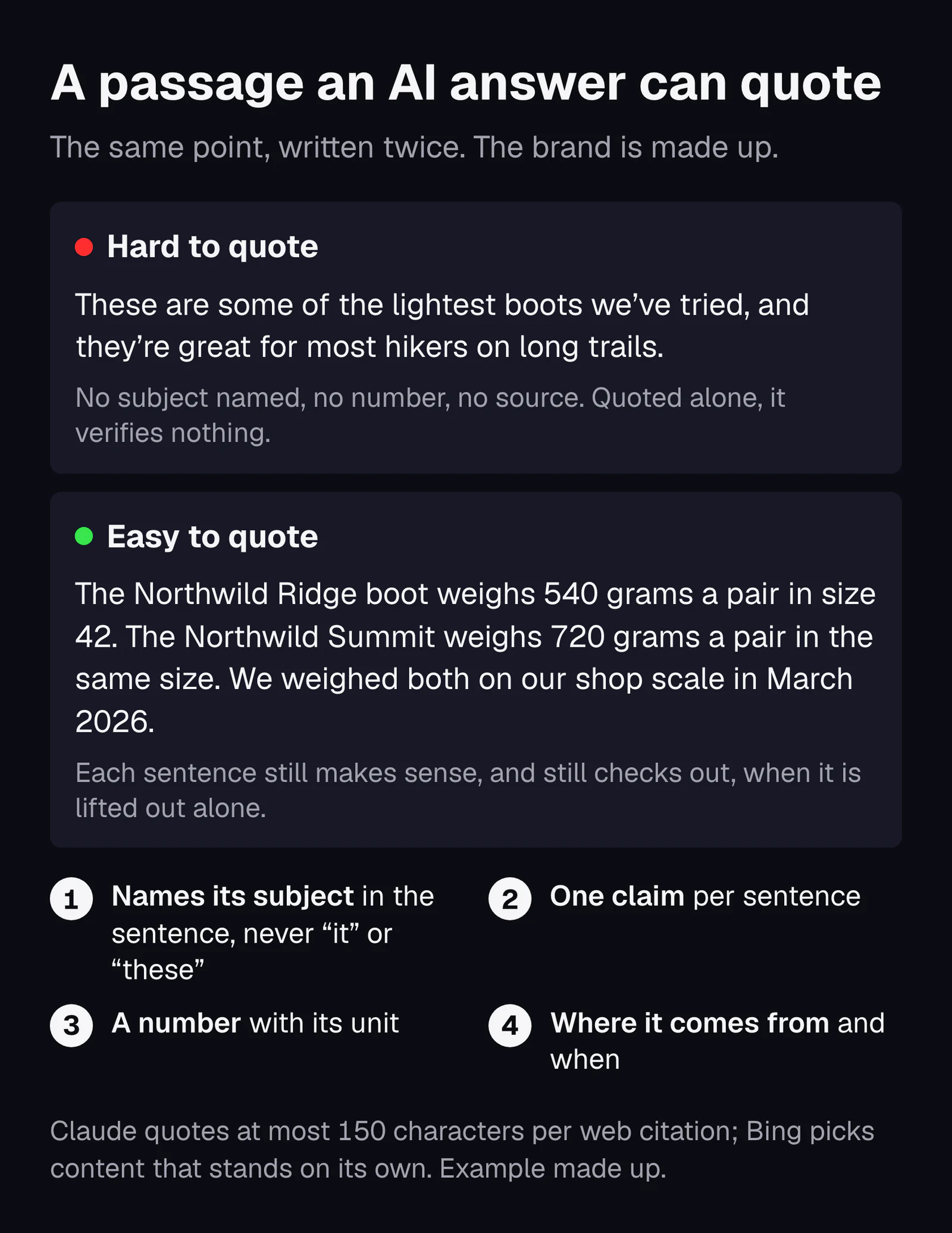
The four marks of a quotable sentence:
- It names its subject. "The Northwild Ridge boot weighs...", never "It weighs...". A quote that starts with "it" points at nothing.
- It makes one claim. Conditions and exceptions get their own sentence, so the engine can take the one it needs.
- It carries the number with its unit. "540 grams a pair in size 42", not "very light".
- It says where the fact comes from, and when. "Weighed on our shop scale in March 2026", or the named study and its year.
This is also why the GEO paper's three winning rewrites worked in the lab. Quotations, statistics and named sources are sentences that can verify something. And a fact only you hold, such as your own measurements, prices or results, is a sentence only you can be cited for. Finding those facts is the subject of information gain.
How to make the engines recognize the business behind the pages
Use one name for the business, say what it does in one plain sentence, and keep both the same everywhere they appear. Then earn mentions on other sites. AI answers lean on what others say about you more than on what you say about yourself.
- One name, spelled one way, on the site, the Google Business Profile, Bing Places and every social profile. Bing's guideline 16 asks for "clear and consistent naming for people, organizations, products, and locations".
- One sentence for what you do, on the homepage and the about page, in the same words. The decision behind it is covered in source context and central entity.
- Real people with real names on the about page and in bylines, so a quoted fact has someone behind it.
- Structured data that matches the page, or none. Google says structured data "isn't required for generative AI search, and there's no special schema.org markup you need to add". Bing says it may support grounding but "does not guarantee visibility".
The mentions matter more than the markup. A University of Toronto team found AI search shows "a systematic and overwhelming bias towards Earned media", pages about you on other people's sites, over brand-owned and social content (Chen and colleagues, 2025). Koray Tuğberk Gübür calls his version "Surround Sound": "a network of mentions, references, and declarations that confirm and reinforce each other" across the web. In his telling that includes corroboration pages a brand builds itself, which is where the line below matters. He also says plainly that links "will always remain fundamental".
There is a line here. Google warns that "seeking inauthentic 'mentions' across the web isn't as helpful as it might seem", and Bing lists link buying and "artificial social promotion schemes" as abuse. The only mentions worth having are ones you did not write: press, suppliers, partners, reviews, being quoted by others. How to earn them on a small site is in links, mentions and reputation, and why coverage and reputation work together is in topical authority.
Which crawlers to allow for each AI engine
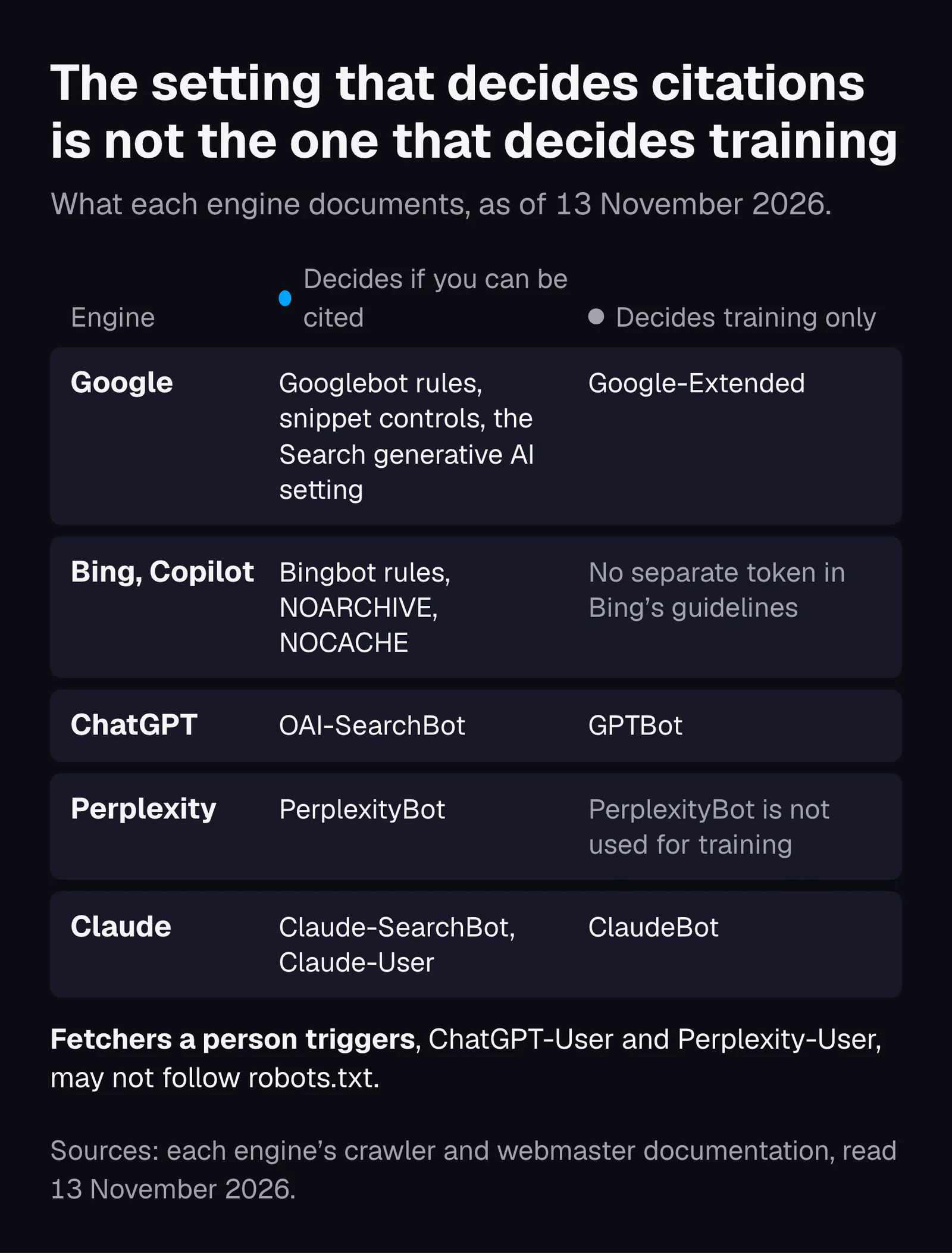
Allow each engine's search crawler if you want to be cited, and decide on its training crawler separately. Blocking a training crawler does not take you out of AI answers. Blocking a search crawler, or its IP ranges at your CDN, does.
| Engine | To be cited, allow | Training only | Also worth knowing |
|---|---|---|---|
| Googlebot in robots.txt, and the Search generative AI setting left on include | Google-Extended: Gemini training and grounding in Gemini Apps and Vertex AI; it "does not impact a site's inclusion in Google Search" | nosnippet, data-nosnippet, max-snippet and noindex limit what AI features show | |
| Bing and Copilot | Bingbot | No separate training token in Bing's guidelines | NOARCHIVE keeps a page out of Copilot answers; NOCACHE limits Copilot to the URL, title and snippet |
| ChatGPT | OAI-SearchBot, plus OpenAI's published IP ranges | GPTBot | ChatGPT-User acts for a person and "robots.txt rules may not apply"; changes take about 24 hours |
| Perplexity | PerplexityBot, plus its published IP ranges | None: PerplexityBot "is not used to crawl content for AI foundation models" | Perplexity-User "generally ignores robots.txt rules" because a person asked for the page |
| Claude | Claude-SearchBot for search; Claude-User for fetches a person asks for | ClaudeBot | Since 30 October 2026 Anthropic has begun recognizing an IETF-draft "no AI training" signal, rolling out over time; a robots.txt rule naming ClaudeBot wins over it |
Sources: Google's list of common crawlers (updated 30 October 2026) and AI features page, the Bing Webmaster Guidelines, OpenAI's crawler overview, Perplexity's crawler guide and Anthropic's crawler article, all read on 13 November 2026.
Google's new switch in Search Console
Since 31 August 2026 every Search Console property has a Search generative AI control under Settings. Include is the default. Exclude removes your links and your content from AI Overviews, AI Mode and Discover's AI features, including as grounding for the answer. Google says the setting "isn't used as a ranking or inclusion signal affecting other parts of Search", and that exclusion takes effect within a few days. Training is still governed by Google-Extended, not by this switch. If your AI Overview impressions are zero, check this setting before anything else.
The block you did not mean to make
Most accidental blocks happen outside robots.txt, at the CDN, the service that delivers your site to visitors, such as Cloudflare. Google tells owners to make sure crawling is allowed "by any CDN or hosting infrastructure". OpenAI and Perplexity both ask you to allow their published IP ranges, the lists of addresses their crawlers come from, and Perplexity gives firewall rules for Cloudflare and AWS. A bot-protection setting switched on at the CDN can refuse these crawlers while robots.txt still says yes. Check the firewall log, not only the file.
If you want to be cited but not trained on, the file carries groups like these:
User-agent: OAI-SearchBotthenAllow: /User-agent: GPTBotthenDisallow: /User-agent: Claude-SearchBotthenAllow: /User-agent: ClaudeBotthenDisallow: /User-agent: Google-ExtendedthenDisallow: /
Whether to allow training is a business choice, and the documentation does not say that it changes citations either way. Checking a robots.txt file and server logs with an AI assistant is shown in Claude Code for SEO.
Where to see your AI citations, and what nobody can measure
Search Console now shows how often your pages appear in AI Overviews and AI Mode, and Bing Webmaster Tools shows how often Copilot cites them and for which searches. For ChatGPT, Perplexity and Claude you check by hand, with a dated log. Some things cannot be measured at all.
Google: impressions in AI Overviews and AI Mode
Google rolled out the Generative AI performance report to all sites on 31 August 2026. It shows impressions, "how many times links to your site were shown to a user in a generative AI feature", by page, country, device and date, for AI Overviews and AI Mode. The help page describes impressions only, and we found no click figure for AI features on their own anywhere in Google's documentation. Google's AI features page says sites in AI features are reported inside the ordinary Web search type of the Performance report. If the report is missing, Google says your site has not had enough AI impressions, or it is excluded by the control above.
Bing: citations and the searches behind them
Bing Webmaster Tools added, as a preview, AI Performance in February 2026: total citations in Copilot and Bing's AI summaries, cited pages, and grounding queries, "the key phrases the AI used when retrieving content", shown as a sample. In a further preview in June 2026 it added Topics, Intents, Compare and Citation Share, your percentage of all citations for a grounding query. For a map, Topics is the useful one: it groups the searches behind your citations into themes, much as a map groups pages into sections.
ChatGPT, Perplexity and Claude: a dated log by hand
In the documentation we read on 13 November 2026, OpenAI, Perplexity and Anthropic describe their crawlers but offer site owners no citation report. So you check by hand, and you plan for answers that change. Kirsten and colleagues found generative search outputs "can vary across time and executions" (2025), so one look proves nothing.
- Take 20 to 30 questions from your map, one for each page you most want cited.
- Ask each one signed out, in a private window, in every engine you care about.
- Run each question three times on different days.
- Write down whether you were cited, which page, and which other sources the answer used.
- Repeat every month and compare the counts, never single answers.
Download the AI citation check logCSV template with one column per thing to record, and three made-up example rows to delete
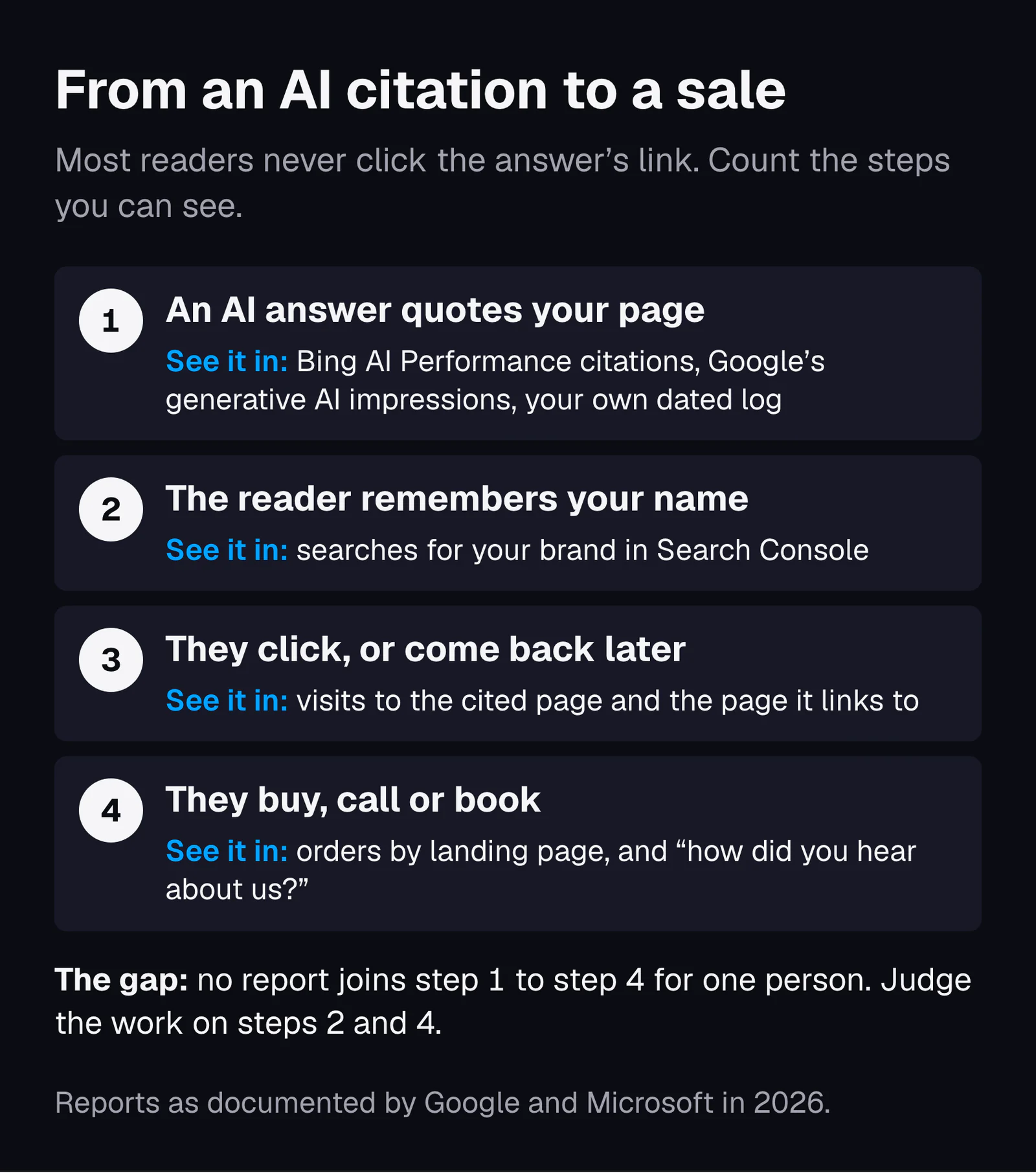
Clicks from AI apps show up in your analytics as referring sites, such as chatgpt.com or perplexity.ai. Count them, and count the sales they bring, not only the visits.
What nobody can measure
- Who read your quoted sentence and never clicked.
- Whether an answer that cited you recommended a competitor in the same breath.
- Clicks from Google's AI features on their own: we found no such figure in Google's documentation.
- What another person saw: answers change with location, history and the day.
- Any report at all for ChatGPT, Perplexity or Claude, as of November 2026.
Bing's guidelines put the consequence in one line: "A decline in clicks does not always indicate a loss of visibility." The monthly routine for reading these numbers next to rankings and sales is in how to tell if a topical map is working.
What being cited cost one store we worked with
A nicotine pouch store we worked with is still quoted in AI Overviews. Yet its clicks fell from a peak of 169,000 a month while Google showed it more often than ever. Being cited is not the same as being visited.
The dates matter here, and they correct a story we used to tell ourselves. Google started showing AI Overviews to everyone in the US from 14 May 2024. The store's clicks did not fall then. They held between 103,000 and 134,000 a month through the summer, then peaked at 169,000 in September 2024, on 2.89 million impressions, a click rate of 5.85%. The fall came from early 2025.
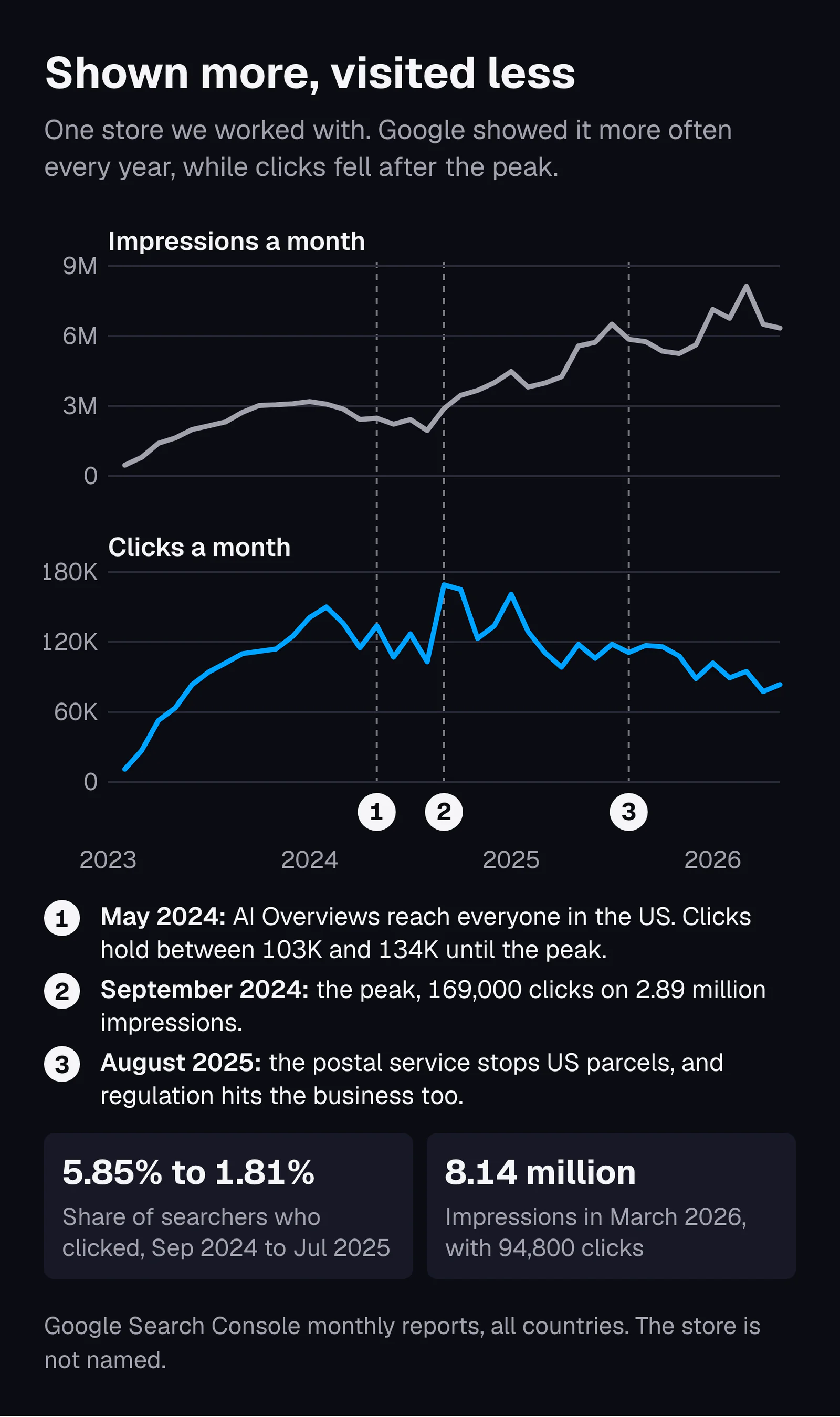
Through 2025 Google showed the store up to 6.5 million times a month, yet clicks settled between 106,000 and 118,000 from May to October. By July 2025 the click rate was 1.81%. When we looked at the pages in March 2025, our report to the client said a majority of the missing clicks came from AI Overviews, "Not a decrease in ranks". That was our judgment at the time, and we did not re-measure it. By March 2026 the gap was wider: 8.14 million impressions and 94,800 clicks.
Two other things happened in the same window, and an honest reading names them. The store's guides moved to new addresses in late 2024, which can cost clicks on its own. And from August 2025 the business was hit by things no map controls: the Nordic postal service stopped sending parcels to the US, while US import holds on unauthorized pouch brands and flavor-ban enforcement added pressure. So not every lost click went to an AI answer.
The AI part is still visible today. On 13 November 2026, 77 of the 100 biggest US searches the store ranks for showed an AI Overview, and it was quoted in 3 of the 6 head-question Overviews we checked. The impressions-and-click-rate reading of the same data is in how to tell if a topical map is working.
How to turn citations into customers when clicks fall
Make every cited page lead to a page that sells, give readers a name worth searching for, and judge the work on brand searches and sales rather than clicks from the answer.
Expect few clicks from the answer itself. In Pew's panel of 900 US adults, people clicked a link inside the AI summary in 1% of visits, and clicked any standard result in 8% of visits with a summary against 15% without (Pew, 2025). Being cited still beats being left out. Seer Interactive, an agency, tracked 3,119 informational searches for 42 client organizations: in the third quarter of 2025, organic click rate was 0.70% where the brand was cited in the AI Overview and 0.52% where it was not. Seer itself warns that citation may not cause the difference, since stronger brands get cited more.
Point every cited page at a page that sells
In a map, the informational pages that get quoted belong to the outer section, and the pages that earn money belong to the core. Each outer page should link to the core page it supports, in the body text, with the core page's name as the link. The split is explained in core section and outer section, and the linking rules in internal links in a topical map. Remember the store: one of its three citations went straight to a product collection.
Give the reader a name to search for
A reader who never clicks may still remember who said it. Put your business name in the page title and next to the facts you want quoted, and keep it the same everywhere. Koray Tuğberk Gübür calls brand search demand "one of the most evergreen insurances for staying relevant within any niche". You can see it grow: searches that contain your brand name in Search Console are a fair stand-in for people who met you in an answer.
Measure sales, not clicks
Report orders, calls and bookings by landing page, and add "an AI assistant, such as ChatGPT" as an option in your "how did you hear about us?" question. Google claims people who click from results pages with AI Overviews are "more likely to spend more time on the site". If that holds for you, it shows up as more sales per click, not more clicks.
What not to do: tactics that break the engines' rules
Do not hide text for bots, serve bots a different page, plant instructions for language models, mass-produce a page for every wording of a question, or buy fake mentions. Google and Bing both name these now, and they can cost you the rankings that citations depend on.
- Hidden text. Google's spam policies list "white text on a white background", text behind an image and "CSS to position text off-screen".
- Serving bots a different page. Google defines cloaking as "presenting different content to users and search engines with the intent to manipulate search rankings and mislead users", including text inserted only when the visitor is a crawler. Bing calls it manipulative.
- Instructions aimed at AI models. Bing's guidelines name "Prompt Injection and AI Manipulation", which "may result in reduced visibility or removal". Pfrommer and colleagues showed in 2024 why engines care: planted text "reliably promotes low-ranked products".
- A page per question wording. Google's scaled content abuse policy covers pages made for fan-out variations to manipulate AI responses.
- Fake mentions and bought links. Google says inauthentic mentions do not help; Bing lists link buying and private networks as abuse.
- Keyword stuffing. It lowered visibility in the GEO paper's tests and is on Bing's list of things to avoid.
Google's spam policies, updated in August 2026, now define spam as including "attempting to manipulate generative AI responses in Google Search".
The AI citation checklist
Keep this list next to your map and go through it for each page you want quoted.
Access
- Googlebot, Bingbot, OAI-SearchBot, PerplexityBot and Claude-SearchBot are allowed in robots.txt.
- The CDN and firewall let the same crawlers through, including OpenAI's and Perplexity's IP ranges.
- Search Console's Search generative AI setting is on include.
- No
NOARCHIVEon pages you want in Copilot, and nonosnippeton pages you want quoted. - Training crawlers are allowed or blocked on purpose, not by accident.
Pages
- Every question on the map has one page, or one section, that answers it.
- No extra pages made only for other wordings of the same question.
- For each question you have marked who the natural source is; where it is not you, you cite that source and link on.
- Every cited outer page links to the core page it supports.
Sentences
- Each section's answer is in its first sentences, not at the bottom.
- Key sentences name their subject, make one claim, carry the number and say where it comes from.
- At least one fact per page that only you can state, such as your own prices, measurements or results.
- Key facts are in the page text, not only in an image, a PDF or a video.
Name
- One business name and one sentence for what you do, the same on every profile.
- Real names on the about page and bylines.
- A plan for earning mentions you did not write.
Measurement and money
- Google's Generative AI performance report and Bing's AI Performance report checked monthly.
- A dated hand log for ChatGPT, Perplexity and Claude, three runs per question.
- Brand searches tracked in Search Console.
- Sales reported by landing page, with an AI option in "how did you hear about us?".
Common questions
Is generative engine optimization replacing SEO?
No. Google says its AI features are rooted in its core Search ranking and quality systems, and Bing says SEO fundamentals still apply to grounding and AI experiences. Bing adds that GEO does not guarantee grounding or citations. A page has to be indexed and ranking for the smaller searches before any wording can help.
How long does it take for a new page to be cited in AI answers?
At least as long as indexing takes. Google says a recrawl can take anywhere from several days to several months, Bing points to IndexNow for faster discovery, and OpenAI says robots.txt changes take about 24 hours to apply. After that, answers vary from run to run, so check over weeks, not days.
Sources
- Optimizing your website for generative AI features on Google Search, Google Search Central, 2026
- AI features and your website, Google Search Central, 2025
- List of Google's common crawlers, Google, 2026
- Search generative AI control, Google Search Console Help, 2026
- Generative AI performance report (Search), Google Search Console Help, 2026
- Introducing Search Generative AI performance reports in Search Console (3 June 2026), Google Search Central, 2026
- Spam policies for Google web search, Google Search Central, 2026
- Google I/O 2024: New generative AI experiences in Search, Google, 2024
- Generative summaries for search results (US11769017B1), Google LLC, 2023
- Search with stateful chat (US20240289407A1), Google LLC, 2024
- Generating query variants using a trained generative model (US11663201B2), Google LLC, 2023
- Searching the web with ChatGPT, OpenAI Help Center, 2026
- Introducing ChatGPT search, OpenAI, 2024
- Overview of OpenAI crawlers, OpenAI, 2026
- Bing Webmaster Guidelines, Microsoft Bing, 2026
- Introducing AI Performance in Bing Webmaster Tools (public preview), Microsoft Bing, 2026
- New AI Visibility Insights in Bing Webmaster Tools: Intents, Topics, Citation Share, Compare, Microsoft Bing, 2026
- How does Perplexity work?, Perplexity Help Center, 2026
- Perplexity crawlers, Perplexity, 2026
- Does Anthropic crawl data from the web, and how can site owners block the crawler?, Anthropic, 2026
- Web search tool, Anthropic, 2026
- Citations, Anthropic, 2026
- GEO: Generative Engine Optimization, Aggarwal, Murahari, Rajpurohit, Kalyan, Narasimhan, Deshpande (KDD 2024), 2023
- C-SEO Bench: Does Conversational SEO Work?, Puerto, Gubri, Green, Oh, Yun, 2025
- Generative Engine Optimization: How to Dominate AI Search, Chen, Wang, Chen, Koudas (University of Toronto), 2025
- Evaluating Verifiability in Generative Search Engines, Liu, Zhang, Liang (Stanford), 2023
- Characterizing Web Search in The Age of Generative AI, Kirsten, Grosse Perdekamp, Wu, Upadhyay, Gummadi, Zafar, 2025
- Ranking Manipulation for Conversational Search Engines, Pfrommer, Bai, Gautam, Sojoudi (UC Berkeley), 2024
- Google users are less likely to click on links when an AI summary appears in the results, Pew Research Center, 2025
- Thoughts on AI Search and AI-based SEO, Medium (Koray Tuğberk Gübür), 2025