Koray Tuğberk Gübür's topical map framework, in plain words
Koray Tuğberk Gübür's topical map framework is a method for planning every page a website needs on its subject, starting from why the site exists, split into pages that sell and pages that build trust, and linked so a search engine can trust the site on that subject.
Koray Tuğberk Gübür gave SEO the words topical map and topical authority. Here is his framework in plain English: who he is, every term with its source and year, how the parts fit, his formula in each version, his own numbers, and which parts a search engine has actually confirmed.

Key takeaways
- Koray Tuğberk Gübür put topical authority and the topical map into SEO's vocabulary with a case study on Oncrawl in February 2021, built on a site he reports growing from 10,000 to over 200,000 monthly clicks in five months.
- Every Koray topical map starts from five decisions: why the site exists (source context), what it is about (central entity), what visitors come to do (central search intent), the pages that sell (core section) and the pages that build trust over time (outer section).
- His formula has changed: topical coverage times historical data in 2021, and in 2026 that product divided by cost of retrieval and read through visual semantics.
- A Microsoft patent application published on 7 January 2021, five weeks before his case study, also defines topical authority as a product, of links, clicks and the share of a site's pages on the topic, so the engine text rewards focus where his formula rewards completeness.
- Koray himself warns that no tool can measure topical authority and that an AI-generated list of subtopics is not a topical map.
Who Koray Tuğberk Gübür is, and where the framework came from
Koray Tuğberk Gübür is an SEO consultant and the founder of the agency Holistic SEO & Digital. In February 2021 he published a case study on Oncrawl, Importance of Topical Authority, that put the topical map and topical authority into the SEO industry's everyday vocabulary.
His own account of how he got there is short. He started in SEO in 2015, in the casino industry, per the author box on his articles. On 1 August 2018, Google's Medic update hit that casino network. "We lost 3,000 websites," he told Sitechecker in a 2023 interview. After that he started reading Google patents and research papers, and he says he has used topical maps in his projects since 2018.
He credits the late Bill Slawski, who wrote about Google patents for many years, for teaching him to read them. In the 2021 case study he calls Slawski "our educator", and his July 2022 Oncrawl article opens "In memory of Bill Slawski".
The name stuck to the idea. When we searched "topical authority" in the US on 12 November 2026, the knowledge panel beside Google's results was about him, not a definition. He wrote three articles for Search Engine Land in 2026, and he sells a course on the method. This lesson uses only his free, public articles. Where a term is defined only in his course, I say so.
I learned this framework from Koray's work, and the way we build maps at FrameworkSEO builds on it. That is the reason for this page: every other lesson in this library links here when it uses one of his words.
What a topical map is in Koray's framework
In Koray's framework, a topical map is the full plan of the pages a site needs on its subject. It is chosen from why the site exists, linked in a set order, and finished before the first article is written. The pages, headings and links built from that plan are a separate thing, which he calls the semantic content network.
That order is his first instruction. Step 1 of the February 2021 case study reads: "Create a Topical Map Before Starting Publishing the First Article." Most guides sort a map out of a keyword export. In his method the map comes first, and the searches follow from it. The general idea of a map, without his terms, is in What is a topical map?.
His quick inputs in 2021 were five, in this order:
- Crawl competitors' sitemaps to see their topical maps.
- Pull related queries and related topics from Google Trends.
- Collect autocomplete and search suggestions.
- Notice how competitors connect their hub pages.
- Use Google's Knowledge Graph to pull the related entities, the named things a topic is made of.
He added a line no page ranking for his name today repeats: "Also use other search engines. I especially recommend you check Swisscows to understand a semantic search engine's nature. Do not solely focus on Google to understand semantic search."
By 2024 the term had become a product category, and he pushed back. In 3 Suggestions about Topical Authority (5 February 2024) he wrote: "Do not believe auto-generated topical maps." And: "Asking ChatGPT for 20 types of X won't give you a topical map about X." In June 2024 he added that "creating a topical map is not merely listing keywords or entities".
The five decisions every Koray topical map starts from
Every Koray topical map starts from five decisions: why the site exists (source context), the one thing it is about (central entity), what visitors come to do (central search intent), the pages that sell (core section) and the pages that build trust over time (outer section). He lists the five by name in a 2025 LinkedIn post on the outer section.
| Decision | The plain question | Where he defines it | Our site's answer |
|---|---|---|---|
| Source context | Why does this site exist, and how does it earn? | His public 2023 article, word for word | We sell growth plans: the pages a business needs, in the order to publish them |
| Central entity | What is every page on this site about? | Fully defined in his course only; public advice in 2024 | The topical map (ours is called a growth plan) |
| Central search intent | What do visitors come here to do? | Course only | Plan the pages a business needs to grow from search |
| Core section | Which pages sell? | His 2025 LinkedIn post | The growth plan offer |
| Outer section | Which pages build trust and history around the sale? | His 2025 LinkedIn post | This lesson library: 32 lessons on topical maps, semantic SEO and Claude for SEO |
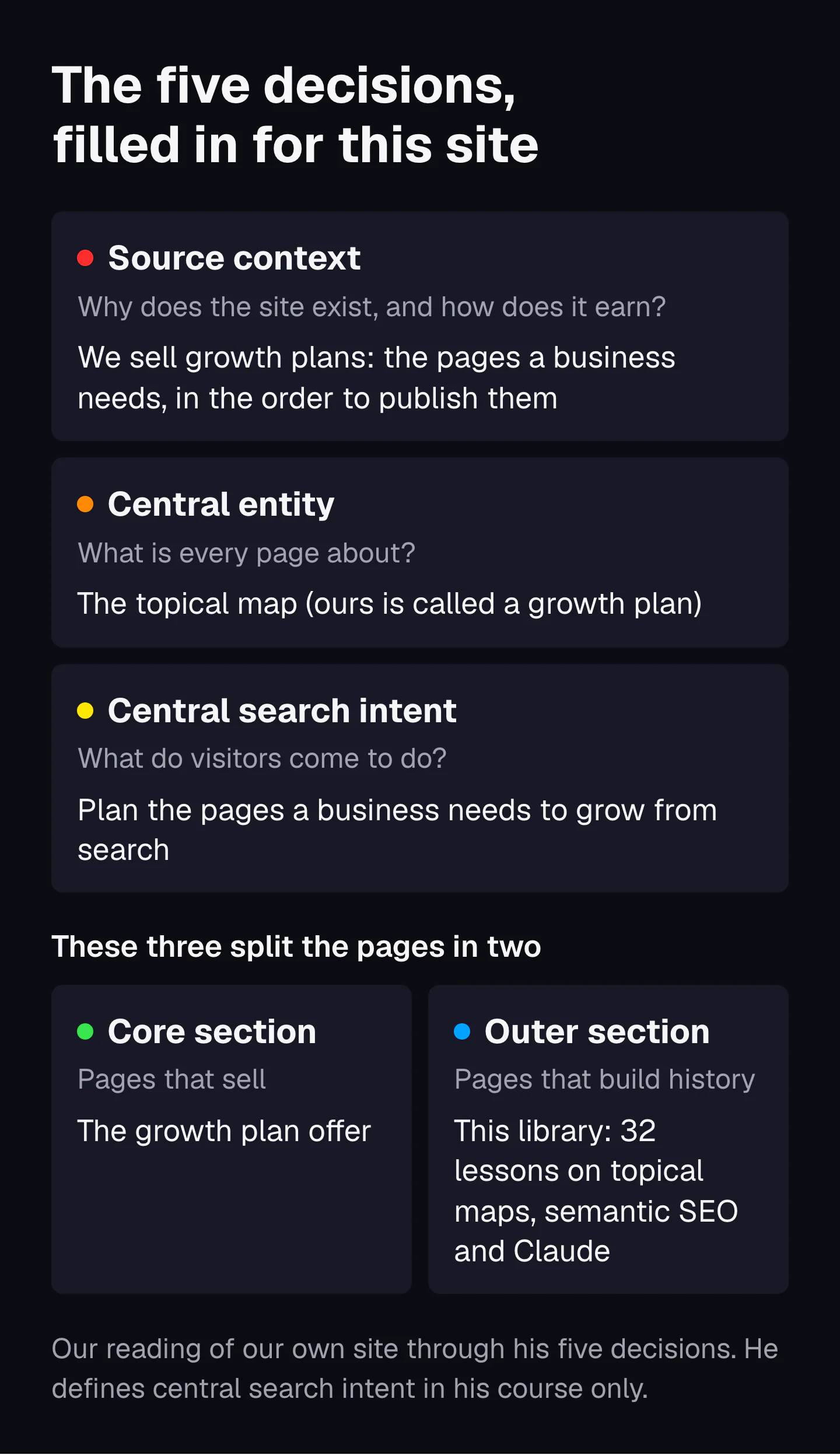
Source context: why the site exists
Source context is the reason the site exists and how it makes money, and it decides the angle of every page. His 2023 definition, in How to Expand a Topical Map for Higher Topical Authority?: "Source Context is the perspective and function of the website and the brand on the open web that involves monetization, and existing purpose."
His example: the question "what is an electronic bicycle" should be answered differently by a site about electric cars, one about renewable energy and one about engineering. The definition, the internal links and the angle all change with the site. The same article says source context decides "the topical map's core and outer sections".
Central entity and central search intent: what the site is about, and what visitors do
The central entity is the one subject every page of the site is about. His public articles say his full definition is taught in the course; his 2023 article on entities and attributes says the concepts of central entities are "explained in the Semantic SEO Course". His public advice that matches it, from February 2024: "Reflect the overall topicality of your source site-wide with universal elements such as footer, header, sidebar, and company definitions."
The central search intent is defined only in the course. His course describes it, in notes students have published, as the union of the source context and the central entity, written as a verb and a noun. For our site that reads: plan the pages a business needs.
Core section and outer section: the pages that sell, and the pages that build history
The core section holds the pages closest to the sale, where he says the money is made and ranking signals gather. The outer section holds the topics further from the sale but still connected, which earn the impressions and clicks that become the site's history. The split, and how to draw it, has its own lesson: core section and outer section. The first three decisions are covered in depth in source context, central entity and central search intent.
How the parts of the framework fit together
The parts fit in one order, and each depends on the one before it. The reason the site exists sets what the site is about and what visitors do. Those split the map into a core and an outer section. Each page then gets its angle, headings and links. The pages go live in batches, and the search engine judges them over time.
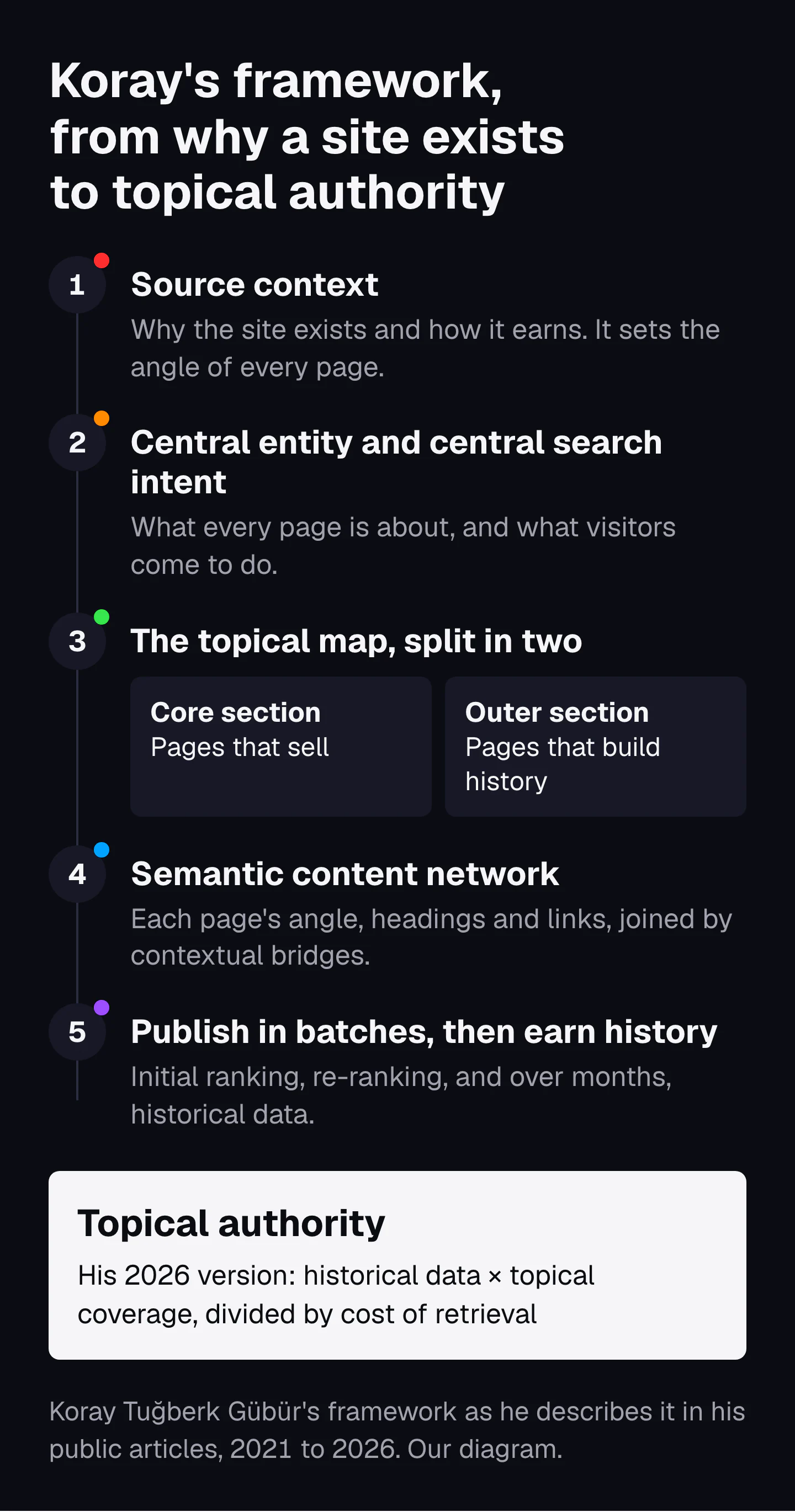
Koray calls the built version a semantic content network. In his January 2022 Oncrawl case study it is "the sum of topical map, and individual content designs that include all of the headings, questions, heading levels, anchor texts, content hierarchy, and positions within the site-tree". The map decides which pages exist. The network decides what each page says and how it links. That step has its own lesson: semantic content networks.
Publishing is part of his method, not an afterthought. He launches networks in batches. On one education site in that case study, two networks went live between May and September 2021. Then the engine does two things he names. The initial ranking is "the rank of a document on the SERP immediately after being indexed". The re-ranking is the engine moving pages "based on the feedback of the users, or relevance, and quality evaluation algorithms". Over months, that record becomes historical data, the second half of his formula.
A decision lower in the chain cannot fix one above it. Good headings do not rescue a page in the wrong section. A complete map does not rescue a site whose reason to exist points somewhere else. His own words, from February 2024: "If your source context is irrelevant to your topic, the high authority references, whether links or linkless mentions, won't bring you closer to your industry's central query networks."
Koray's vocabulary in plain words, with the source for each term
Koray's vocabulary is easier to learn sorted by when you need it: terms for planning the map, terms for writing each page, and terms for what the search engine does after you publish. Each term below has one plain sentence and the article where he uses it, with the year.
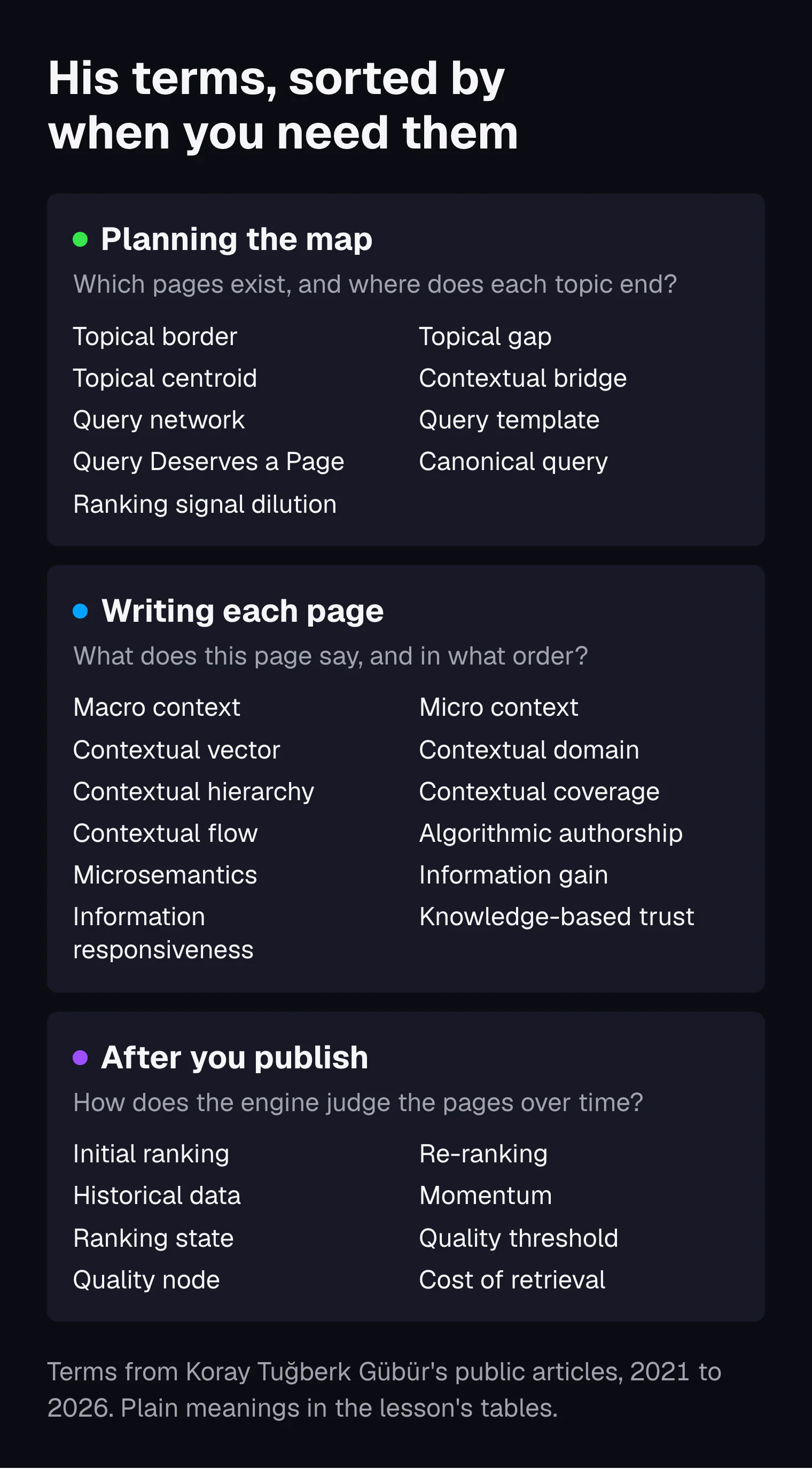
Terms for planning the map
| Term | In plain words | His source |
|---|---|---|
| Topical border | Where one topic ends and the next begins, so two pages do not cover the same ground. | Named in the 2021 case study; semantic search article, 2023 |
| Topical gap | "A contextual disconnectedness between different topics": a missing link of meaning in your map, and the place to expand. | How to Expand a Topical Map, 2023 |
| Topical centroid | A key concept other concepts are explained from, such as interest formulas on a mortgage site. | How to Expand a Topical Map, 2023 |
| Contextual bridge | The shared idea that justifies a link between pages on two different subtopics. He writes that without one, internal links "can't pass relevance". | How to Expand a Topical Map, 2023; Majestic interview, 2021 |
| Query network | All the searches around a topic and how they connect to each other. | Quality thresholds case study, 2022 |
| Query template | A search pattern that repeats with one part swapped, such as "can X cause addiction". | Semantic content networks case study, 2022; Search Engine Land, 2026 |
| Query Deserves a Page (QDP) | His test for whether a search gets its own page: high demand, different entities, low similarity and a pattern. If not, it is a section on another page. | Search Engine Land, 2026 |
| Canonical query | The one wording that best sums up the many ways people ask for the same thing. | Topical authority page, 2021 |
| Ranking signal dilution | Two of your pages competing for the same need, so both are weaker. It is the cause of cannibalization. | Topical authority page, 2021 |
QDP is the most useful of these for a beginner, because deciding page or section is the hardest call in any map. It has its own lesson: when a search deserves its own page. Gaps and bridges are how a map grows after launch, covered in expanding a topical map, and bridges are the rule behind internal links in a topical map.
Terms for writing each page
| Term | In plain words | His source |
|---|---|---|
| Macro context | The one main focus of a page. | Lexical semantics article, 2022 |
| Micro context | The smaller angles inside that page. In his words, "a macro context can have multiple micro contexts within it". | Lexical semantics article, 2022 |
| Contextual vector | The angle a page takes. His example: "earthquake" is the topic, "comparing earthquakes" is one angle. | Oncrawl case study, 2021 |
| Contextual domain | All the angles you get by adding one or two words to a term. | Search Engine Land, 2026 |
| Contextual hierarchy | Which angle sits inside which, from broad to narrow. | Topical authority page, 2021 |
| Contextual coverage | How many angles of one concept a page handles, as opposed to how many topics a site covers. | Semantic content networks case study, 2022 |
| Contextual flow | The order of ideas inside a page, built around the verbs so the meaning carries forward. | Semantic search article, 2023 |
| Algorithmic authorship | A fixed set of writing rules so every writer produces the same clear, fact-first structure. | Entities and attributes article, 2023 |
| Microsemantics | The small choices: word order, sentence form, which fact comes first. | How to Expand a Topical Map, 2023; Search Engine Land, 2026 |
| Information gain | What a page adds beyond the pages the reader has already seen. He took it from a Google patent. | Oncrawl case study, 2021; topical authority page, 2021 |
| Information responsiveness | Answering every likely form of a need, not only the exact search. | Sitechecker interview, 2023 |
| Knowledge-based trust | Being trusted for accurate facts rather than for links. He credits Google researcher Luna Dong, whose 2015 paper named the idea. | Semantic content networks case study, 2022 |
Information gain has its own lesson, information gain, because the patent behind it says less than SEO folklore claims. One link here is mine, not his. His query templates are the planning side of what Google's AI Mode posts call query fan-out, where one question is split into many searches. A map that covers a template's variations already has pages for the searches the engine fans out to. More on fan-out in semantic SEO in plain words.
Terms for what happens after you publish
| Term | In plain words | His source |
|---|---|---|
| Initial ranking | Where a new page lands right after it is indexed. | Semantic content networks case study, 2022 |
| Re-ranking | The engine moving pages up or down once it sees how they perform. | Semantic content networks case study, 2022 |
| Historical data | In 2021, how long you have covered the topic at a certain level. By 2023, how well searchers responded over time. | Oncrawl case study, 2021; How to Expand a Topical Map, 2023 |
| Momentum | Keeping a steady publishing pace. Of one site that stopped, he wrote that "momentum is lost". | Semantic search article, 2023 |
| Ranking state | Whether the engine treats your whole site as rankable for a topic right now. | Medium, March 2024 |
| Quality threshold | The bar a page must clear, set by the best and the weakest results already ranking. | Quality thresholds case study, 2022 |
| Quality node | A few of your strongest pages, linked from the homepage, which he says change how the engine judges the whole site. | Medium, March 2024 |
| Cost of retrieval | What it costs a search engine to crawl, understand, store and serve your pages, against their value. | Reboot Online interview, 2022 |
Cost of retrieval is now inside his formula, so it has its own lesson: cost of retrieval. Initial ranking and re-ranking explain why a new group of pages can jump and then drop before it settles, which is how we tell whether a map is working.
Download the Koray glossaryCSV for Google Sheets or Excel. 37 terms, one row each: the stage, the plain meaning, his wording or the closest public source, the article and its year, and whether the definition is public or course only.
The topical authority formula, version by version
Koray's topical authority formula has three published versions. In February 2021 it was topical coverage times historical data. An undated bio on his course site writes the same two terms with a plus sign. In 2026 it is historical data times topical coverage, divided by cost of retrieval, and "interpreted with visual semantics".
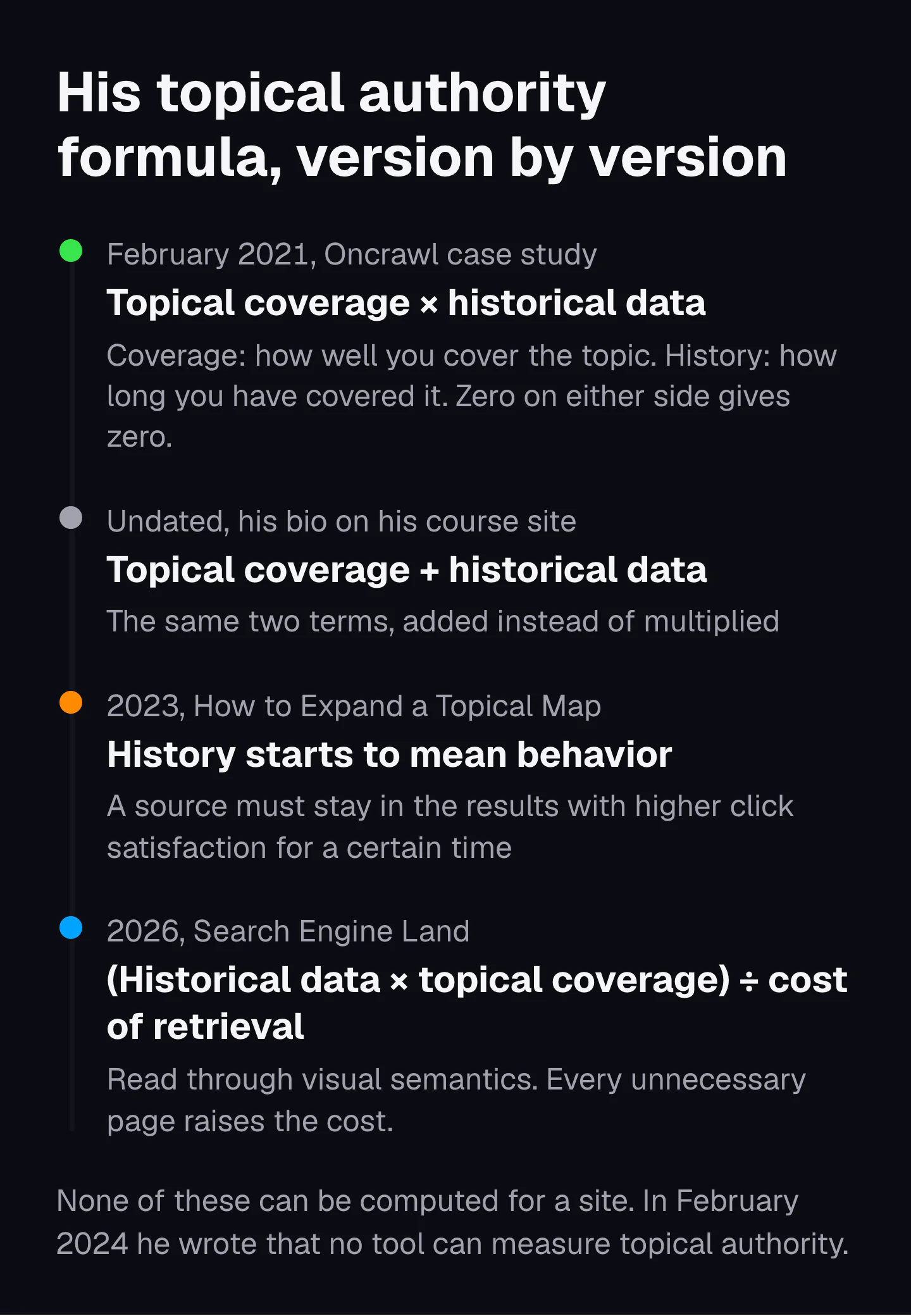
In the 2021 case study he defined both terms. Topical coverage "means how well you cover" the graph of connected topics. Historical data "refers to how long you have been covering this topical graph at a certain level." Then: "Topical Authority = Topical Coverage * Historical Data." Multiplying is the point. Zero on either side gives zero, however big the other side is.
The 2026 version adds two ideas. The first is cost of retrieval, which he defined in 2022 as "the ratio of the cost experienced during crawling, understanding, evaluating, indexing, ranking, and serving, and the value obtained afterwards". It divides, so needless pages make authority smaller. The same 2026 article says it plainly: "every unnecessary page increases the cost of retrieval."
The second is visual semantics: the layout carries meaning too. In one 2026 case he made 19 changes on a converter site. The biggest gain, he reports, came from moving a calculator from the bottom of the page to the top.
"Historical data" changed meaning along the way. In 2021 it is time spent covering the topic. By 2023 he writes that a source "needs to stay in the results with higher click satisfaction for a certain amount of time". Time became behavior: history now means how searchers responded, not only how long you were there. The lesson on cost of retrieval shows what the new divisor changes on a real map.
His published case studies and the numbers he reports
Koray has published case studies since 2021 with large reported gains. One site went from 10,000 to over 200,000 monthly clicks in five months; another gained over 1 million extra clicks in three months. These are his numbers, from his own Search Console, Ahrefs and Semrush screenshots, with no control site.
| Year | Site | What was done | Result he reports | Where |
|---|---|---|---|---|
| 2021 | Interingilizce.com, English learning | A new network of pages on the subject | 10,000 to 200,000+ monthly clicks in 5 months | Oncrawl, Feb 2021 |
| 2021 | GetWordly.com, a new domain | The same method | 0 to 330,000 monthly clicks, 11,000 a day, in 6 months | Oncrawl, Feb 2021 |
| 2021 | Unnamed, Azerbaijan only | The same method | 10,000 to 70,000 monthly (600%) in 5 months | Oncrawl, Feb 2021 |
| 2021 | Unnamed, Arabic-speaking countries | The same method, with less of his time | 400% growth | Oncrawl, Feb 2021 |
| 2021 | IstanbulBogaziciEnstitu.com, education | Two semantic content networks, May to Sep 2021 | "From 1400 daily clicks to 140000 clicks, and then a regular 10.000+ clicks per day" | Oncrawl, Jan 2022 |
| 2021 | Vizem.net, visa applications | Networks built country by country | 0 to 9,000+ daily clicks in 6 months | Oncrawl, Jan 2022 |
| 2022 | Unnamed health store | 27 articles | In 30 days: 20,000 new queries, 847% more impressions, 142% more clicks | Oncrawl, Jul 2022 |
| 2023 | Kanbanize.com, software | A topical map for a software company | 245%+ clicks, 39,000 more ranking queries | His 2023 article |
| 2023 | Encazip.com, energy price comparison | An energy map, then bridges into credit and insurance | 5,150%+ clicks, 45,000+ more ranking queries | His 2023 article |
| 2023 | Complaintsboard.com, over 5 million URLs | Merging pages, then noindexing and removing the rest | 320%+ clicks, 413,000+ more ranking queries | His 2023 article |
| 2023 | BKMKitap.com, books | Authors and genres as entities, bridged to the shop pages | 750,000 to 3,200,000 or 3,900,000 clicks (the article gives both) | His 2023 article |
| 2024 | Lexinter.net, law | A technical sprint, then a new network | 120% growth in 4 months | Medium, Mar 2024 |
| 2026 | A QR code generator | Microsemantic changes, technical fixes, a new CMS | 1 million+ extra clicks in 3 months | Search Engine Land, 2026 |
| 2026 | A converter site | 19 changes; the calculator moved to the top | 3.47 million to 4.53 million clicks (+30.5%) | Search Engine Land, 2026 |
For maps you can open row by row, see topical map examples.
What search engines have confirmed and what is his interpretation
No search engine has confirmed Koray's framework. Google confirms parts of the idea in its own words: a site should have a primary focus, and Google runs a topic authority system for news. A Microsoft patent and a 2024 Google leak describe measuring a site's focus on a topic. The rest is his model, built from patents and his own tests.
| The idea | Who said it, and when | What kind of evidence |
|---|---|---|
| A site should have one main purpose (close to his source context) | Google's helpful content guidance: "Does your site have a primary purpose or focus?" | Google's own advice. Not a named ranking system |
| A history on a topic earns trust on it (close to his historical data) | Google, 23 May 2023: its topic authority system looks at "a source's history of high-quality reporting" | A confirmed system, for news only |
| Engines measure how focused a site is | Google's leaked documents, 2024: siteFocusScore and siteRadius | The fields exist. Their weight and use are unknown |
| Topical authority as a score per site and per topic | Microsoft patent, published 2021, granted 2024 | A patent: an idea written down, not proof of use |
| Pages ranked by what they add (information gain) | Google patent, granted 2022 | A patent, framed around automated assistants |
| Coverage times history, cost of retrieval, core and outer sections, quality nodes | Koray, 2021 to 2026 | His model, from patents and his own case studies |
The Microsoft patent that defined topical authority five weeks before he did
Microsoft filed a patent application in July 2019 that defines a website's "topical authority" on a topic. It was published on 7 January 2021 as US20210004416A1, five weeks before Koray's Oncrawl case study. It was granted on 16 January 2024. I found no sign that either side knew of the other.
Its baseline model is a product, like his. It multiplies three things: the site's rank from links, the clicks the site gets, and "topic purity", defined as "the percentage of pages within the site s that are tagged with topic t". Topic purity is squared, so it counts twice. An improved version also multiplies by the logarithm of the site's page count. On a log scale, growing from 100 to 200 pages adds the same bonus as growing from 1,000 to 2,000. The click counts can come from "Bing's anonymized traffic log", and the granted claims give one site "multiple topical authority scores" for different topics.
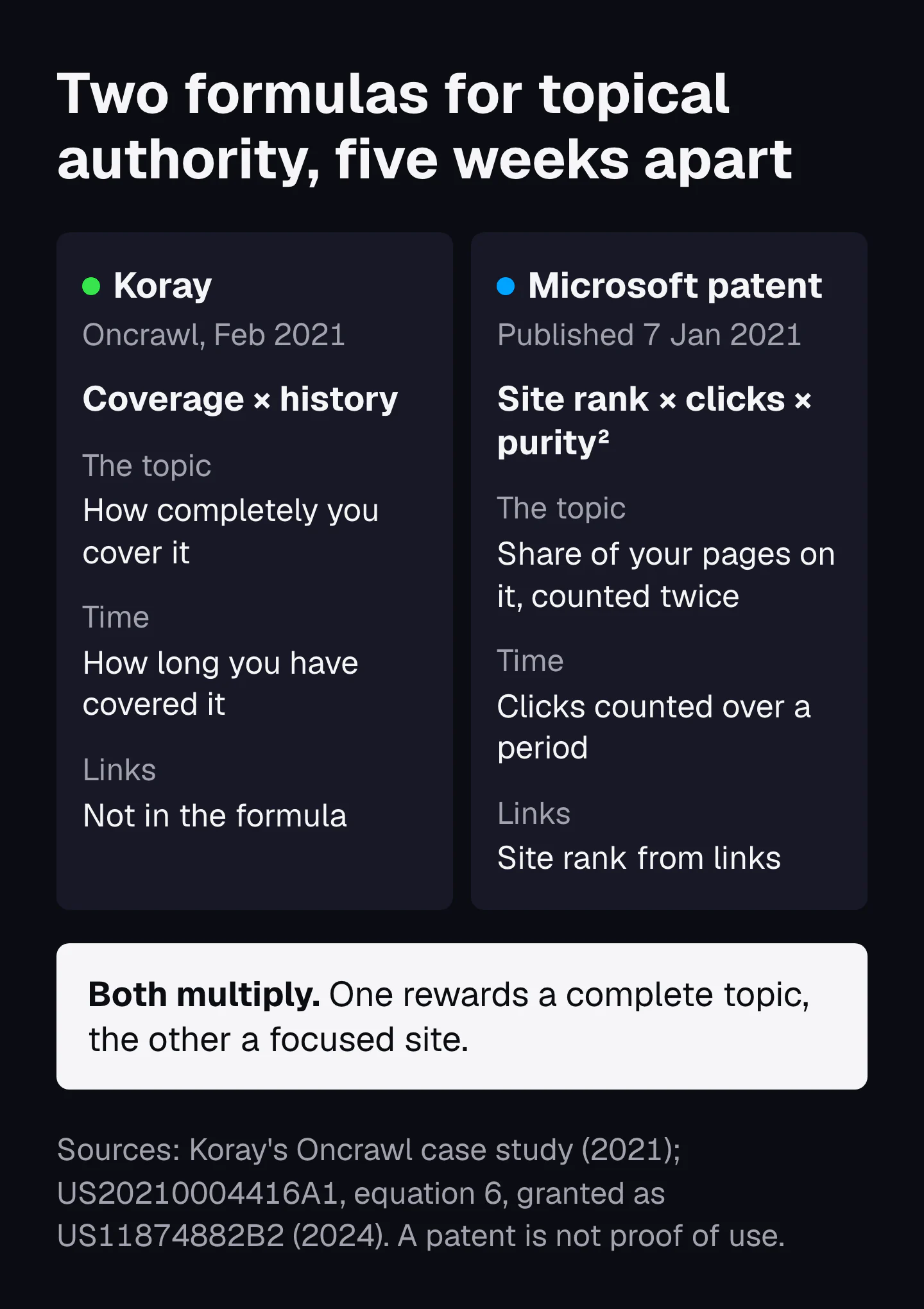
Both formulas multiply, but they reward different things. Koray's coverage asks how completely you cover the topic. Microsoft's purity asks how much of your site is about it. A site can be complete and still diluted by pages on other subjects. Google's leaked siteFocusScore points the same way as purity. My reading: treat his coverage as complete and focused, and keep the outer section on the topic. An outer section that chases any traffic lowers the one thing the engine texts measure most directly.
The patent shows what Microsoft's engineers designed. It does not show that Bing ranks this way today. The same caution holds for the information gain patent Koray cites. Search Engine Journal counted "automated assistant" 69 times in its latest version, against 25 for "search engine". More on that in information gain.
Where independent evidence agrees, and where it is silent
- Focus matters: Google's guidance, the leaked siteFocusScore and Microsoft's topic purity all point the same way. This is the best-supported part of his framework.
- History on a topic matters: Google says so for news (2023). Microsoft's patent counts clicks over a period. His shift from time to click satisfaction matches both.
- Links still matter: Microsoft's formula starts from link-based site rank. Koray agrees in his own words, "It is not Links vs Semantics; it is Links in Semantics" (2024), but links are not in his 2021 formula.
- No outside evidence: the core and outer split, quality nodes, momentum and the exact form of his formula. These come from his case studies.
Koray reads engines through patents and results pages. He says he does not trust their public statements: "it is not trusting Google's official announcements, but trusting the Google search result pages" (2023). I take a different line in this library. I cite Google where Google has spoken, Koray where he adds what Google has not said, and I label which is which. The wider evidence for topical authority is in topical authority.
Five misreadings of the framework, checked against his own words
Five readings of Koray's framework circulate that his own articles contradict: that the central entity is your brand name, that source context means authority, that a tool can score topical authority, that an AI list of subtopics is a topical map, and that more pages build more authority.
| The misreading | What he wrote |
|---|---|
| "The central entity is your brand name." | Reflect "the overall topicality of your source site-wide", in the header, footer, sidebar and company definitions (February 2024). The subject goes site-wide; brand identity is a separate concept (2023). |
| "Source context means your authority or your unique angle." | "The perspective and function of the website and the brand on the open web that involves monetization, and existing purpose" (2023). |
| "A tool can score your topical authority." | "Refrain from believing that anyone can measure TA with a tool" (February 2024). |
| "An AI list of subtopics is a topical map." | "Asking ChatGPT for 20 types of X won't give you a topical map about X" (February 2024). |
| "More pages build more authority." | "Content count is not a ranking factor" (2021), and "every unnecessary page increases the cost of retrieval" (2026). |
The third and fourth matter most when you shop for help. Tools now sell a score from 0 to 100 for each of his five decisions, and generators promise a map in minutes. His own words rule both out. Our test of the generators is in topical map tools and generators. And if you want to know where the word "topical map" came from before SEO borrowed it, read where the topical map came from.
We built our own system on his framework, which is how a map of about 159 pages takes us about two to two and a half hours. If you would rather have the map made than build it by hand, that is our growth plan.
Common questions
Can I use Koray's framework without taking his course?
Yes. His case studies on Oncrawl, his articles on holisticseo.digital, his 2026 Search Engine Land articles and his Medium posts explain the map, the formula and most of the terms for free. Only a few definitions, such as the central search intent, are taught in the course alone, and this lesson marks them.
Is there a free example of a Koray topical map?
This lesson fills in his five decisions for our own site, and its case table lists the sites he has published with what was done on each. For full maps opened row by row, see our topical map examples lesson, and for a blank sheet to fill in, our free topical map template.
Is Koray's topical authority the same as Google's topic authority?
No. Topic authority is a named Google system, described on 23 May 2023, that helps decide which news sources are experts in areas such as health, politics or finance. Topical authority is the SEO idea Koray popularized in February 2021 for websites in general. They share an intuition, trust earned on one subject over time, but Google has not adopted his framework.
Sources
- Importance of Topical Authority: A Semantic SEO Case Study, Oncrawl (Koray Tuğberk Gübür), 2021
- Importance of Topical Authority for SEO, Holistic SEO & Digital (Koray Tuğberk Gübür), 2021
- SEO in 2022: Focus on semantic SEO and natural language processing, with Koray Tugberk GUBUR, Majestic, 2021
- Creating Semantic Content Networks with Query and Document Templates (Case Study), Oncrawl (Koray Tuğberk Gübür), 2022
- The Importance of Quality Thresholds and Predictive Ranking, Oncrawl (Koray Tuğberk Gübür), 2022
- Q&A: Koray Tugberk GUBUR, Reboot Online, 2022
- Importance of Lexical Semantics and Semantic Similarity for SEO, Holistic SEO & Digital (Koray Tuğberk Gübür), 2022
- How to Expand a Topical Map for Higher Topical Authority?, Holistic SEO & Digital (Koray Tuğberk Gübür), 2023
- Importance of Entity, Attribute, Value (EAV) Architecture for SEO, Holistic SEO & Digital (Koray Tuğberk Gübür), 2023
- Semantic Search for Semantic SEO: Understanding the Verbs of Life, Holistic SEO & Digital (Koray Tuğberk Gübür), 2023
- The Best Practices of Content Topical Coverage Strategy by Koray Tugberk GUBUR, Sitechecker, 2023
- 3 Suggestions about Topical Authority, Medium (Koray Tuğberk Gübür), 2024
- Achieving Positive Ranking State: 120% Growth in 4 Months, Medium (Koray Tuğberk Gübür), 2024
- Koray's Agents (Generative AI Agents for Semantic SEO and Topical Authority), Medium (Koray Tuğberk Gübür), 2024
- Outer section of topical maps: why it matters, LinkedIn (Koray Tuğberk Gübür), 2025
- How semantics and topical authority improve local SEO, Search Engine Land (Koray Tuğberk Gübür), 2026
- Query templates: Expanding the scope of topical authority, Search Engine Land (Koray Tuğberk Gübür), 2026
- Visual semantics: The missing piece of topical authority, Search Engine Land (Koray Tuğberk Gübür), 2026
- US20210004416A1: Extracting key phrase candidates from documents and producing topical authority ranking, Microsoft Technology Licensing, via Google Patents, 2021
- US11874882B2: Extracting key phrase candidates from documents and producing topical authority ranking, Microsoft Technology Licensing, via Google Patents, 2024
- US11354342B2: Contextual estimation of link information gain, Google LLC, via Google Patents, 2022
- Google's information gain patent for ranking web pages, Search Engine Journal, 2024
- Knowledge-Based Trust: Estimating the Trustworthiness of Web Sources, Google Research (Xin Luna Dong and others), via arXiv, 2015
- QualityAuthorityTopicEmbeddingsVersionedItem (google_api_content_warehouse 0.4.0), HexDocs, 2024
- Google confirms the leaked Search documents are real, The Verge, 2024
- Understanding news topic authority, Google Search Central Blog, 2023
- Creating helpful, reliable, people-first content, Google Search Central, 2026
- AI in Search: Going beyond information to intelligence, Google, 2025