Expanding a topical map: what to add once the first pages are live
Expanding a topical map means adding pages to a map whose first pages are already live, by going deeper into the subject, sideways into a neighboring topic over a bridge, toward a new audience or into new page types, without leaving the subject the site is trusted for.
Your first pages are live and the map is working. Here is how to tell it is ready for more, what to add, what to leave out, and how to slot new pages in without breaking what already ranks.

Key takeaways
- A map is ready to grow when most planned pages are live and indexed, the live pages show for searches you never planned, and impressions rise across whole groups; two of your pages competing for one search means fix first.
- Koray Tuğberk Gübür names three ways to expand a map (2023): more entities of the same type, more attributes of the entities you cover, and deeper context; a neighboring topic needs at least three bridges from your existing pages.
- The follow-up questions AI search splits your core questions into show where your border is: a topic that keeps appearing in them gives you bridges, a topic that never appears is drift.
- Add new pages as a new batch at the end of the publishing order, each under a live parent and linked from a live page that already gets impressions; never renumber or move what is live.
- There is no right map size: our median growth plan is 159 pages, but maps run from about 50 to over 20,000 depending on the company, so a map grows when the business does, not to hit a number.
How to tell from Search Console that a map is ready to grow
A topical map is ready to grow when most of its planned pages are live and indexed, the live pages show for searches you never planned, and impressions rise across whole groups of pages. Two signals mean the opposite: fix what is live first. You can check all five in Google Search Console.
Expansion is the step after a topical map is built and its first batches are published. Adding pages too early spreads a young site thin. Adding them too late leaves searches you already show for to someone else.
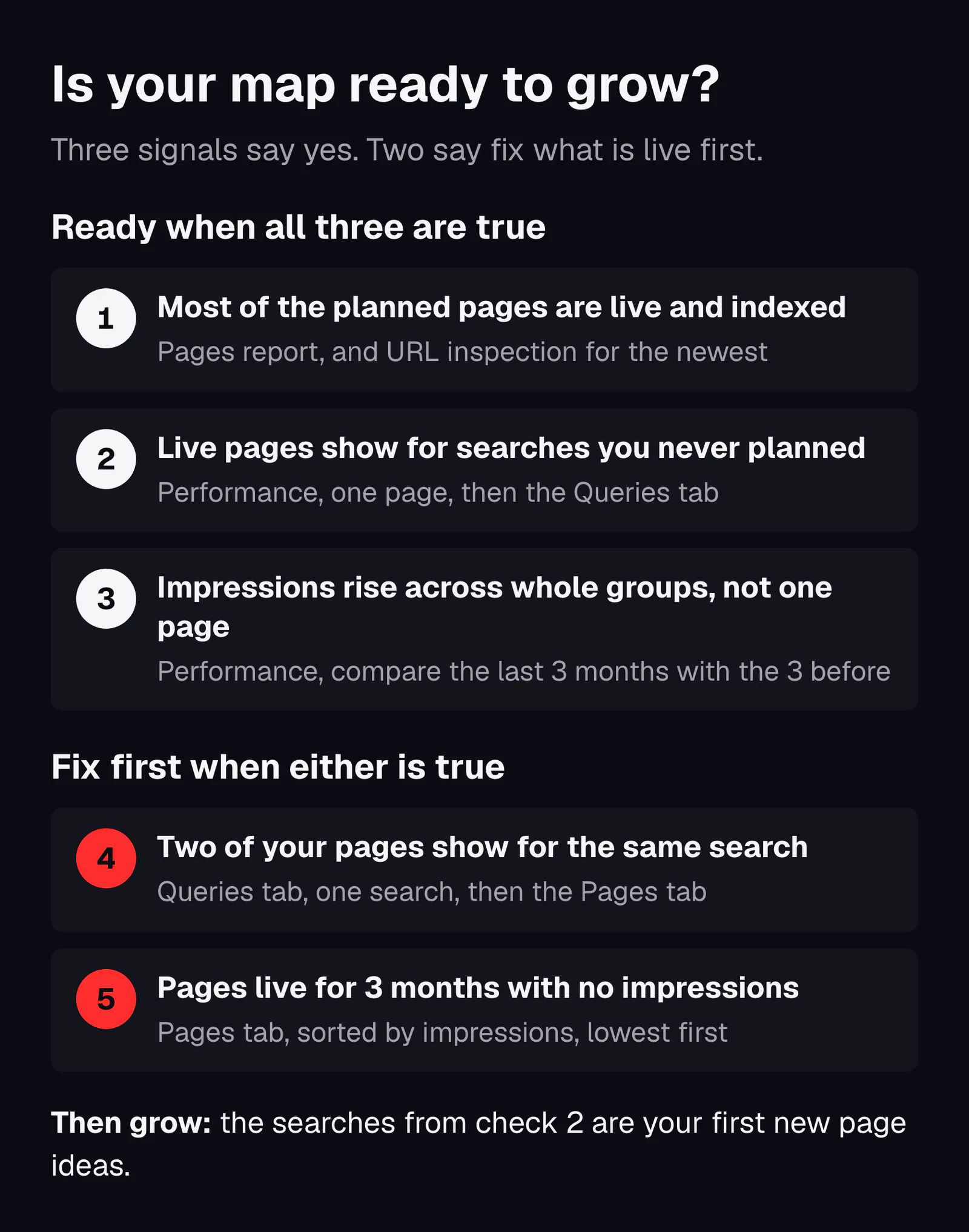
The five checks, in order
- Count the planned pages that are live and indexed. Open Indexing, then Pages, and use URL inspection on the newest pages. If most of the planned pages are still unpublished, publish them first. A map half written is not a map that needs more pages.
- Look for searches you never planned. Open Performance, Search results, set the last 3 months, open the Pages tab, click one live page, then open the Queries tab. Sort by impressions. Every search with impressions that no page in your map targets is a candidate. These are your best ideas, because Google already connects them to you.
- Compare impressions group by group. In Performance, choose Date, then Compare, and set the last 3 months against the 3 before. Filter by the pages of one group. A group whose impressions rise as a whole is earning trust on that part of the subject.
- Check whether two of your pages share one search. Click a search in the Queries tab and open the Pages tab. If two of your pages split the impressions, that is keyword cannibalization. Fix it before you add a third page on the same thing.
- Find the pages nobody sees. Sort the Pages tab by impressions, lowest first. Pages live for 3 months or more with no impressions need work, a merge or removal. That is covered in pruning and merging, the opposite move to this lesson.
Google defines an impression as "How many times your site appeared in Search results", and average position as the position of your topmost result (Search Console Help, Performance report). Impressions move before clicks do. That is why the checks lean on impressions and on which searches a page shows for, not on traffic.
Koray Tuğberk Gübür makes the same call in a March 2024 case write-up: "Focus on impression difference to see true ranking potential in the future." In the same post he waits for "a higher impression and ranked query on the web page" before preparing new documents. The full method for reading a map's results is in how to tell if a topical map is working.
What the four ways to expand a topical map are
You can expand a topical map in four directions: deeper into the subject you already cover, sideways into a neighboring topic over a bridge, toward a new audience for the same subject, and into new page types. The first two come from Koray Tuğberk Gübür's framework. The other two apply the same rules to how a business actually grows.
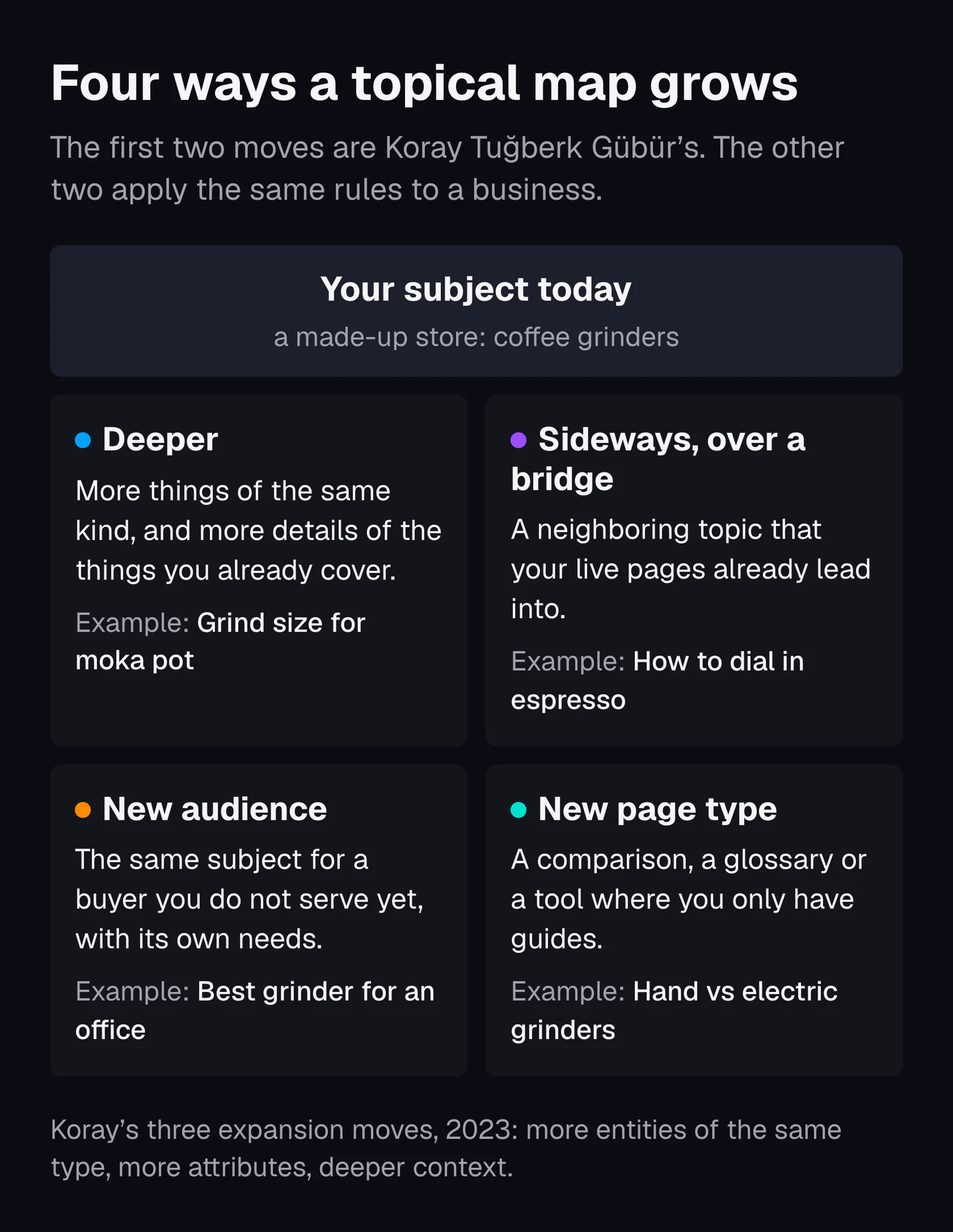
In his 2023 article "How to Expand a Topical Map for Higher Topical Authority?", Koray lists three ways to expand: "covering more entities from the same type", "covering more attributes from already existing entities", and "deepening the context with further consistency". In plain words: more things of the same kind, more facts about the things you cover, and more angles on them. His framework, in plain words, is in Koray's topical map framework.
Deeper into the same topic
Deeper is the safest direction, because every new page sits inside the subject you are already trusted for. A grinder store that covers grind size for pour-over and French press adds grind size for AeroPress and moka pot: more brew methods, the same kind of thing. It adds a page on grinder retention: a new fact about grinders it already sells.
Sideways, over a bridge
Sideways means a neighboring topic that your live pages already lead into. Koray calls the link between two topics a contextual bridge. His Kanbanize.com case, a Kanban board tool, started out focused on "Kanban Charts" and expanded into "Task Management", "Team Management" and "Business Efficiency". He reports 245% more organic clicks and over 39,000 new ranking searches. Those are his reported numbers from his own screenshots, not audited figures.
His Encazip.com case, an energy price comparison site, shows a bigger jump. To reach credit and insurance he needed "a contextual bridge ... between the energy topical map, and credit, along with the insurance", built on a shared "roof context" of "money saving". The roof is what the old topic and the new one have in common for the same reader.
A new audience
A new audience means the same subject for a buyer you do not serve yet. A grinder store that sells to home brewers can add pages for offices and small cafés. The searches differ ("best grinder for an office"), and so does the page that sells: a commercial grinders collection joins the core section. For a service business, the same move is a new town or a new type of client; see topical maps for local and service businesses.
New page types
New page types mean a comparison, a glossary or a tool where the map only had guides. They often answer searches the map already touches, in the shape searchers want: "hand vs electric grinders" wants a verdict and a table, not another guide. Our map format names 12 page types, but a site is not limited to those. A tool page needs building, so it goes in the plan with its own timeline.
How far a map can grow before it drifts off its subject
A map can grow as far as its bridges reach. A neighboring topic belongs when at least three of your live pages lead into it naturally and it still serves why your site exists. Past that point, new pages stop adding to the subject you are trusted for and start diluting it.
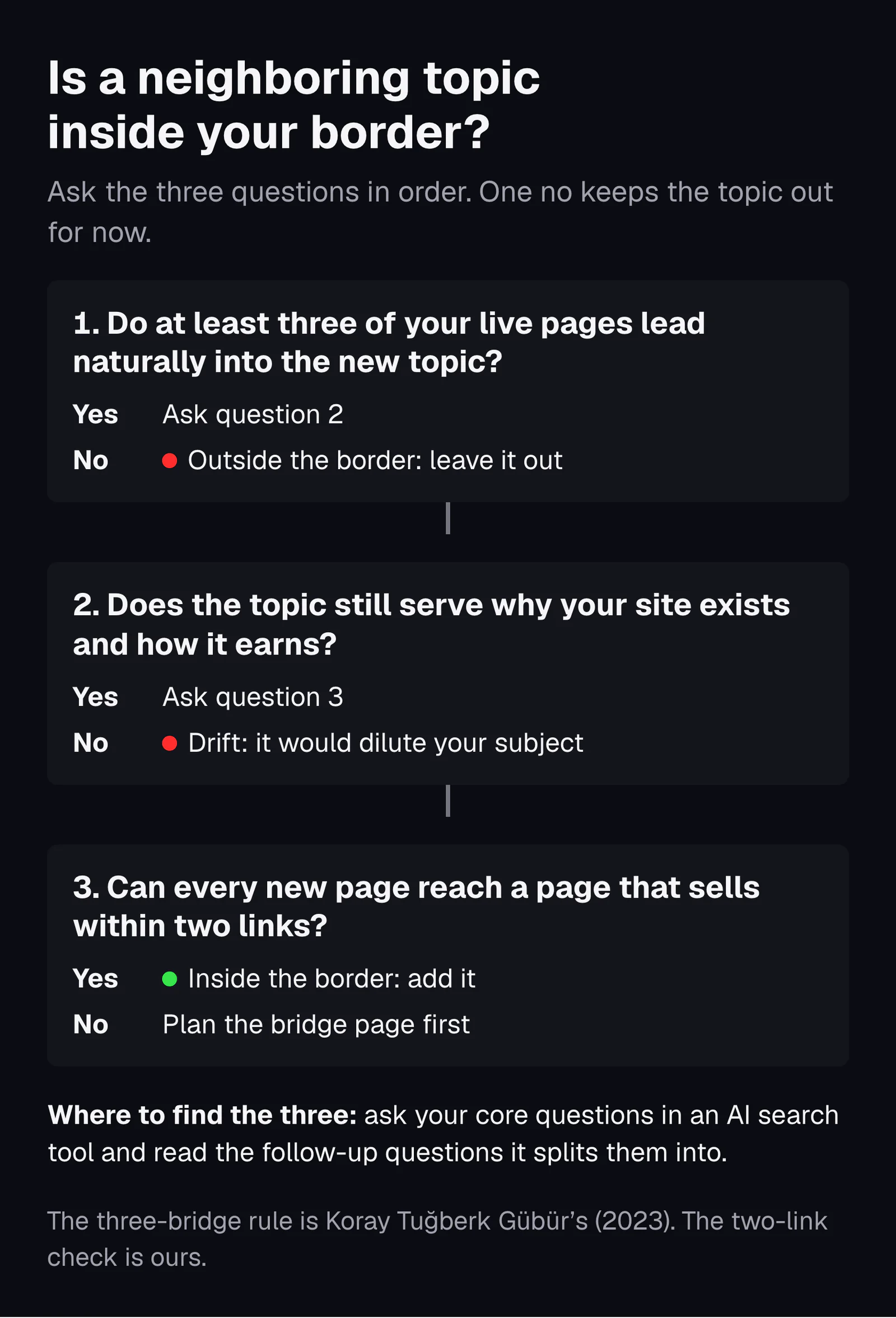
The three-bridge rule
Koray's line between a topic you can add and one you cannot is a count. In the same 2023 article he writes that a new area "should have at least 3 side contextual bridges". He calls the empty space between two topics a topical gap: "a contextual disconnectedness between different topics". One bridge is a coincidence. Three mean the topics share a reader.
The second question is about purpose. Koray calls it the source context: why the site exists and how it earns. A coffee grinder store can bridge into espresso because grind size is half of espresso. It cannot bridge into coffee shop business plans, however many people search for them.
Use the follow-up questions AI search asks to find your border
The follow-up questions an AI search engine splits your core questions into show where your border is. Google says AI Mode works by "breaking down your question into subtopics and issuing a multitude of queries simultaneously" (Google, May 2025). Those subtopics are the neighbors the engine already treats as part of the same need.
So run the test by hand. Take five of your core questions, such as "how to choose a coffee grinder". Ask each one in AI Mode or ChatGPT and write down the topics the answer pulls in. If espresso dialing shows up for three or more of them, that is your three bridges, found by the engine itself. If latte art never shows up, it is outside the border, however close it looks.
What the evidence says about drifting off topic
No public study proves that a site loses rankings for straying from its subject. What exists points the same way from four directions.
- Google's own guidance. Google's helpful content questions ask "Does your site have a primary purpose or focus?" and "Are you producing lots of content on many different topics in hopes that some of it might perform well in search results?" They also ask: "Did you decide to enter some niche topic area without any real expertise, but instead mainly because you thought you'd get search traffic?"
- The 2024 documentation leak. Google's leaked Content Warehouse documentation lists a field called siteFocusScore, "how much a site is focused on one topic", and one called siteRadius, "how far page_embeddings deviate from the site_embedding". In plain words: how far each page sits from what the whole site is about.
- Bing's patent. Microsoft's patent US11874882B2 (granted January 2024) ranks a page partly by "a topical authority score assigned to the website", and lets one site hold "multiple topical authority scores" for different topics. A new topic starts with its own score, not with the one you earned elsewhere.
- Google's court record. Notes of a 2025 interview with Google engineer HJ Kim, filed in the US antitrust case (exhibit PXR0356), say page quality is "largely related to the site rather than the query". Weak pages on a far topic count against the same site as your best pages.
The cost Koray names himself
Koray is open about the risk in his own Encazip case. He calls the main obstacle "the fast-growing contextual expansion", and says other products the brand wanted to move into were halted. His advice to the people running SEO: they "should be able to convince the brands not to risk their digital existence".
I see the same thing on sites that come to us after another agency. Any website that's worked with a bad agency before has a large percentage of off-topic posts, because the agency just worked to publish as much as possible. That's what was in the retainer, but that's not how SEO is done properly. Every single page needs a purpose on the website. If a page does not have a purpose, it does not deserve to be on the website. Expanding a map is how you add pages with a purpose; it is never a reason to add pages without one. Why fewer, clearer pages can win is in cost of retrieval.
Where honest new page ideas come from
Honest new page ideas come from four places: searches your live pages already show for, questions your customers ask you, the follow-up questions AI search splits a query into, and pages your competitors have that you lack. Each idea then passes one filter: does it deserve its own page, or a section on a page you already have?
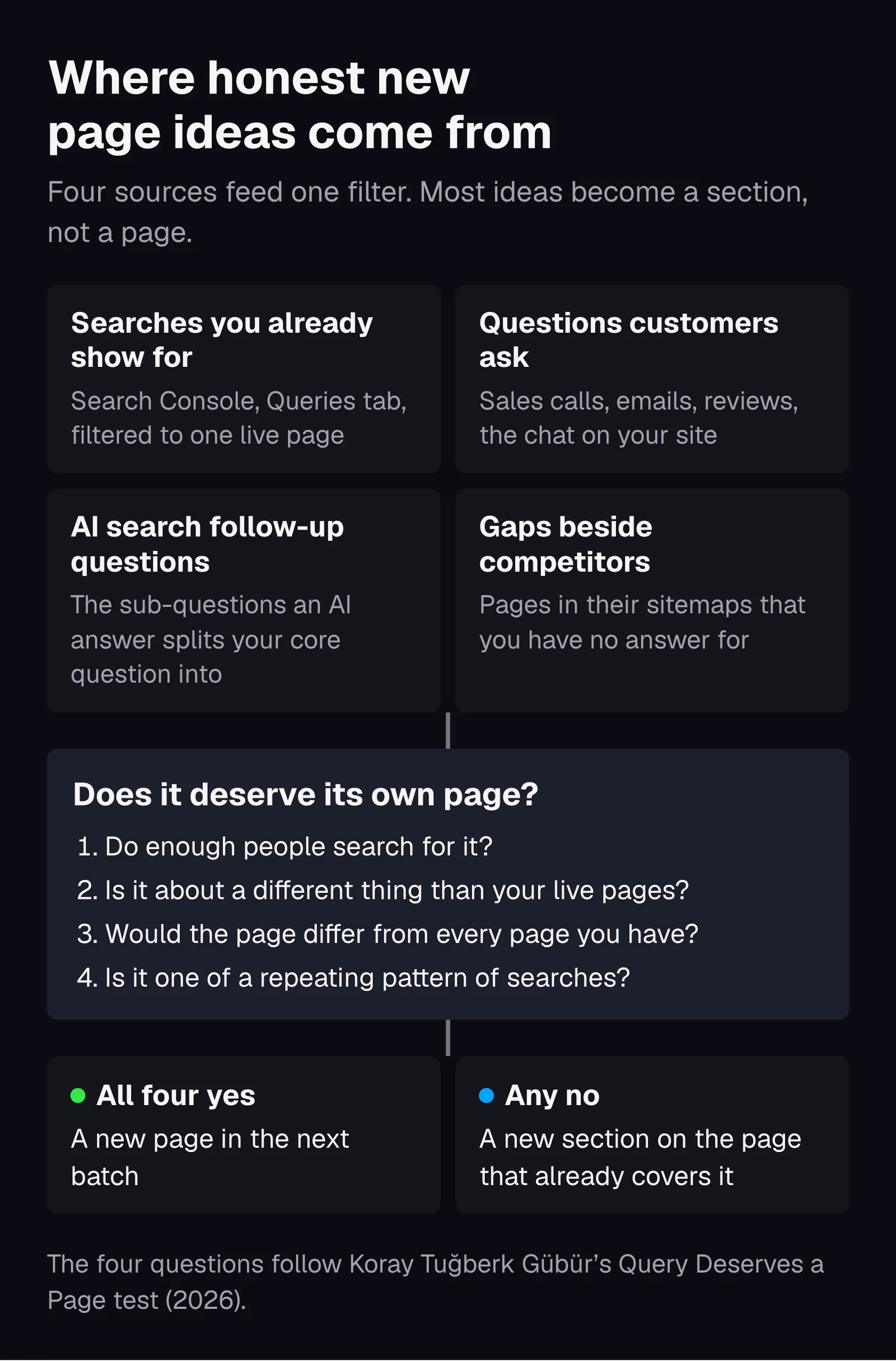
Searches you already show for
This is check 2 from the first section. Searches with impressions that no page targets are the strongest ideas you will ever get, because Google has already tied them to your site. Write each one down with its impressions and average position.
Questions customers ask
Sales calls, support emails, reviews and the chat on your site hold the questions people ask right before they buy. They rarely show in a keyword tool, because they are asked in full sentences, once, to a person. A question three customers asked this quarter is worth a section; one that comes up every week is worth a page.
The follow-up questions AI search asks
AI search engines break one question into several. OpenAI says ChatGPT search "typically rewrites your query into one or more targeted queries" (OpenAI Help Center). Google's patent application on search with a chat companion (US20240289407A1, published August 2024) generates "synthetic queries" from a search and picks documents that answer them too. The idea is older than AI search: the Self-Ask method (Press and colleagues, 2022) has a language model ask itself follow-up questions before it answers.
For you, it means a page can be picked for a sub-question it answers well, even when nobody typed that sub-question into Google. Read the sub-questions off the AI answers to your core questions, the same way as the border test. Each one your map does not answer is a candidate. Writing so those answers get cited is covered in getting a topical map cited in AI answers, and the idea of query fan-out itself in semantic SEO in plain words.
Gaps beside competitors
Koray's first research step in his 2021 case study still works for expansion: "Crawl your competitors' sitemaps to understand their topical maps." Read their page list, mark every page you have no answer for, and treat each one as a question, not a page to copy. A competitor's page is a hint about demand, not proof of it.
The filter: page or section
Most ideas do not deserve a page. One of the most common mistakes we see in maps buyers build themselves is that a query gets its own page when it should be a section of a page that already exists. Koray's test for this, which he calls Query Deserves a Page, has four parts: the search has real demand, it is about different things, it has low similarity to your other searches, and it follows a pattern. Fail any one and the idea becomes a section. The full method is in when a search deserves its own page.
How to add pages without breaking the links and order already in place
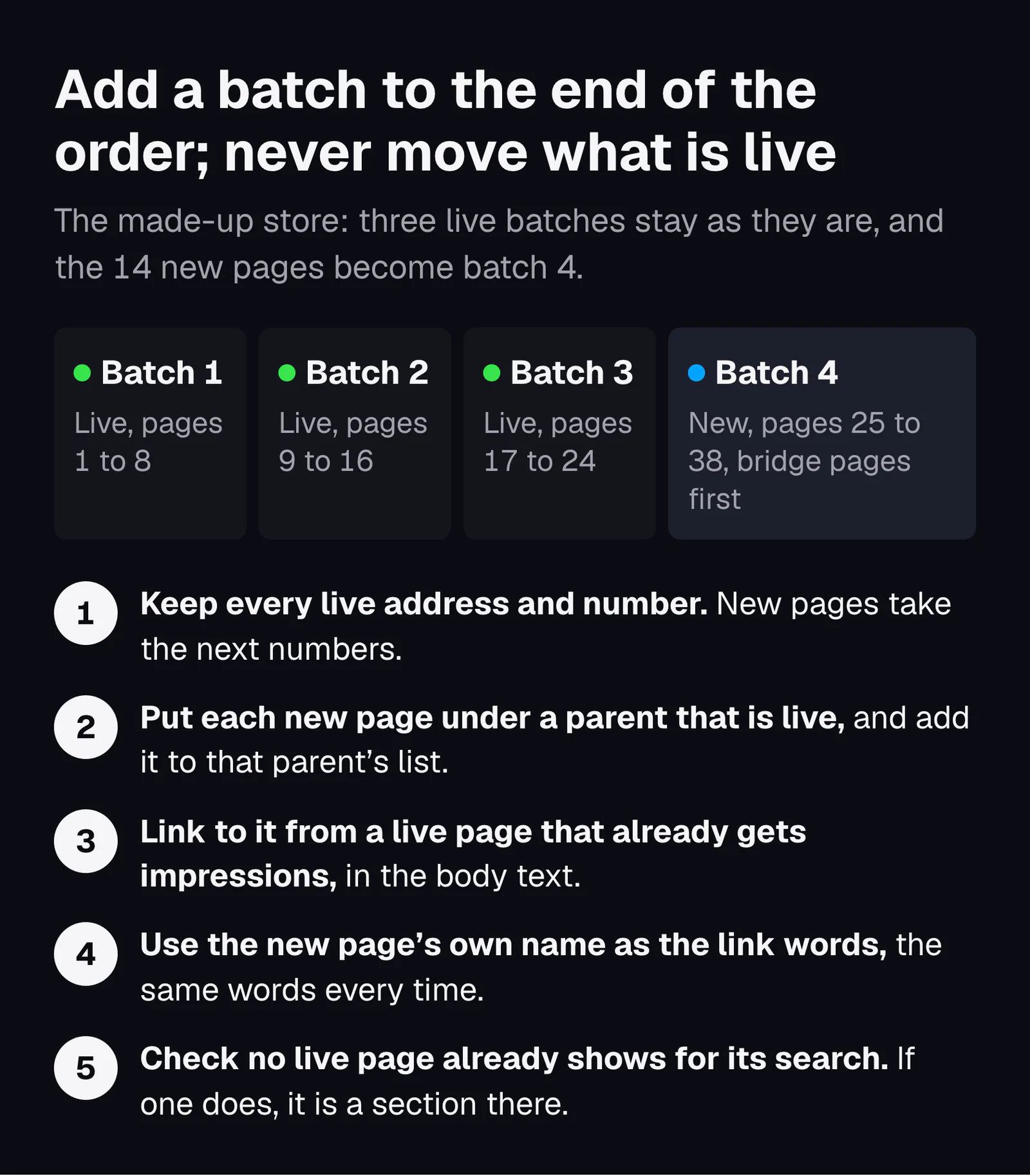
Add new pages as a new batch at the end of the publishing order. Put each one under a parent page that is already live, and give each one a link from a live page that already gets impressions. Never renumber, move or rename the pages that are live.
The first order was built so each page could lean on pages before it. That logic is in publishing order, and expansion follows the same rule one level up: a new batch leans on everything already live.
- Keep every live address and number. A live page has history: links, impressions, clicks. Changing its address throws that away, and renumbering the plan confuses everyone who works from it. New pages take the next numbers.
- Publish the bridge pages first. In a sideways move, the pages that join the old topic to the new one go live first. In the made-up store, "How to dial in espresso" goes before "Single dosing explained", because it is the page the grind size chart links into.
- Put each new page under a live parent, and add it to that parent's list of pages in the body text. A page with no parent is an orphan: nothing leads to it.
- Link to it from a live page that already gets impressions. Google's leaked documentation has a field called onsiteProminence that "measures the importance of the document within its site", computed "by propagating simulated traffic from the homepage and high craps click pages". In plain words: a link from a page people actually reach counts for more than a link from a page nobody visits.
- Use the new page's own name as the link words, the same words on every page that links to it. The rules are in internal links inside a topical map.
- Check that no live page already shows for its search. Look the target search up in the Queries tab and open the Pages tab. If a live page already gets impressions for it, the idea is a section on that page, not a new page. Bing's webmaster guidelines warn that duplicate URLs "dilute signals".
- Tell the engines the batch is live. Update your sitemap. For Bing, Yandex, Seznam, Naver and others, send the new addresses through IndexNow, which takes up to 10,000 URLs per request. Google is not part of IndexNow.
New pages start slow, and that is expected. In a 2016 internal Google slide shown at the US antitrust trial (exhibit UPX0203), Google's ranking leans on how people respond to a page, and that fails when "a document is new, recently-changed, or rarely-shown". A new page has no responses yet. Strong links from pages that do are how it gets seen while it earns its own.
A worked expansion of one made-up map, before and after
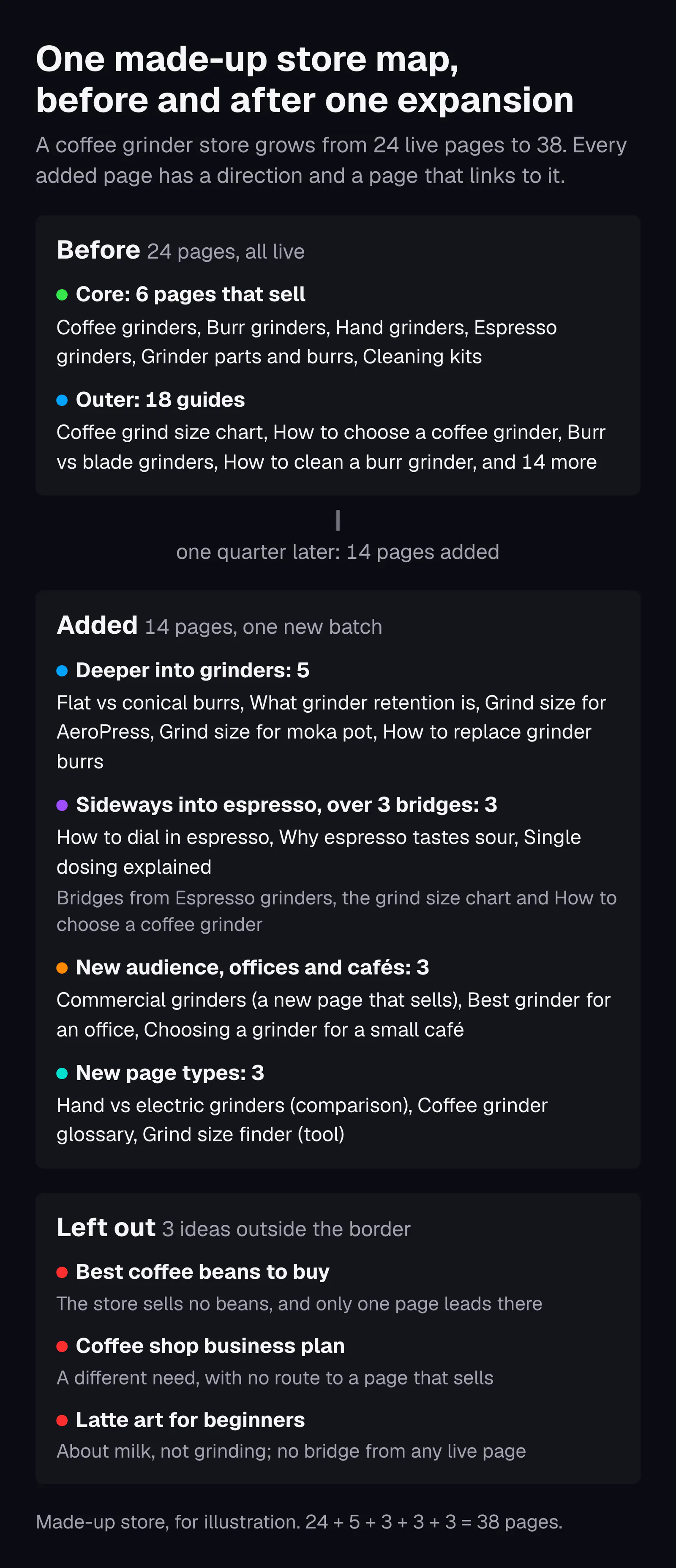
Here is one expansion from start to finish, on a store that does not exist. The made-up coffee grinder store has 24 live pages. One quarter later it has 38: 5 deeper, 3 sideways into espresso, 3 for a new audience and 3 new page types. Three more ideas were left out.
Where it started
The store had 6 pages that sell (coffee grinders, burr grinders, hand grinders, espresso grinders, grinder parts and burrs, cleaning kits) and 18 guides around them. All 24 were live and indexed, which passed check 1.
What the checks found
The grind size chart showed for searches about AeroPress and moka pot that no page targeted, which passed check 2. Impressions for the burr grinder guides rose as a group, check 3. No search was split between two pages and every guide had impressions, so checks 4 and 5 found nothing to fix first.
| Direction | Pages added | Why it passed |
|---|---|---|
| Deeper | Flat vs conical burrs; What grinder retention is; Grind size for AeroPress; Grind size for moka pot; How to replace grinder burrs | Searches the live pages already showed for; more brew methods and more facts about grinders it sells |
| Sideways | How to dial in espresso; Why espresso tastes sour; Single dosing explained | Three bridges: from the espresso grinders collection, the grind size chart and how to choose a coffee grinder |
| New audience | Commercial grinders (a new page that sells); Best grinder for an office; Choosing a grinder for a small café | Customers asking about grinders for work; a product line the store could add |
| New page types | Hand vs electric grinders (comparison); Coffee grinder glossary; Grind size finder (tool) | Searches the guides touched, but in a shape that wants a verdict, a list of terms or a calculator |
What was left out, and why
- Best coffee beans to buy. Popular, and close to the subject, but the store sells no beans and only one live page leads there. One bridge, not three.
- Coffee shop business plan. A real search from the same audience, but a different need. No page that sells is within two links.
- Latte art for beginners. About milk, not grinding. It never showed up in the AI follow-up questions for the store's core questions.
The 14 new pages went in as batch 4, numbered 25 to 38, with the espresso bridge page first. Every page got a parent and one link in from a live page with impressions before it was published.
How big a topical map should get, and when to stop
A topical map should get as big as the business needs and no bigger. Our median growth plan was 159 pages on 5 November 2026, but a map can be anywhere from about 50 pages to over 20,000, depending on the size of the company, what central entity it has that needs that sort of coverage, how many services it has, and so on.
So 159 is not a target, and neither is any other number. A plumber with three services in one town needs a small map. A store with 2,000 products in 40 categories needs a big one. A map grows when the business grows: a new service, a new town, a new product line, a new kind of buyer. Each of those is one of the four directions.
Stopping is a decision too. Koray, in the same 2024 write-up, goes the other way on a law site: "Decrease the total page number to prevent ranking signal dilution." When the quarterly checks keep finding split searches and pages nobody sees, the next move is pruning and merging, not more pages.
Speed matters less than direction. The only data on publishing pace comes from agency and vendor surveys, such as Orbit Media's 2026 survey of 1,042 content marketers and Stratabeat's 2025 comparison of 300 software sites. Neither is a controlled test. Which page goes next is the decision you control.
The quarterly review sheet for growing a topical map
Once a quarter, run the same checks in the same order, write the numbers down and make one decision: grow, fix or prune. The sheet below is the whole review. The CSV is the copy you keep and fill in each quarter.
| Check | Where to look | Decision rule |
|---|---|---|
| 1. Planned pages live and indexed | Indexing, Pages; URL inspection for the newest | Most planned pages not live yet: publish them before adding anything |
| 2. Searches you never planned | Performance, last 3 months, one page, Queries tab | Each one is a new page idea; run it through the page-or-section test |
| 3. Impressions across whole groups | Performance, compare last 3 months with the 3 before | A group rising as a whole can go deeper; a flat group needs work first |
| 4. Two of your pages on one search | Queries tab, one search, Pages tab | Fix it first: merge or make the pages differ |
| 5. Pages with no impressions | Pages tab, lowest impressions first | Live 3 months with none: improve, merge or remove |
| 6. Ideas from the other sources | Customer questions, AI follow-up questions, competitors' sitemaps | Only ideas that pass all four page-or-section questions become pages |
| 7. Border check for a new topic | Your map | Fewer than three live pages leading in, or no fit with how you earn: leave it out |
| 8. Decision and next batch | Your map | Append the batch at the end of the order and write the date in your change log |
Download the quarterly map review sheetCSV, 8 checks with where to look in Search Console, what to write down, the decision rule and a column for this quarter. Opens in Google Sheets or Excel.
Write the date of every batch in a change log. Three months later, compare the new pages' impressions with the quarter before, the way measuring a topical map describes. That is how you learn which direction worked for your site.
A map that grows this way stays one subject, well covered. If you would rather start from a map planned for your business, that is the growth plan.
Sources
- How to Expand a Topical Map for Higher Topical Authority?, Koray Tuğberk Gübür, Holistic SEO, 2023
- Importance of Topical Authority: A Semantic SEO Case Study, Koray Tuğberk Gübür, Oncrawl, 2021
- Achieving Positive Ranking State: 120% Growth in 4 Months, Koray Tuğberk Gübür, Medium, 2024
- Performance report (Search results), Google Search Console Help, 2026
- Creating helpful, reliable, people-first content, Google Search Central, 2026
- AI in Search: Going beyond information to intelligence, Google, 2025
- Searching the web with ChatGPT, OpenAI Help Center, 2026
- Search with stateful chat (US20240289407A1), Google LLC, patent application, 2024
- Measuring and Narrowing the Compositionality Gap in Language Models (Self-Ask), Press, Zhang, Min, Schmidt, Smith, Lewis (arXiv), 2022
- Extracting key phrase candidates from documents and producing topical authority ranking (US11874882B2), Microsoft Technology Licensing, patent, 2024
- QualityAuthorityTopicEmbeddingsVersionedItem (siteFocusScore, siteRadius), Google Content Warehouse API documentation (2024 leak), 2024
- PerDocData (onsiteProminence), Google Content Warehouse API documentation (2024 leak), 2024
- Google confirms the leaked Search documents are real, The Verge, 2024
- Interview with H.J. Kim notes (exhibit PXR0356), US v. Google LLC, U.S. Department of Justice, 2025
- Q4 Search All Hands (exhibit UPX0203), US v. Google LLC, U.S. Department of Justice, 2023
- Bing Webmaster Guidelines, Microsoft Bing, 2026
- IndexNow documentation, IndexNow.org, 2026