Information gain: how to make a page add what the top results lack
In SEO, information gain is what a page tells a reader that the pages they have already seen for the same search do not, counted in true and useful facts, not in words.
Information gain is the most repeated idea in SEO writing right now, and most of what is said about it comes from a patent few people have read. This lesson separates the three things the term means, reads the patent's claims, and gives you a test you can run by hand on any page, shown on this lesson's own search.

Key takeaways
- Information gain names three different things: a 1986 statistics measure of how much a question reduces uncertainty, a 2018 Google patent that scores a document against what one user has already seen, and the SEO habit of adding what the top results lack.
- Google holds four granted US patents in the Contextual estimation of link information gain family, from 2022 to 2025; every claim compares a document with what that user has already seen or been shown, only the 2023 grant puts a ranked list of search results in its first claim, and Google has said a patent does not mean it is used.
- The test you can run by hand is the nugget method NIST assessors used in 2003: split the top results into single facts, count how many results state each one, keep the facts every reader needs, and add at least one true, sourced fact that none of them has.
- Gain is worth most when it is hard to copy: a clearer picture can be redrawn in an afternoon and a primary source cited in a day, while a measurement takes weeks to rerun and first-hand data from your own records can only be cited.
- On 13 November 2026 none of the top five results for this lesson's query quoted a patent claim, named the 2023 or 2025 grants or cited the retrieval research, and Google's AI Overview for information gain patent described nugget scoring that appears in none of the four patents.
Information gain has three meanings that share one name
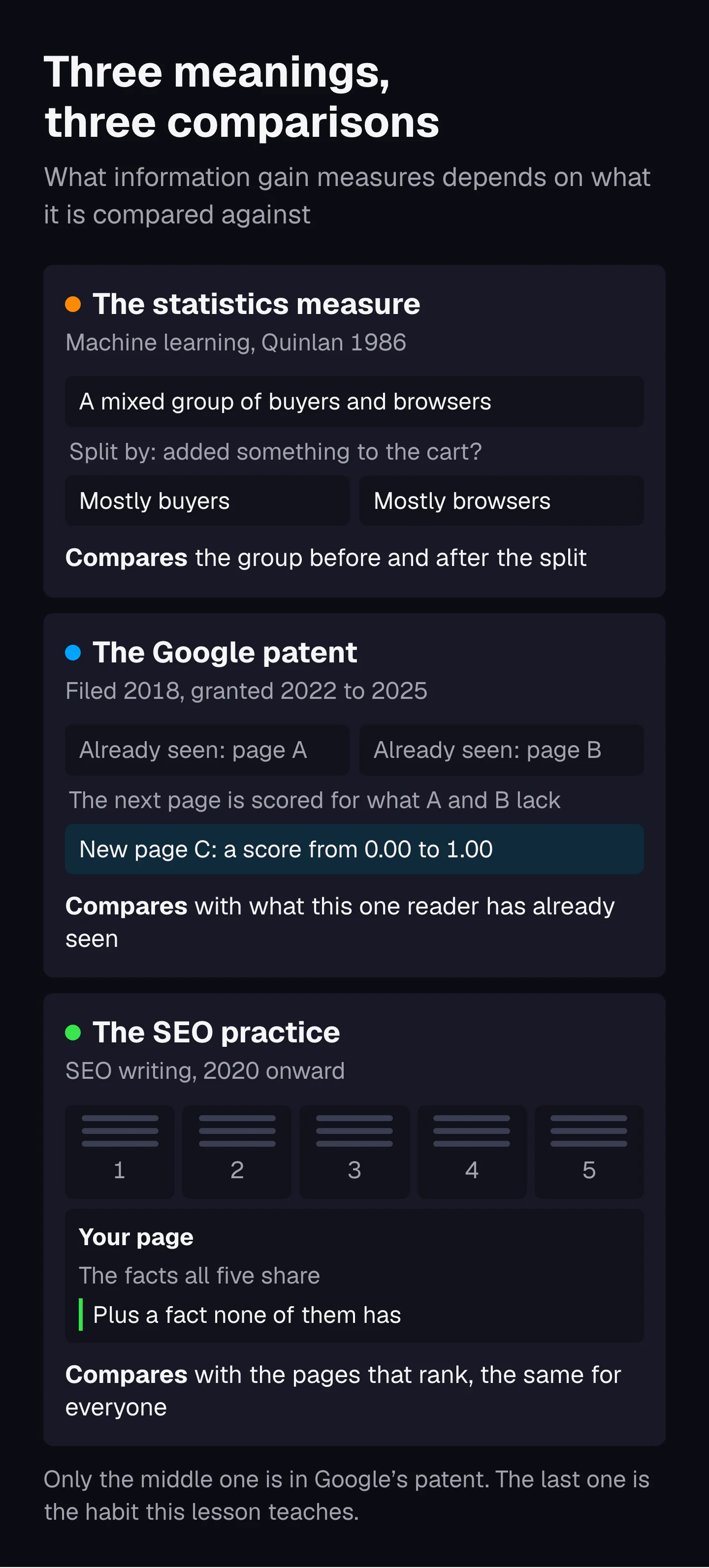
Information gain means three different things. In statistics it measures how much one question reduces uncertainty. In a Google patent it scores a document by what it adds beyond what one user has already seen. In SEO it is the habit of putting on your page what the top results leave out.
Most articles blend the three, and that is where the bad advice starts. So here they are one at a time, with what each one compares against.
The measure from statistics and machine learning
The oldest meaning comes from information theory. Claude Shannon defined entropy, a number for uncertainty, in his 1948 paper A Mathematical Theory of Communication. In 1986 J. R. Quinlan used it to grow decision trees. His paper Induction of decision trees describes ID3, which at each step picks the question that most reduces the uncertainty about the answer. That reduction is the information gain, measured in bits.
A made-up example: you want to predict which visitors will buy. Splitting them by "added something to the cart" separates buyers from browsers far better than splitting them by browser. The first question has a high information gain, the second almost none.
Quinlan also named its weak spot. A question with many possible answers can look like it explains everything while explaining nothing, so he proposed a corrected version, the gain ratio. Writers have the same trap: a page full of unusual words looks new without being useful.
This is the meaning many people get when they search "information gain score". On 13 November 2026, four of the six People also ask questions on that search were about decision trees: entropy, gain ratio, the formula.
The Google patent
In October 2018 Google filed a patent called Contextual estimation of link information gain, by Victor Carbune and Pedro Gonnet Anders. It was granted on 7 June 2022 as US 11,354,342 B2. Its abstract defines an information gain score as "additional information that is included in the document beyond information contained in documents that were previously viewed by the user". The comparison is with what one person has already seen. The claims are read in full further down.
The SEO practice
The SEO meaning is looser: what your page says that the pages already ranking for the query do not. A 2026 explainer from Ahrefs, an SEO tool company, defines it as "the additional information your page contributes beyond what already ranks for the query" and adds that whether Google runs a literal information gain score "is still unconfirmed". This meaning is a writing goal, not a measurement, and it is the one this lesson teaches you to run.
| Meaning | Field and year | What it measures | Compared against |
|---|---|---|---|
| The statistics measure | Machine learning, Quinlan 1986 (Shannon 1948) | How much a question reduces uncertainty about an answer, in bits | The data before and after the split |
| The Google patent | Google, filed 2018, granted 2022 to 2025 | How much new information a document adds, a score from 0.00 to 1.00 in its example | What this one user has already been shown |
| The SEO practice | SEO writing, 2020 onward | What a page says that the others do not, judged by reading | The pages that rank for the query, the same for everyone |
How a statistics term became an SEO ranking story
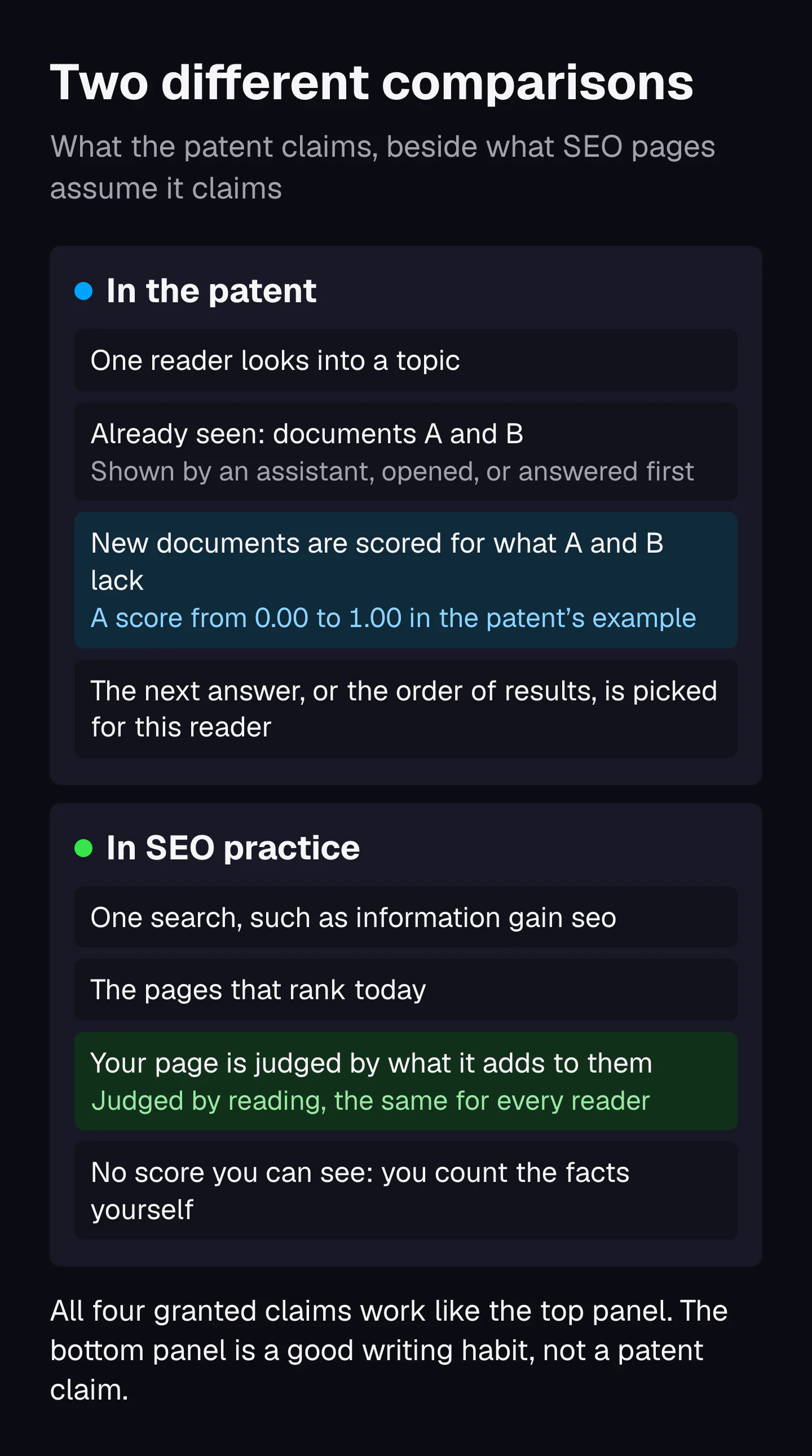
The term moved from statistics into a Google patent, then into SEO through two writers who read that patent early. Each step made sense on its own. Added up, they produced a belief that Google gives every page a novelty score, which no Google document says.
- 1948 and 1986. Shannon's entropy, then Quinlan's information gain for decision trees.
- 2004. A Google patent on phrase-based indexing by Anna Lynn Patterson, granted in 2009, uses "information gain" in the statistical sense, for phrases that tend to appear together. Same words, a different idea.
- October 2018. Google files the information gain patent. The application is published in April 2020 as an international application, and in the US that November.
- June 2020. Bill Slawski, the late patent analyst, writes one of the first SEO breakdowns of the application. His wording is hedged: he quotes the patent's line that results "may be ranked at least in part" on the score.
- February 2021. Koray Tuğberk Gübür publishes a "unique information gain score" and tells writers to look for information gaps, not keyword gaps. More on that below.
- June 2022. The first US grant. Three more follow, in 2023, 2024 and 2025.
- 2022 to 2026. The idea attaches itself to Google's updates and to AI writing. The top result for "information gain seo" on 13 November 2026 says the 2022 helpful content update hit sites "due to lack of information gain". The second calls information gain "the dominant content-quality evaluator" since the March 2026 core update. Neither gives a Google statement for it.
Here is what Google itself wrote. Its guidance on creating helpful, reliable, people-first content never uses the words "information gain". It asks questions instead. One of them is "Does the content provide substantial value when compared to other pages in search results?" That question is worth answering whether or not any patent is in use.
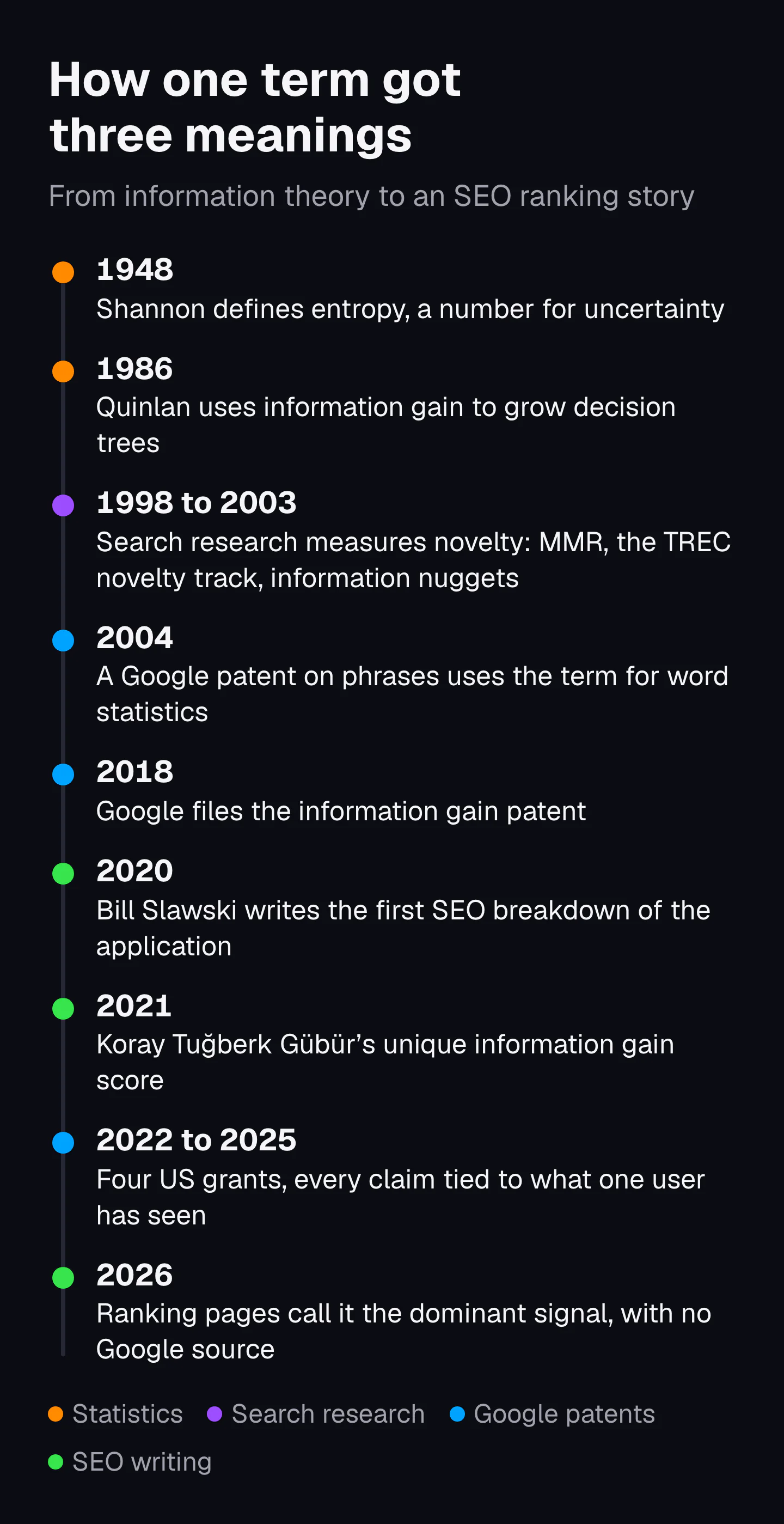
What Google's information gain patent claims, and what it does not
Every claim in the four granted patents scores a document against what this user has already seen or been shown. Only the 2023 grant puts a ranked list of search results in its first claim. None describes a fixed score that compares a page with the top ten for everyone.
Four grants, four claims
The family has four US grants so far, all from the same October 2018 filing and all listed as active on Google Patents. Claim 1 is the heart of each one, so that is what the table puts in plain words. I read all four on 13 November 2026.
| Grant | Granted | Claim 1: new documents are compared against | Claim 1: what the user gets |
|---|---|---|---|
| US 11,354,342 B2 | 7 June 2022 | Information an automated assistant already presented to the user | Information read from one new document, picked by its score |
| US 11,720,613 B2 | 8 August 2023 | Documents the user already opened, for a search engine query | A ranked list of search results |
| US 12,013,887 B2 | 18 June 2024 | The most relevant document, shown first, once the user asks for more | More information, picked by score |
| US 12,326,889 B2 | 10 June 2025 | Content already shown for the user's first query, scored by a machine learning model | One of two candidate answers to a follow-up query |
Most SEO pages quote the 2022 grant and stop. Its later claims do cover a ranked list and a search results page, but its first claim is set in an automated assistant. The 2023 grant is the one whose first claim is a ranked list of search results, and even it ranks new results against documents "accessed by the user". The 2024 and 2025 grants read like a chat: you get an answer, you ask for more, and the next answer is picked for what it adds. Across all four, the yardstick is always this user's history.
The assistant framing is not a footnote. I counted 71 uses of "automated assistant" in the 2022 grant's full text against 25 of "search engine". Roger Montti of Search Engine Journal counted 69 against 25 in the 2024 version in August 2024, and my count of that version matches.
What the description adds
The description, the long text under the claims, gives examples rather than rules. Its score runs from 0.00, nothing new given what the user has seen, to 1.00, only new information. The input can be a document's whole text, information pulled out of it, or a compact stand-in for its meaning, such as an embedding or a bag of words, run through a machine learning model.
The training data it describes is a human judgment. People searching in the ordinary course of their lives could be asked, through a browser plugin, "Was this document redundant?" for each new page they read. Keep that question. It comes back in the hand test.
The patent also says why it exists. A spoken answer has to be short, and the score helps avoid "a redundant output, or an extra dialog turn". That fits a voice assistant reading results aloud better than a page of ten blue links.
What none of the four texts say
I searched the full text of all four grants for words that SEO pages and AI answers attach to this patent. None contains "nugget", "rarity", "front-load", "penalty", "skyscraper", "Gemini" or "AI Overview".
That matters because those words circulate as patent facts. On 13 November 2026, Google's own AI Overview for "information gain patent" said the system "breaks down documents into discrete 'information nuggets'" and "scores them by rarity and proximity", and that facts "placed higher up" are "weighted more heavily". The 0.00 to 1.00 range in the same answer is real. The nuggets and the weighting are not in the patent. The nugget idea does exist, in older research, covered in the next section.
A patent is not proof of use
A patent shows what engineers invented and protected. It does not show what runs in Google Search today. John Mueller of Google said so in a Search Central hangout on 5 February 2021, as reported by Search Engine Journal: "just because it's patented from Google, and maybe even from someone who works on search, doesn't mean that we actually use it in search."
So say "Google patented a method that scores what a document adds for a user who has seen other documents". Do not say "Google ranks pages by information gain". The practice in this lesson does not need the patent to be in use, because Google's guidance already asks for the outcome.
Information retrieval measured new and redundant information decades before SEO
Search researchers worked on this problem long before the patent, under the names novelty, redundancy and diversity. Their methods are published and tested, and one of them is the hand test in this lesson.
- 1998, maximal marginal relevance. Jaime Carbonell and Jade Goldstein at Carnegie Mellon proposed MMR, which picks the next result for being relevant to the query and different from the results already picked. In their words it "strives to reduce redundancy while maintaining query relevance".
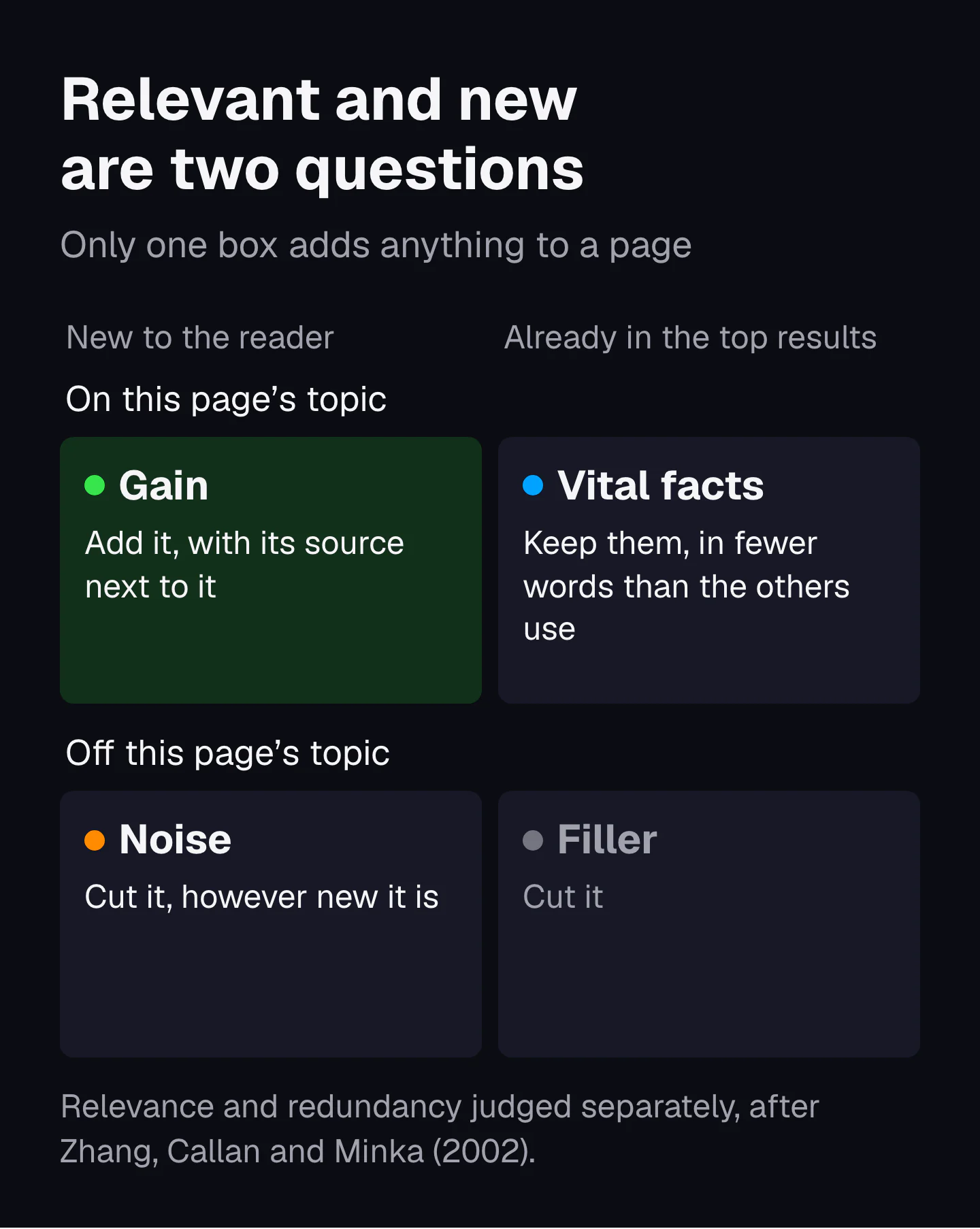
- 2002, relevance and redundancy are separate. Yi Zhang, Jamie Callan and Thomas Minka argued in a SIGIR paper on novelty and redundancy detection that "relevance and redundance should each be modelled explicitly and separately". A page can be fully on topic and still add nothing.
- 2002, the TREC Novelty track. The Novelty track at NIST, overviewed by Donna Harman, asked 13 research groups to find the sentences in a ranked list of documents that were both relevant and new. Novelty was judged sentence by sentence, which is the right size for checking one section of a page.
- 2003, information nuggets. In her overview of the TREC 2003 question answering track, Ellen Voorhees describes how NIST assessors judged answers. Each assessor first listed "information nuggets", each one "a fact for which the assessor could make a binary decision" about whether a response contained it. Some nuggets were marked vital, facts a good answer must have. A nugget returned twice "was marked only once".
- 2008, less credit for repeats. Charles Clarke and colleagues at the University of Waterloo built an evaluation measure for novelty and diversity in which a nugget earns less credit each time the reader has already seen it.
Put those together and you have the test SEO writers keep reinventing. List the nuggets in the top results, mark the vital ones, count repeats once, and look for what is missing. It is the TREC assessor's method pointed at a page of search results instead of at one system's answer. It is also where the "nuggets" in that AI Overview came from: this research, not the patent.
The 2002 finding also rules out the most common shortcut. New is not enough. A fact can be new and off topic, and then it is noise. The picture below has a box for that.
How Koray Tuğberk Gübür turned the patent into a writing goal
Koray Tuğberk Gübür read the patent application in early 2021 and turned it into something a writer can aim at: a "unique information gain score" measured against competitors. Two years later he added "information responsiveness", answering every form a search can take.
On 11 February 2021 his topical authority case study defined the unique information gain score as "a score for calculating the unique information amount within a content according to its competitors". He added: "It is not enough for content to be original." A page should also answer the questions competitors cannot, "with the least words and the most information". His Oncrawl version of the case study, published the same day, made it step 11: "Find Information Gap Instead of Keyword Gap".
In a 2023 interview with Sitechecker he named the other half: "information responsiveness is defined as being responsive to all related and possible search activities in every form of the search query with all context interpretations as a web source."
My reading of how the two fit: responsiveness is the floor, gain is the ceiling. Responsiveness means your page carries the vital nuggets, every fact a reader needs, in every form they ask for it. Gain is what you add on top. A page with only the floor repeats the top results. A page with only the ceiling is interesting and still sends the reader back to search.
One honest difference. The claims compare a document with what one user has seen; Koray compares it with competitors. His version is not what the patent claims. It is the version a writer can act on, because you cannot know what each reader has read, but you can read what ranks. I learned this method from Koray, and his framework is laid out in plain words in Koray Tuğberk Gübür's topical map framework.
How to run the information gain test by hand
Read the top results for your query, split them into single facts, count how many pages state each fact, keep the ones every reader needs, and add at least one true, sourced fact that none of them has to each section of your page.
- Write down the search, the date, the country and the device. Results change. The test is a snapshot, and a dated snapshot can be checked later.
- Open the top five organic results and any AI answer. Read them in full. Go to ten when the five disagree with each other. Skip ads, and skip forum threads and videos unless they rank in the five.
- Split every page into nuggets. A nugget is one fact, number, step, definition, recommendation or named source, written as a short line. Use the NIST rule: you must be able to answer yes or no to "does this page contain it?" Ignore wording. Two pages saying the same thing in different words share one nugget.
- Merge and count. One row per nugget, one column per result, a mark where a result states it. Two or more marks is covered. One mark is rare. Your own additions, which no result has, are absent.
- Mark the vital nuggets. These are the covered ones a reader needs to get the answer at all. Your page keeps them, in fewer words than the others use. Rewording them adds nothing.
- Add at least one absent nugget to each section. It has to be true, useful to this reader and on this page's topic. Write its source next to it: your records, a test you ran, a primary document, a worked example. If you cannot name the source, cut it.
- Check the rare ones. A rare nugget that is wrong is a counter-case you can correct. A rare one that is right but thin is a place to go deeper.
Two questions settle the hard cases. The patent's: "Was this document redundant?" And one from Google's helpful content guidance: "Are you mainly summarizing what others have to say without adding much value?" If the honest answer to either is yes, the section is not done.
Download the information gain worksheetCSV, blank: one row per nugget, a column per result, the count, covered, rare or absent, vital, what you add and its source
Download the worked exampleCSV, 29 nuggets from the top five results and the AI Overview for information gain seo, read on 13 November 2026, with what this lesson added
The test on this lesson's own query, read on 13 November 2026
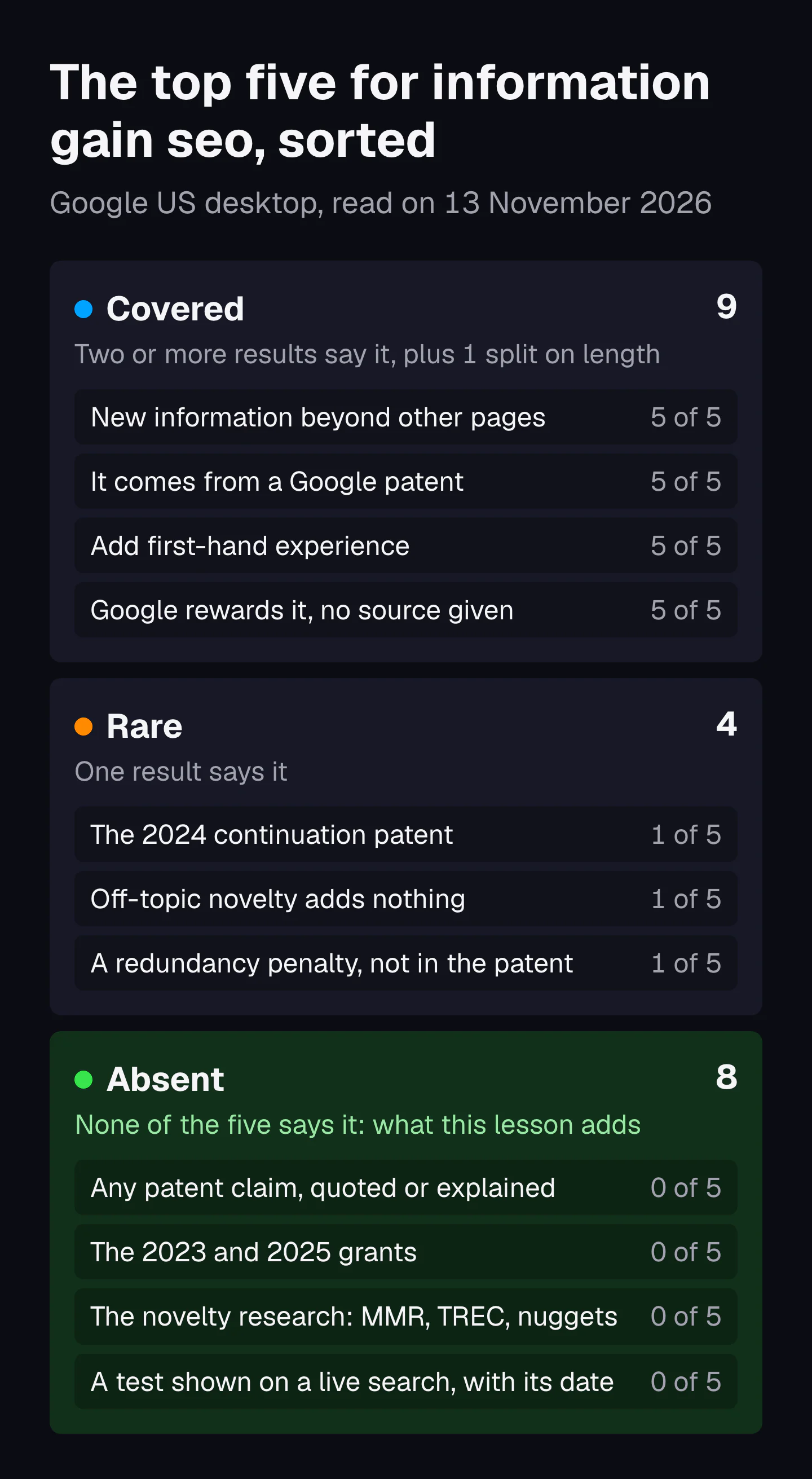
On 13 November 2026 the top five results for "information gain seo" shared nine points and split on one. None quoted the patent's claims, named the 2023 or 2025 grants, cited the retrieval research or showed a test a reader can run. Those gaps became this lesson.
I pulled Google's US desktop results for "information gain seo" and read the top five organic pages in full. They were an SEO software company's guide from May 2024, an agency's post on the March 2026 core update, a home-services marketing agency's glossary entry, a question-and-answer software company's help article and an SEO consultant's blog post. They ran from about 1,700 to 5,000 words. Google also showed an AI Overview built from 11 sources.
| Nugget | Results stating it, of 5 | Status |
|---|---|---|
| Information gain is new information beyond what other pages say | 5 | Covered, vital |
| It comes from a Google patent | 5 | Covered, vital |
| Add first-hand experience or expert input | 5 | Covered, vital |
| Google rewards it in rankings (no Google source given) | 5 | Covered, unsupported |
| The patent compares with what the user has already seen | 4 | Covered |
| Add original research or your own data | 4 | Covered |
| AI writing repeats the consensus, so gain is how to stand out | 4 | Covered |
| It helps earn backlinks | 3 | Covered |
| Measure it with stand-ins such as traffic, engagement and links | 2 | Covered |
| Length: long pages help (1 result) or short pages win (2 results) | 3 | Split |
| A points rubric to score a page | 1 | Rare |
| The 2024 continuation patent | 1 | Rare |
| Off-topic novelty adds nothing | 1 | Rare |
| The patent describes a "redundancy penalty" | 1 | Rare, and not in the patent |
| Any patent claim, quoted or explained | 0 | Absent |
| The 2023 and 2025 grants | 0 | Absent |
| Google saying a patent does not prove use | 0 | Absent |
| The decision-tree meaning | 0 | Absent |
| The novelty research: MMR, TREC, nuggets | 0 | Absent |
| Google's question about value compared with other results | 0 | Absent |
| Koray Tuğberk Gübür's information gain score | 0 | Absent |
| A test shown on a live search, with its date | 0 | Absent |
Here is what I did with it. The vital nuggets sit in the definition and the first section, once and short. The unsupported one, that Google rewards it, became a claim to check, which is why the patent section exists. The split on length became the first kind of fake gain below. The wrong one, the "redundancy penalty", became a counter-case. Every absent nugget became a section or a paragraph, each with its primary source: the four patents, the TREC papers, Koray's own pages and Google's guidance.
The AI Overview added little. It matched the top five on the definition and the methods, and it suggested covering "fringe entities", subtopics the standard guides skip. The second AI Overview I read, for "information gain patent", is the one with the nuggets and the weighting from the patent section. Both are snapshots: AI answers differ by person and by day.
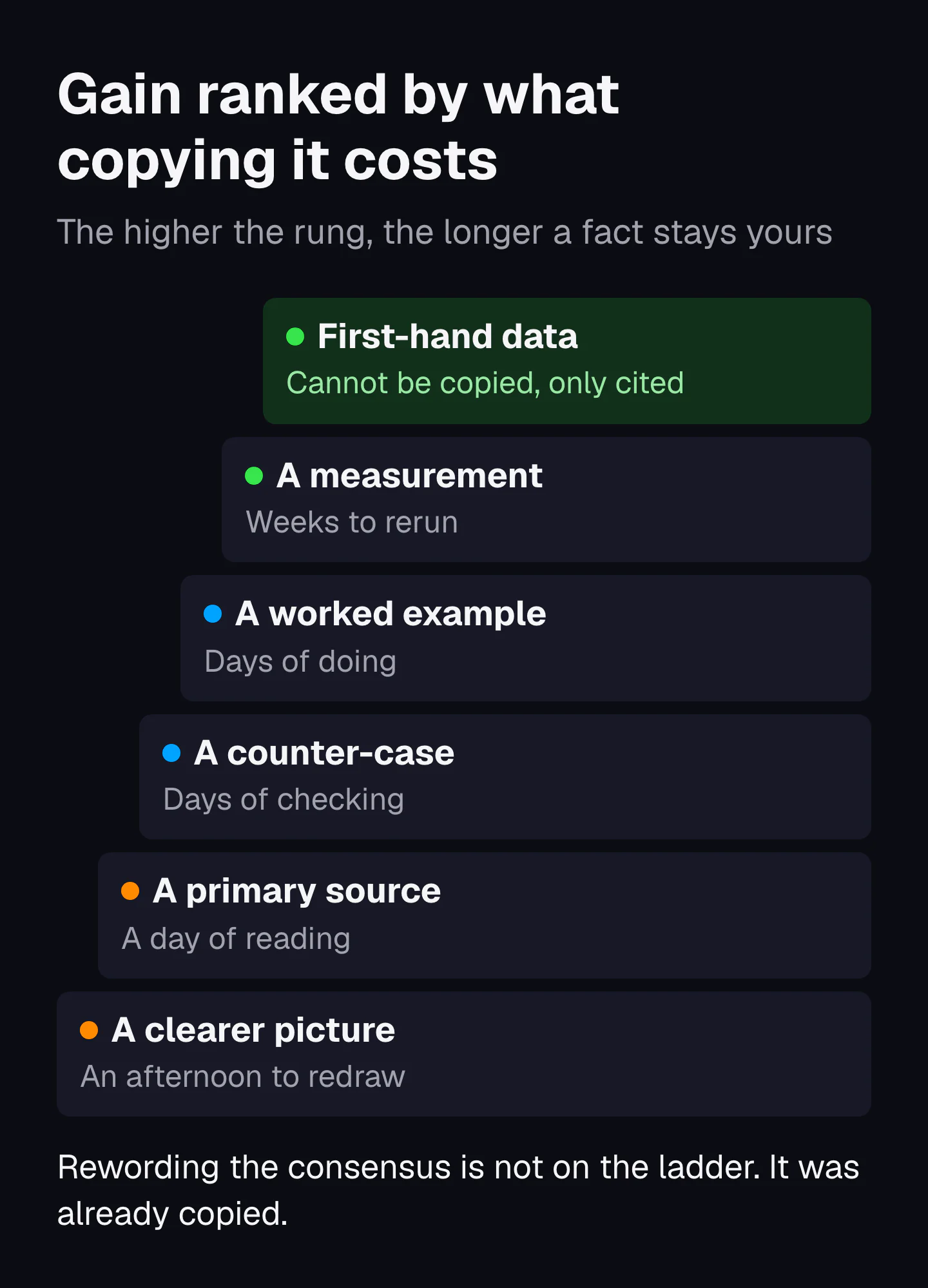
Which kinds of information gain are hardest to copy
Rank what you add by how long a competitor needs to copy it once they have seen it. A clearer picture takes an afternoon and a primary source a day. A counter-case or a worked example takes days, and a measurement weeks. First-hand data from your own records cannot be copied at all, only cited.
| Kind of gain | What it looks like | What copying it costs |
|---|---|---|
| A clearer picture | A diagram of how the parts relate, a decision table, a better order | An afternoon: anyone can redraw it once they see it |
| A primary source the others skip | A patent claim, a court exhibit, a study's method section | A day of reading, then everyone can cite it |
| A counter-case | A common claim shown to be wrong, with the evidence | Days of checking, which most copiers skip |
| A worked example | The method run on a real case, with real numbers and a date | Days of doing; they can run their own, not reuse yours |
| A measurement | A test with a control group, a count, a timing | Weeks to rerun, and then they cite you as the first |
| First-hand data | Your orders, support questions, job records, customers' words | Cannot be copied, only cited |
The order is reasoning, not a study, and it rests on one rule: the more of your own time, data or access a fact needs, the longer it stays yours. Rewording the consensus is not on the ladder. It costs nothing to copy because it was already copied.
The top two rungs are also where the experience in Google's E-E-A-T lives: proof that you did the thing. So ask what you know from doing the work that nobody can read on the top five pages. A plumber knows which fittings fail in the town's hard water. A store knows which size gets returned most. That is the gain the top results cannot have.
Fake gain: how a page looks new without adding anything
Fake gain is anything that looks new but adds no true, useful fact. It comes in five kinds: padding, numbers with no source, mechanisms the cited source does not contain, bold takes with no evidence, and novelty that is off topic. The examples below come from the top results for this lesson's search.
- Padding. More words, the same nuggets. Google's guidance asks: "Are you writing to a particular word count because you've heard or read that Google has a preferred word count? (No, we don't.)" Position 5 says long-form content "tends to perform well for information gain". Positions 2 and 3 say a short page with one new fact beats a long guide. Length is not information either way. Count nuggets, not words.
- Numbers with no source. Position 2 lists visibility changes by page type after the March 2026 core update: "+15 to +25%" for original research, "-60 to -80%" for AI content farms. It credits them to unnamed "SEO community analyses" and adds that "exact figures vary by tracker/tool", with no tool, sample or method behind the table. A number with no method only looks like information.
- Mechanisms the source does not contain. Position 3 says the patent "describes behavior that acts in the opposite way, an 'Anti Skyscraper' effect" and "methods that behave like a redundancy penalty". Neither idea appears in any of the four granted texts. Catching these is real gain for you: each one is a counter-case.
- Bold takes with no evidence. "Google's #1 ranking signal", in the title of position 2, is a take. So is calling information gain a myth. Either one is gain only when it arrives with its evidence. Without it, it is an opinion dressed as a finding.
- Novelty that is off topic. Zhang, Callan and Minka again: relevance and redundancy are judged separately. Position 1 makes the point with its own example. Adding Ferrari, Lamborghini and BMW to an article about SEO "would add information gain without making much sense". A new fact has to serve the reader of this page.
A quick check for any addition: can you name where it came from, and would this page's reader miss it if you cut it? Two yeses, keep it. One no, it is fake.
Where information gain fits in a topical map and AI answers
A topical map makes sure your pages cover the subject, so readers get every fact they need. Each page then earns its place with facts the other pages and the AI answers do not have. Sourced specifics are what generative answers credit.
Coverage and gain work at different levels. The map is coverage: every question in the subject has a page or a section, which is Koray's responsiveness at the scale of a whole site. Deciding which searches get their own page is when a search deserves its own page, and building the pages so they connect is semantic content networks. Gain is per page and per section. A map can be complete while every page on it repeats the top results.
AI answers raise the stakes. An AI Overview or a chat answer pulls the covered nuggets from many pages at once. A page with only covered nuggets gives the answer nothing it has to credit to you. The 2023 GEO study by researchers from Princeton and other institutions edited pages and measured how visible they became in generative answers. Adding citations, quotations and statistics did best, a 30 to 40% relative improvement on the study's position-adjusted word count, a measure of how much of the answer draws on the page. A 2025 benchmark, C-SEO Bench, tested newer tricks aimed at chat search on two tasks with three domains each and found most were "largely ineffective", while traditional SEO did better.
My reading: the edits that worked were sourced specifics, which is exactly what an absent nugget is when it is done properly. Tricks aimed at the machine did not. More on that in getting a topical map cited in AI answers, and on how meaning, entities and the follow-up searches AI tools run fit together in semantic SEO in plain words.
On client maps we built our own process for this step. What you see here is the hand version, which is how I learned it. If you would rather start from a finished map with every page already planned, that is the growth plan.
Sources
- A Mathematical Theory of Communication, Claude E. Shannon, Bell System Technical Journal, 1948
- Induction of decision trees, J. R. Quinlan, Machine Learning, 1986
- Contextual estimation of link information gain (US11354342B2), Google LLC, Google Patents, 2022
- Contextual estimation of link information gain (US11720613B2), Google LLC, Google Patents, 2023
- Contextual estimation of link information gain (US12013887B2), Google LLC, Google Patents, 2024
- Contextual estimation of link information gain (US12326889B2), Google LLC, Google Patents, 2025
- Generative summaries for search results (US11769017B1), Google LLC, Google Patents, 2023
- Phrase-based indexing in an information retrieval system (US7536408B2), Google LLC, Google Patents, 2009
- The use of MMR, diversity-based reranking for reordering documents and producing summaries, Jaime Carbonell and Jade Goldstein, SIGIR, 1998
- Novelty and redundancy detection in adaptive filtering, Yi Zhang, Jamie Callan and Thomas Minka, SIGIR, 2002
- Overview of the TREC 2002 Novelty Track, Donna K. Harman, NIST, 2003
- Overview of the TREC 2003 Question Answering Track, Ellen M. Voorhees, NIST, 2003
- Novelty and diversity in information retrieval evaluation, Charles L. A. Clarke and others, SIGIR, 2008
- Creating helpful, reliable, people-first content, Google Search Central, 2026
- Google: Patents Are Not Always Used in Search, Search Engine Journal, 2021
- Google's information gain patent for ranking web pages, Roger Montti, Search Engine Journal, 2024
- What is Topical Authority? How does Topical Authority Work?, Koray Tuğberk Gübür, Holistic SEO, 2021
- Importance of Topical Authority: A Semantic SEO Case Study, Koray Tuğberk Gübür, Oncrawl, 2021
- The Best Practices of Content Topical Coverage Strategy by Koray Tuğberk GÜBÜR (interview), Sitechecker, 2023
- GEO: Generative Engine Optimization, Pranjal Aggarwal and others, arXiv, 2023
- C-SEO Bench: Does Conversational SEO Work?, Haritz Puerto and others, arXiv, 2025