The other half of topical authority: links, mentions and reputation
The reputation half of topical authority is what other sites say about yours: the links they give you, the words on those links and the mentions of your name, none of which you can publish for yourself.
Coverage gets a site further than most link advice admits. One store we worked with took its Google clicks up 29 times while the number of sites linking to it grew about 2.5 times, and hardly moved during the fastest climb. Links and mentions still do jobs your own pages cannot. Here is what those jobs are, from the US antitrust trial against Google to the 2024 leak of its internal documentation, which links a small site can earn honestly, and how to tell which half you are missing.

Key takeaways
- In Google's own trial documents a link counts twice: its words are evidence of what a page is about for one search, and PageRank, built from links, feeds a quality score that is mostly about the whole site.
- An online store we worked with went from 3,500 to 102,000 Google clicks a month in 15 months while the sites linking to it went from about 80 to about 200.
- When that store's linking sites tripled in 2025, its clicks still fell; our report at the time put most of the loss down to AI answers, not lost rankings.
- AI answers lean on what other sites say about you: in a 75,000-brand study, brand mentions tracked AI visibility far more closely than backlink counts or page counts.
- Read Search Console before you buy anything: no impressions is a coverage problem, impressions stuck on page two is usually reputation, and rising impressions with falling clicks is neither.
What links and mentions do that coverage cannot, and the reverse
Coverage tells a search engine what your pages say. Links and mentions tell it what other sites say about them: the words they use when they point at you, and how close you sit to sites it already trusts. Neither half can stand in for the other.
Google drew this split itself, in a slide it never meant to publish. "Life of a Click" is a 2017 Google deck shown in the US antitrust trial as exhibit UPX0004. Its slide "The 3 Pillars of Ranking" lists three things. Body is "What the document says about itself". Anchors are "What the Web says about the document". User interactions are "What users say about the document".
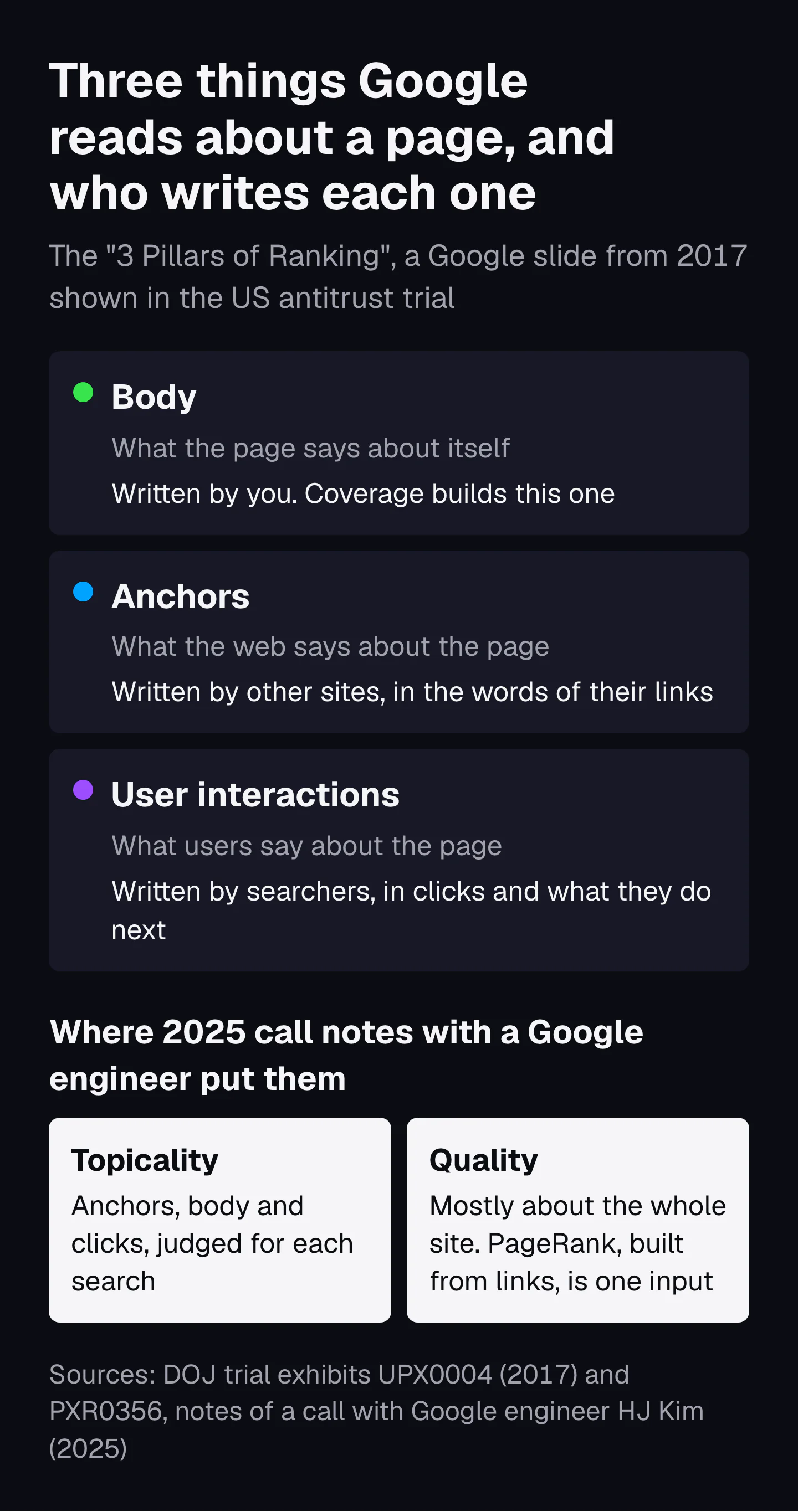
Coverage writes the first pillar. A topical map plans every page your subject needs, and the body of those pages is yours. Anchors are written by other people, in the words of the links they give you. Clicks are written by searchers.
Two jobs a link does, in two places
Notes of a February 2025 call between Google engineer HJ Kim and Google's lawyers and expert witness, filed in the trial as exhibit PXR0356, say where each signal counts. Anchors, "a source page pointing to a target page (links)", are one of three "ABC signals" with body and clicks. The notes say "ABC signals are the key components of topicality", and that topicality "is connected to a given query".
Quality is different. The same notes call it "Generally static across multiple queries" and say it is "largely related to the site rather than the query". Then comes the line about links. PageRank, Google's original system for scoring pages by the links pointing at them, "is a single signal relating to distance from a known good source, and it is used as an input to the Quality score."
So a link does two jobs: its words tell Google what your page is about for one search, and its PageRank feeds a quality score that is mostly about your site, not the search. No page you publish can do either job for you.
| Job | Coverage (your pages) | Links from other sites | Mentions without a link |
|---|---|---|---|
| Says what a page is about | Yes, through the body text | Yes, through the link's words and the sentence around them | Partly: your name next to a subject |
| Adds to how far your site is trusted | Not directly | Yes: PageRank is one input to the quality score | Nothing to follow; a Google patent counts it another way |
| Answers the searches people type | Yes | No: a link to a page you never wrote ranks nothing | No |
| Gets a new page found | Yes, through internal links | Yes, when the crawler follows it | No |
| Can you make it yourself? | Yes | No | No |
The reverse holds too. A link cannot rank a page you never wrote. Anchor words pointing at a page that does not answer the search do not make it answer. That is why I build coverage first: links need somewhere worth landing. How links inside your own site share that weight is in internal links inside a topical map.
What Google, Bing, the trial and the leak say about links
In public, Google has played links down for years. In court, its own records still treat PageRank as a key quality signal. Bing writes that links should be "earned organically". The 2024 leak shows Google stores far more about a link than the fact that it exists.
What Google says in public
Gary Illyes of Google said at PubCon in September 2023 that he would not put links in the top three ranking signals, as Search Engine Roundtable reported. At SERP Conf in April 2024 he repeated it more bluntly, in words the same site reported from a listener's notes: "We need very few links to rank pages... Over the years we've made links less important."
Less important is not unimportant. Very few links is still some links.
What the court record says
Judge Amit Mehta's remedies opinion of 2 September 2025 says "a key quality signal is PageRank, which captures a web page's quality and authoritativeness based on the frequency and importance of the links connecting to it" (page 143 of the opinion, 147 of the PDF). On the same page it says two exhibits suggest Google's popularity signal draws on "Chrome visit data" and "the number of anchors", which is "used to promote well-linked documents", while noting the record did not show to what extent.
Notes of a January 2025 call with Google's Pandu Nayak, with the same lawyers and expert (exhibit PXR0357), say PageRank "continues to be one of the factors" in the quality signals. They also say Google "avoids simply 'predicting clicks' because clicks are easily manipulated".
What the 2024 leak shows Google keeps about a link
Google confirmed to The Verge on 29 May 2024 that the leaked Content Warehouse documents are real. For each anchor, the AnchorsAnchor record has a sourceType field "to record the quality of the anchor's source page", plus fields for the full text to the left and right of the link.
Per page, an anchor statistics record holds spamLog10Odds, "The log base 10 odds that this set of anchors exhibits spammy behavior", and a field that identifies a "spike of spammy anchor phrases". A site-level siteAuthority value is "applied in Qstar", which reads like the Q* quality score in the call notes.
In plain words, the documentation lists fields for the page that links to you, a quality tier for that page, the words around the link, and the odds that a burst of anchor phrases is spam. It does not say how much any of them counts.
What Bing writes down
Bing's Webmaster Guidelines, which now cover Copilot too, say "Strong internal and external linking supports discovery, authority evaluation, and grounding eligibility." Grounding is Bing's word for the pages an AI answer is built from. The same guidelines list "link buying, link spamming, private networks" as link schemes and say "Links should be earned organically through high-quality, useful content."
Where "relevant links count more" comes from
Every guide on page one says a link from a site in your field beats a random one. None says why. The idea is older than most SEO blogs.
- Hilltop (about 1999). Krishna Bharat and George Mihaila proposed ranking broad searches from a special index of "expert documents" on the topic. Bharat later worked at Google.
- Topic-Sensitive PageRank (2002). Taher Haveliwala computed a separate importance score for each topic instead of one score for the whole web.
Both make the same point: a link counts for the subject the linking page is about.
How a mention counts without a link
A mention is your name on someone else's page with no link. Google patented a way to count it as an "implied link". In AI answers, mentions line up with visibility far better than backlink counts do.
The patent is US8682892B1, "Ranking search results", by Navneet Panda and Vladimir Ofitserov. It was filed in 2012 and granted on 25 March 2014, and Google Patents lists it as expired. It names two kinds of link. An express link is a hyperlink you can follow. "An implied link is a reference to a target resource, e.g., a citation to the target resource, which is included in a source resource but is not an express link".
The patent then weighs those links against "reference queries": searches that refer to the site, such as people typing its domain. A site that many independent pages point at, and that people also look for by name, scores differently from one with plenty of links and nobody searching for it. Google's 2015 site quality patent builds a score from searches that name a site in a similar way.
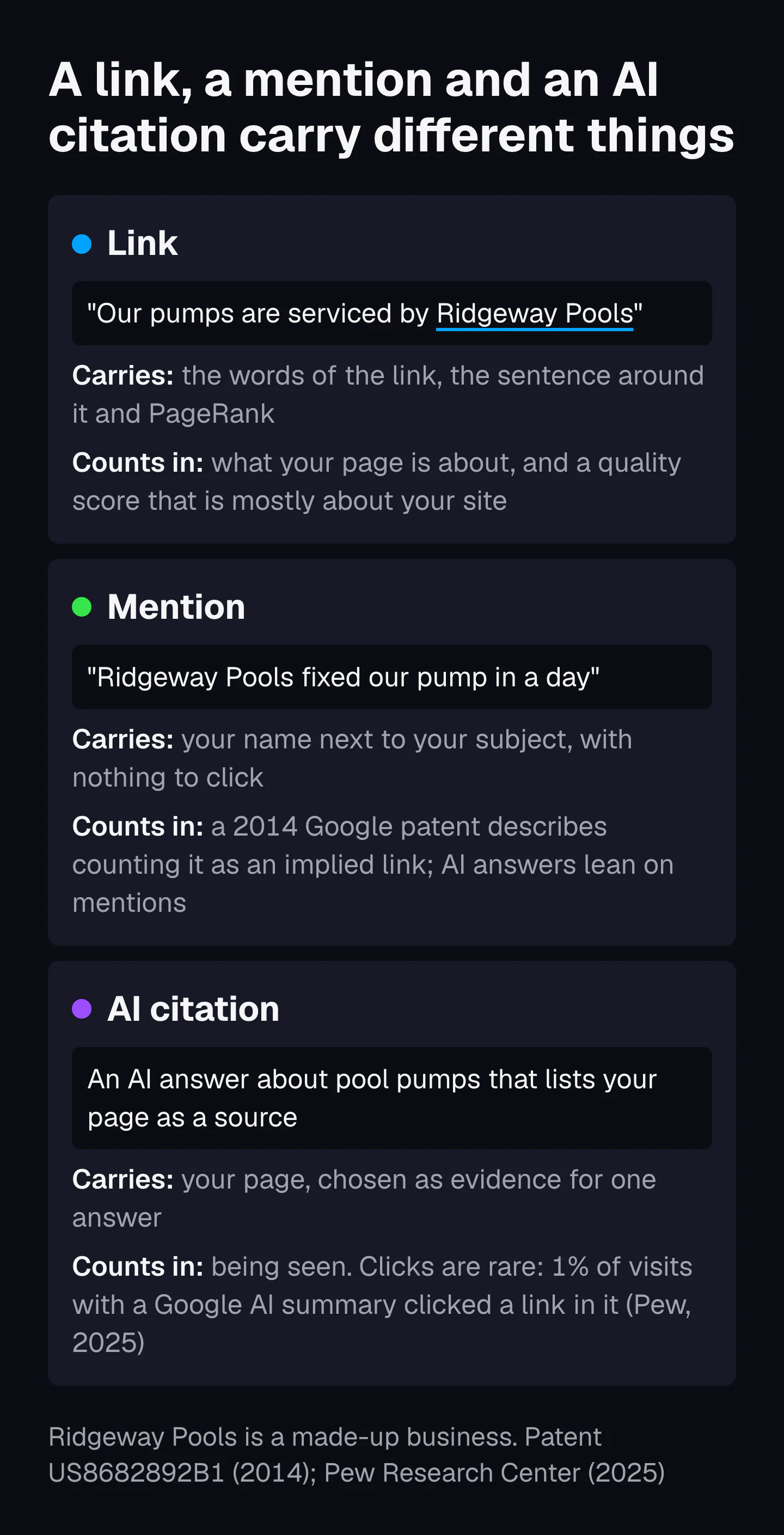
A patent shows a method Google owned, not one it runs today. It does explain why a store named in a trade magazine without a link has still gained something.
Mentions only help on your own subject
Koray Tuğberk Gübür, whose case studies gave SEO the terms topical map and topical authority, states the limit plainly. In a February 2024 post he wrote: "If your source context is irrelevant to your topic, the high authority references, whether links or linkless mentions, won't bring you closer to your industry's central query networks."
Source context is his term for what a site exists to do and how it earns money; source context and the central entity explains it. His other line in the same post sums up this whole lesson: "It is not Links vs Semantics; it is Links in Semantics." The rest of his vocabulary is in Koray's topical map framework.
What a 75,000-brand study found
Ahrefs, an SEO tool company, compared data on 75,000 brands with how often ChatGPT, AI Mode and AI Overviews mention them (December 2025, using a standard rank correlation). Branded web mentions correlated at 0.66 to 0.71 with AI visibility, and YouTube mentions topped the list at about 0.74. Links that carry the brand name also correlated (0.628 in AI Mode). Plain link counts showed what the authors call "very weak correlations", and the number of pages on a site, about 0.19, showed almost no relationship.
That is a correlation, from a company that sells the metrics it measured. It counts brands named in answers, not pages cited. It still points one way: for AI answers, being talked about beats being big.
What AI answer engines cite, and why the studies disagree
AI answer engines cite third-party sources more than brand sites, and they often cite pages outside Google's top 10. The studies disagree on how often because each one counts something different.
The clearest academic result is from a University of Toronto team. Chen and colleagues (2025) ran controlled tests across several fields and languages. They found AI search shows "a systematic and overwhelming bias towards Earned media (third-party, authoritative sources) over Brand-owned and Social content". Earned media means pages on independent sites, such as reviews, news and guides. For a business, that is where the reputation half lives.
| Study | What it counted | Finding |
|---|---|---|
| Ahrefs, 2025 | The top 3 citations in 1 million AI Overviews | 76.1% ranked in Google's top 10 for the same search |
| Ahrefs rerun, 2026 | Every citation, not only the top 3, in 863,000 results pages, with new parsing | 37.9% in the top 10 |
| BrightEdge, Sep 2025 | AI Overview citations in 9 industries | 16.7% from the top 10; 54.5% ranked somewhere |
| seoClarity, Oct 2025 | 362,000 searches: is any top 10 page cited at all? | Yes for 90% of them |
| Ahrefs, 2025 | 15,000 long-tail prompts in ChatGPT, Gemini, Copilot and Perplexity | About 12% of cited pages were in Google's top 10 for the prompt |
| Profound, Aug 2024 to Jun 2025 | 680 million citations (not an overlap study) | Wikipedia was 7.8% of all ChatGPT citations |
| Pew Research Center, 2025 | The real browsing of 900 US adults (clicks, not overlap) | A result was clicked in 8% of visits with an AI summary, 15% without |
These figures do not contradict each other. "90% of searches have a top 10 page cited" and "16.7% of citations come from the top 10" can both be true. The first counts searches with at least one overlap. The second counts every single citation. One company's own figure fell from 76% to 38% when it began counting every citation instead of the top three and changed its parsing. Its authors suggest a third reason: assistants split a question into several hidden searches (query fan-out) and cite pages that rank for those sub-questions, not for the original prompt.
Two warnings come with every AI citation number. Columbia's Tow Center asked eight AI search tools to name the source of 1,600 news excerpts in 2025, and they were collectively wrong on more than 60% of them. And a citation rarely sends a visit: in Pew's panel, people clicked a link inside the AI summary in 1% of visits.
What I take from it: rank well for the sub-questions your map covers, and get talked about on other sites, because that is where AI answers look for corroboration. How to get the map's own pages cited is in getting a topical map cited in AI answers.
A store that grew 29 times on content with few links
One of our clients, an online nicotine pouch store selling mostly to the US, grew from 3,500 to 102,000 Google clicks a month in 15 months. In that time the number of sites linking to it went from about 80 to about 200. Later the linking sites tripled, and clicks still fell.
When we started in May 2022 the store had a few hundred pages and few links: about 80 sites linked to it. We spent the first year answering the questions buyers actually type, like what happens if you swallow a pouch, whether you can take one on a plane, and which pouches are strongest. Links came slowly.
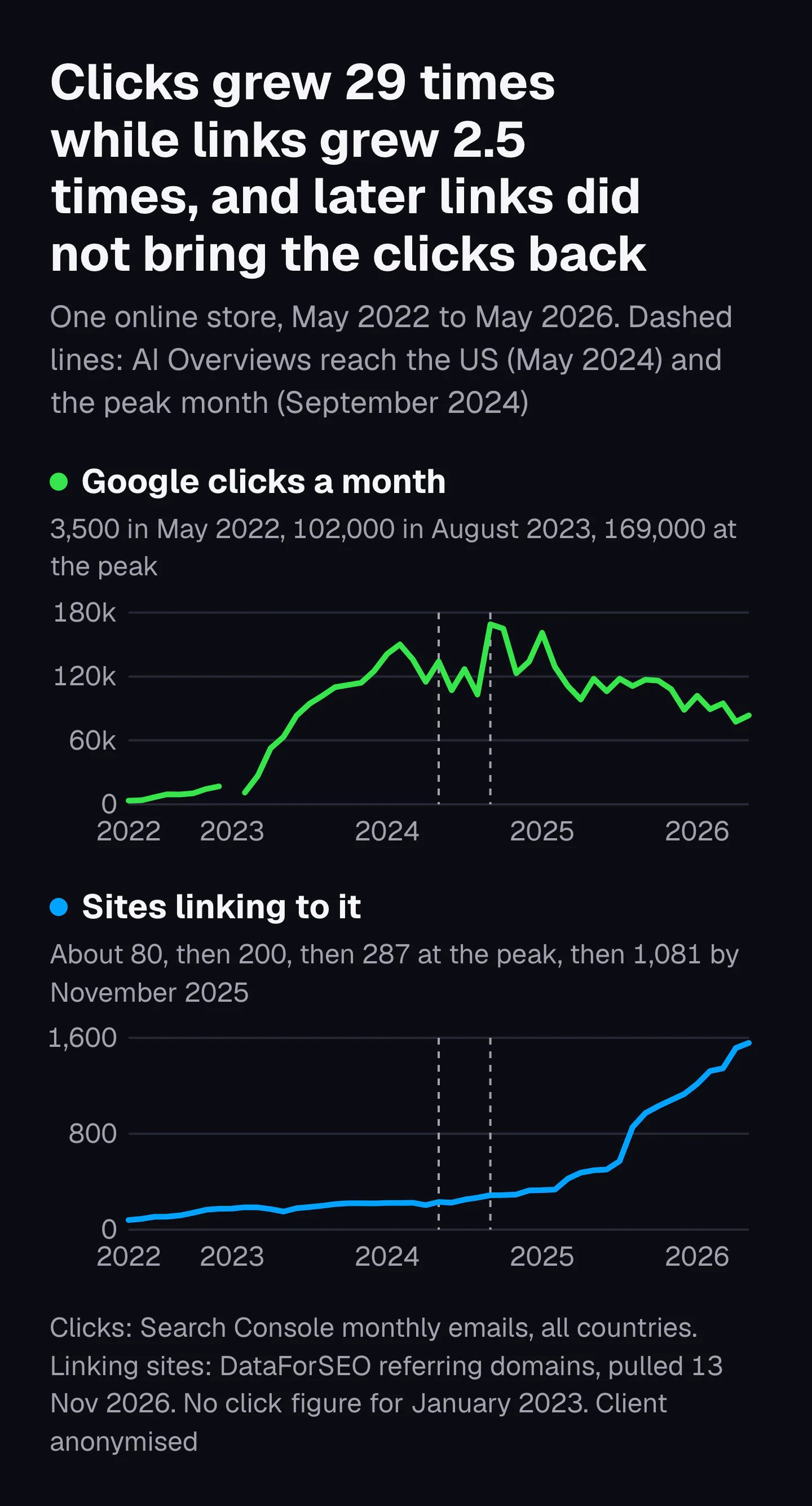
| Month | Google clicks | Impressions | Click rate | Sites linking |
|---|---|---|---|---|
| May 2022 | 3,500 | 230,000 | 1.52% | 80 |
| Mar 2023 | 26,800 | 799,000 | 3.35% | 185 |
| Jul 2023 | 94,300 | 2,150,000 | 4.39% | 188 |
| Aug 2023 | 102,000 | 2,320,000 | 4.40% | 200 |
| Sep 2024 (peak) | 169,000 | 2,890,000 | 5.85% | 287 |
| Feb 2025 | 129,000 | 3,810,000 | 3.39% | 334 |
| Nov 2025 | 108,000 | 5,250,000 | 2.06% | 1,081 |
| Mar 2026 | 94,800 | 8,140,000 | 1.16% | 1,346 |
| May 2026 | 83,500 | 6,340,000 | 1.32% | 1,558 |
Clicks, impressions and click rate come from Google's monthly Search Console emails for the whole site, all countries. Sites linking is the referring domain count from a link data provider, pulled on 13 November 2026.
Coverage did the climbing
The fastest climb ran from March to July 2023, when clicks went from 26,800 to 94,300. Month by month in those five months, the count of linking sites read 185, 171, 151, 179 and 188. It barely moved, and it dipped in the middle. At the peak of 169,000 clicks in September 2024, about 290 sites linked to the store. Clicks rose 29 times while linking sites rose 2.5 times, and the fastest climb came while the link count stood still. What grew in that stretch was the set of pages answering what buyers search for.
Links tripled, and the clicks did not come back
From February to November 2025 the linking sites went from 334 to 1,081, and on to 1,558 by May 2026. Over the same months clicks went from 129,000 to 108,000, then to 83,500. Impressions went the other way, to a record 8.14 million in March 2026. The share of impressions that got a click fell from 5.85% at the peak to 1.16% in March 2026.
Our report to the client for March 2025 put most of the missing clicks down to AI Overviews, "Not a decrease in ranks". Google kept showing the site. People got the answer at the top of the results and did not click. More links did not bring the clicks back.
Koray's own published cases point the same way and carry the same limit. His case study on Oncrawl, published on 11 February 2021, reports an English-learning site going from 10,000 to over 200,000 monthly clicks in about five months, with no backlinks by design. Those are his reported numbers, with no control either.
I am not holding up this store's link building as the way to do it. The next section is how I would earn links today.
Which links a small site can earn without breaking a spam policy
The best links for a small site come from people who already know the business: suppliers, partners, customers, trade and local bodies, and journalists who need a number you have. The line you never cross is trading money, goods or a product for a link.
Google's spam policies (last updated 28 August 2026) list what counts as link spam. Three lines catch small businesses most often:
- "Sending someone a product in exchange for them writing about it and including a link"
- "Excessive link exchanges ("Link to me and I'll link to you") or partner pages exclusively for the sake of cross-linking"
- "links with optimized anchor text in articles, guest posts, or press releases distributed on other sites"
Paying for a placement is allowed "as long as they are qualified with a rel="nofollow" or rel="sponsored" attribute". A qualified link is meant to pass no ranking credit, but the mention and the visitors are still real.
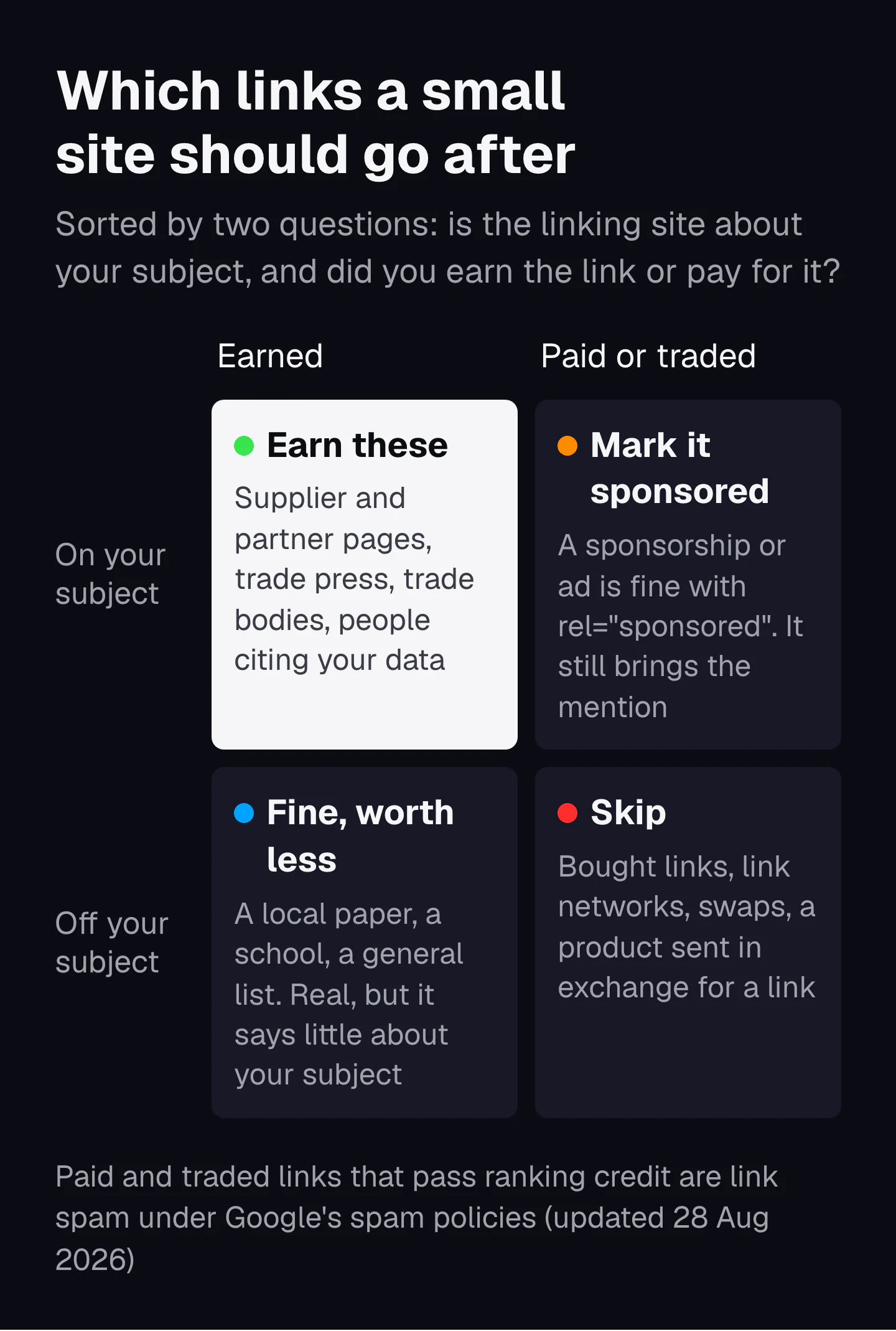
| Source | Why they would link or mention you | What you offer | Where the policy line sits |
|---|---|---|---|
| Suppliers and manufacturers | You sell or service their products | Your dealer details and proof you stock the range | A dealer or "where to buy" page reflects a real relationship |
| Partners and software you use | You are a customer who can explain your setup | A short case study in your own words | Fine, unless the page exists only to swap links |
| Business customers | You did work they are proud of | A write-up they can publish, with their numbers if they agree | Never make a link a condition of a discount: that trades services for links |
| Trade bodies and associations | You are a member doing real work in the field | Member details, a story for their newsletter, a talk | A judgment call: keep a member listing plain and treat it as a listing, not a ranking tactic; if the link is what you are buying, mark it sponsored |
| Local bodies, schools and events | You are part of the area | An event, a talk, a sponsorship | Sponsorship links should carry rel="sponsored"; the mention still counts as a mention |
| Trade and local press | You have a number or a view they need | Original data, a quote with your name and role | Pitch the story, not the link; no press releases stuffed with keyword links |
| People citing your own data | Yours is the only source for a figure | One page with your method and your numbers | Fine, and it keeps earning without more work |
Why original data is the strongest of these
A journalist or a blogger needs a source for a number. If yours is the only place that number exists, the citation goes to you, on someone else's site. That is exactly the earned media AI answers lean on. It is also the cheapest item on the list to keep alive: one page with the method and the figures, updated once a year. Finding a number nobody else has is covered in information gain.
Download the link prospect sheetCSV for Google Sheets or Excel. One row per site you could earn a link or mention from, with the policy check filled in for eight common source types. The example rows are made up.
Is my problem coverage or reputation? A decision table
Read Search Console before you buy anything. No impressions means a coverage or indexing problem. Impressions stuck below page one usually means reputation. Rising impressions with falling clicks means AI answers or a changed results page, and more links will not fix that.
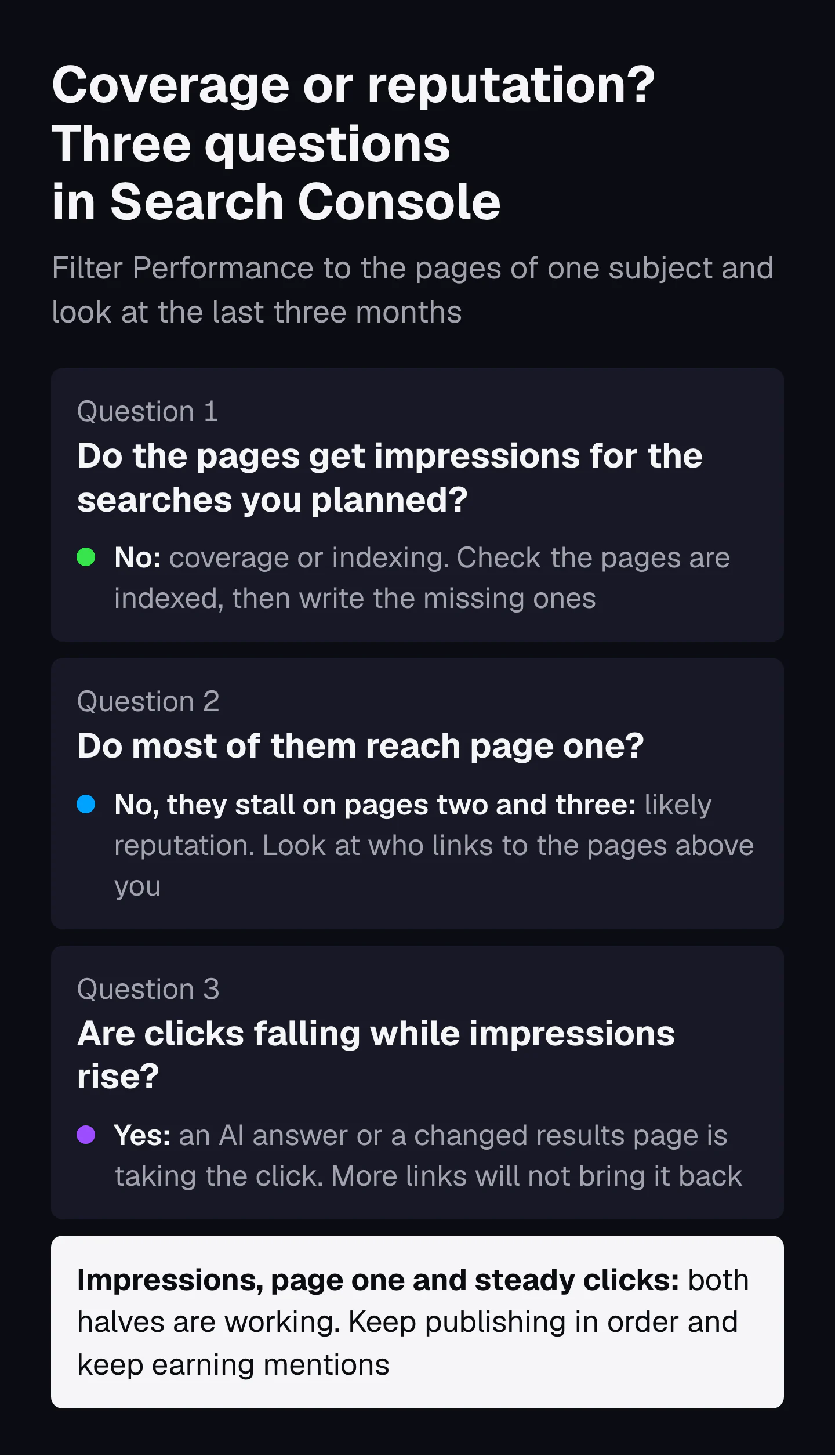
Filter the Performance report to the pages of one subject and compare the last three months with the three before. The rows below are my rules of thumb from reading client accounts, not the result of a published test.
| What you see | Likely cause | What to do first |
|---|---|---|
| Few or no impressions for the searches you planned pages for | Coverage or indexing | Check the pages are indexed with URL Inspection, then write the pages the map still lacks |
| Impressions, but positions 11 to 30 for most searches | Usually reputation | Look at who links to the three pages above you for each search, and earn links from the same kinds of sites |
| Page one for detailed questions, page two or lower for the broad searches | Both | Keep publishing, and point the links you earn at the hub pages that target the broad searches |
| Impressions rising, clicks falling, positions steady | AI answers or a changed results page | Check whether an AI Overview shows for those searches; work on being cited and on what the page offers beyond the answer |
| Positions falling across the whole subject at once | A Google update or a quality problem | Match the dates against Google's ranking updates and review the weakest pages before adding links |
| Impressions, page one and steady clicks | Both halves working | Keep publishing in the map's order and keep earning mentions |
| Searches for your brand flat for a year while your pages rank | Little reputation outside the site | Get named where your buyers read: trade press, partners, podcasts |
The fourth row is the store from the case. On clicks alone it looked like a site in decline. It was a site Google still showed, answering questions people no longer clicked through for. Reading those numbers month by month is covered in how to tell if a topical map is working, and the short version of this table sits in topical authority.
What I would do this month, in order:
- Answer the three questions for your most important subject, with the last three months against the three before.
- If it is coverage, fix indexing and write the missing pages before you ask anyone for a link.
- If it is reputation, list the three pages above you for your five most important searches and note who links to them. Then fill the link prospect sheet with the sources you can reach honestly.
If your answer is the first row and you would rather have the coverage half planned for you, that is what our growth plan is.
Common questions
How many backlinks do I need for topical authority?
There is no number. Search Engine Roundtable reported in April 2024, from a listener's notes, that Google's Gary Illyes said Google needs very few links to rank pages. Compare your site with the pages above you for your own searches, not with a target count.
Is topical authority more important than backlinks?
They do different jobs. Your pages decide which searches you can answer; links help decide how far your site is trusted for them. One store we worked with grew 29 times on coverage with few links. In my experience links matter more where the pages above you already have strong link profiles.
Do nofollow links and unlinked mentions help?
A nofollow or sponsored link is meant to pass no ranking credit, but it can still bring visits and put your name next to your subject. A Google patent describes counting mentions without links as implied links, and AI answers lean on mentions.
Sources
- Life of a Click (user-interaction), trial exhibit UPX0004, US Department of Justice, 2017
- Interview with H.J. Kim, notes, remedies exhibit PXR0356, US Department of Justice, 2025
- Interview with Pandu Nayak, notes, remedies exhibit PXR0357, US Department of Justice, 2025
- United States v. Google LLC, memorandum opinion on remedies (Document 1436), US District Court for the District of Columbia, 2025
- Google: Links No Longer A Top Three Ranking Signal, Search Engine Roundtable, 2023
- Google: We Need Very Few Links To Rank Pages; Links Are Less Important, Search Engine Roundtable, 2024
- Google confirms the leaked Search documents are real, The Verge, 2024
- AnchorsAnchor (leaked Content Warehouse API documentation), HexDocs, 2024
- IndexingDocjoinerAnchorStatistics (leaked Content Warehouse API documentation), HexDocs, 2024
- CompressedQualitySignals (leaked Content Warehouse API documentation), HexDocs, 2024
- Bing Webmaster Guidelines, Microsoft Bing, 2026
- Hilltop: A Search Engine based on Expert Documents, University of Toronto (Bharat and Mihaila), 1999
- Topic-Sensitive PageRank, ACM (Haveliwala, WWW 2002), 2002
- US8682892B1: Ranking search results (implied links), Google Patents, 2014
- US9031929B1: Site quality score, Google Patents, 2015
- 3 Suggestions about Topical Authority, Medium (Koray Tuğberk Gübür), 2024
- Generative Engine Optimization: How to Dominate AI Search, arXiv (Chen, Wang, Chen and Koudas), 2025
- Google users are less likely to click on links when an AI summary appears in the results, Pew Research Center, 2025
- AI Search Has A Citation Problem, Columbia Journalism Review, Tow Center, 2025
- Spam policies for Google web search, Google Search Central, 2026