Where the topical map came from: topic maps to SEO
A topic map is an ISO standard, first published in 2000 as ISO/IEC 13250, for describing a body of knowledge as topics, the typed associations between them, and occurrences, the resources about each topic.
The topical map got its SEO name in 2021, but almost every part of it is older. Here is the family tree with dates and names: library shelves, thesauri, concept maps, the ISO topic maps standard, ontologies and link research, and the one thing a person building a map today should take from each.

Key takeaways
- Almost every part of today's topical map is older than SEO: one place per subject comes from library classification (Dewey, 1876), one term per concept from retrieval thesauri (Du Pont, 1959), labeled links from concept maps (Novak, 1972), and topics, associations and occurrences from the ISO topic maps standard (2000).
- Cannibalization is the oldest problem in the family: Ranganathan rejected Dewey's scheme partly because one book could take two class numbers, and topic maps were invented to merge indexes, with a rule that two topics about the same subject become one.
- Koray Tuğberk Gübür's case study of 11 February 2021 is the article that taught SEO to plan with a topical map, and its first step points back at the ancestors: "Remember ontology and taxonomy?"
- What SEO added that the libraries never had is search demand, pages that earn money, a publishing order, and a search engine that decides which relations count.
- Google still reads "topical map" as a land map: on 12 November 2026 all ten US results for the term were about topographic maps, so a builder should check what Google thinks a word means before building a page on it.
The short answer: seven older ideas under a 2021 name
The topical map is a 2021 SEO name for ideas built up over 145 years. Library classification gave it one place per subject in 1876. Thesauri gave it one term per concept in 1959. Concept maps gave it labeled links in 1972. Ontologies, from 1993, gave it typed relations. The ISO topic maps standard gave it topics, associations and occurrences in 2000.
Link research then made authority depend on the topic, between 1997 and 2002. Content marketing named the topic cluster in 2017. Koray Tuğberk Gübür built the whole thing into an SEO plan in 2021.
You do not need any of this history to build a map. You need it to build a good one, because each ancestor solved a problem your map still has. The family tree below shows which part of what a topical map is came from where.
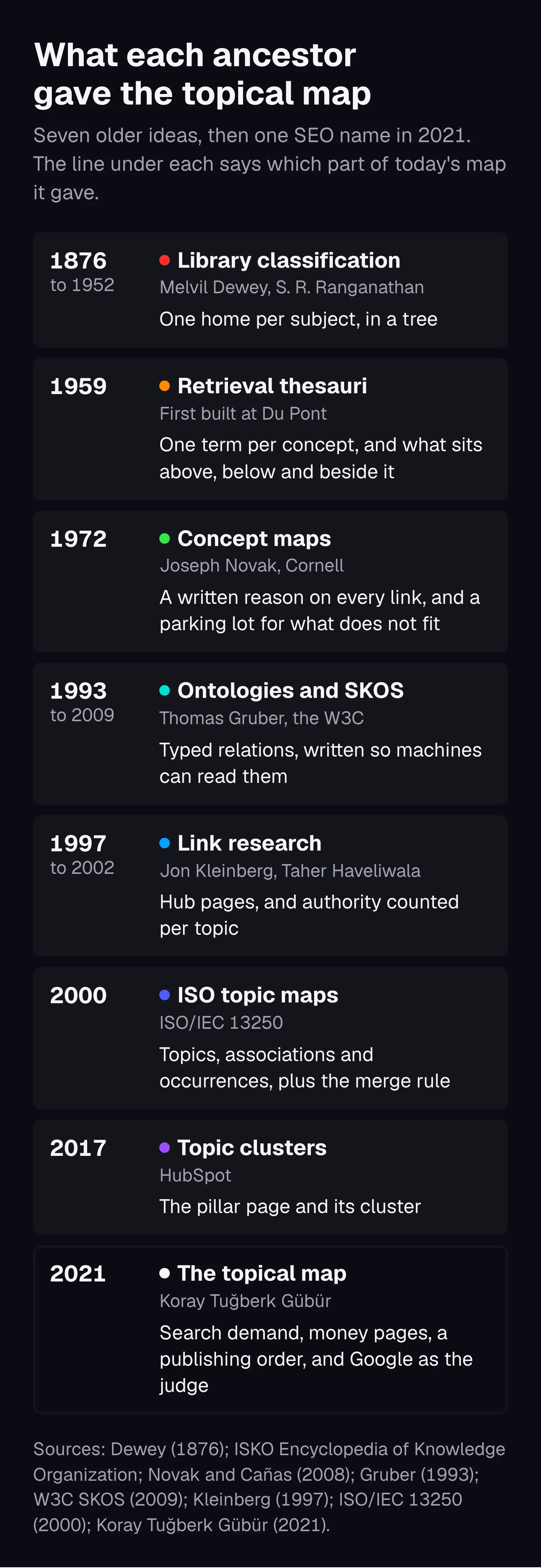
The best evidence that this is a real lineage, not a story told afterwards, is the founding SEO text itself. On 11 February 2021, Koray published "Importance of Topical Authority: A Semantic SEO Case Study" on Oncrawl. Step one reads: "Create a Topical Map Before Starting Publishing the First Article". The next words are "Remember ontology and taxonomy?"
The person who made the topical map an SEO standard pointed straight back at library and information science in his first sentence about it. When we pulled the US results for "history of topical maps" on 12 November 2026, none of the ten was about SEO. The rest of this lesson follows his pointer back, one ancestor at a time.
Library classification gave the map one home per subject
Library classification gave the topical map its first rule: every subject has one place, decided before the books arrive. Melvil Dewey published the scheme in Amherst, Massachusetts, in 1876, after the Amherst College Library adopted it in 1873.
The 1876 text, A Classification and Subject Index for Cataloguing and Arranging the Books and Pamphlets of a Library, says "the classification is mainly made by subjects or content". Its numbers already form a tree: 500 is science in general, 510 is mathematics and 513 is geometry. That is a pillar, a cluster and a page, 145 years early.
The Library of Congress started its own list of subjects soon after. Its Library of Congress Subject Headings "has been actively maintained since 1898". A list of subjects that one organization keeps up to date for over a century is what a topical map is for one website.
Ranganathan and the first cannibalization complaint
S. R. Ranganathan, a mathematician who became the first trained librarian of Madras University, found a flaw in Dewey. M. P. Satija's entry on Colon Classification in the ISKO Encyclopedia of Knowledge Organization gives his example. A book on "Anatomy of flowering plants" could take the number for plant anatomy or the number for the botany of flowering plants.
One book, two homes. In Ranganathan's view that "defeated the purpose of classification itself". Swap books for pages and shelves for search results. Now you have keyword cannibalization: two pages that answer the same search, so neither is clearly the one to show.
His fix came from a toy. In 1924, at Selfridge's department store in London, he watched a salesman build different toys from one Meccano kit. He conceived the Colon Classification from 1924 to 1928 and first published it in 1933. Instead of one ready-made slot per book, it built each subject from parts called facets.
In the fourth edition, in 1952, he cut the facets down to five fundamental categories: personality, matter, energy, space and time, known as PMEST. Two of his rules matter for a map:
- One basic subject: "every subject belongs to one and only one basic subject". Every page in a map belongs to one cluster first, even when it links to others.
- The wall before the picture: his Wall-Picture principle orders facets by dependency, because "there cannot be any mural without a wall". In a map, the page others depend on goes live first, which is the logic behind a publishing order.
| PMEST facet | What it asks | Pages it suggests on a made-up coffee gear store |
|---|---|---|
| Personality | What is the thing itself? | Burr grinders, espresso machines, pour-over drippers |
| Matter | What is it made of, what are its properties? | Ceramic vs steel burrs, stainless vs plastic drippers |
| Energy | What is done with it, or to it? | How to clean a grinder, how to dial in espresso |
| Space | Where? | Grinders for travel, espresso machines for small kitchens |
| Time | When? | New models this year, how long a grinder lasts |
Facets also reached shops. Birger Hjørland's ISKO entry on facet analysis cites the Circuit City website's camera filters, resolution, camera style, brand and price, as faceted classification on the web. Every store filter is a facet. Which filters deserve their own indexable page is covered in topical maps for ecommerce stores.
Thesauri gave the map one term per concept
Thesauri gave the topical map its rule that each concept gets one preferred term, with every variant pointed at it. The first full-scale, operational in-house retrieval thesaurus was built at E.I. du Pont de Nemours in Wilmington in 1959, per Stella G. Dextre Clarke's ISKO entry on the thesaurus, citing Roberts (1984).
A retrieval thesaurus is not the book of synonyms on a writer's desk. It is a controlled vocabulary for finding documents. Calvin Mooers first suggested one for retrieval in 1947. After Du Pont came the Thesaurus of Engineering and Scientific Terms in 1967, and the first ISO thesaurus standard, ISO 2788, in 1974.
The current standard, ISO 25964-1 from 2011, states the aim in one line: a thesaurus guides "the indexer and the searcher to choose the same term for the same concept". In the United States the same rules sit in ANSI/NISO Z39.19-2005 (R2010), the guidelines for controlled vocabularies.
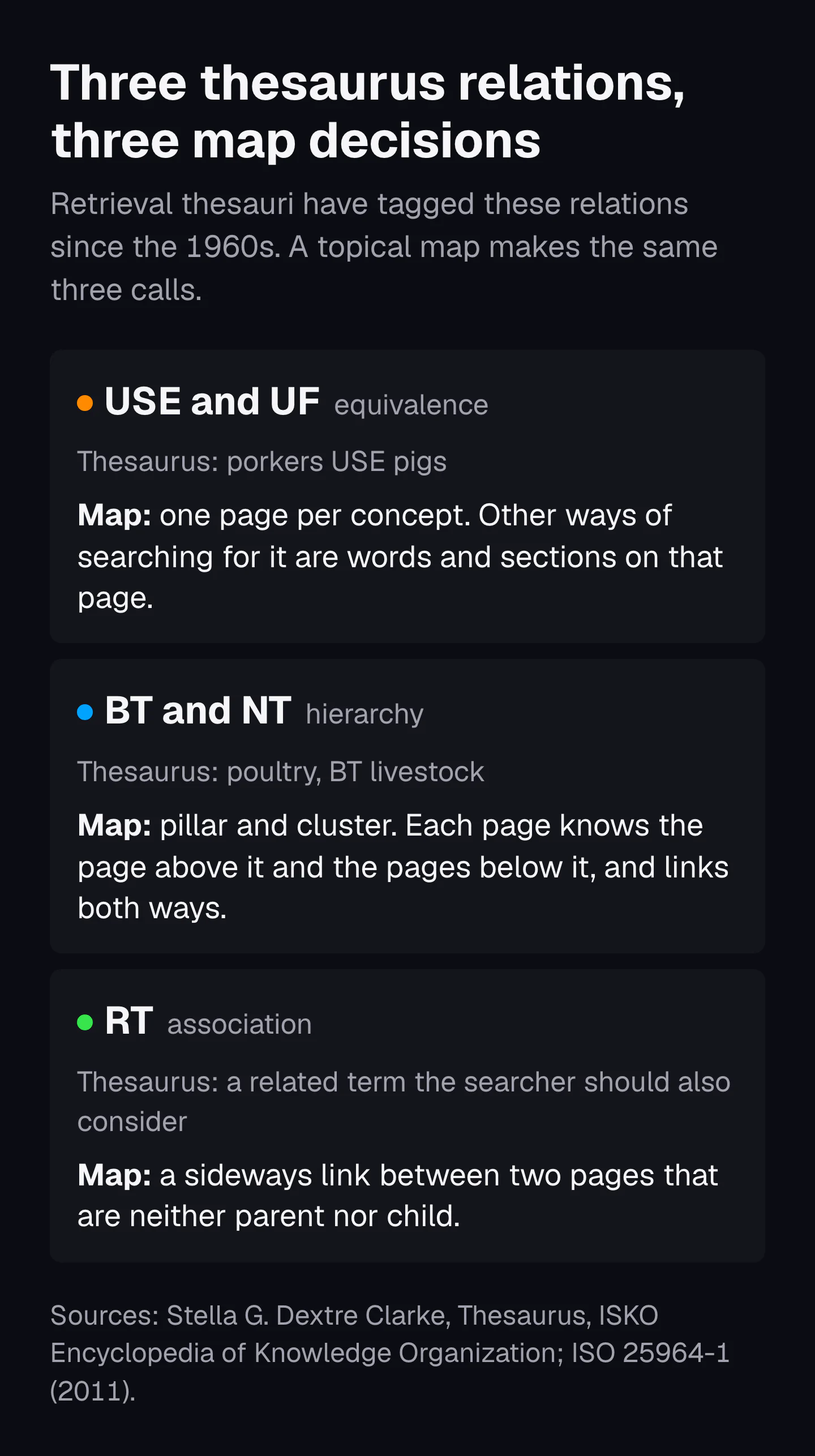
Thesauri record three kinds of relation, each with a tag that has not changed in decades. Each one is a decision your map makes too.
| Thesaurus relation | Tags | What it means | The topical map decision |
|---|---|---|---|
| Equivalence | USE, UF (use for) | "Pigs" is the preferred term; "porkers" points to it (USE pigs) | One page per concept. Variant searches become sections or words on that page. |
| Hierarchical | BT, NT (broader, narrower) | For example, "livestock" is broader than "poultry" | Pillar and cluster: which page sits above which, and links up and down. |
| Associative | RT (related term) | Two concepts a searcher should consider together | A sideways link between two pages that are neither parent nor child. |
The equivalence rule is the one most maps break. A list of 400 keywords often holds 40 concepts, each spelled ten ways. A thesaurus would collapse them into 40 entries with their variants listed under each. Deciding which searches are variants of one concept and which deserve their own page is the subject of when a search deserves its own page.
Concept maps gave the map labeled links and a parking lot
Concept maps gave the topical map two habits: start from one question, and write the relation on every line. Joseph Novak developed them in 1972 at Cornell, in a research program that followed how children's knowledge of science changed, built on the learning psychology of David Ausubel.
The source is Novak and Alberto Cañas's 2008 technical report for the Florida Institute for Human and Machine Cognition, The Theory Underlying Concept Maps and How to Construct and Use Them. Three parts of their method carry straight into a topical map.
- Linking words. "Words on the line, referred to as linking words or linking phrases, specify the relationship between the two concepts." Two concepts and their linking words form a proposition, a statement that can be true or false. A link on your map should be one too: "the burr grinder page links to the grinder cleaning page because burr grinders need cleaning every few weeks".
- A short list first. "Usually 15 to 25 concepts will suffice" for one map, ranked from the most general to the most specific. A topical map is bigger, but the habit holds: rank before you link.
- The parking lot. Novak and Cañas call the list of concepts waiting to be placed "a parking lot". Some concepts stay there when the map is finished, "if the mapmaker sees no good connection for these with other concepts in the map".
The parking lot is the most useful idea in this lesson for anyone with an older site. A page that connects to nothing else in your map does not belong in the map. My rule for buyers is the same one: a page without a purpose does not deserve to be on the website. Before removing one, I check whether it can merge into a page that is more relevant.
Novak and Cañas also warn about the opposite mistake. Once people learn to write good linking words, "they can see that every concept could be related to every other concept", and so "they must choose to identify the most prominent and most useful cross-links". That is the case for linking with restraint, covered in internal links inside a topical map.
The ISO topic maps standard gave the map its parts
Topic maps, published as ISO/IEC 13250 in 2000, gave the topical map its three parts: topics, the typed associations between them, and occurrences, the resources about each topic. They started in the early 1990s as a way to merge back-of-book indexes.
Who made topic maps, and when
Steve Pepper, founder of the topic map software company Ontopia, told the story in The TAO of Topic Maps, first published in June 2000. In the early 1990s, a group later known as the Davenport Group was working on how to exchange computer documentation; the same group went on to create DocBook. One of its problems was merging the indexes of different sets of documentation.
Pepper quotes the insight, which he credits to Steven R. Newcomb, one of the original developers: indexes "conform to models of the structure of the knowledge available in the materials that they index. But the models are implicit, and they are nowhere to be found!" Topic maps were the attempt to write those models down.
- 2000: ISO 13250:2000, the first standard, defined HyTM, a way of writing topic maps in SGML, the document markup language that came before XML. Its editors were Michel Biezunski, Steven R. Newcomb and Martin Bryan, per the committee's 2002 guide to the topic map standards.
- 2001: TopicMaps.Org, an independent group with Pepper as editor, wrote XTM, an XML syntax for the web. It was accepted into ISO 13250 in October 2001.
- 2006: ISO/IEC 13250-2:2006 set out the data model, edited by Lars Marius Garshol and Graham Moore. ISO's summary says it defines "the rules for merging topic maps".
Six parts of a topic map, and what each means for yours
What is a topical map shows the three parts everyone knows. Pepper's paper describes more. These six are the ones that matter to a person planning pages.
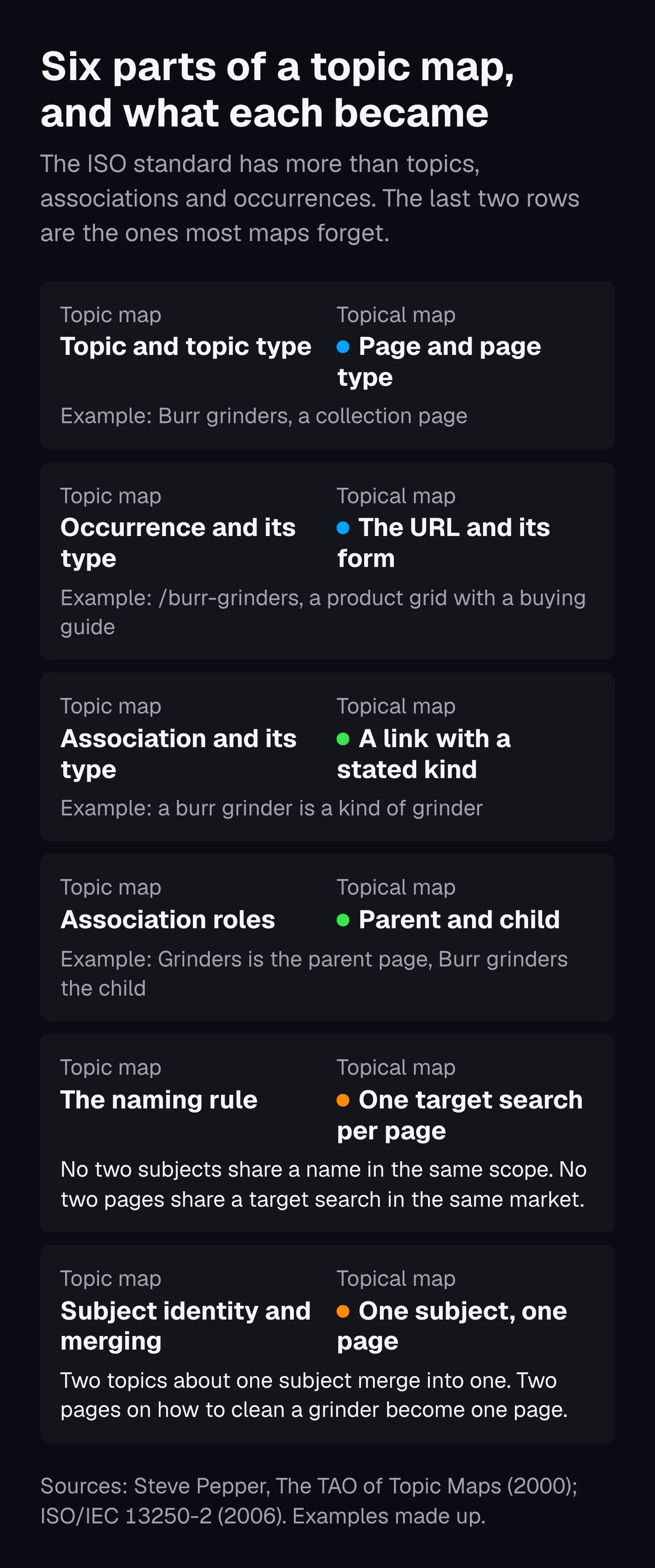
| Topic map part (Pepper, 2000) | What the standard says | In a topical map |
|---|---|---|
| Topic and topic type | A topic stands for any subject; topics have types, such as composer or opera | A page and its page type (collection, guide, comparison) |
| Names and variants | A topic can have several names; "no two subjects can have exactly the same base name in the same scope" | One target search per page; no two pages share it in the same market |
| Occurrence and its type | A resource about the topic, typed as an article, an illustration, a mention | The URL that covers the subject, and what form it takes |
| Association and its type | A relationship between topics, typed as written by, takes place in, born in | An internal link with a stated kind: part of, kind of, compared with |
| Association roles | Associations have no direction; roles say who plays which part, influencer or influencee | Which page is the parent and which the child in a link pair |
| Subject identity and merging | Two topics about the same subject are merged into one with the union of their names, occurrences and associations | Two pages that answer the same search become one page that keeps the best of both |
The last row is the one I would print out. Pepper writes that the goal is a one-to-one relationship between topics and subjects, "in order to ensure that all knowledge about a particular subject can be accessed via a single topic". When two topics turn out to share a subject, they are merged.
That is the oldest anti-cannibalization rule there is, written for merging indexes in the 1990s. It works the same way on a website. Two pages, one subject: keep one URL, move the best content of the other into it, and redirect the old address.
One part of the standard maps onto something SEO usually leaves unwritten: scope. Pepper's example is the word "tosca", which means Puccini's opera to his readers and "quite other and sweeter connotations" to an audience of bakers. A topic map records the context a name is valid in. A topical map does the same when it states the site's market and purpose, the source context.
Taxonomies, ontologies and SKOS took the idea onto the web
Taxonomies sort subjects into a tree, ontologies add typed relations and properties, and SKOS writes thesauri and taxonomies in a form the web can read. A good topical map sits between a thesaurus and an ontology on that line.
The word ontology came into computing with a definition that still fits a map. Thomas Gruber wrote in 1993, in A translation approach to portable ontology specifications: "An ontology is an explicit specification of a conceptualization." A topical map is that for one business, written down so somebody else can check it.
The web got its own taxonomies quickly. Maria Teresa Biagetti's ISKO entry on ontologies notes that Yahoo! ran a directory of sites by subject categories from 1994 to 2002, and that the volunteer directory DMOZ kept a taxonomy of the web from 1998 to 2017.
In May 2001, Tim Berners-Lee, James Hendler and Ora Lassila described The Semantic Web in Scientific American, a web where machines read meaning, not only text. The W3C then published SKOS, the Simple Knowledge Organization System, as a Recommendation on 18 August 2009. SKOS gives thesauri and taxonomies a shared format: preferred and alternative labels, broader, narrower and related.
Google took the same step in search on 16 May 2012. Its post Introducing the Knowledge Graph: things, not strings said the graph held "more than 500 million objects, as well as more than 3.5 billion facts about and relationships between these different objects". Search had moved from matching words to knowing things, which is where semantic SEO in plain words picks up the story.
Where a topical map sits on the line
Knowledge organization researchers arrange these tools by semantic richness, the number of kinds of relation they can hold. The ISKO entry cites Marcia Zeng's 2008 spectrum and Olensky's 2010 "semantic staircase", rising from simple word lists to ontologies.
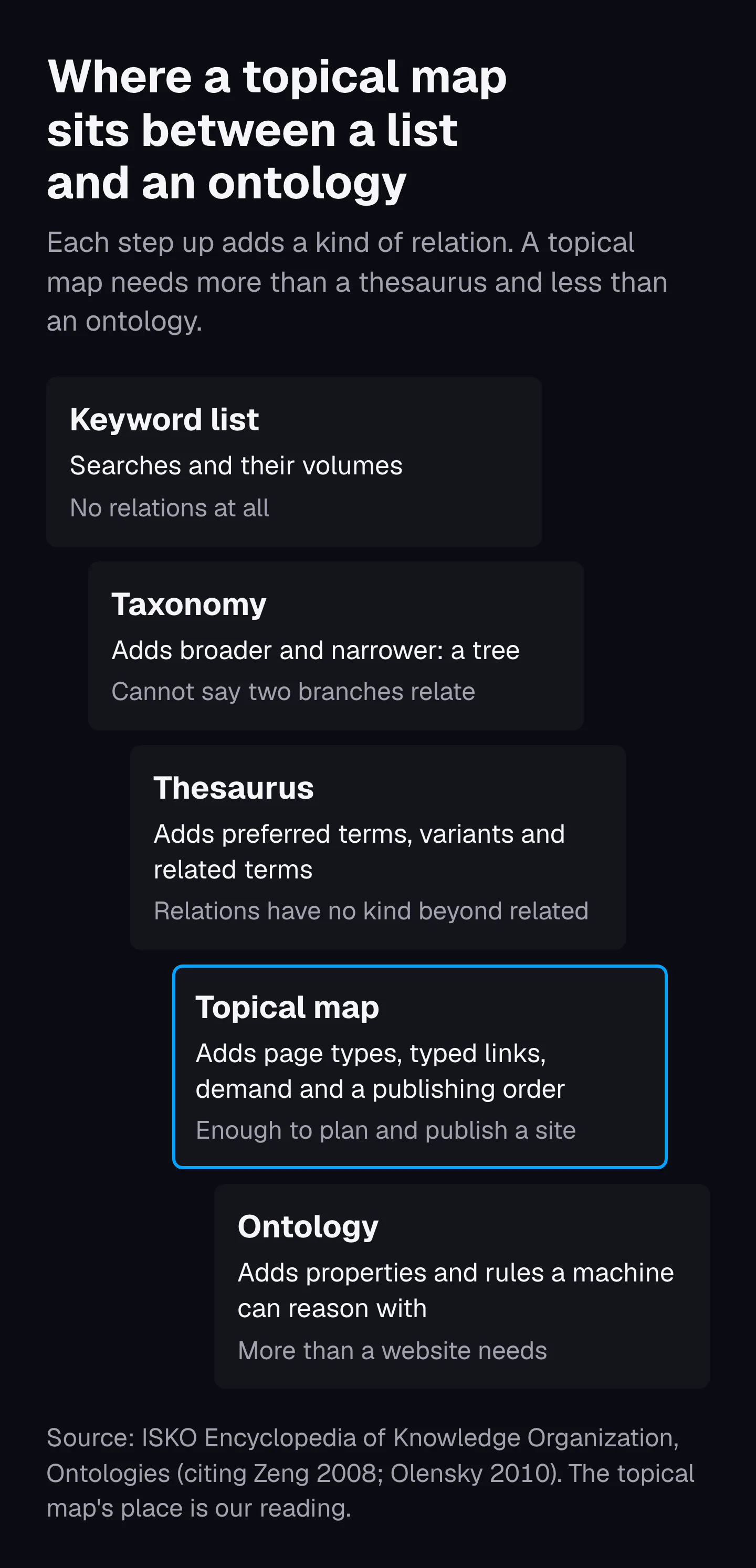
| Tool | What it records | What it misses for SEO |
|---|---|---|
| Keyword list | Searches and their volumes | Any relation between them |
| Taxonomy | A tree: broader and narrower | Sideways relations, page types, order |
| Thesaurus | Preferred terms, variants, broader, narrower, related | Types of relation beyond "related", attributes |
| Topical map | Pages, page types, typed links, demand, publishing order | Formal logic, which search pages do not need |
| Ontology | Classes, properties, typed relations, rules a machine can reason with | Demand, money pages, order |
Search engines made authority a property of a topic
Link research made authority depend on the topic. Jon Kleinberg's hubs and authorities, first circulated as an IBM research report in May 1997, found the best pages on a broad topic through the hub pages that link to them.
His paper, Authoritative Sources in a Hyperlinked Environment, puts it in one line: "a good hub is a page that points to many good authorities; a good authority is a page that is pointed to by many good hubs." The two make each other stronger.
In 1998, Sergey Brin and Lawrence Page described Google's first design and its PageRank in The Anatomy of a Large-Scale Hypertextual Web Search Engine. Haveliwala's 2002 abstract describes that original PageRank this way: "a single PageRank vector is computed" for the whole web. In 2002 Taher Haveliwala of Stanford proposed Topic-Sensitive PageRank: instead of one score, "a set of PageRank vectors, biased using a set of representative topics". Importance became something a page has for a topic.
Papers show what researchers designed, not what Google runs today. But they explain two habits of a good map. A pillar page is a hub inside one site, which is the subject of pillar pages. And if importance is counted per topic, a cluster whose links wander off its topic spends its strength in the wrong place.
Marketing named the cluster in 2017, and Koray named the map in 2021
The SEO words arrived last. HubSpot launched a topic cluster tool in September 2017, and Koray Tuğberk Gübür published the case study that taught SEO to plan with a topical map on 11 February 2021.
On 7 September 2017 the trade press reported HubSpot's new Content Strategy tool and its "topic-based model on creating content, called topic clustering". HubSpot's reason: "For years, the best way to solidify a spot at the top of the results was to focus on creating multiple pieces of content focused on niche, long-tail keywords." The pillar and cluster spread through content marketing from there. How a cluster differs from a full map is in topical map vs topic cluster.
Koray did not invent the words. His own article shows a "Topical Map (Topical Graph) example" from InLinks, an SEO company. What his February 2021 case study on Oncrawl did was make the map the first step of a published method, with results attached. Its page carries the publish date 11 February 2021. The longer version on his own site was first published the same day and updated in 2022. Jason Barnard, writing in Search Engine Land in 2026, says Koray "coined 'topical map' as a standard SEO deliverable".
I learned this method from Koray, and the vocabulary in this library is mostly his. His full framework, in plain words, is in Koray Tuğberk Gübür's topical map framework.
What SEO added that the libraries never had
Koray's step one does not stop at ontology and taxonomy. It goes on: "You should check Google's Knowledge Graph because for Google, things can connect to each other in a different way than according to a Dictionary or Encyclopedia." That sentence marks the break with the ancestors. Four things are new.
- Demand. A library classifies every book it owns. A map plans pages people search for, so search volume decides what gets a page.
- Money. A thesaurus has no sales page. A map puts the pages that earn money at its core and builds the rest around them.
- Order. A library catalog is complete on the day it opens. A map is published over months, so the order pages go live in is part of the plan.
- A judge. In a topic map, the author decides which relations exist. In SEO, the search engine decides which relations count, which is why Koray tells you to check how Google connects things.
Why Google still reads topical map as a land map
Google still treats "topical map" as a topographic map. When we pulled the US results on 12 November 2026, all ten were about topographic maps, such as USGS topoView and CalTopo. On the same date, every result for "history of topical maps" was about historical topographic maps.
The top results for that history search included the USGS Historical Topographic Map Collection and Esri's historical topo maps. Google's related searches offered "Topographic map". The USGS explains what those pages are about: "The distinctive characteristic of a topographic map is the use of elevation contour lines to show the shape of the Earth's surface."
That is the scope problem from the topic maps standard, live in Google today. The word means one thing to SEO people and another to everyone else, and Google follows everyone else. Pepper's "tosca" would understand.
The practical lesson is for every page on your map, not only this one. Search each target term before you build a page on it. If the results are about another meaning of the word, pick the term your buyers and Google share. Or add the word that tells them apart ("topical map SEO", "espresso grinder" rather than "grinder"). Koray's advice from 2021 says the same thing: check the results "to see which entity has been connected to which and in what way for which queries".
The borrowed ideas checklist: nine checks from 150 years of practice
Run these nine checks on your map before you publish it. Each comes from one ancestor in this lesson, and each catches a mistake that is older than SEO.
| Check | Borrowed from | Passes when |
|---|---|---|
| One home per subject | Dewey (1876), Ranganathan (1933) | Every subject on your list has exactly one page, and you can name it. |
| One term per concept | Thesauri (1959), ISO 25964 (2011) | Each page targets one preferred search; its variants are sections on that page, not pages of their own. |
| Above, below, beside | Thesaurus BT, NT and RT | Every page knows its parent, its children and its neighbors, and each of those is a link. |
| A written reason for every link | Concept maps (1972) | You can finish the sentence 'this page links to that page because ...' for every link. |
| A parking lot | Concept maps (1972) | Pages with no good connection to the rest stay out of the map, or merge into a page they do connect to. |
| The merge rule | ISO topic maps (2000, 2006) | No two pages share a target search in the same market. Where two do, they become one page. |
| Typed relations and page types | Topic maps, ontologies (1993 to 2009) | Each link has a kind (part of, kind of, compared with), and each page has a type. |
| On-topic hubs | Kleinberg (1997), Haveliwala (2002) | Each hub page links to the best pages on its own topic, and a cluster's links stay inside its topic. |
| Google's meaning of your words | Koray (2021), topic map scope (2000) | You searched each target term and the results are about your subject, not another meaning of the same word. |
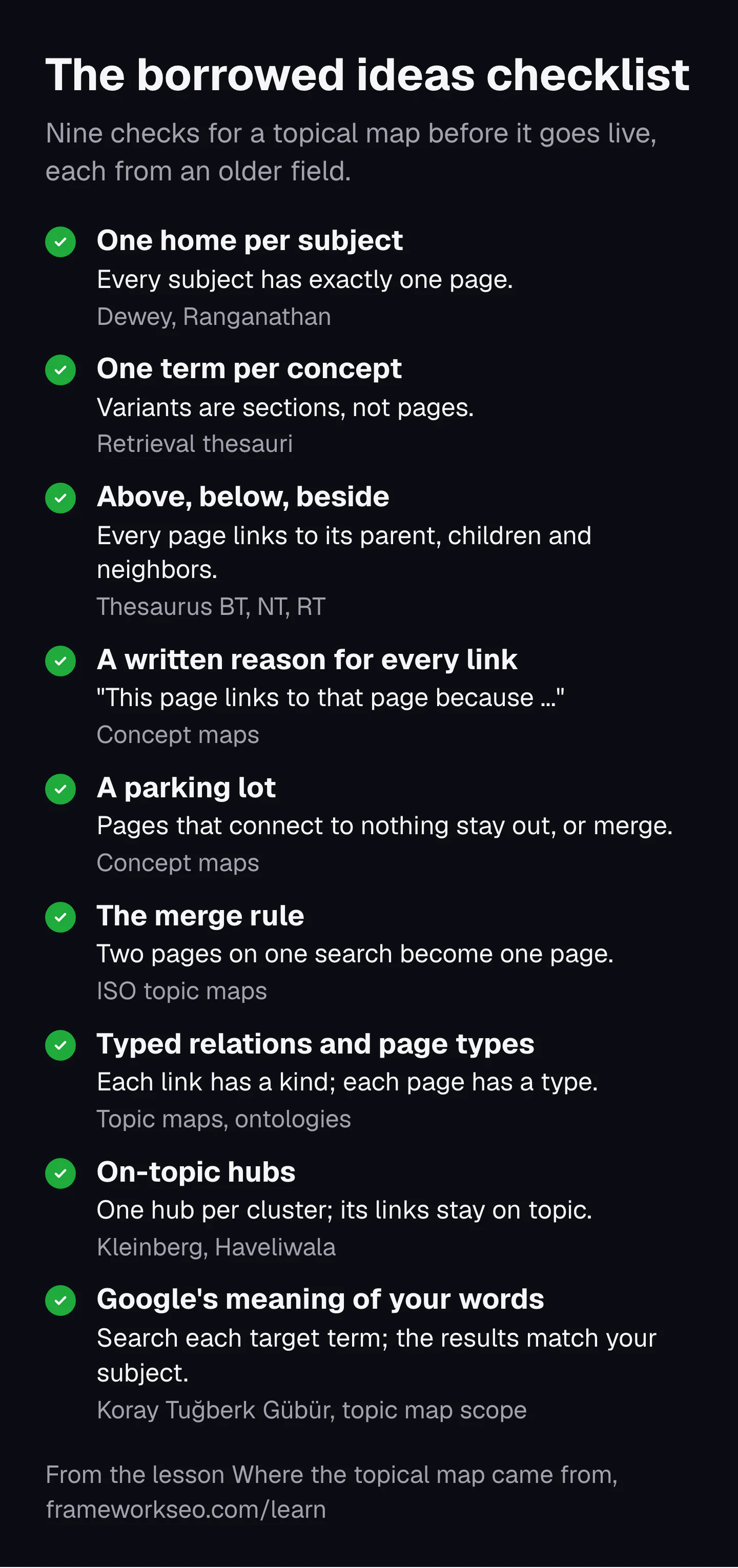
Download the borrowed ideas checklistCSV, nine rows: check, borrowed from, passes when, and an empty column for your notes
If your map fails a check, the fix is usually small: merge two rows, write a missing sentence for a link, or move a page to the parking lot. If you would rather have the whole map built and checked for you, that is the growth plan.
Sources
- Topical Authority: the long version of the February 2021 semantic SEO case study, Koray Tuğberk Gübür, Holistic SEO & Digital, 2021
- A Classification and Subject Index for Cataloguing and Arranging the Books and Pamphlets of a Library, Melvil Dewey (Project Gutenberg edition), 1876
- Subject Headings and Genre/Form Terms, Library of Congress, 2026
- Colon Classification (ISKO Encyclopedia of Knowledge Organization), M. P. Satija, ISKO (online entry, read 13 Nov 2026), 2026
- Facet analysis (ISKO Encyclopedia of Knowledge Organization), Birger Hjørland, ISKO, 2013
- Thesaurus (for information retrieval) (ISKO Encyclopedia of Knowledge Organization), Stella G. Dextre Clarke, ISKO (online entry, read 13 Nov 2026), 2026
- ANSI/NISO Z39.19-2005 (R2010) Guidelines for the Construction, Format, and Management of Monolingual Controlled Vocabularies, NISO, 2010
- The Theory Underlying Concept Maps and How to Construct and Use Them, Joseph D. Novak and Alberto J. Cañas, IHMC, 2008
- The TAO of Topic Maps, Steve Pepper, Ontopia, 2000
- Guide to the topic map standards (ISO/IEC JTC 1/SC 34 N323), ISO/IEC JTC 1/SC 34, 2002
- ISO/IEC 13250-2:2006 Topic Maps, Part 2: Data model, ISO/IEC JTC 1/SC 34, 2006
- Topic Maps: Data Model (editors' draft), Lars Marius Garshol and Graham Moore, ISO/IEC JTC 1/SC 34, 2008
- A translation approach to portable ontology specifications, Thomas R. Gruber, Knowledge Acquisition, 1993
- Ontologies (as knowledge organization systems) (ISKO Encyclopedia of Knowledge Organization), Maria Teresa Biagetti, ISKO (online entry, read 13 Nov 2026), 2026
- The Semantic Web, Tim Berners-Lee, James Hendler and Ora Lassila, Scientific American, 2001
- SKOS Simple Knowledge Organization System Reference, W3C, 2009
- Introducing the Knowledge Graph: things, not strings, Google (Amit Singhal), 2012
- Authoritative Sources in a Hyperlinked Environment, Jon M. Kleinberg, Cornell University (first as IBM Research Report RJ 10076), 1997
- The Anatomy of a Large-Scale Hypertextual Web Search Engine, Sergey Brin and Lawrence Page, Computer Networks, 1998
- Topic-Sensitive PageRank, Taher H. Haveliwala, WWW 2002 (ACM), 2002
- New Tool Aims to Revolutionize SEO Content Strategy for Businesses, Ratchet+Wrench, 2017
- What is a topographic map?, U.S. Geological Survey, 2026