Content briefs with Claude: a template and a real test
A content brief is the written instructions for one page, made before anyone drafts it: who the page is for, the search it must answer, the facts it may use and where they come from, and how it links to the rest of the site.
A content brief tells a writer what one page must do before anyone drafts it. This lesson sets out what goes in one, then drafts a real brief with Claude twice: once from a one-line prompt and once the right way, with every mistake it made and how I caught it.

Key takeaways
- A content brief decides a page's one job, its reader, its facts and its links before anyone writes, so the writer builds from evidence instead of guessing.
- The parts most brief templates miss are a facts table with a source and a date for every fact, a list of claims the page must not make, and the searches that belong to other pages on the site.
- In a real test with web search off, a one-line prompt gave Claude's brief eight grooming intervals with no source, and six of its nine headings were already in Google's results for the search.
- Asked for statistics with links, Claude gave four links and three of them led to pages that do not exist, although it warned that it could not open them.
- Give Claude your notes on the results, the business facts and the row from your site plan, make it ask questions before it writes, then check every fact, link, heading and claimed gap yourself.
What a content brief is, and what it is for
A content brief is the written instructions for one page, made before anyone drafts it. It says who the page is for, which search it must answer, what it may say and on whose authority, and how it links to the rest of the site. The writer builds the page from it. The editor checks the page against it.
A brief has three jobs:
- It forces the decisions first. The page's angle, its reader and its limits are settled before a writer spends hours guessing them.
- It hands over the evidence. Every fact the page may use sits in the brief with its source, so nothing on the page is made up along the way.
- It gives the editor a checklist. A draft is checked against the brief, line by line, instead of against someone's memory of a phone call.
A brief is not an outline, a creative brief or a draft
These four get mixed up, and each one does a different job. The AI answer Google showed for "content brief" on 13 November 2026 separates a content brief from a creative brief. The outline is the one people confuse most: it is one part of a brief, not the brief.
| Document | What it holds | Who uses it |
|---|---|---|
| Content brief | One page's job, reader, search, facts, headings, links and limits | The writer, then the editor |
| Outline | The headings of one page, in order | The writer |
| Creative brief | A campaign's message, audience and channels (ads, social, video) | A creative team |
| Draft | The page itself, written from the brief | The editor, then the reader |
Where a brief sits in a site plan
A topical map lists every page a site needs. A brief takes one row of that map, one page, and turns it into instructions. If you have no map yet, start with how to build a topical map. A brief written without one cannot know which searches belong to other pages, and that is the first mistake the test below shows.
Koray Tuğberk Gübür, whose 2021 case studies put the term topical map into SEO, builds the brief into his framework. In his 2023 article on expanding topical maps he describes a "content item brief" that "involves contextual vector, hierarchy, connection, and structure". In plain words: the page's angle, which idea sits inside which, how the page links to others, and the order and format of its parts. In one case he reports in the same article, "a topical map and over 200 content brief designs" were left with the client's team. His page-level ideas in full are in semantic content networks, and his whole method in plain words is in Koray Tuğberk Gübür's topical map framework.
What a good content brief contains, part by part
A good content brief has nine parts in four groups: decide what the page is for, prove what it may say, build its shape and links, and check it before it goes live. I read five of the guides ranking on Google's first two pages for "content brief" on 13 November 2026. Most of them ask for a goal, an audience, keywords, an outline, a word count, links and a call to action. None of them asks for a source next to each fact, a list of things the page must not claim, or the searches that belong to other pages on the site. Those three parts are where a page goes wrong, and they matter most when an AI drafts the brief.
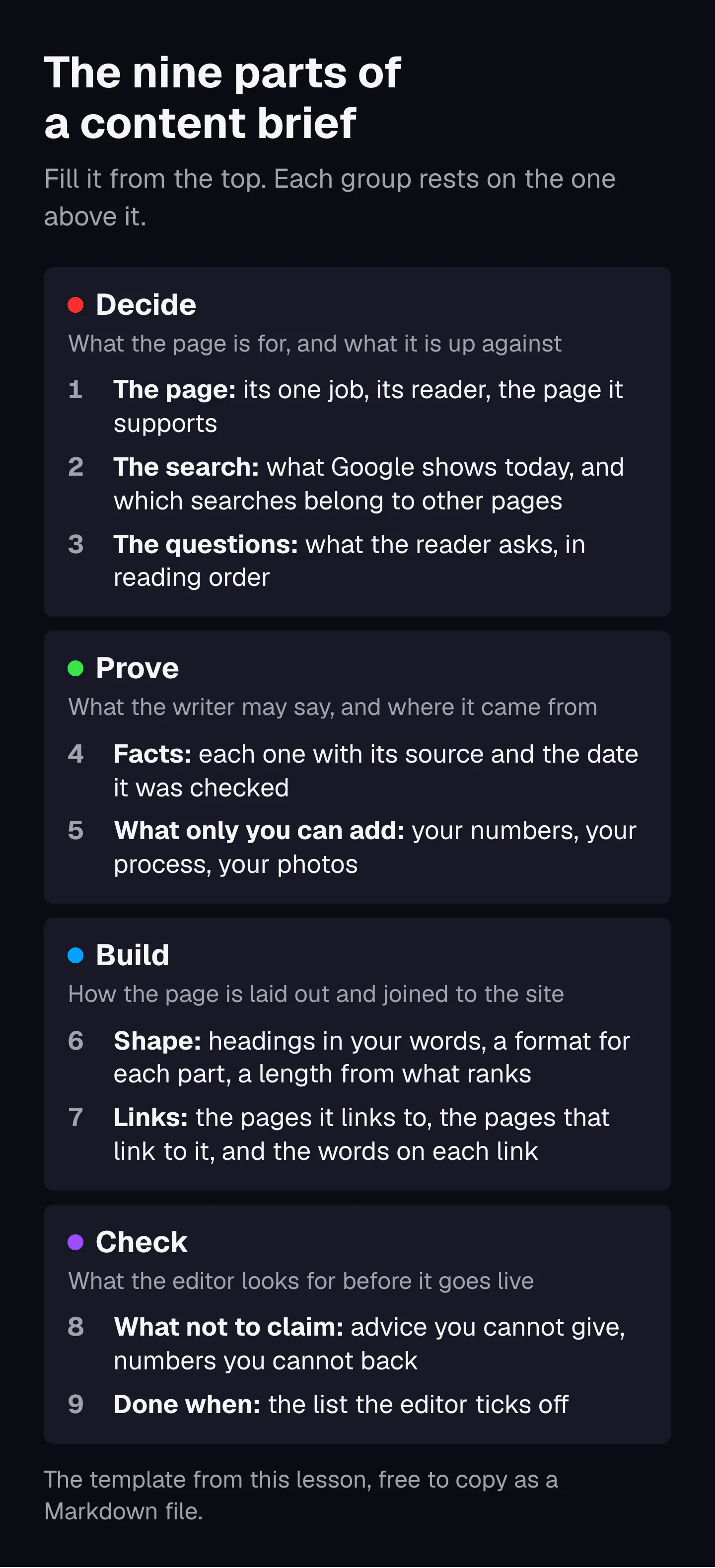
Every part has a reason that comes from somewhere other than habit:
| Part | What it holds | Where the idea comes from |
|---|---|---|
| 1. The page | The page's one job in a sentence, its reader, and the page it supports | Google asks whether a reader will "leave feeling they've learned enough about a topic to help achieve their goal". A page needs one goal to be judged against |
| 2. The search | The main search, what Google shows today, where the results agree and disagree, and which searches belong to other pages | Microsoft (2025): AI search picks "which pieces of content earn a place in the final answer", so you need to know what the pieces on the page today say |
| 3. The questions | What the reader asks, in reading order, and where each answer goes | Google's answer passage patents (2018, 2019) score a passage, not a whole page. Koray (2021): "Every heading should focus on different information" |
| 4. Facts | Each fact with its source and the date it was checked | Liu, Zhang and Liang (2023) found only 51.5% of sentences from AI search engines fully supported by their citations |
| 5. What only you can add | Your numbers, your process, your photos, what you see in your work | Google asks for "original information, reporting, research, or analysis" and "substantial value when compared to other pages in search results" |
| 6. Shape | Headings in your own words, a format for each part, a length range | Microsoft: headings "act like chapter titles that define clear content slices". Koray: "Every heading's content should have the right format" |
| 7. Links | The pages it links to and the pages that link to it, with the words on each link and where | Koray (2023): "connection" is one of the four parts of his content item brief |
| 8. What not to claim | Advice you are not qualified to give, numbers you cannot back, promises | Google calls fabricated credentials "a form of deception". The test below shows what an AI adds when nobody sets limits |
| 9. Done when | The list the editor ticks before the page goes live | Each line turns one of the parts above into a yes or no |
Part 5 is where a page earns its place. The top results already say the obvious things, and a page that repeats them adds nothing. That idea has a name, information gain, and a brief is the place to plan it, before the writer starts.
What to leave out: a fixed word count and a keyword list
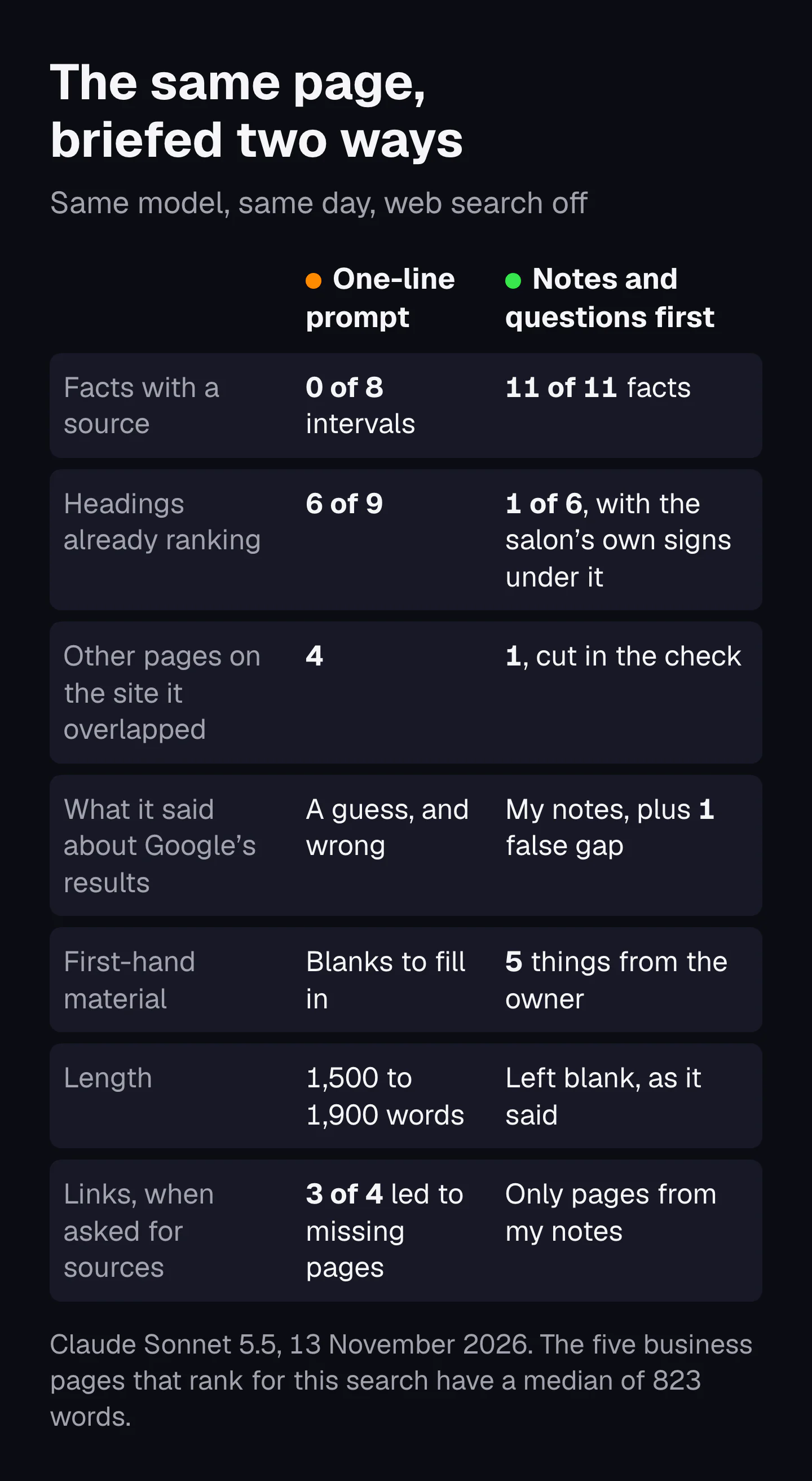
Most templates in the results ask for a target word count. Koray's 2021 rule fits better: "Content should be short as possible and long as necessary." Give a range taken from the pages that already rank for the search, and say where it came from. In the test below, Claude asked for 1,500 to 1,900 words on a search where the business pages ranking had a median of 823.
A keyword list tells a writer which words to use, not what to say. Write the reader's questions instead. In the same 2021 case study Koray titles one step "Find Information Gap Instead of Keyword Gap", and writes that "More information" and "unique questions" are the keys, not longer content or keywords.
What Claude gives you from a one-line prompt
A one-line prompt gets you a brief that looks finished and is built on guesses. To show that, I gave Claude the sentence most people type. The business is the made-up dog grooming salon in Portland, Oregon from how to build a topical map. The page is one row of its map: "How often should a dog be groomed?", a guide for a search with 480 US searches a month, which feeds the salon's Full groom page.
The salon is made up, and so is everything it says about itself. The search results and every Claude reply in this lesson are real: Claude Sonnet 5.5, a fresh, plain conversation with no tools, no web search and no files, on 13 November 2026. Replies change from run to run, so read this as one honest run, not a rate.
Write an SEO content brief for a blog post targeting the keyword "how often should a dog be groomed". The post is for my dog grooming salon's website in Portland, Oregon.
The reply was tidy: metadata, keywords, a nine-section outline, a chart of grooming intervals by coat, links, schema and success metrics. It also said, fairly, that it had not pulled live search data. Then I checked it against what Google showed for the search that day.
| What Claude wrote | What was wrong | How I caught it |
|---|---|---|
| "most dogs need professional grooming every 4-8 weeks", a chart of five coat types, nail trims "about every 3-4 weeks" | Eight intervals in weeks, none with a source. In 3 of the 5 chart rows the range starts sooner than the made-up salon's own schedule, which you meet in Step 2 below | Tried to put a source next to each number. There was none to put |
| "National pet brands and vet sites dominate", its guess at the results | 5 of the first 10 results were forum or social posts, 1 was a pet food brand's blog and 4 were groomers' blogs. No vet site at all | Pulled Google's first 10 results for the search and counted |
| Nine section headings | Six had a near twin in the results: the same section idea in close wording. One FAQ question matched a ranking page word for word | Put the headings side by side |
| Sections on bathing, nail trims and puppies, a line on shaving double coats, and "how often should you bathe a dog" as a keyword | All four are pages the salon's map already plans. The bathing page's search alone has 5,400 a month | Checked the brief against the map |
| "Target length: 1,500-1,900 words" | The five business pages ranking ran 266 to 1,399 words, median 823 | Counted the words on each page |
| "Mark up with FAQ schema" | Google stopped showing FAQ rich results on 7 May 2026 | Google's documentation changelog |
| "Add a quote or tip from your lead groomer" | Placeholders only. No first-hand material, because Claude had none to give | Read what was left to fill in |
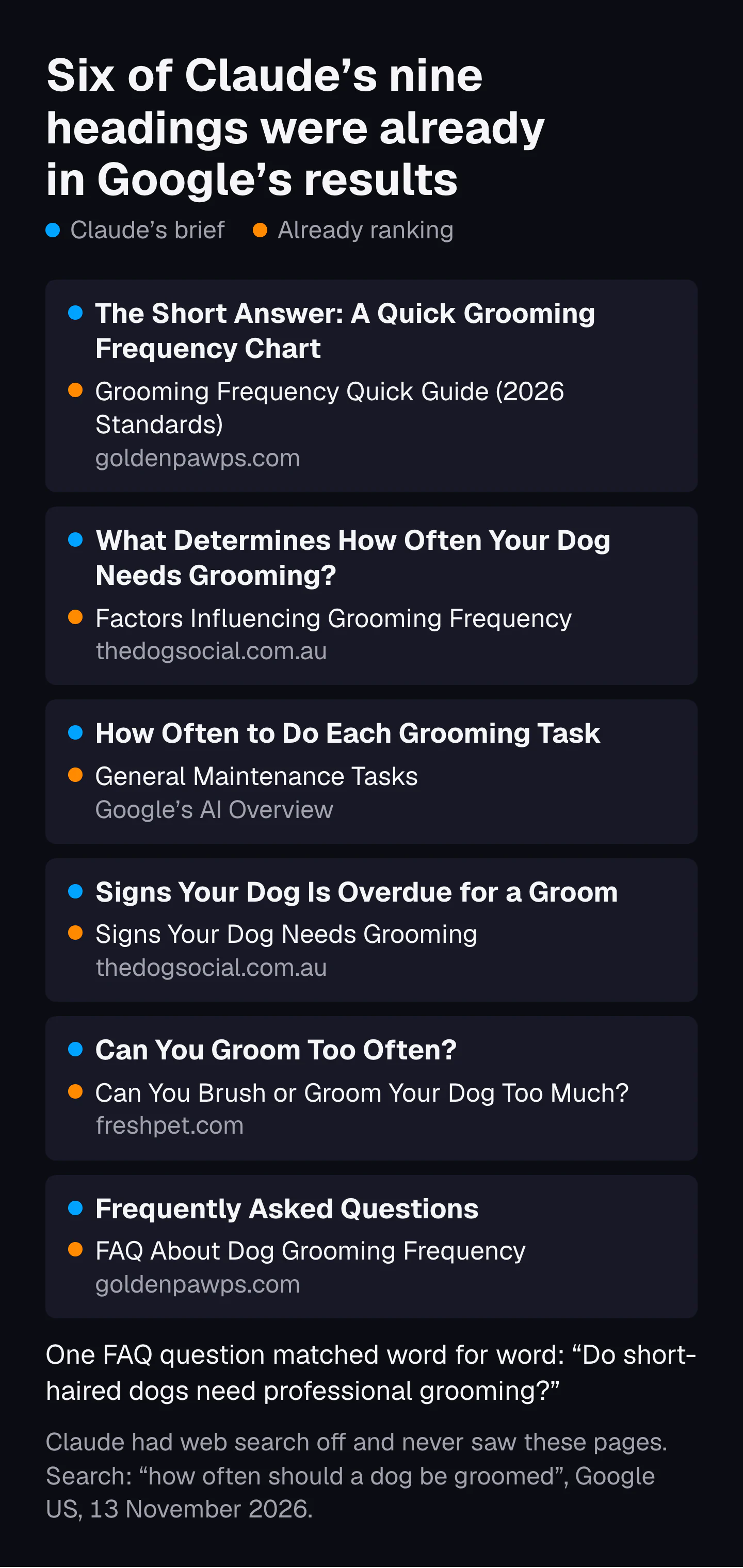
The overlap with the salon's other pages is the costly one. Two pages answering the same need compete with each other, which is how keyword cannibalization starts. Claude could not have known: nobody told it which other pages exist.
Asking for sources made it worse
The same prompt, plus one sentence:
Include statistics the writer can use, with a source and a link for each.
This time Claude opened with a warning: "I couldn't open any of the links below, so I'm giving each statistic from memory, with the page where it should appear." It still gave four statistics with links. I opened all four:
- American Kennel Club, on how often to bathe a dog: the link returns the AKC's 404 page.
- American Veterinary Medical Association, pet ownership data: "The requested page could not be found."
- National Weather Service, Portland climate: "Page Not Found".
- American Pet Products Association: the page loads, but its headline figure differs. Claude gave about 66% of US households owning a pet, from a 2023 to 2024 survey. The page says 95 million US households own a pet, from its 2025 survey.
Two of the four, both on pet ownership, have nothing to do with how often to groom a dog, and Claude did note that a newer survey edition might exist. The rainfall figure only decorates the Portland section. They were there because I asked for statistics. Treat every link Claude writes from memory as a guess until you open it. Its own warning said as much, and it was the most useful line in the reply.
Why the work splits between you, Claude and a check
The work splits three ways because Claude is good at some of it and blind to the rest. It sorts material well, spots what is missing and writes it up in order. It does not know what it was never shown: what Google shows for your search today, what your business does, what your staff tell customers. In the app with web search off it has no search data at all. With search on, it reads pages it picks itself, not the results you see. What Claude is good and bad at for SEO in general is in Claude for SEO.
Research points the same way. Kalai and colleagues (2025) argue that language models guess "because the training and evaluation procedures reward guessing over acknowledging uncertainty". Liu, Zhang and Liang (2023) audited AI search engines and found that "a mere 51.5% of generated sentences are fully supported by citations". Walters and Wilder (2023) found 55% of GPT-3.5 citations and 18% of GPT-4 citations fabricated. None of those studies tested Claude Sonnet 5.5, so read them as a direction, not a rate for the model you use.
A brief from memory is a brief of the consensus
This is the part that matters most for SEO. A model writing from memory writes the most likely brief for a search, and the most likely brief is the one the top results already follow. That is how six of nine headings came back as twins without Claude seeing a single ranking page.
Information retrieval research has kept "relevant" and "new" apart for over twenty years. Zhang, Callan and Minka (2002) argue that "relevance and redundance should each be modelled explicitly and separately". A brief from memory scores high on the first and fails the second. Whatever is new on the page has to come in through what you give Claude: your notes on the results, and the facts only your business has.
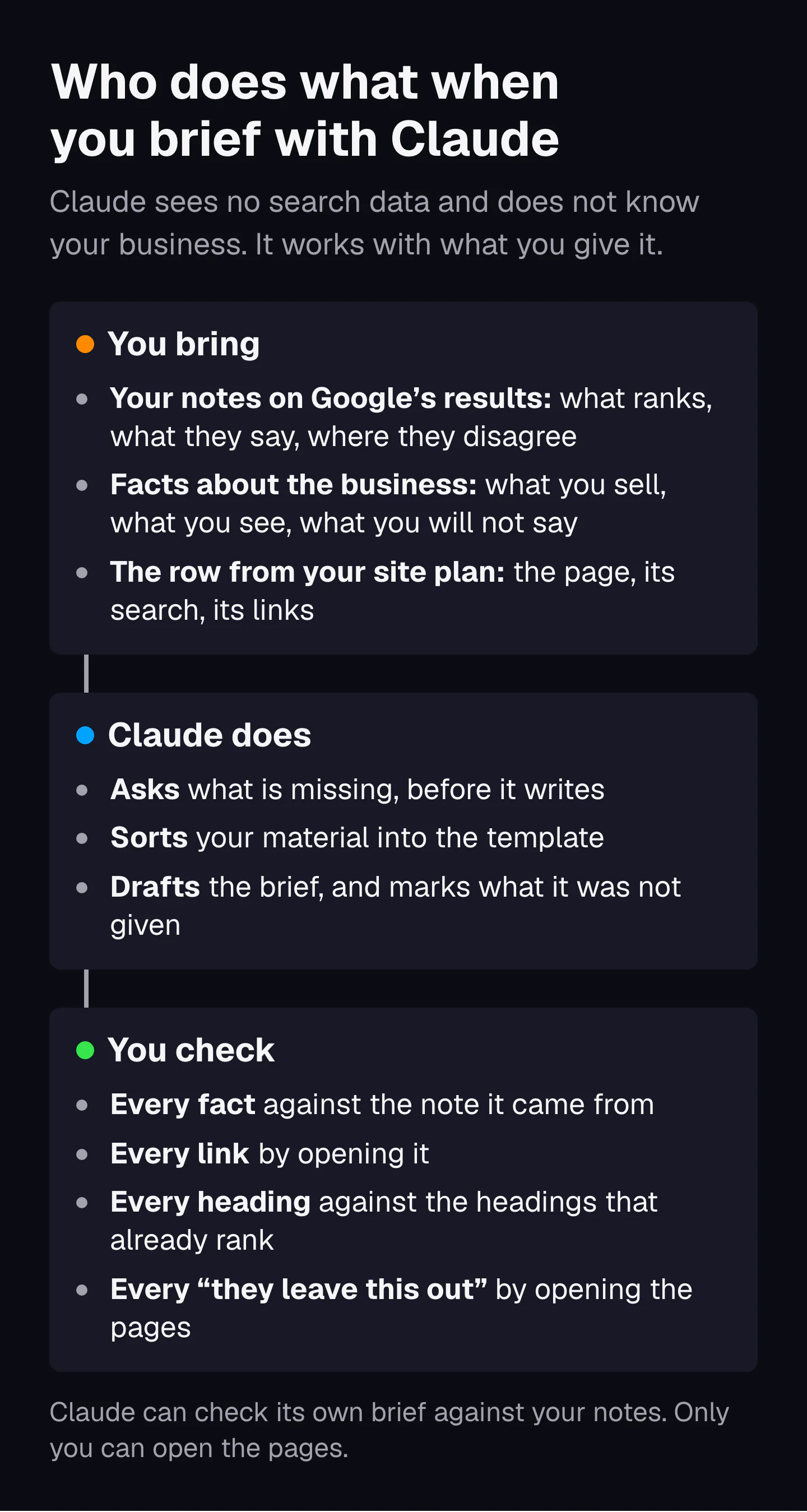
Anthropic's own advice, applied to a brief
Anthropic's guide to reducing hallucinations lists techniques that fit a brief almost word for word:
- Let it say it does not know. "Explicitly give Claude permission to admit uncertainty." In a brief, ask for NOT GIVEN instead of a guess.
- Keep it to your material. Anthropic calls this "External knowledge restriction": tell Claude to use only the documents you provide.
- Make it find the quote. Have Claude find a supporting quote for each claim, and "If it can't find a quote, it must retract the claim."
- Put the rules first and last. Liu and colleagues (2023) found models do best when the relevant information sits "at the beginning or end of the input context", and worse in the middle. Long notes go in the middle, so repeat the rules after them.
Anthropic's API also has a citations feature that points to exact passages in the documents you send. In the app, you get the same effect by asking for the quote.
Write a content brief with Claude in five steps
You write a content brief with Claude in five steps: read the results yourself, gather your facts, make Claude ask questions, have it fill the template, then have it check its own work. Same page, same model, same day as the test above. The prompts below are written for this lesson. Copy them and swap in your page.
Step 1: Read the results yourself and write notes
Search the main query in a private window. Open the first ten results and read the AI answer at the top. Write down five things: what kind of pages rank, what numbers or advice they give, where they disagree, what none of them covers, and any claim with nothing behind it.
My notes for the salon's page ran to ten bullet points. Two did more work than the rest. The results disagree on curly coats: every 4 to 6 weeks on one groomer's page, 6 to 8 on another, 4 to 8 in Google's AI answer. And one groomer's page argues for a visit every 3 weeks because, it says, a dog's skin renews every 21 days. The page gives no source for that.
Reading is the slowest step and the one you cannot hand over. Claude cannot see what you saw unless you write it down.
Step 2: Gather the site plan row and the business facts
The first block is the row from your site plan: the page, its search and volume, the page it supports, its links in and out, and the pages that already own nearby searches. The third block is the business: what it sells, what staff tell customers, what they see in their work, what they will not say.
For the made-up salon: poodles and doodles every 6 weeks, long coats every 6 to 8, double coats a de-shed bath every 8 to 12, short coats a bath and nails every 8 to 12. Doodles that come back after 10 weeks or more usually need dematting first. From November to April, wet walks mean more mats behind the ears and in the armpits. No vet on staff. Their own photos of one doodle at 6 weeks and at 12 weeks since its last groom.
Step 3: Ask Claude for questions before the brief
I need a content brief for one page on my website. A freelance writer will write the page from your brief. Rules for this whole conversation:
1. Use only facts that are in the three blocks or in my answers to your questions. If you want a fact that is not there, write NOT GIVEN. Do not fill it in from memory.
2. Do not give me links or sources that are not in the blocks.
3. Do not reuse the headings of the pages in block 2.
4. For now, do NOT write the brief. Ask me up to five questions about what you need and cannot find in the blocks, most important first.

BLOCK 1: THE PAGE (the site plan row).
BLOCK 2: WHAT GOOGLE SHOWS (my notes, with the date I read them).
BLOCK 3: ABOUT MY BUSINESS.

Reminder of the rules: only facts from the blocks or my answers, NOT GIVEN otherwise, no outside links, none of the headings from block 2, and only your questions for now.
That prompt is shortened: in the prompt I ran, each block held my full notes, and the rules came first and again at the end, as above. Claude asked five questions. The first was the best moment of the whole test:
"Your groomers' suggested next visits for double coats and short coats are a de-shed bath, or a bath and nails, not a full groom. Only curly and long coats are clearly full-groom dogs. Should the page tell double-coated and short-coated owners to book a full groom, or point them to de-shedding or bath and brush?"
It was right, and the mistake was mine. The site plan row said the guide feeds the Full groom page, and half the dogs it talks about do not need a full groom. I changed the row: curly and long coats go to Full groom, double coats to De-shedding, short coats to Bath and brush. A one-line prompt never asks that. The other four questions covered what a full groom includes, how readers book, which signs show a dog is due, and whether the photos and a groomer's name can be used.
Step 4: Answer, then have Claude fill the template
I answered in five short lines, all made up for the salon, and pasted the template from the end of this lesson with one instruction: fill it section by section, with the same rules.
The brief that came back held 11 facts, each with a source. Its facts table marked two NOT GIVEN: an interval for wire coats, and whether a bath and brush includes nails. Its list of what not to claim was one I would have been glad to write myself:
"Don't use the claim that dog skin renews every 21 days."

"Don't present a "6-week rule" or any "most groomers recommend" claim as industry fact. Intervals are what our groomers suggest."
Its headings were its own: "Match your dog's coat to a schedule", "The same doodle at 6 weeks and at 12 weeks", "Portland's wet months: where we find mats". One, "Three signs your dog is ready for a visit", covers the same ground as a heading in the results, with the salon's own three signs under it. It left the length blank and said why: my notes had no word counts.
Step 5: Have Claude check its own brief
Now check your own brief before I send it to the writer. Go through sections 2, 4, 5 and 8 line by line. For each line, quote the exact words from my three blocks or my answers that support it. Then give me a list of every line you could not support with a quote, and say what you would change. Do not rewrite the whole brief.
This is Anthropic's find-the-quote advice turned on a brief. Claude listed 12 changes. The most useful were two lines it had written under "what the top results leave out": that no result ties the interval to a service to book, and that none shows the same dog at two gaps. Its verdict on both was "Unsupported." It also caught two lines that overstated how far the results agree, a label it had invented ("our own records" for facts I gave as plain statements), and "checked on" dates I had never given.
Check the brief before a writer sees it
Check the brief yourself even after Claude has checked it, because Claude compares the brief with your notes and nothing else. It cannot compare your notes with the web, and it skipped the sections I did not name. Three problems were left for me:
- A gap that was false. Claude flagged "no result ties the interval to a service to book" as unsupported. Opening the pages showed it was wrong. The Boise groomer's page suggests "brush-outs or de-shedding treatments" for dogs that shed a lot, and the Massachusetts groomer's sample calendar names a full groom and a "Nail Only" visit. A false gap sends the writer after an angle that is not new. Unsupported and false are different things, and only the pages tell them apart.
- A comparison of unlike things. Under "where the results disagree", Claude set one page's bath interval for short coats (every 4 to 6 weeks) against grooming visit intervals (every 8 to 12 weeks). Its own check marked the line supported, because both numbers are in my notes. They measure different things. I cut it.
- A section that belongs on another page. Claude planned a section on what a full groom includes, because I answered its question about it. That list belongs on the Full groom page. The guide keeps one line and the link.
Then came the parts that were mine to fill: a length of 700 to 1,000 words, from a median of 823 for the business pages that rank, and the words on the three links into the page.
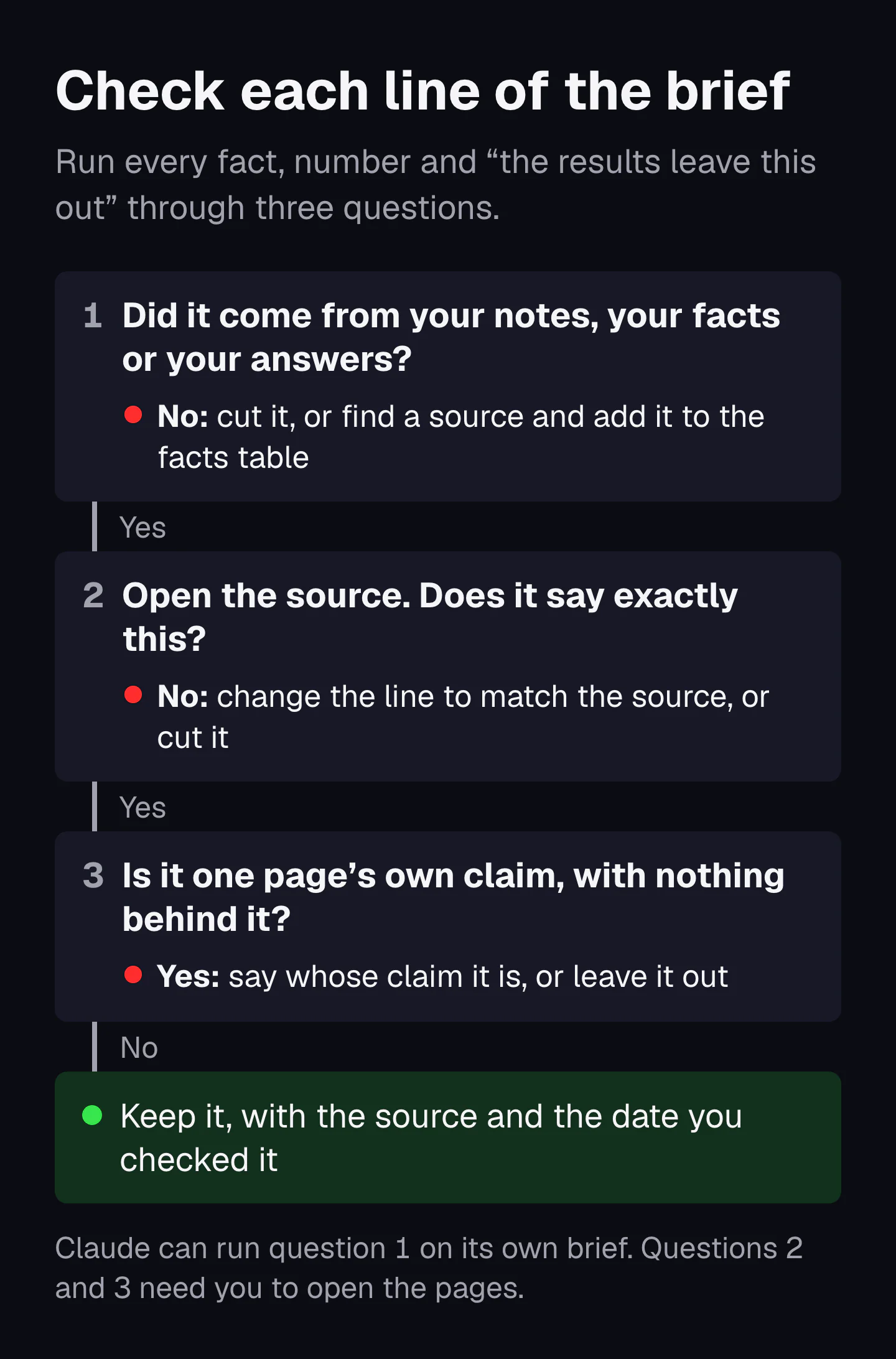
The check, line by line
- Every fact and number: find it in your notes, open the source, and confirm the words.
- Every link: open it. Do not trust a link because the site's name is real.
- Every heading: put it next to the headings of the top five results.
- Every "the results leave this out": open the pages and look.
- Every section: ask whether it belongs on this page or on a page your map already plans.
- First-hand material: make sure the brief holds something only this business could say.
- The not-to-claim list: read the draft against it when it comes back.
The finished brief for the salon's page, with every line I changed after the check marked:
Download the filled example briefMarkdown, about 1,800 words: the made-up salon's guide page, all nine parts, changes after the check marked
The content brief template to copy
The template is a plain Markdown file with the nine parts in the order of the picture above. Markdown pastes cleanly into Claude, Google Docs, Notion or a code repository, and the tables survive. Fill it top to bottom, delete the instruction line, and send it.
Download the content brief templateMarkdown, nine parts: the page, the search, the questions, facts with sources and dates, what only you can add, shape, links, what not to claim, done when
Three things make it work with Claude, and they are the reason it differs from the templates in the results:
- A facts table with a date column. Claude fills it from your notes, and you can see at a glance which facts came from where.
- A line for searches that belong to other pages. Without it, Claude covers every nearby search, as it did in the first test.
- A list of what not to claim. Claude fills this well once it has your notes, and it is the part a writer most often lacks.
If you brief often, save the template and the three prompts as a Claude skill, so the rules travel with them every time. Claude skills for SEO shows how to write one.
On client work we write briefs with our own system, and if you would rather have every page of your site planned for you, that is the growth plan.
Common questions
Who should write the content brief?
The person who decides what the page is for: usually the SEO lead, the business owner or an editor, not the writer. Claude can draft it, but the page's job, the notes on the search results and the facts have to come from someone who read the results and knows the business.
Can Claude search the web for the brief itself?
Yes, with web search turned on, Claude runs its own searches and cites short passages from the pages it reads. Those are pages it picks, not the results you see in Google for your search, so read the results yourself, give Claude your notes, and open every link it cites.
How long should a content brief be?
Long enough to hold the decisions and the facts, and no longer. The filled example in this lesson runs to about 1,800 words for a page of 700 to 1,000 words, because every fact sits in a table with its source. A writer reads the tables, not paragraphs.
Sources
- How to Expand a Topical Map for Higher Topical Authority?, Koray Tuğberk Gübür, Holistic SEO, 2023
- Importance of Topical Authority: A Semantic SEO Case Study, Koray Tuğberk Gübür, Oncrawl, 2021
- Scoring candidate answer passages (US9940367B1), Google LLC, 2018
- Candidate answer passages (US10180964B1), Google LLC, 2019
- Optimizing your content for inclusion in AI search answers, Krishna Madhavan, Microsoft Advertising blog, 2025
- Evaluating Verifiability in Generative Search Engines, Nelson F. Liu, Tianyi Zhang, Percy Liang (arXiv), 2023
- Fabrication and errors in the bibliographic citations generated by ChatGPT, William H. Walters, Esther Isabelle Wilder, Scientific Reports, 2023
- Why Language Models Hallucinate, Adam Tauman Kalai, Ofir Nachum, Santosh S. Vempala, Edwin Zhang (arXiv), 2025
- Novelty and redundancy detection in adaptive filtering, Yi Zhang, Jamie Callan, Thomas Minka, ACM SIGIR, 2002
- Lost in the Middle: How Language Models Use Long Contexts, Nelson F. Liu and others (arXiv), 2023
- Reduce hallucinations, Anthropic, 2026
- Citations, Anthropic, 2026
- QualityNsrPQData (contentEffort), Google Content Warehouse API documentation, hexdocs.pm (leaked Google documentation), 2024
- Creating helpful, reliable, people-first content, Google Search Central, 2026
- Latest Google Search documentation updates (FAQ rich result deprecation, May 2026), Google Search Central, 2026