One page per keyword? When a search deserves its own page
A common mistake in a map you build yourself is giving every search its own page. Many searches are a section of a page that already exists. This lesson gives you the decision for any search: four questions, the tests behind them, ten real pairs I read on 12 November 2026, and a worksheet you can keep.

Key takeaways
- A page answers a need, not a phrase: a search gets its own page only when no page on your map already answers the same need, and many searches are a section of a broader page.
- Shared results prove one need, but no shared results prove little: on 12 November 2026, two reads of the same search a few minutes apart shared only 30% of their pages across 19 searches.
- Ask four questions in order: do the two searches show the same pages, is it only a step of a bigger job, does it have its own job and its own things, and does it have the demand and the pattern of Koray Tuğberk Gübür's Query Deserves a Page test.
- Since Google began ranking passages in October 2020, a well-built section can be found for its own search, so a sub-question rarely needs a page of its own.
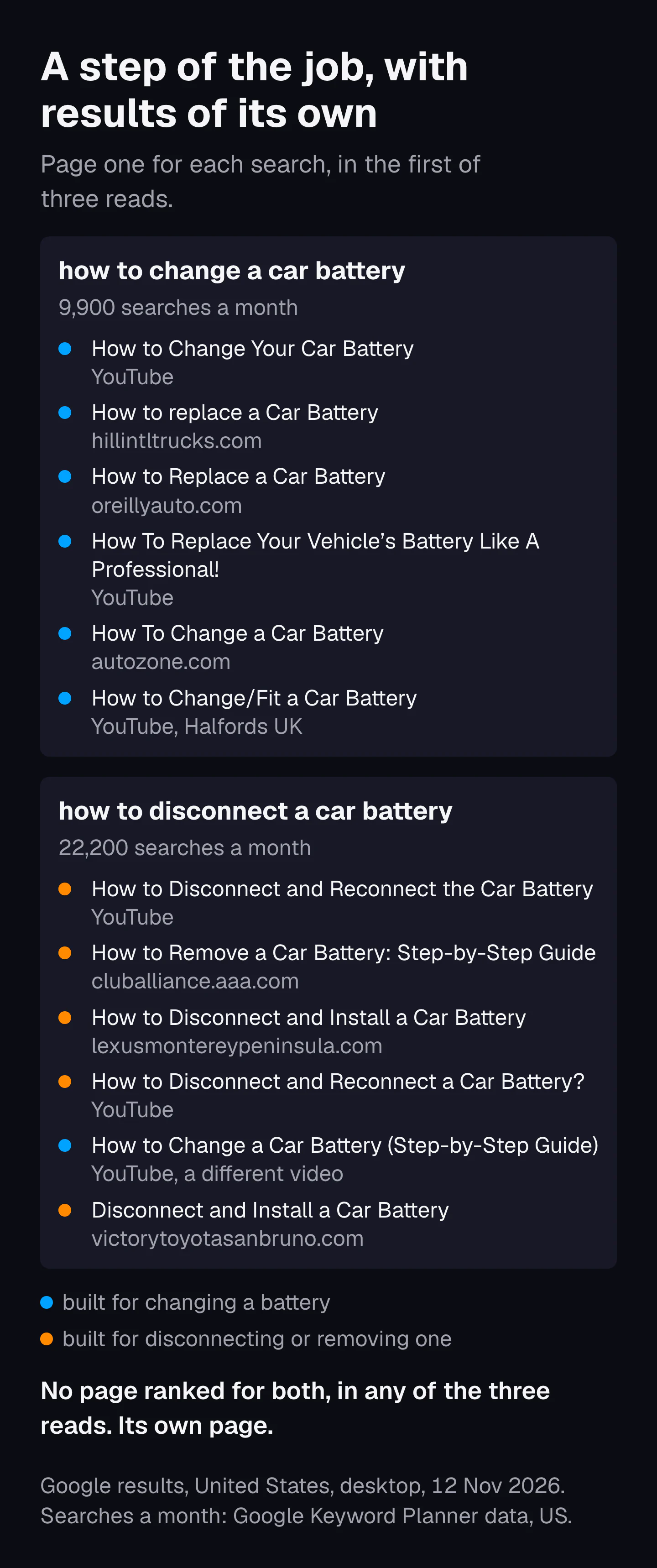
- A step can still earn its own page: "how to disconnect a car battery" gets 22,200 US searches a month against 9,900 for "how to change a car battery", and its results are pages built for disconnecting.
Why one page per keyword is the wrong rule
One page per keyword is the wrong rule because a page answers a need, not a phrase. People type one need in dozens of wordings, and one good page can rank for all of them. Other searches are a step inside a bigger need. They belong on that page, under their own heading.
So every search on a map ends up in one of three places:
- The same page as another search. It is another wording of a need the map already covers. "Roof replacement cost" and "how much does a new roof cost" are one need.
- A section of a broader page. It is part of a bigger job, answered under its own heading. "Can you use soap on cast iron" is a section of a guide to cleaning cast iron.
- Its own page. It is a need with its own job, its own things to explain and its own results. "How to disconnect a car battery" is one, even though it sounds like a step.
This is one of the mistakes I check for in maps that owners built for themselves. The pages "do not build on each other". There are off-topic pages that "could have been part of another post". And searches get pages they never needed, because a query does not deserve its own page just because someone types it. A search has to earn a page.
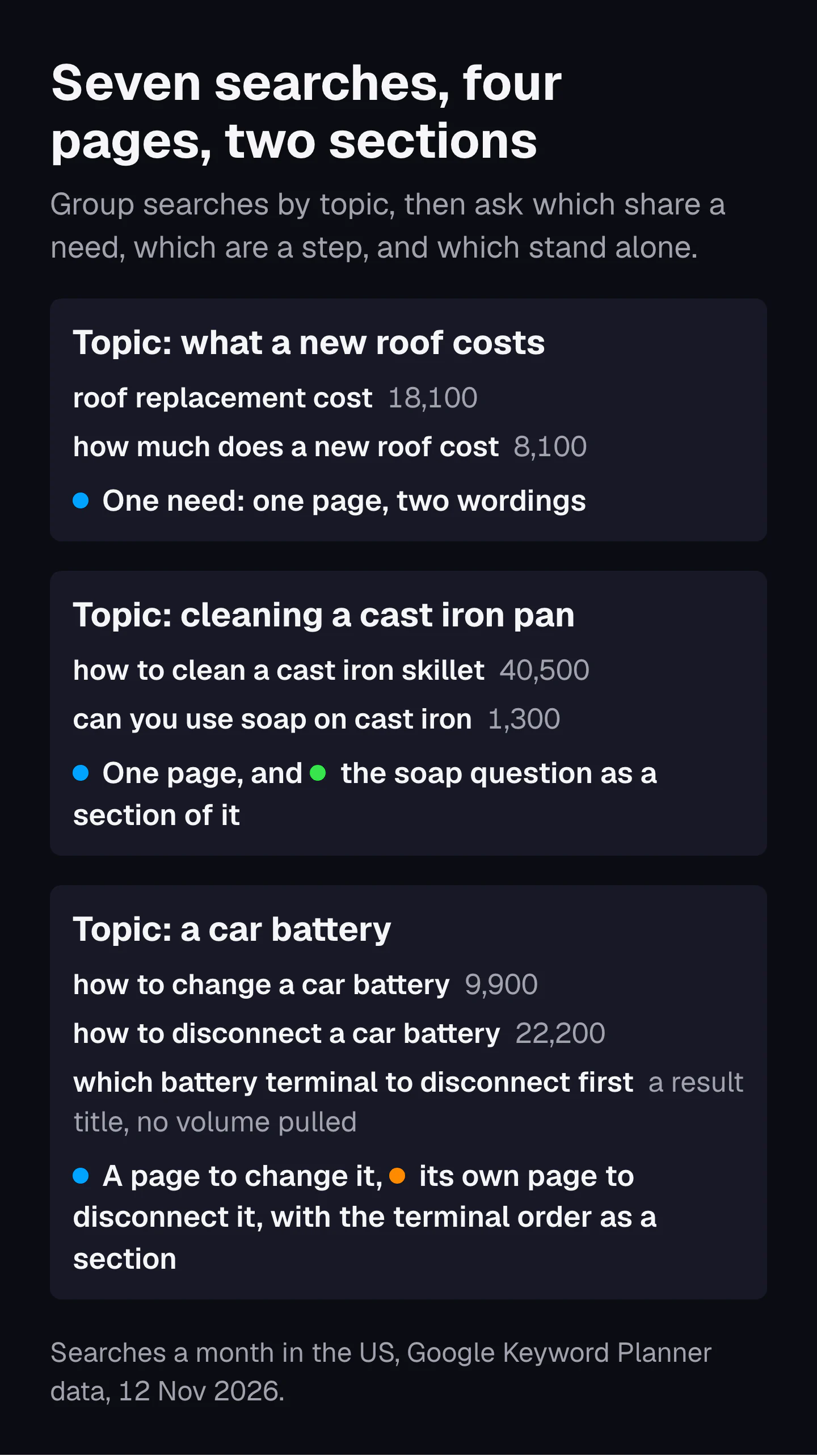
Two pages on one need compete with each other. That has a name, keyword cannibalization, and it is the most common result of the one-page-per-keyword habit. The opposite mistake, one page stuffed with several needs, is rarer and just as costly. Both get a fix at the end of this lesson.
One search engine says it from its side. Bing's Webmaster Guidelines tell site owners to "Focus Each URL on a Single Topic".
The decision path for any search
Put every search through four questions, in this order. The first question that sends it somewhere decides where it goes. The path starts with the cheapest proof, what Google already shows, and ends with the judgment calls.
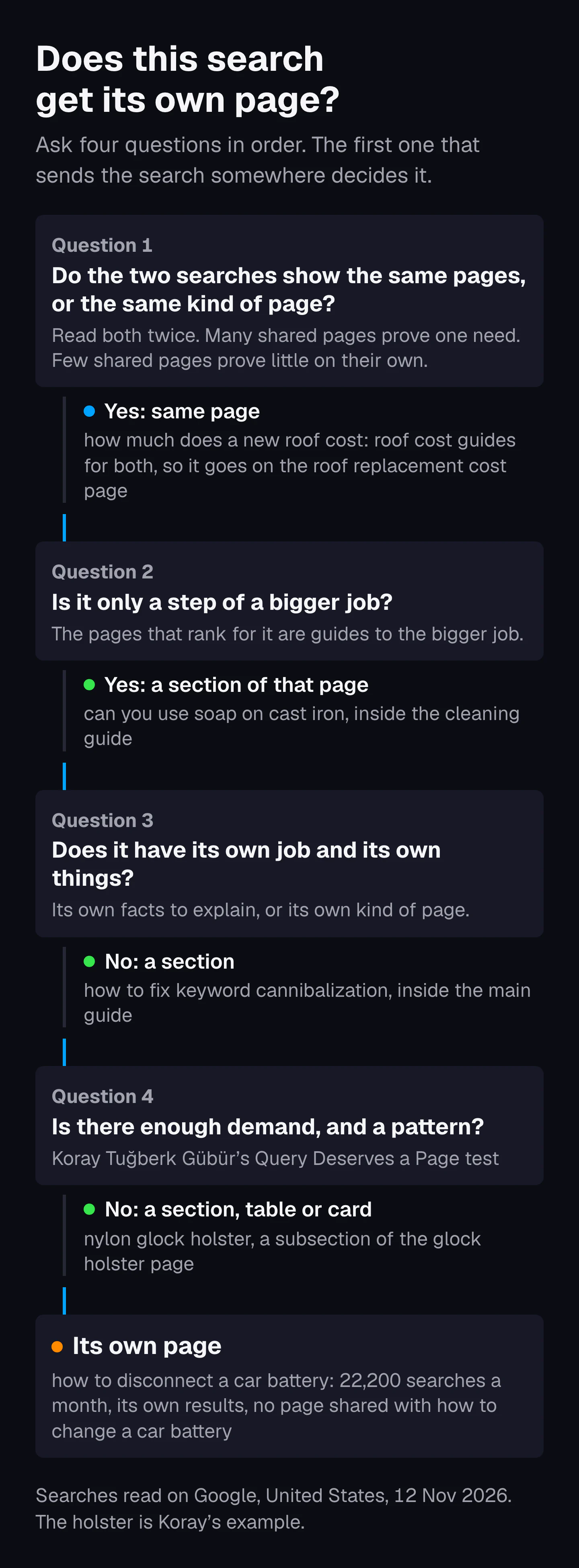
1. Do the two searches show the same pages, or the same kind of page?
Search the new phrase and the closest search already on your map. When several of the same pages rank for both, Google treats them as one need, and they share one page. Count pages, not sites. One site ranking with two different pages is a sign of two needs.
This test proves only one direction. Few shared pages do not prove two needs, for reasons the next part of this lesson shows with numbers. When few pages are shared but both searches show the same kind of page, a list of cost guides for both, treat them as one need.
2. Is it only a step of a bigger job?
Ask what the person is trying to get done. When the search is a step that only makes sense inside a bigger job, and the pages that rank for it are guides to that bigger job, it is a section of that page. "Can you use soap on cast iron" is a step of cleaning a pan.
The word "only" matters. Disconnecting a car battery is a step of changing one. People also disconnect a battery to store a car or to work on its wiring, and Google answers that search with pages built for disconnecting. So it passes this question.
3. Does it have its own job and its own things?
A search earns a page when it brings its own job, its own things to explain or its own kind of page. "Roth IRA income limits" has things the main Roth IRA page does not: income ranges by filing status, and a new table every year. "Best espresso machine" asks for a different kind of page than "espresso machine": reviews instead of a shop.
When the honest answer is no, the search is a section of the page that owns the job.
4. Is there enough demand, and a pattern?
Last, check that the search is worth a page. People search it, and it belongs to a family of searches the site will answer the same way. This question comes from Koray Tuğberk Gübür's Query Deserves a Page test, which gets its own part below. A search that fails it lives as a section, a table, a card or a sentence on a page that already exists.
A search that passes all four gets its own page. This decision is step 5 of How to build a topical map; here it gets the depth that step only sketches.
Download the page-or-section worksheet (PDF)One A4 page to print: the four questions in order and a blank table for twelve searches.
Download the worksheet as a spreadsheet (CSV)The same columns for Google Sheets or Excel, with the ten pairs from this lesson filled in as examples and empty rows for yours.
The worksheet has one row per search and a column for each question, so you can see why every search landed where it did. Keep it beside your topical map template: the template lists the pages, the worksheet records the decisions behind them.
How to read the results without fooling yourself
Read each search twice, in a private window, and count the same pages, not the same sites. Shared pages prove one need. No shared pages prove little. One read of Google is a sample, and two reads of the same search match each other less than most people assume.
I measured it. On 12 November 2026 I read Google's US results for 19 searches three times each, within about ten minutes, through a search results service. Between two reads of the same search, 30% of the pages came back: 120 of a possible 403. Counting sites instead of pages, 44% came back: 156 of 354.
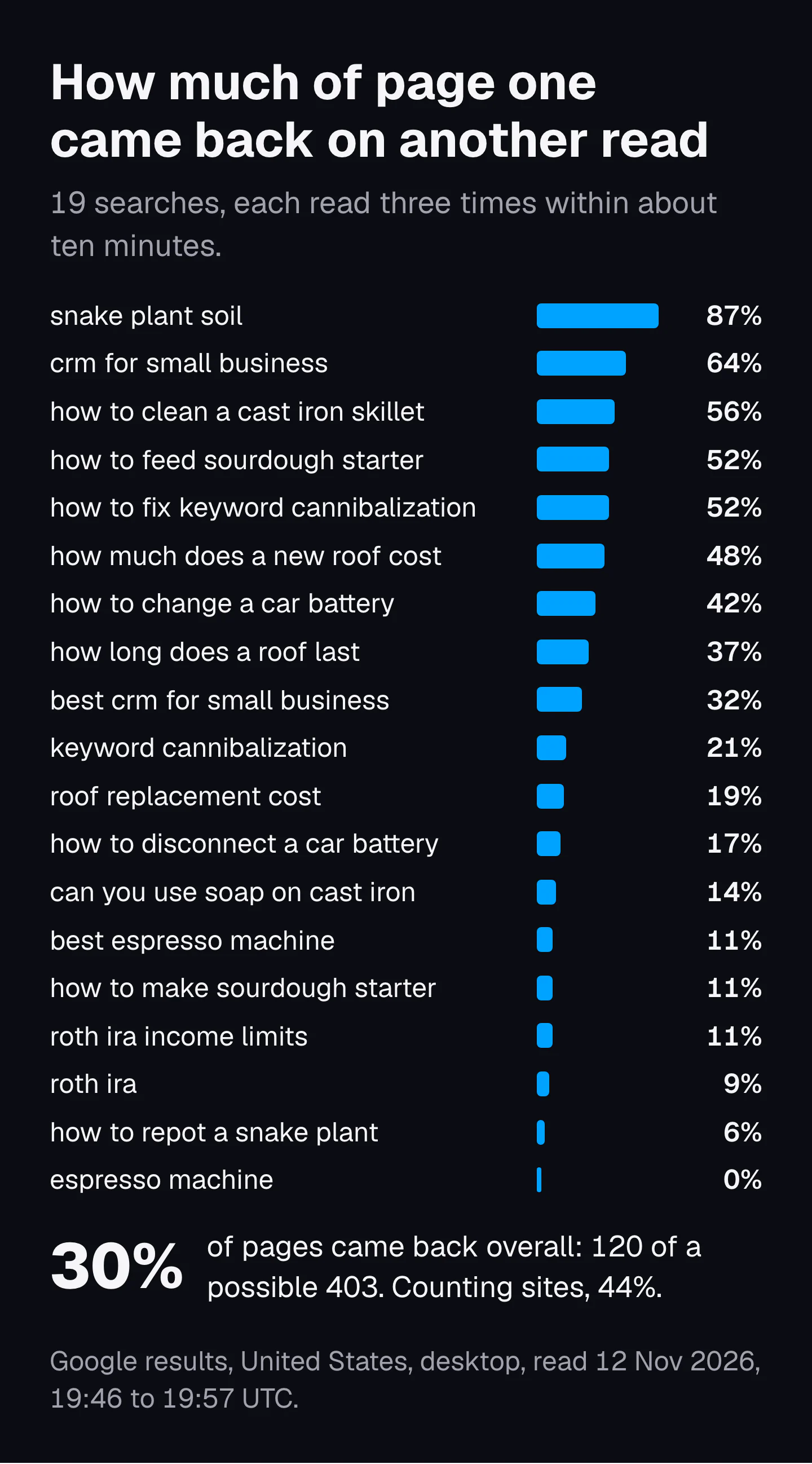
The spread was wide. "Snake plant soil" kept 4 pages through all three reads. "Best espresso machine" showed 24 different pages, and not one of them came back in all three reads. Some of that churn may come from how a results service reads Google, and some from Google itself, which uses "your location, past Search history, and Search settings" to choose results, in its own description of ranking.
Now set that against the line people use to group searches. One clustering guide that ranks for this lesson's main search sets it at "40%+ of the same URLs", and our own lesson on building a map uses 3 shared pages out of 10 as a working line. When a search shares only 30% of its pages with itself, two wordings of one need can easily fall under either line.
Both of my same-need pairs fell under both lines. "Roof replacement cost" and "how much does a new roof cost" shared exactly 1 page in each of the three reads. "Crm for small business" and "best crm for small business" shared 2 pages in the first read and none in the next two. Both are one need anyway, and the other three questions show it.
So read more than the count:
- What kind of page ranks. Two lists of cost guides are one need, even with few shared addresses. A shop against a list of reviews is two needs.
- Who splits. This is the one place where sites, not pages, tell you something. When the same sites rank a different page for each search, they decided it was two needs. King Arthur Baking ranks one page for making a sourdough starter and another for feeding one.
- What the titles promise. When the pages for the broad search already say "and how to fix it", the narrow search is a section.
The test has a long research history. In 2000, Doug Beeferman and Adam Berger grouped search queries by the pages people clicked for them, without reading the words at all. Two years later Ji-Rong Wen, Jian-Yun Nie and Hong-Jiang Zhang found that "a combination of both keywords and user logs is better than using either method alone". That is the habit to keep: the shared pages and the words, read together. Grouping by similarity alone gives you clusters, not pages, which is the difference explained in topical map vs topic cluster.
Koray Tuğberk Gübür's Query Deserves a Page test
Koray Tuğberk Gübür, the SEO whose case studies on topical maps and topical authority date back to 2021, published the clearest test for this decision in a July 2026 article for Search Engine Land. He calls it Query Deserves a Page. A search gets its own page when it meets these four metrics, in his words:
- "The query has high search demand."
- "The query has different entities."
- "The query has low similarity."
- "The query has a pattern."
When the metrics are not met, he writes, the variations "should exist as different sections on the same page", shown as headings, sentences, product cards or information cards. His own example: "Nylon Glock Holster" can be a subsection of the "Glock Holster" page instead of a page of its own. In another of his examples, three of the four metrics were enough for a new page.
Here is each metric in plain words, with a way to check it by hand:
| Metric | What it asks | How to check it by hand | From the ten pairs |
|---|---|---|---|
| High search demand | Do enough people search it to justify a page? | Look up the monthly searches in Google Keyword Planner | how to disconnect a car battery: 22,200 a month |
| Different entities | Does it bring things the other page does not explain? | List the things each search names: products, parts, rules, numbers | roth ira income limits: income ranges and filing status |
| Low similarity | Is the word that carries the search different? | Find the most important word in each search and see if they share it | snake plant soil: "snake plant" carries both searches, so it fails |
| A pattern | Is it one of a family of searches the site will answer the same way? | Swap one word and see whether the family exists | roth ira income limits: a new set every year |
Two details matter. Similarity is not about shared letters: Koray writes that it "isn't calculated using basic string similarity" but weighted by the most important word. And a wrong split has a cost. Splitting one need across pages causes what he calls "micro-cannibalization", and "every unnecessary page increases the cost of retrieval", an idea with its own lesson on cost of retrieval.
The idea is older in his work. In his 2021 case study on topical authority he named the failure Ranking Signal Dilution: two pages that "compete with each other for the same canonical query and canonical search intent with very similar content or mutual content points".
Read it as one practitioner's model, not Google's rulebook. He does not publish the thresholds behind "high" and "low", and the results he shows come from his own case studies. It is still the best published test I know, and it ends in the same three outcomes. The rest of his method is in Koray Tuğberk Gübür's topical map framework.
Why a section can rank on its own
A section can rank on its own because Google ranks passages, not only whole pages. Google announced in October 2020 that its systems judge individual sections of a page to decide how relevant the page is to a search. So a sub-question rarely needs a page of its own to be found.
Google announced it on 15 October 2020: understanding passages "will improve 7 percent of search queries across all languages". Its guide to its ranking systems still lists passage ranking as a system that identifies individual sections, or passages, of a web page to judge how relevant the page is to a search.
The idea is older than Google's version. In 1994 James Callan tested passages built from paragraphs and from fixed windows of text, after earlier research had shown that evidence from passages can improve retrieval. Google's 2018 patent on scoring candidate answer passages judges the passage, not the page, as the answer to a question. A patent shows a method, not proof that it runs today. Microsoft says the same of its AI answers: ranking is now "less about ordering entire pages and more about which pieces of content earn a place in the final answer", and headings "define clear content slices" (Microsoft Advertising, October 2025).
What passage ranking changes is the bar for a page, not the need. A section can be found for its own search. It cannot win a search whose need the page does not serve. Bing states the limit plainly: "URLs focused on a primary topic are more likely to be selected for grounding results", the sources its AI answers draw on.
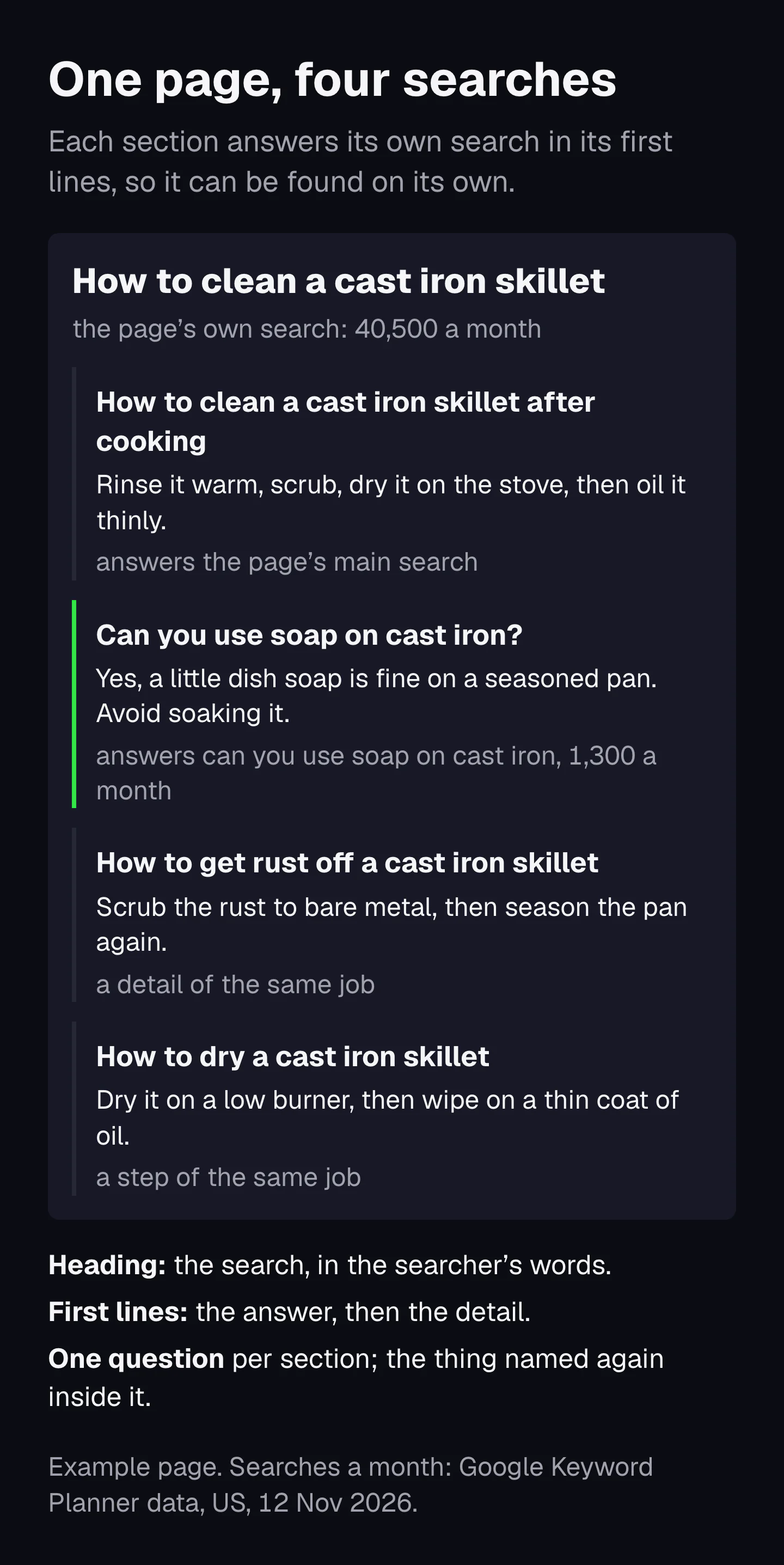
Build a section so it can stand on its own:
- Put the search in the heading, in the searcher's words: "Can you use soap on cast iron?"
- Answer in the first two sentences, with the fact, not a lead-in.
- Name the thing again inside the section, so the passage still makes sense when it is lifted out.
- Keep the section to one question. A second question gets a second heading.
Ten real search pairs, read on 12 November 2026
Of the ten pairs below, two became one page, three became a section and five earned their own page. I read Google's US results for each search three times on 12 November 2026. The monthly searches are US figures from Google's Keyword Planner data, pulled the same day.
| Searches | US a month | Shared pages, read 1, 2, 3 | What ranked | Verdict |
|---|---|---|---|---|
| roof replacement cost / how much does a new roof cost | 18,100 / 8,100 | 1, 1, 1 | Roof cost guides for both, many written for one state | One page |
| crm for small business / best crm for small business | 3,600 / 3,600 | 2, 0, 0 | Best-of lists of CRM software for both | One page |
| how to clean a cast iron skillet / can you use soap on cast iron | 40,500 / 1,300 | 0, 0, 0 | Soap: mostly forum and Facebook threads; pages made for it came and went between reads | A section of the cleaning guide |
| keyword cannibalization / how to fix keyword cannibalization | 390 / 70 | 1, 0, 0 | Guides to the main term, already titled “what it is and how to fix it” | A section of the main guide |
| how to repot a snake plant / snake plant soil | 2,400 / 2,400 | 0, 0, 0 | Soil: a soil-mix video, forum threads, a care guide, a bag of soil for sale | A section of the repotting guide |
| how to change a car battery / how to disconnect a car battery | 9,900 / 22,200 | 0, 0, 0 | Disconnect: pages built for disconnecting, from AAA, Jiffy Lube, AutoZone and car dealers | Its own page |
| how to make sourdough starter / how to feed sourdough starter | 90,500 / 27,100 | 0, 0, 0 | The same baking sites rank a different page for each | Its own page |
| roth ira / roth ira income limits | 368,000 / 90,500 | 0, 0, 0 | The IRS, Schwab, Vanguard and Fidelity rank a separate limits page, most dated by year | Its own page |
| roof replacement cost / how long does a roof last | 18,100 / 12,100 | 0, 0, 0 | Lifespan by material, and not one site in common | Its own page |
| espresso machine / best espresso machine | 368,000 / 33,100 | 0, 0, 0 | Head: shops mixed with reviews. Best: reviews and buying guides | Its own page, of another type |
One page: another wording of the same need
The roof pair and the CRM pair both fell under the shared-pages line and are one need anyway. Both roof searches showed roof cost guides, many of them written for a single state. Both CRM searches showed best-of lists of CRM software, and the results for "crm for small business" were titled "best CRM" too. Google's volume data gave both CRM wordings the same 3,600 searches a month.
A section: a step or a detail of a bigger job
"Can you use soap on cast iron" (1,300 a month) sits inside "how to clean a cast iron skillet" (40,500). Its results were mostly forum and Facebook threads. A few pages made for the question showed up in one read and were gone in the others, and a cleaning guide ranked in another. It is one heading in the cleaning guide.
"How to fix keyword cannibalization" (70) is a section of the main guide (390). The pages that rank for the main search were already titled "what it is and how to fix it". Our own lesson on keyword cannibalization does the same.
"Snake plant soil" (2,400) is a section of the repotting guide, with one exception. Its results were a soil-mix video, forum threads, a care guide and a bag of soil for sale. A store that sells that soil gives it a product page; a plant guide answers it under a heading. If your site covers soil for dozens of plants, "[plant] soil" becomes a pattern, and Koray's fourth metric says each one can earn a page.
Its own page: its own job, its own things, its own results
The surprise is the car battery. "How to disconnect a car battery" gets 22,200 searches a month, more than twice the 9,900 for "how to change a car battery", the job it belongs to. Its results were pages built for disconnecting, from AAA, Jiffy Lube, AutoZone and car dealers. No page ranked for both.
Sourdough and the Roth IRA show the clearest signal: the same sites split the pair. King Arthur Baking, The Clever Carrot and Breadtopia each rank one page for making a starter and another for feeding it. The IRS, Schwab, Vanguard and Fidelity each rank a Roth IRA page and a separate limits page, and most of the limits pages carry the year in their titles, a pattern that renews every year.
"How long does a roof last" (12,100) shared no page and no site with the roof cost results; it is about lifespan by material, a thing of its own. "Best espresso machine" (33,100) asks for reviews and buying guides, while "espresso machine" (368,000) showed shop pages mixed with reviews. Those are two kinds of page, so a store builds both: the category page for the broad search and a buying guide for the "best" search, linked to each other.
What to do when you already built two pages for one need
When two live pages answer one need, prove it first, then keep one. The fix is a merge: the stronger page stays, the other page's useful parts move into it, its address redirects with a 301, and every internal link points at the page that stays.
- Prove it is one need. Run both pages' main searches through the four questions. Two pages that look alike but pass question 3 serve two needs. Keep both, and make each one clearer.
- Pick the page that stays. Choose the one with more clicks and more links, or the better address if they are close. Compare both in Search Console over the same three months.
- Move what the other page adds. A fact, an example or a table the keeper lacks. Leave out what repeats.
- Redirect the old address. A permanent 301 redirect from the retired page to the page that stays, as Google's guide to consolidating duplicate URLs describes.
- Fix the internal links. Point every link at the page that stays, with the same anchor words each time. How those links should run is in internal links inside a topical map.
- Measure it. Write down the clicks and the average position for the main search before the merge, and compare the same number of weeks after it.
Why merge at all: engines limit how many results one site gets for a search. The background section of a Google patent application published in 2011 describes engines that limit "the display of the results from a particular host or domain" (US20110016108A1), so two of your pages on one need mostly fight over the same place. Bing says duplicates "dilute signals and reduce Bing's confidence in selecting a URL for grounding results or citations".
The full process for pages that should go, merge or be rewritten is in pruning and merging, and how to find the overlaps in Search Console is in keyword cannibalization.
The opposite mistake: one page for several needs
The opposite mistake is one page that tries to answer several needs. Picture a store's espresso machines page that also carries a long buying guide and a cleaning manual: it tries to answer three kinds of search at once, and such a page tends to rank well for none of them. Split it by need.
The signs, mostly visible in Search Console:
- It shows for many searches but ranks low for nearly all of them.
- Its top searches want different kinds of page: to buy, to compare, to fix.
- Its headings read like the outlines of three different articles.
Bing's guidelines name it directly: "Avoid mixing unrelated concepts on a single URL." The same reasoning runs through Koray's idea of the cost of retrieval: a page is easiest to rank when it is easy to tell what it is for.
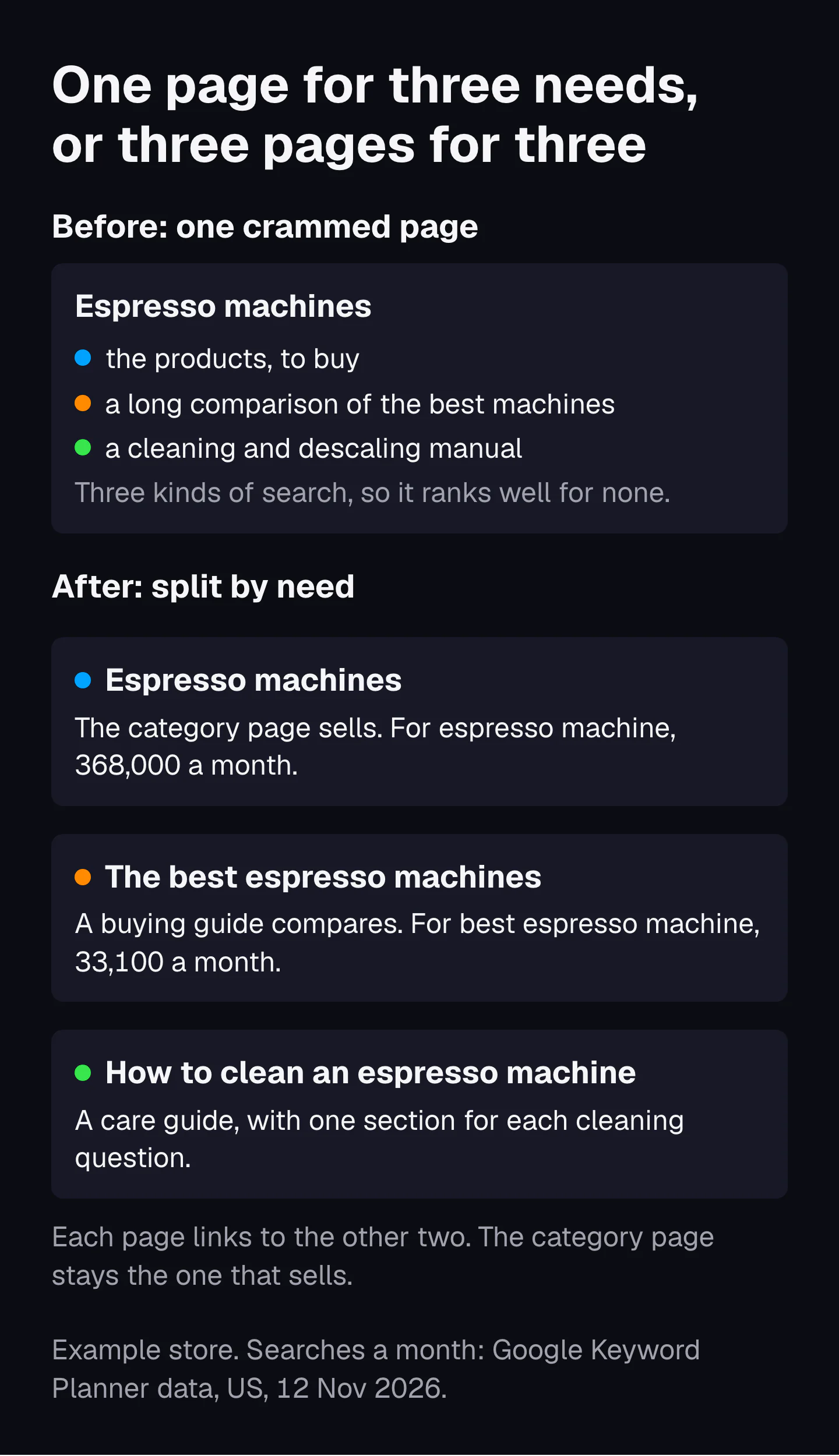
The split follows the decision path. The category page keeps the products and a short note on choosing. The comparison becomes a buying guide for "best espresso machine". The cleaning questions become a care guide with a section for each question. Each page links to the others, and the category page stays the one that sells. For stores this split is the core of topical maps for ecommerce stores.
Both mistakes have one cure: one page per need, and a section for every search that is only part of one. If you would rather not run every search on your site through it yourself, our growth plan plans every page for you.
Sources
- How semantics and topical authority improve local SEO (Koray Tuğberk Gübür), Search Engine Land, 2026
- Importance of Topical Authority for SEO (Koray Tuğberk Gübür), Holistic SEO & Digital, 2021
- Agglomerative clustering of a search engine query log (Doug Beeferman, Adam Berger), ACM SIGKDD, 2000
- Query clustering using user logs (Ji-Rong Wen, Jian-Yun Nie, Hong-Jiang Zhang), ACM Transactions on Information Systems, 2002
- Passage-level evidence in document retrieval (James P. Callan), SIGIR '94, Springer, 1994
- Scoring candidate answer passages, US9940367B1, Google LLC (patent), 2018
- Search result plusbox including restricted results, US20110016108A1, Google LLC (patent application), 2011
- Bing Webmaster Guidelines, Microsoft Bing, 2026
- Optimizing your content for inclusion in AI search answers, Microsoft Advertising, 2025
- The Information Retrieval Thesaurus (Stella G. Dextre Clarke), ISKO Encyclopedia of Knowledge Organization, 2019
- ANSI/NISO Z39.19-2005 (R2010), Guidelines for the Construction, Format, and Management of Monolingual Controlled Vocabularies, NISO, 2005
- How AI is powering a more helpful Google (Search On 2020), Google, 2020
- A guide to Google Search ranking systems, Google Search Central, 2025
- How Search works: ranking results, Google, 2026
- Consolidate duplicate URLs, Google Search Central, 2026