Topical authority: what it is and how to build it
Topical authority is the trust a search engine gives a website on one subject, earned by covering that subject completely and by being known and cited for it by others.
Topical authority is one of the most repeated ideas in SEO and one of the least checked. Here is who brought it into SEO, what search research, court records, patents and leaks show, what no study has shown yet, and what one real store taught us about coverage, links and AI answers.

Key takeaways
- Koray Tuğberk Gübür brought topical authority into SEO in February 2021 as topical coverage times historical data, and by 2023 he described historical data as staying in the results with higher click satisfaction.
- Court notes of a 2025 call with a Google engineer describe topicality as connected to a given search and quality as largely related to the site, which is why I read topical authority as a per-search half and a per-site half.
- No independent study with a stated method has yet linked site-wide topic coverage to rankings, so every claim about topical authority rests on engine documents, patents, single-site case studies or tool scores.
- In a nicotine pouch store we worked with, Google clicks grew from 3,500 to 102,000 a month in 15 months while the number of linking sites went from about 80 to about 200.
- When AI answers began taking that store's clicks, its linking sites more than tripled in nine months and clicks still fell, so judge topical authority on impressions and AI citations, not on clicks alone.
What topical authority means in plain words
Topical authority is the trust a search engine gives a website on one subject. It is earned two ways: by covering the subject completely, and by being known and cited for it by others. No search engine publishes it as a score you can look up.
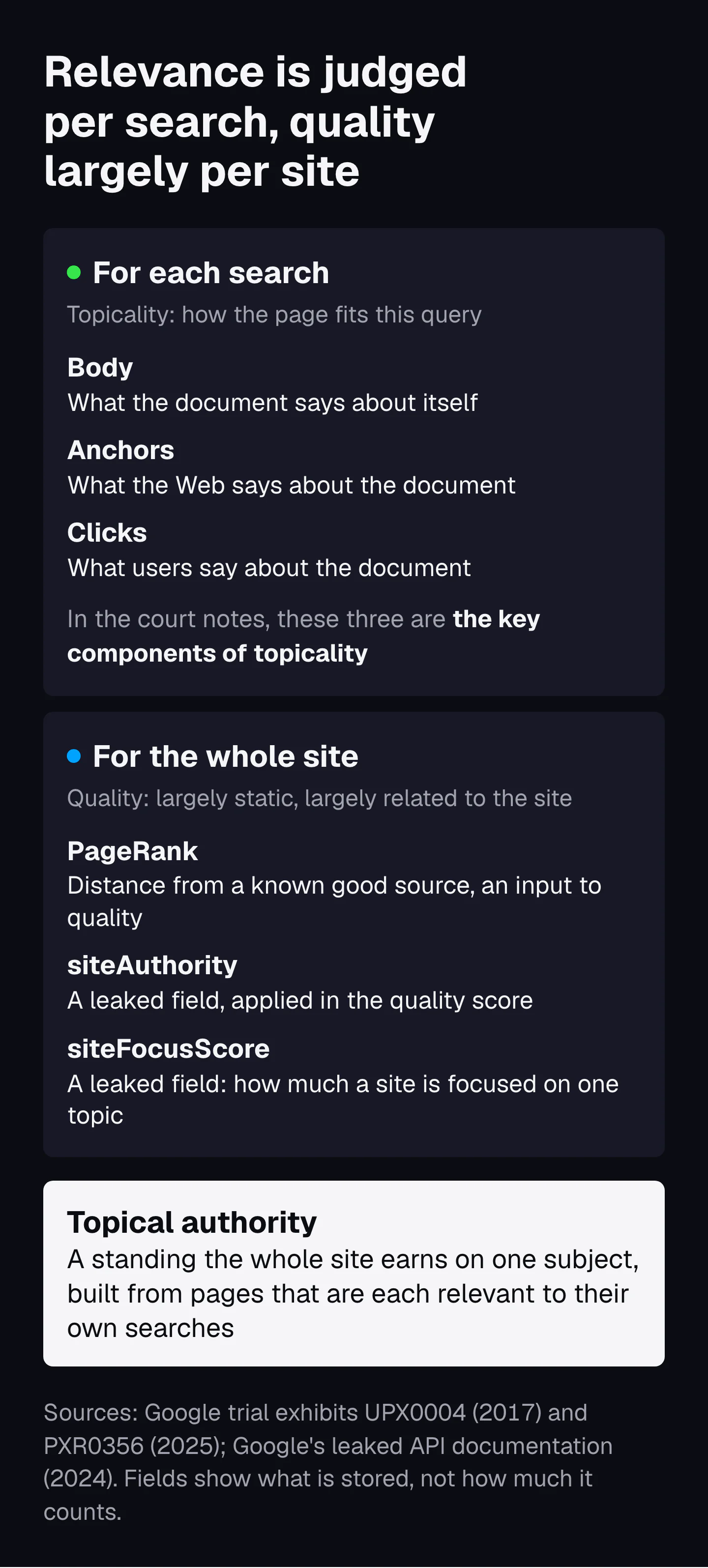
The split is close to how a Google engineer described ranking. In the notes of a 2025 call with Google engineer HJ Kim, filed as an exhibit in the US antitrust case against Google, topicality "is connected to a given query". Quality, by contrast, is "largely related to the site rather than the query". Topicality here means how relevant a page is to one search. Mapping that onto the two halves is my reading, not the engineer's words. Relevance is judged search by search. Reputation is judged largely for the whole site.
Three terms get mixed up because of this split:
| Term | What it describes | Judged for | Who measures it |
|---|---|---|---|
| Topical relevance | How well one page matches one search | One page, one search | The search engine, every time someone searches |
| Topical authority | How much a whole site is trusted on one subject | One site, one subject | Nobody publishes a number. Engine records describe its parts |
| Domain authority | The strength of the links pointing at a whole site | One site, every subject | Moz and other SEO tools, each with its own score |
Think of a hospital. Each answer a doctor gives is judged on the question asked. Whether you go to that hospital at all depends on its name in the field. A topical map plans the answers, every page the subject needs and the links between them. The name is earned partly on other people's sites.
Who brought topical authority into SEO, and how his formula changed
Koray Tuğberk Gübür, an SEO consultant and the founder of the agency Holistic SEO & Digital, put topical authority into SEO's vocabulary with a case study on Oncrawl on 11 February 2021. He defined it as topical coverage times historical data, and he has rewritten the formula since. When we searched "topical authority" in the US on 12 November 2026, Google's knowledge panel beside the results was about him.
In the 2021 case study he wrote: "Topical coverage means how well you cover this graph. Historical data refers to how long you have been covering this topical graph at a certain level." The formula followed: "Topical Authority = Topical Coverage * Historical Data." Multiplying matters. Full coverage with no history gives zero, and so do years of history with no coverage.
| When | Where | His formula |
|---|---|---|
| 11 Feb 2021 | Oncrawl case study | Topical coverage × historical data |
| Undated | His bio on his course site | Topical coverage + historical data |
| 5 Jan 2023 | How to Expand a Topical Map for Higher Topical Authority? | Same terms, but a source must "stay in the results with higher click satisfaction for a certain amount of time" |
| 22 Jul 2026 | His Search Engine Land article on local SEO | "Historical data multiplied by topical coverage," divided by "cost of retrieval," and "interpreted with visual semantics" |
Two shifts matter here. In his current version, cost of retrieval, what it costs an engine to crawl, understand and serve your pages, divides the result, so in his model needless pages count against you. It has its own lesson, cost of retrieval. And historical data moved from time spent on a topic to how searchers respond to you. That second shift explains the case further down.
I learned the idea from his work. His whole framework, term by term with a source for each, is in Koray Tuğberk Gübür's topical map framework. This lesson uses only the parts topical authority needs, and checks them against sources outside his own writing.
How search research made authority depend on the topic, 1999 to 2002
Search research made authority depend on the topic more than 20 years before SEO had the term. Three papers did most of it, and each one maps onto a piece of how topical authority works today.
| Year | Paper | The idea | What it means for a site |
|---|---|---|---|
| 1999 | HITS, Jon Kleinberg, Journal of the ACM | For a broad topic, authorities are the pages good hub pages link to, and good hubs are the pages that link to good authorities | A page that points to the best pages on a subject is doing what a pillar page does |
| 1999 | Hilltop, Krishna Bharat and George Mihaila | Rank by links from expert pages: pages on the topic that point to "numerous non-affiliated pages on the subject" | A link from an independent page about your field says more than a link from anywhere |
| 2002 | Topic-sensitive PageRank, Taher Haveliwala | "A set of PageRank vectors, biased using a set of representative topics": one importance score per topic instead of one for the whole web | One site can be strong on one subject and weak on the next |
Kleinberg described "a certain natural type of equilibrium" between hubs and authorities: each makes the other count. Hilltop's experiments ran in August 1999, and Krishna Bharat's address on the paper is Google's. Haveliwala's paper was published in May 2002, and its whole point is that importance depends on the subject of the search.
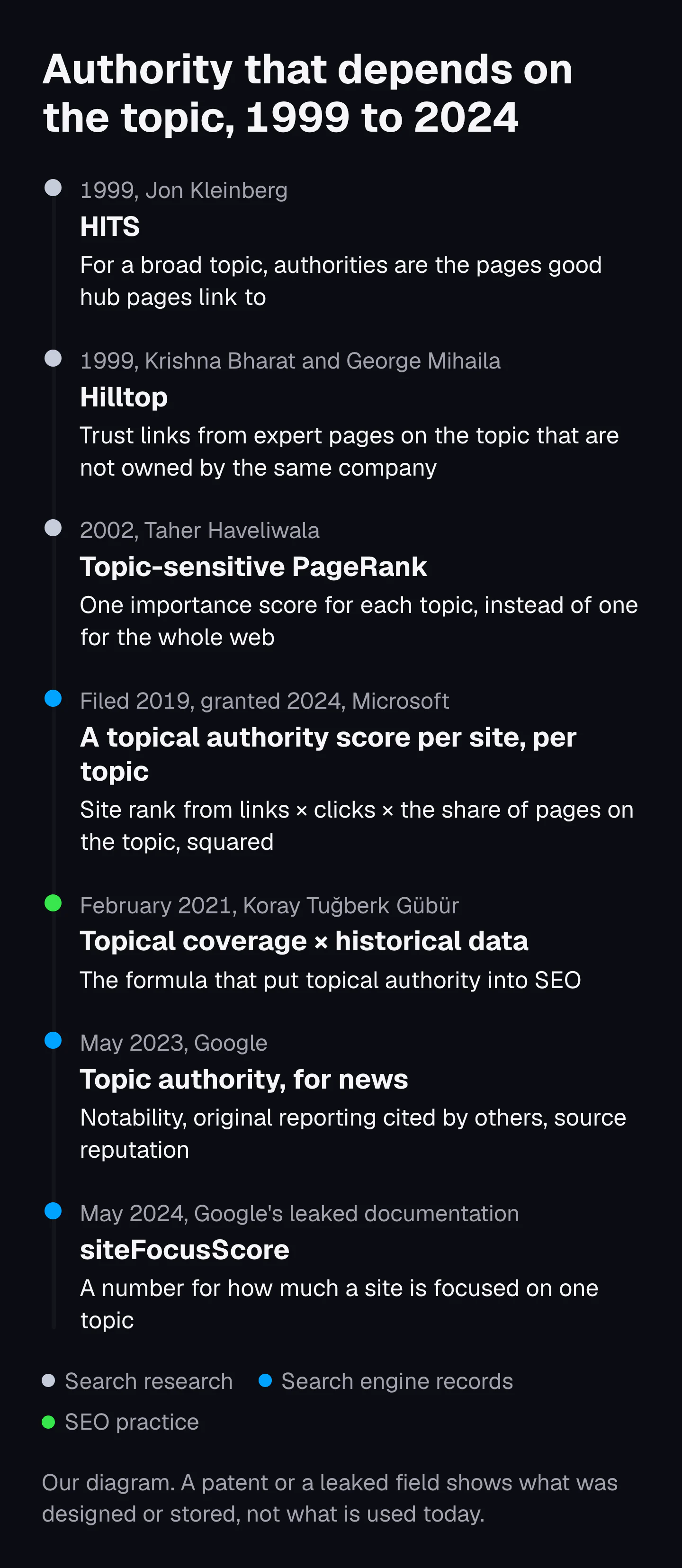
The line from these papers runs to a Microsoft patent and to Koray's formula, both in the next sections. For the older roots of the map itself, in library classification and the topic maps standard, see where topical maps came from.
What search engines' own records show about relevance and reputation
Search engines' own records describe topical authority in two parts: relevance, judged search by search, and reputation, judged largely for the whole site. Four kinds of record say so: Google's court documents, its leaked API documentation, a Microsoft patent, and the guidelines Google and Bing publish.
Google's court record
The US Department of Justice published Google's internal slides as exhibits in its antitrust case. A 2017 deck by Google engineer Eric Lehman, Life of a Click (exhibit UPX0004), has a slide titled "The 3 Pillars of Ranking". Body is "What the document says about itself." Anchors is "What the Web says about the document." User-interactions is "What users say about the document."
The 2025 HJ Kim notes say how those pillars combine. "ABC signals are the key components of topicality": anchors, body and clicks. Quality is a separate score, "largely static and largely related to the site rather than the query." PageRank "is a single signal relating to distance from a known good source, and it is used as an input to the Quality score." The notes also say why the quality team started: content farms that "wrote 1000s of articles on each topic."
The court's liability opinion of 5 August 2024 adds that Navboost, a Google system that remembers which results people click, "pairs queries and documents through memorizing user click data", trained on 13 months of data. Clicks feed relevance, search by search. The case below turns on that.
The 2024 leak
In 2024 Google's internal documentation for its Content Warehouse API leaked, and Google confirmed to The Verge on 29 May 2024 that the documents are real. One record, QualityAuthorityTopicEmbeddingsVersionedItem, holds siteFocusScore, a "Number denoting how much a site is focused on one topic", and siteRadius, "The measure of how far page_embeddings deviate from the site_embedding." An embedding is a summary of a page's meaning as numbers. In plain words: how tightly a site sticks to one subject, and how far each page strays from it. Another record, CompressedQualitySignals, describes siteAuthority as "applied in Qstar", which looks like the Q* quality score in the court notes, though nobody outside Google has confirmed they are the same.
Microsoft's patent and Bing's guidelines
The only search engine document I found that uses the exact words "topical authority" is a Microsoft patent, US11874882B2, filed on 2 July 2019. The application was published on 7 January 2021 and the patent was granted on 16 January 2024. It ranks a page "based upon a topical authority score assigned to the website with respect to a topic", and claim 2 gives one site "multiple topical authority scores" for different topics.
Its baseline formula multiplies three things: the site's rank from links between sites, the clicks the site gets (measured, it says, from "Bing's anonymized traffic log"), and topic purity, "the percentage of pages within the site s that are tagged with topic t", squared. Links, clicks and focus all have to be there at once. The comparison with Koray's formula is in his framework lesson.
Bing's Webmaster Guidelines put the same idea as advice. One section is titled "Focus Each URL on a Single Topic". Another warns that "Duplicate URLs dilute signals and reduce Bing's confidence in selecting a URL for grounding results or citations." Grounding means the pages Bing's AI answers draw on.
What Google says in public
Google has one system with a similar name. On 23 May 2023 it described a topic authority system for news with three prominent signals: how notable a source is for a topic or location, how often its original reporting is "cited by other publishers", and its reputation, including "recommendations from expert sources, such as professional societies." It ranks news sources, not websites in general. For ordinary sites, Google's helpful content guidance asks: "Does your site have a primary purpose or focus?"
Read together, topical authority is a standing the whole site earns on one subject, built from pages that are each relevant to their own searches. How engines read what a page is about, its entities and the questions behind a search, is the subject of semantic SEO.
What no independent study has shown about topical authority yet
No independent study with a stated method has yet linked site-wide topic coverage to rankings. Most advice on topical authority reads as if one had. What exists is engine documents, patents, single-site case studies and tool scores, and each proves something narrower.
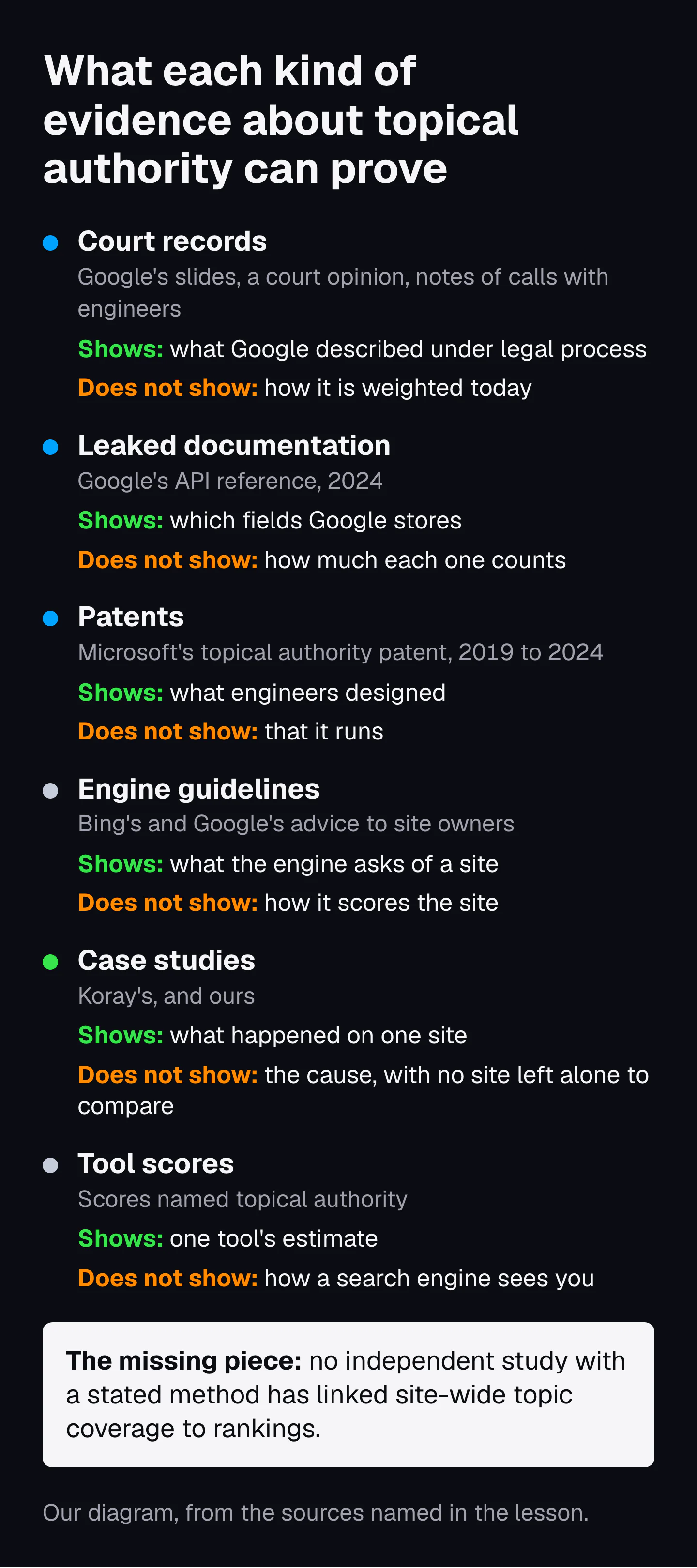
The closest study is a 2024 ranking analysis published by Search Engine Journal, with keyword data from the SEO tool Surfer. Pages "missing common keywords and phrases" ranked lower, a correlation of -.11 in December 2023 and -.13 in April 2024. The authors called it topical authority. It measures the words on one page, not a site's coverage of a subject, and a correlation does not show cause.
Koray's own case studies report big gains, such as one site that went from about 10,000 to about 200,000 a month in 145 days in 2021, by his figures. They are his numbers, from his own screenshots, with no similar site left alone for comparison. Our case below has the same limit: one site, measured before and after.
A store that grew on coverage before it had many links
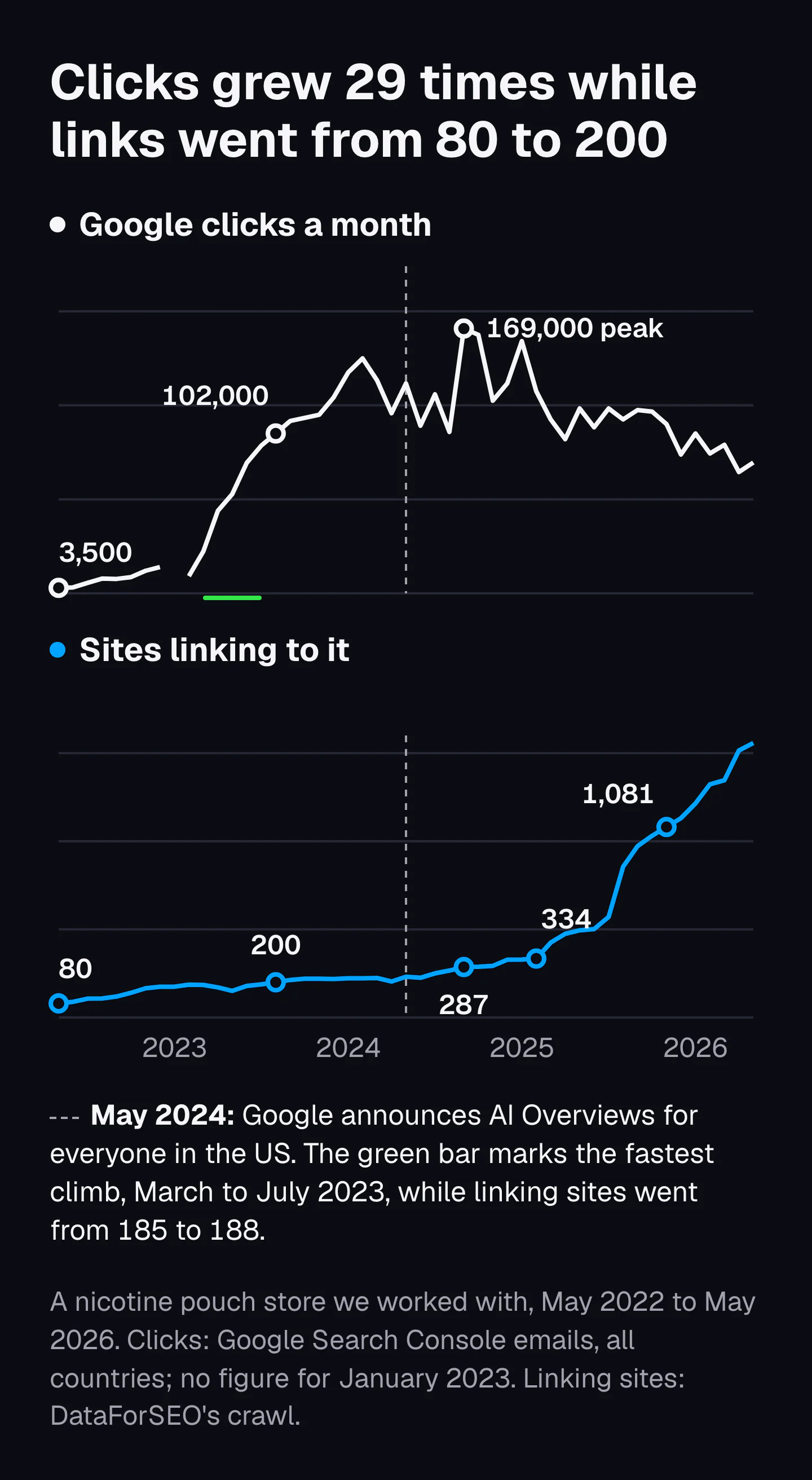
In a nicotine pouch store we worked with, Google clicks grew from 3,500 to 102,000 a month in 15 months. Over the same months the number of sites linking to it, the referring domains a crawler counts, went from about 80 to about 200.
When we started in May 2022, the store had a few hundred pages and almost no links. We spent the first year answering the questions buyers actually type: what happens if you swallow a pouch, whether you can take one on a plane, which pouches are strongest. The fastest climb came from March to July 2023, when clicks went from 26,800 to 94,300 a month. In those five months the count of linking sites went 185, 171, 151, 179 and 188. The count barely changed: the crawler saw dozens of new linking sites in those months and about as many drop away.
| Month | Google clicks | Linking sites |
|---|---|---|
| May 2022, the start | 3,500 | 80 |
| August 2023 | 102,000 | 200 |
| September 2024, the peak | 169,000 | 287 |
| February 2025 | 129,000 | 334 |
| November 2025 | 108,000 | 1,081 |
Coverage came first. Links came slowly. At the peak, 169,000 clicks a month in September 2024, about 290 sites linked to the store. On this site the coverage did most of the work on a small link profile.
Why more links did not bring the store's clicks back
More links did not bring the clicks back, most likely because AI answers were taking them, not other websites. Through 2025 Google showed the store more often than ever, while the share of searchers who clicked fell from 5.85% in the peak month to about 2%.
Google announced on 14 May 2024 that AI Overviews, the AI answer at the top of its results, would begin rolling out to everyone in the US. The store's clicks did not fall then: they held between 103,000 and 134,000 a month from May to August 2024, then jumped to the September 2024 peak of 169,000, and fell from early 2025. Between February and November 2025 the count of linking sites more than tripled, from 334 to 1,081. Over the same months clicks went from 129,000 to 108,000 a month, while impressions, the times Google showed the site, reached 6.5 million a month.
When we looked at the pages in March 2025, our report to the client put the missing clicks down to the AI answers, "Not a decrease in ranks". On 13 November 2026, all six of the store's biggest question searches we checked opened with an AI Overview, and the store was quoted in three of them.
Pew Research Center measured the same effect in the browsing of 900 US adults in March 2025. In its study published on 22 July 2025, people clicked a traditional result on 8% of visits to a results page with an AI summary, against 15% without one.
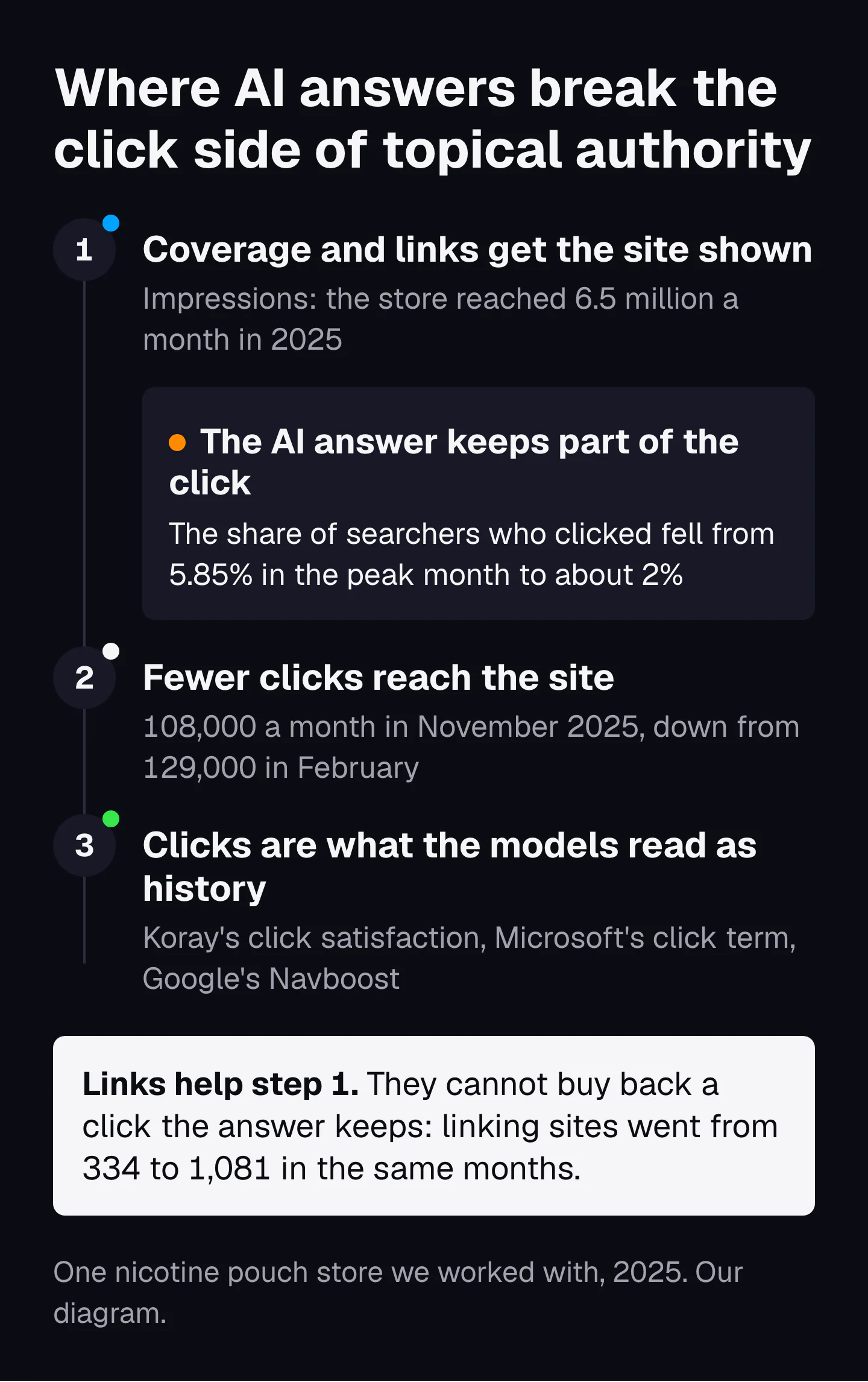
This is where topical authority models run into trouble. The three models built since 2019 all use clicks: Koray's historical data became click satisfaction in 2023, Microsoft's patent multiplies in a site's clicks, and Google's Navboost memorizes them. When the answer keeps the click, the click side of authority falls while the site is still shown, and links cannot buy back a click the answer keeps.
Links still matter, for the half they belong to. In the court notes, PageRank is distance from a known good source and feeds quality, and anchors are one of the three parts of topicality. In AI search, Mahe Chen and colleagues at the University of Toronto found in 2025 "a systematic and overwhelming bias towards Earned media", meaning third-party sources, over a brand's own pages. That suggests mentions in your field matter more for being quoted, not less. How to earn them is in links, mentions and reputation, and how pages get quoted is in getting a topical map cited in AI answers.
How to build topical authority on your own site, step by step
Build topical authority in seven steps, in this order: decide what the site is for, plan every page the subject needs, give each search one page or one section, link the pages the way the subject connects, publish what other pages depend on first, give every page a purpose, and earn mentions in your field.
- Decide what the site is for. Google's guidance asks whether a site has "a primary purpose or focus". Koray calls this the site's source context: its purpose and how it earns. It sets the angle of every page. The decision is in source context and central entity.
- Plan every page the subject needs. List every question a buyer asks before, during and after buying, and every attribute they compare. That plan is a topical map, and how to build a topical map walks through it by hand.
- Give each search one page, or one section of a page. Many searches are a section of a page, not a page of their own. Two pages on one search compete, and Bing's guidelines say duplicates "dilute signals". The test is in page or section.
- Link the pages the way the subject connects. A hub links down to its pages, pages link back up and across to neighbors, and the sentence around each link says why. In the court notes, anchors are one of the three parts of topicality. The method is in internal links in a topical map.
- Publish what other pages depend on first. A page that ten others link to goes live before them, so each new page arrives into a structure. See publishing order.
- Give every page a purpose. Pages off the subject are what the leaked
siteRadiusfield and Microsoft's topic purity describe measuring, though nobody outside the engines knows how much either counts. The next section covers what to do with them. - Earn mentions in your field. Publish something worth citing, such as your own numbers or a test you ran, and get it in front of the sites your buyers already read. The reputation half has its own lesson: links, mentions and reputation.
Steps 1 to 5 are planning, step 6 is cleanup on your own site, and step 7 happens on other people's sites. A map is planned around your subject, so its size follows the subject: from about 50 pages to over 20,000. If you would rather have the plan made for you, that is our growth plan.
What to do with off-topic posts on an existing site
Give every page on the site a purpose. When a post has none, first try to merge it into a page that is more relevant, and remove it only when nothing fits. How much of a site is off topic varies too much for any target share.
The engine records point the same way, without saying how much it counts. The leaked siteRadius measures how far pages stray from what the site is about, and Microsoft's topic purity, the share of a site's pages on the topic, is squared in its formula. Koray put the cost side plainly in his July 2026 article: "every unnecessary page increases the cost of retrieval." A post with no purpose adds a page without adding coverage.
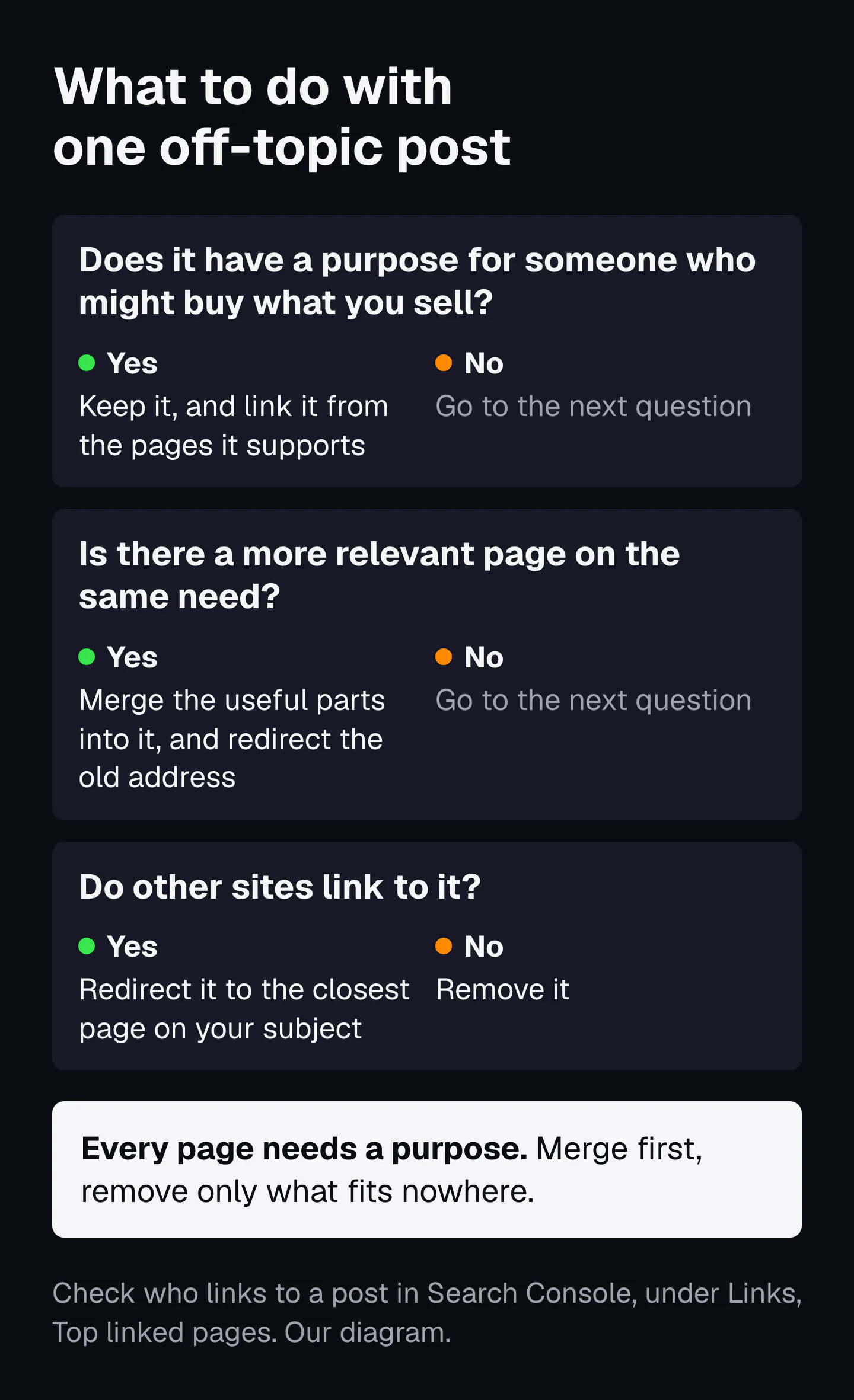
- Name the post's purpose in one sentence. Say what it does for someone who might buy what you sell. If you can, keep it and link it from the pages it supports.
- If you cannot, look for a more relevant page on the same need. Move the useful parts into that page and redirect the old address to it.
- If nothing fits, remove it. First check whether other sites link to it, in Search Console under Links, Top linked pages. If they do, redirect it to the closest page on your subject instead.
Traffic alone does not settle purpose. A support page with few visits can be exactly what a buyer needs, and a recipe post with thousands of visits can still have no purpose on a plumber's site. With that much traffic, or with other sites linking to it, merge or redirect it rather than delete it. Sort every page in the sheet below, then work through it from the top.
Download the page purpose audit sheetCSV for Google Sheets or Excel. One row per page: its purpose in one sentence, the closest more relevant page, impressions, clicks, linking sites and the action. Four made-up rows show how to fill it in.
Redirects, merges and how to measure the result are covered step by step in pruning and merging.
How to tell whether topical authority is growing
Watch a group of pages on one subject, not one ranking. Compare impressions, the number of different searches the group appears for, and citations in AI answers before you judge clicks, because AI answers now take clicks from pages that still rank.
In Google Search Console, filter Performance to the pages of one subject and compare month on month. Impressions usually move first, because a page has to be shown before it climbs to where it gets clicked. Koray makes the same point: in March 2024 he advised focusing on the difference in impressions to see a site's true ranking potential. Bing Webmaster Tools added an AI Performance report in February 2026 that counts Total Citations and the pages cited in AI answers. Koray's warning holds here too: no tool score measures topical authority itself.
| What you see | What it usually means | What to do |
|---|---|---|
| Few impressions across the subject | Pages are missing, or not indexed | Check indexing, then compare your pages with a full map of the subject |
| Impressions rising, clicks flat or falling, rankings steady | AI answers or other results take the click | Check which searches show an AI answer and whether you are quoted. Judge the group on impressions and citations, and do not answer it with links alone |
| Shown for the subject but stuck below page one | The pages above answer more, or are better known in the field | Compare their pages with yours section by section first, then look at who mentions them and not you |
| Two of your pages swap places on one search | Two pages may compete for one search | If they answer the same question, merge them into one. See keyword cannibalization |
| Many pages with no clear purpose | The site's focus is diluted | Merge first, and remove what fits nowhere |
The full method, with a baseline and a group of pages left alone for comparison, is in how to tell if a topical map is working.
Sources
- Importance of Topical Authority: A Semantic SEO Case Study, Oncrawl (Koray Tuğberk Gübür), 2021
- How to Expand a Topical Map for Higher Topical Authority?, Holistic SEO (Koray Tuğberk Gübür), 2023
- 3 Suggestions about Topical Authority, Medium (Koray Tuğberk Gübür), 2024
- Authoritative sources in a hyperlinked environment, Journal of the ACM (Jon M. Kleinberg), 1999
- Hilltop: A Search Engine based on Expert Documents, University of Toronto (Krishna Bharat, George A. Mihaila), 1999
- Topic-sensitive PageRank, ACM, WWW 2002 (Taher H. Haveliwala), 2002
- US11874882B2: Extracting key phrase candidates from documents and producing topical authority ranking, Microsoft Technology Licensing (Google Patents), 2024
- Life of a Click (user-interaction), trial exhibit UPX0004, US v. Google, U.S. Department of Justice, 2017
- Notes of a call with Google engineer HJ Kim, remedies exhibit PXR0356, US v. Google, U.S. Department of Justice, 2025
- Memorandum opinion (liability), US v. Google LLC, No. 20-cv-3010, U.S. District Court for the District of Columbia (CourtListener), 2024
- QualityAuthorityTopicEmbeddingsVersionedItem (google_api_content_warehouse 0.4.0), HexDocs, 2024
- CompressedQualitySignals (google_api_content_warehouse 0.4.0), HexDocs, 2024
- Google confirms the leaked Search documents are real, The Verge, 2024
- Bing Webmaster Guidelines, Microsoft Bing, 2026
- Introducing AI Performance in Bing Webmaster Tools (public preview), Bing Webmaster Blog, 2026
- Google users are less likely to click on links when an AI summary appears in the results, Pew Research Center, 2025
- Generative Engine Optimization: How to Dominate AI Search, arXiv (Mahe Chen, Xiaoxuan Wang, Kaiwen Chen, Nick Koudas), 2025
- 260k search results analyzed: here's how Google evaluates your content, Search Engine Journal, 2024
- Understanding news topic authority, Google Search Central Blog, 2023
- Creating helpful, reliable, people-first content, Google Search Central, 2026
- Achieving Positive Ranking State: 120% Growth in 4 Months, Medium (Koray Tuğberk Gübür), 2024
- Generative AI in Search: let Google do the searching for you, Google, 2024