What is a pillar page? Where it sits in a map
A pillar page is the page at the top of one branch of a topical map: it covers the whole subject at the level of an overview, links down to every page that covers a part of it, and every one of those pages links back up to it.
Some guides put a word count on a pillar page. A pillar is defined by its links, and on a store it is often a collection. Here is what a pillar is, where it sits in a topical map, and how to pick yours.

Key takeaways
- A page is a pillar because of its links, not its length: every page in its branch links up to it, and it links down to each of them.
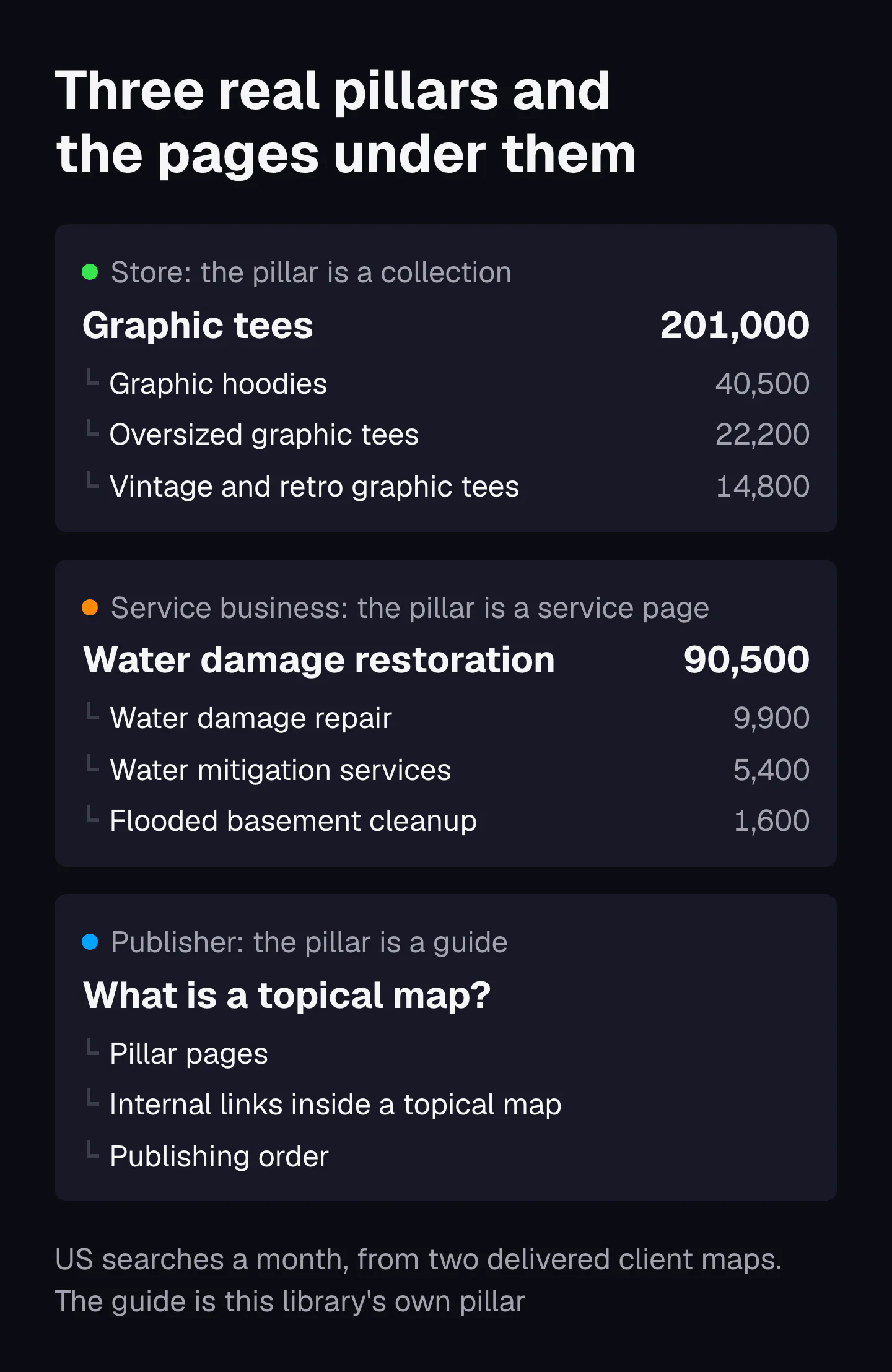
- On a store the pillar is usually a collection, on a service business a service page, and on a publisher a guide; in a store map we delivered, the pillar is the graphic tees collection, a search made 201,000 times a month in the US.
- The pillar and cluster model is a content marketing idea, made a product when HubSpot launched a topic cluster tool in September 2017; I found no page about pillar pages in Google's Search Central documentation.
- A pillar gives each part of its subject a short summary and a link, and leaves the depth to that part's own page; a pillar that covers a part in full competes with the page under it.
- Do not count on a pillar to lift the pages under it: in a 2021 SearchPilot split test on one store, the hub pages that linked to more articles gained 16% and the articles they linked to showed no detectable change.
What a pillar page is, and what it is not
A pillar page is the top page of one branch of a topical map. It covers the subject as an overview and links down to every page that covers a part of it. Each of those pages links back up. If you are new to maps, start with what a topical map is, which is itself the pillar of this library.
The picture people use is hub and spoke. The pillar is the hub. The pages under it, often called cluster pages, are the spokes. The same page goes by other names: pillar content, cornerstone content, a hub page.
All five top results for "pillar page" I read on 13 November 2026 describe it as a broad overview that links to its cluster. Two also gave a length. One said many pillar pages are "over 2,000 words" and showed an example of over 9,000 words. Another said "3,000 to 5,000 words". Neither cited a source. And every example in them is a long article; none shows a store or a service business.
A long page is not a pillar. What makes a page a pillar is its links, not its length. That idea is older than SEO blogs. In 1999 the computer scientist Jon Kleinberg defined a hub as a page whose worth is what it points to: "a good hub is a page that points to many good authorities; a good authority is a page that is pointed to by many good hubs".
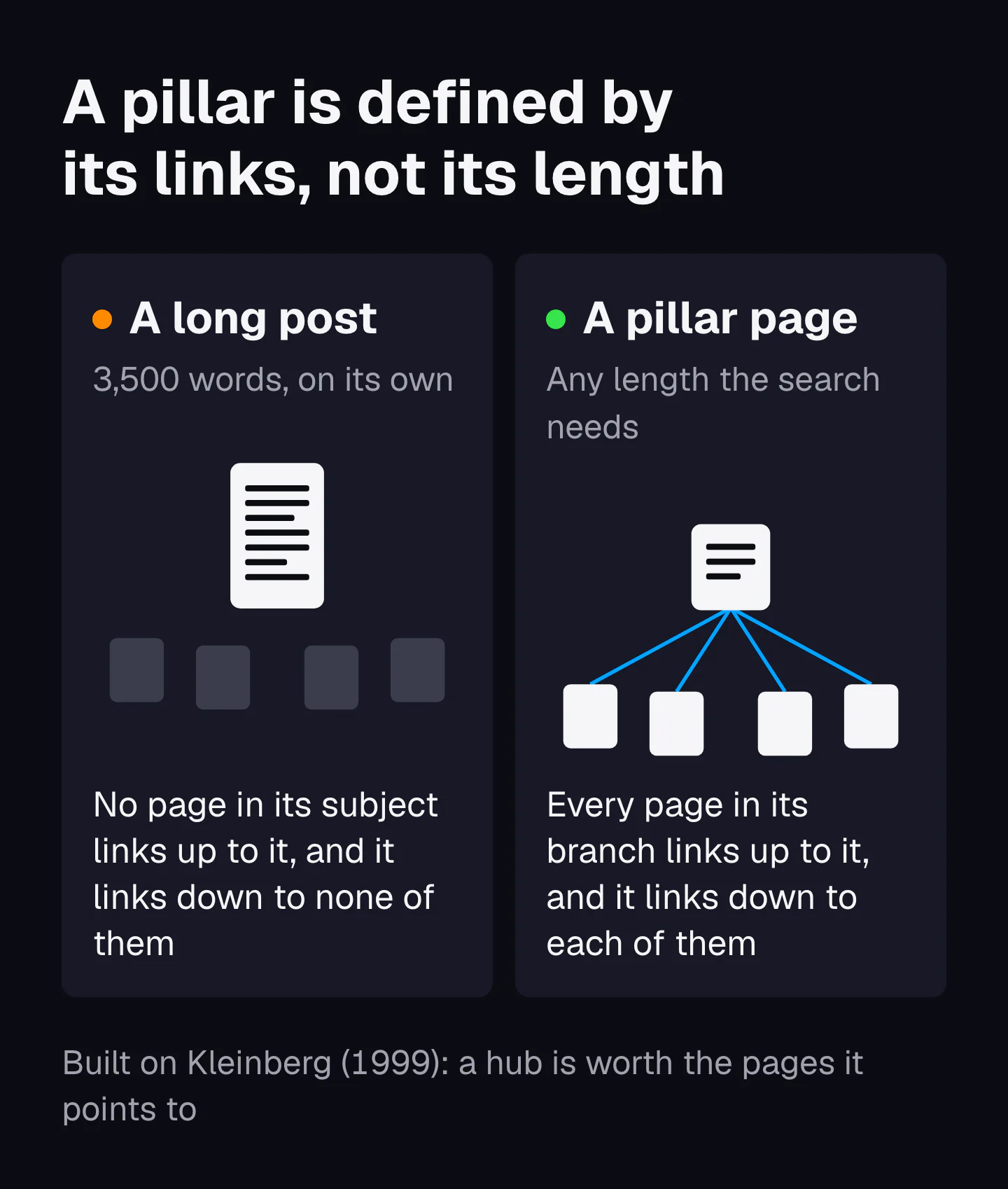
So test a page by its links. Does every page in the subject link up to it? Does it link down to each of them? If both answers are no, it is a long post, however good it is.
A pillar page next to the pages it gets confused with
| Page | What it is for | Links that define it | Can it be the pillar? |
|---|---|---|---|
| Pillar page | The overview of one subject | Every page in its branch links up; it links down to each | It is the pillar |
| Long blog post | The full answer to one search | Often none in, a few out | Only if the branch is rebuilt around it |
| Landing page | One action from one campaign | Few or none; traffic arrives from ads or email | Rarely: it is built to convert, not to cover a subject |
| Category or collection page | Showing and selling a range of products | Links down to products and smaller collections | Often, on a store |
A topic cluster is the pillar plus the pages under it. A topical map is every cluster a site needs, in order. The difference is the subject of topical map vs topic cluster.
Where the pillar page came from, and when
The idea is older than its name. Link research described hub pages between 1997 and 1999. Marketing software made topic clusters a product in 2017. Koray Tuğberk Gübür described the planned network a pillar sits in, the topical map, in 2021. None of the five top results I read gives a date for any of it.
1997 to 1999: hubs and authorities. Kleinberg's paper first circulated as an IBM research report in May 1997 and appeared in the Journal of the ACM in 1999. It split the web into hubs, which point to the best pages on a topic, and authorities, which those hubs point to. The two make each other stronger.
1999: expert pages. In the same year, Krishna Bharat and George Mihaila described a search engine called Hilltop. It ranked pages by what "expert" pages linked to. They defined an expert page as "a page that is about a certain topic and has links to many non-affiliated pages on that topic". Hilltop counted links between unrelated sites, so a pillar is not an expert page in its sense. The shape is the same, though: one page on a topic, pointing to the pages that cover it.
September 2017: topic clusters. HubSpot, the marketing software company, launched a tool called Content Strategy, built on what it called topic clustering. The trade press reported it on 7 September 2017. The report summed up HubSpot's case: "For years, the best way to solidify a spot at the top of the results was to focus on creating multiple pieces of content focused on niche, long-tail keywords." The pillar page is the top page of such a cluster, and the pair is still a content marketing idea. Four of the five top results I read come from software companies.
February 2021: the topical map. Koray Tuğberk Gübür published the case study that put the topical map in front of the SEO industry, on 11 February 2021. His article does not use the word pillar. In his method, the plan comes first: every page of the subject, chosen from what the site is for, connected in a set order. A pillar then is one level of that plan, not a single big article. His work is explained in Koray Tuğberk Gübür's topical map framework, and the longer history in where the topical map came from.
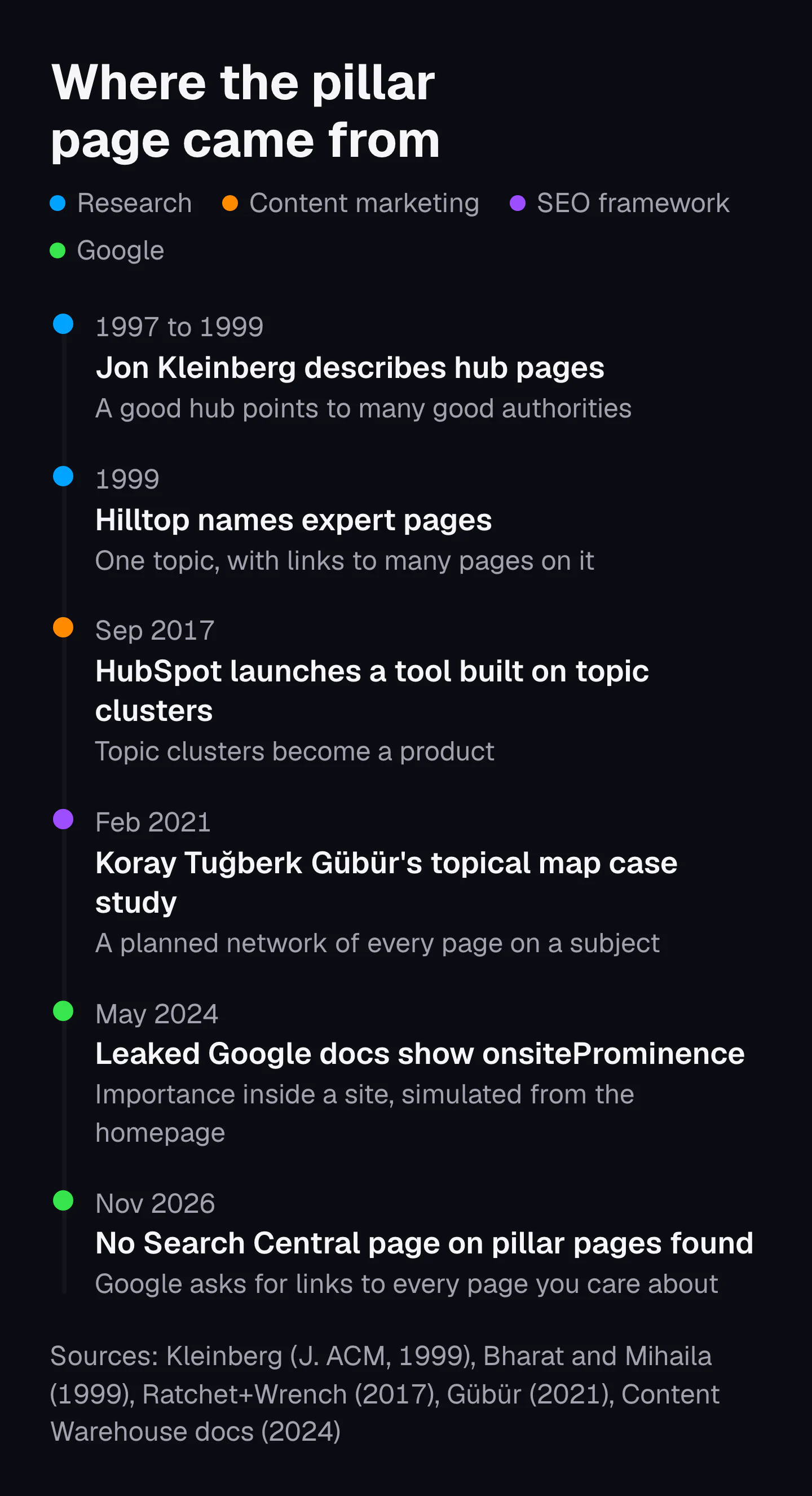
Google is missing from that list. I searched Google's Search Central documentation on 13 November 2026 and found no page about pillar pages. What Google does say is simpler. Its guide to links states: "Every page you care about should have a link from at least one other page on your site." A pillar is one tidy way to meet that rule. It is not a ranking factor of its own.
Where a pillar page sits in a topical map
A pillar sits one step under the homepage, at the top of its branch. Hubs and pages hang under it. It belongs to the core section of the map: the pages closest to what the site sells.
A topical map has four heights:
- The homepage says what the whole site is about and links to each pillar.
- The pillar covers one subject the site is built around.
- Hubs gather one group of pages inside that subject.
- Pages each answer one search.
A hub and a pillar do the same job at two heights. The hub is the pillar of a smaller branch. That is why some guides say the two words mean the same thing. In a map it helps to keep them apart, because a hub links up to a pillar and a pillar links up to the homepage.
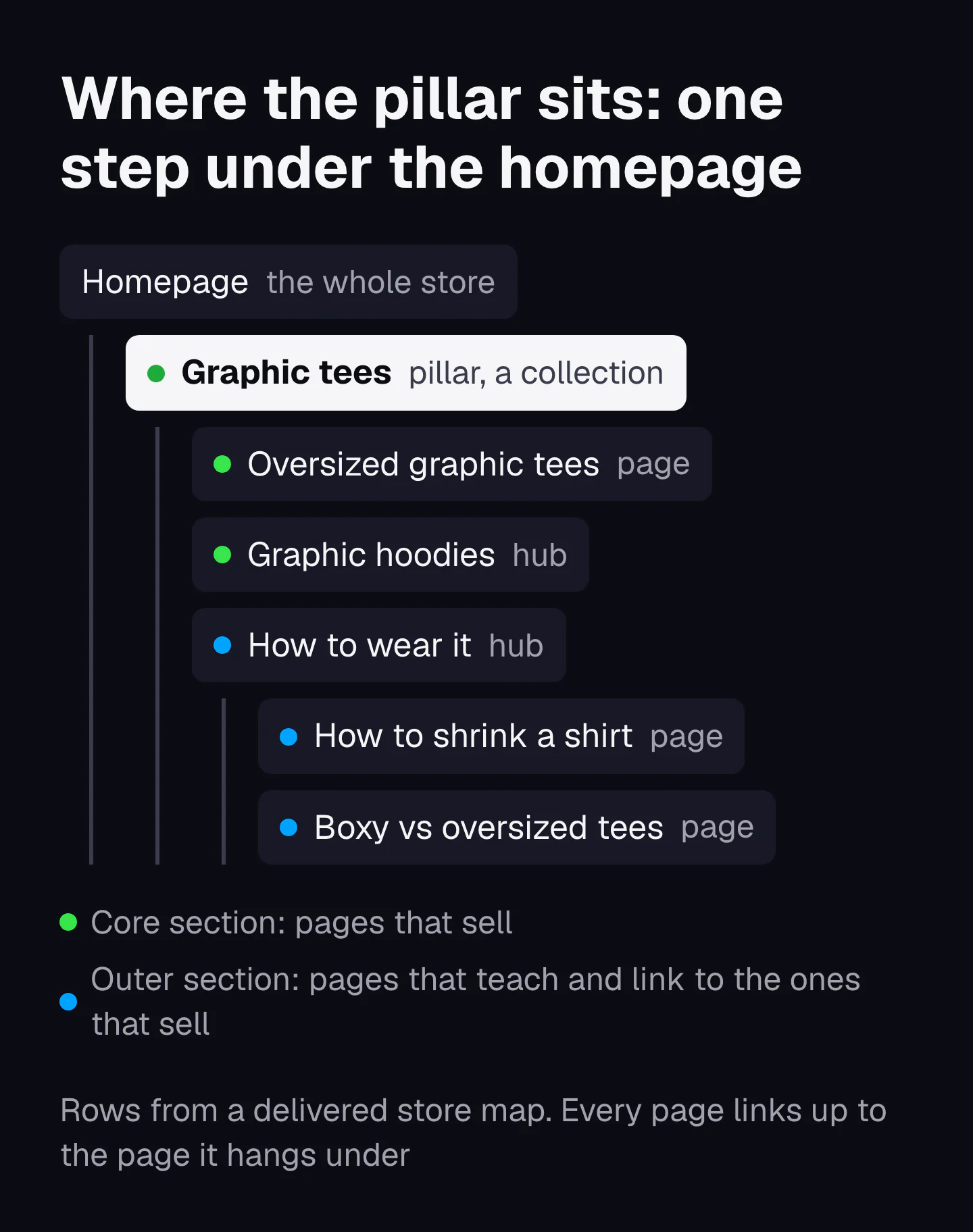
Most sites need one pillar per subject they are built around. A store that only sells graphic tees has one. A restoration company that does water, fire and storm damage can have one per kind of damage, under a page that lists all its services.
Why the pillar belongs in the core section
Koray's framework splits a map into a core section, where the site earns its money, and an outer section of supporting pages that build history and send links to the core. In a 2023 case study he put the link rule plainly: "All the topical map nodes should be connected to the conversion points and landing pages to support them with link flow." A pillar on a store or a service business sits in the core. The pages that teach, in the outer section, link up to it. The split is explained in core section and outer section.
He also names a few of a site's strongest, fullest pages quality nodes, pages that change how a search engine judges the whole site. In March 2024 he wrote: "Link all of the Quality Nodes from your homepage." In my reading, a pillar is the first candidate.
Google's leaked documentation points the same way. The 2024 leak, which Google confirmed was real, lists a field called onsiteProminence. Its description says it "measures the importance of the document within its site" and is "computed by propagating simulated traffic from the homepage and high craps click pages" (the field's own wording). How much the field counts is unknown, and Google warned against reading too much into the leak. My reading, not Google's statement: a page one click from the homepage looks more important inside its site than a page five clicks away.
How a pillar looks on a store, a service business and a publisher
On a store the pillar is usually a collection page. On a service business it is a service page. On a publisher it is a guide. Only the publisher's pillar is the long article most guides describe.
| Site | The pillar is usually | Real example | Pages under it |
|---|---|---|---|
| Store | A collection | Graphic tees, 201,000 searches a month | Smaller collections, then style and care guides |
| Service business | A service page | Water damage restoration, 90,500 searches a month | Narrower services, then the questions customers ask |
| Publisher | A guide | What is a topical map?, this library's pillar | Lessons on each part of the subject |
The store and service examples are rows from two maps we delivered to paying buyers. The rows are copied from their map files. The business names and one state name are taken out, and the search volumes are US searches a month.
A store: the graphic tees collection
This map has 391 pages. Its pillar is the store's graphic tees collection, an existing page being rebuilt. It is number 1 in the publishing order. Here is one branch.
| Order | Page | Type | Role | Searches a month |
|---|---|---|---|---|
| 1 | Graphic tees: funny, weird and vintage statement T-shirts | collection | pillar | 201,000 |
| 2 | Oversized graphic tees | collection | cluster | 22,200 |
| 3 | Vintage and retro graphic tees | collection | cluster | 14,800 |
| 4 | Graphic hoodies | collection | hub | 40,500 |
| 145 | 90s outfits: how to dress the decade today | guide | cluster | 110,000 |
| 202 | How to wear it: style, fit and care guides | hub | hub | 720 |
| 204 | How to shrink a shirt (and how to unshrink one) | guide | cluster | 18,100 |
Two things stand out. The pages that sell come first in the order, and the guides come later. And the guide with 110,000 searches a month, on 90s outfits, is not the pillar. It sits under an outfit ideas page and links to the vintage tees collection. The pillar is the page that sells the subject, not the biggest article in the map.
A service business: water damage restoration
This map has 173 pages. A page for all the company's water, fire and storm damage services sits above the branch. Under it, the water damage restoration service page heads the water branch, with 90,500 searches a month. The map labels it a hub, because it sits under the services page; as the section above says, a hub is the pillar of a smaller branch. The narrower services hang under it: water damage repair (9,900), water mitigation (5,400) and flooded basement cleanup (1,600).
The questions customers ask feed the service they belong to. "How to tell if a pipe burst" (1,300) links up to burst pipe cleanup. "Dehumidifier for water damage" (6,600) links up to water mitigation. A homeowner who reads the question page is one click from the page that books the job.
A publisher: this library
On a site that sells nothing on the page, the pillar is a guide. In this library it is what a topical map is. Every lesson in the topical maps category links back to it, and it links down to every lesson as they go live. This lesson is one of the pages under it.
More on each kind of site is in topical maps for ecommerce stores and topical maps for local and service businesses. Whole maps, opened up, are in topical map examples.
How to tell which page should be the pillar
The pillar is the page that answers the broadest search in its branch, in the page type Google already shows for it. Every other page in the branch must be able to link up to it by name. Five checks settle it.
| Check | How to check it | Passes when |
|---|---|---|
| 1. The broadest search in the branch | List the main search of every page in the branch, with its monthly searches | Your page's search is the one the others are parts of |
| 2. Google's page type for that search | Search it and note what most of the top 10 results are | Your page is the type most of the top 10 already are |
| 3. Every page can link up to it by name | Write the sentence each page in the branch would use to link up | Each sentence reads naturally with the pillar's own name as the linked words |
| 4. Rebuild before you replace | Check whether a page for this search already exists and has links or history | You rebuild the existing page instead of starting a second one |
| 5. Closest to what the site sells | Ask whether a visitor can buy or book from it; on a publisher, whether it is the overview | Yes for a store or a service business; the overview for a publisher |
The checks on the store map
The graphic tees collection passes all five. Its search is the one the oversized, vintage and heavyweight tees are parts of. On 12 November 2026, all 8 US results for "graphic tees" were store collections, so a collection matches what Google shows. "Shop all graphic tees" reads naturally on every page in the branch. The page already existed. And it sells.
The 90s outfits guide fails three of the five. Its search is not the one the tees pages are parts of. Google answers it mostly with articles, photo pages and videos: 6 of the 8 results that day. And nobody buys from it. It is a strong page in the outer section, and it belongs under a hub.
The water damage service page passes too. On the same day, the US results for "water damage restoration" were a map pack, then company service pages and directory lists. None of the 9 was a guide.
Download the pillar checkCSV for Google Sheets or Excel. The five checks, how to run each, the store map's answers and a blank column for your page.
Picking the pillars is the first decision in every map, and the one that is hardest to undo once pages are live. If you would rather have the pillars picked and every branch laid out for you, that is what the growth plan does.
What goes on a pillar page and what the pages under it keep
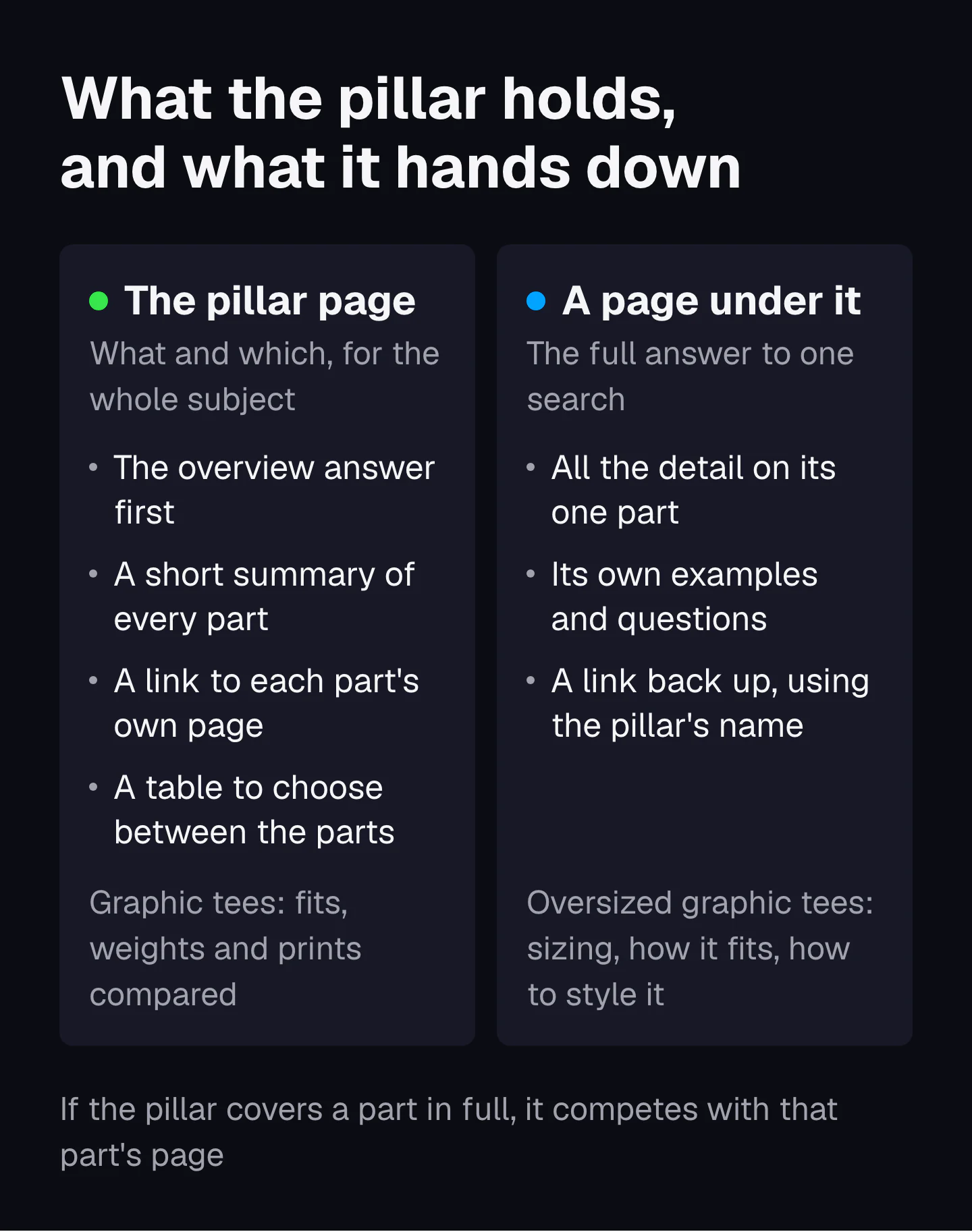
A pillar answers what and which for the whole subject. It gives every page under it a short summary and a link. The depth on any one part stays on that part's own page.
A pillar holds four things:
- The overview answer first. What the subject is, or on a store, what the range is and who it is for.
- A short summary of every part. Two to four sentences each, enough for a reader to know which part they need.
- A link to each part's own page, using that page's own name as the linked words.
- A way to choose between the parts, usually a table. For the tees: fit, weight and print, with a link to each collection.
Each page under it keeps the full answer to its own search. The oversized tees collection keeps the sizing, how the fit sits on different builds and how to style it. The pillar says oversized tees exist, who they suit, and links there.
Why the summaries must stand alone
A long page is often judged a section at a time. Google patented a method for scoring candidate answer passages, granted on 10 April 2018, that scores passages taken from pages, not the pages as a whole. A patent is not proof Google uses the method. Microsoft Advertising said in October 2025 that, for AI search, headings "act like chapter titles that define clear content slices".
Length may help a pillar in AI answers. A 2026 study of AI-mediated search by Michelle Huang and colleagues found that in AI summaries "Wikipedia and longer sources are disproportionately overrepresented". The study does not say why. My advice, not the paper's: if a pillar is long, write each section so it can be lifted out and still make sense.
One subject per page, at each height
Bing's Webmaster Guidelines say it plainly: "Avoid mixing unrelated concepts on a single URL." The pillar's single subject is the overview. Each child's single subject is its part. Keep that line and no two pages fight for the same search.
Length follows the results, not a rule. On a collection pillar, keep the short intro above the products, so they stay on the first screen of a phone, and put the longer guidance below them. A guide pillar on a publisher may run to thousands of words, if the top results for its search do.
The links, in short
- Every page in the branch links up to the pillar, with the pillar's own name as the linked words.
- The pillar links down to every page under it, in the summary for that page.
- Pages beside each other link sideways only where they share a real context.
- The homepage links to the pillar.
The full rules, including how many links a page can carry, are in internal links inside a topical map. How a map turns into written, linked pages is in semantic content networks.
Six ways pillar pages fail
Pillars fail when nobody links to them, when they swallow the pages under them, or when they are the wrong type of page. They also fail when they go live in the wrong order, when they are expected to lift other pages, and when work goes into signals Google ignores.
One mistake we see in maps buyers build themselves is that the pages "do not build on each other". Each failure below is a version of that.
| Failure | How you spot it | The fix |
|---|---|---|
| 1. The orphan pillar | A long guide that no page in its subject links to | Link every page in the branch up to it, and the homepage to it |
| 2. The pillar that swallows its pages | The pillar and a page under it take turns ranking for the same search | Cut the pillar's section on that part to a summary and a link |
| 3. The wrong page type | A guide as pillar for a search where Google shows collections or service pages | Make the selling page the pillar; move the guide under it |
| 4. The wrong order | Pages go live with no pillar to link up to, or the pillar goes live last | Publish the pillar early; add each link down as its page goes live |
| 5. Expecting it to lift the rest | You expected the pages under the pillar to rise, and they did not | Give each page its own reason to rank |
| 6. Work on signals Google ignores | A higher priority value for the pillar in the XML sitemap | Spend the time on links in body text instead |
Failure 5: expecting the pillar to lift the pages under it
One of the top results promises an internal linking strategy that will "spread ranking power where it matters". I found one controlled test of hub links, and it does not support that. In 2021 SearchPilot, an SEO testing company, ran a split test on the content hub pages of one ecommerce site. The test pages went from two to four links to related articles.
The hub pages that added links gained 16% organic traffic, at a 95% chance of a positive effect. The articles they linked to showed "no detectable impact". SearchPilot's own explanation is that those articles had much less traffic, so the test was likely too small to see a change.
So treat it as one sign from one store, not a law. It is consistent with Kleinberg's 1999 definition: a hub is worth what it points to. In that test, the pages that added links gained, and the pages they linked to did not. Give every page under a pillar its own reason to rank.
Failure 6: sitemap priority
One of the top results advises giving pillar pages a higher priority in the XML sitemap. Google's sitemap documentation says: "Google ignores <priority> and <changefreq> values." A link from the homepage and from every page in the branch does what that setting cannot.
Sources
- Authoritative sources in a hyperlinked environment, Jon M. Kleinberg, Journal of the ACM, 1999
- Hilltop: a search engine based on expert documents, Krishna Bharat and George A. Mihaila, University of Toronto, 1999
- New tool aims to revolutionize SEO for businesses with 'Content Strategy', Ratchet+Wrench, 2017
- Importance of topical authority: a semantic SEO case study, Koray Tuğberk Gübür, Holistic SEO, 2021
- SaaS SEO case study, Koray Tuğberk Gübür, Holistic SEO, 2023
- Achieving positive ranking state: 120% growth in 4 months, Koray Tuğberk Gübür, Medium, 2024
- PerDocData (onsiteProminence), Content Warehouse API documentation, hexdocs.pm, 2024
- Google confirms the leaked Search documents are real, The Verge, 2024
- Scoring candidate answer passages (US9940367B1), Google LLC, Google Patents, 2018
- Optimizing your content for inclusion in AI search answers, Microsoft Advertising blog, 2025
- Answer bubbles: information exposure in AI-mediated search, Michelle Huang, Agam Goyal, Koustuv Saha, Eshwar Chandrasekharan, arXiv, 2026
- Bing Webmaster Guidelines, Microsoft Bing, 2026
- Make your links crawlable, Google Search Central, 2026
- Build and submit a sitemap, Google Search Central, 2026