Topical map examples: three real maps, opened up
Most topical map examples online are lists of titles. These are real maps: rows from a store's map and a service business's map we delivered to paying buyers, plus the map behind this library. I open each one the same way, then show what to copy.

Key takeaways
- In a real 391-page store map, every guide links to the collection that sells what it talks about and goes live after it: the 90s outfits guide, at 110,000 searches a month, goes live 145th.
- In a real 173-page service map, every question page feeds exactly one service page, and two pages with no recorded search volume stay on the map because homeowners ask them.
- Links follow what readers need next, not search volume: in this library's map the most-linked lesson has 10 searches a month and 17 links in, while the biggest search, 1,000 a month, has 5.
- Read every planned link as a sentence, page, linking words, page; a link you cannot put into words points to a page that does not build on the others.
- Copy a map's structure, never its rows: on 13 November 2026, 16 of the first 17 US results for "topical map examples" were not about SEO but about maps of land, and keyword-built maps pick up the same mix.
How to read the three maps
Each map below is a table with one row per page. Read across a row and you get the page's place in the publishing order, its type, its role, the one search it is built for, how many people search that in the US each month, the page it feeds and whether the site already has it.
The first two maps are real. We delivered both to paying buyers, one an online store and one a service business, and every row is copied from their map files. The third is the map behind this library, which you can check against the lessons around this one. If the idea of a topical map is new to you, start with What is a topical map?
| Column | What it tells you |
|---|---|
| P | The page's place in the publishing order of the whole map. The numbers jump because each excerpt shows one branch, not every page. |
| Page | The page title as written in the map. |
| Type | What kind of page it is: collection, service page, guide, blog post, comparison or hub. |
| Role | Where it sits: the pillar at the top, hubs that gather a group, cluster pages under them, and support pages that answer questions and feed the others. |
| Main search | The one search the page is built to answer. |
| Searches | The US monthly volume the map records for that search. "None recorded" means the map holds no number. |
| Feeds | The page this one sits under and passes its links up to. |
| Also links to | Store map only: the collections an informational page links to as well, the pages that sell. |
| Existing | Yes when the site already has a page for this, so the map rebuilds that page instead of adding a second one. |
The excerpts show six page types: collection, service, guide, blog, comparison and hub. Our map format names 12 page types, but it is not limited to only those page types. A site gets the types its business needs.
How big a real map is
The store map is 391 pages and the service map 173. Neither number is a target. Our median growth plan is 159 pages (as of 5 November 2026), and a map can be anywhere from about 50 pages to over 20,000, depending on the size of the company, what central entity they have that needs that sort of coverage, how many services they have, and so on.
Map 1: an online store that sells graphic tees
Map 1 is a 391-page US English map for a store whose subject is graphic tees. The excerpt follows one branch: the main collection, the collections under it, and the guides and comparisons that send readers to them. No word in these rows was changed.
What the map is about
The central entity, the one thing every page comes back to, is the graphic tee. The store sells it in cuts people search for by name: oversized, vintage, heavyweight, women's. The pillar is an existing collection page, rebuilt as "Graphic tees" for a search of 201,000 a month.
| P | Page | Type | Role | Main search | Searches | Feeds | Also links to | Existing |
|---|---|---|---|---|---|---|---|---|
| 1 | Graphic tees: funny, weird and vintage statement T-shirts | collection | pillar | graphic tees | 201,000 | (top of the map) | Yes | |
| 2 | Oversized graphic tees | collection | cluster | oversized graphic tee | 22,200 | Graphic tees: funny, weird and vintage statement T-shirts | No | |
| 3 | Vintage and retro graphic tees | collection | cluster | vintage graphic tees | 14,800 | Graphic tees: funny, weird and vintage statement T-shirts | No | |
| 4 | Graphic hoodies | collection | hub | graphic hoodies | 40,500 | Graphic tees: funny, weird and vintage statement T-shirts | Yes | |
| 83 | Graphic tees for women | collection | cluster | graphic tees for women | 18,100 | Graphic tees: funny, weird and vintage statement T-shirts | Yes | |
| 86 | Heavyweight graphic T-shirts | collection | cluster | heavyweight t shirt | 9,900 | Graphic tees: funny, weird and vintage statement T-shirts | No | |
| 145 | 90s outfits: how to dress the decade today | guide | cluster | 90s outfits | 110,000 | Outfit ideas built around a graphic tee | Vintage and retro graphic tees | No |
| 202 | How to wear it: style, fit and care guides | hub | hub | how to style graphic tees | 720 | Graphic tees: funny, weird and vintage statement T-shirts | Yes | |
| 203 | How to style an oversized T-shirt | guide | cluster | how to style an oversized t shirt | 720 | How to wear it: style, fit and care guides | Oversized graphic tees | Yes |
| 204 | How to shrink a shirt (and how to unshrink one) | guide | cluster | how to shrink a shirt | 18,100 | How to wear it: style, fit and care guides | Heavyweight graphic T-shirts | No |
| 329 | Heavyweight vs regular T-shirts: GSM, fit and feel | comparison | support | what is a heavyweight t shirt | 390 | How to wear it: style, fit and care guides | Heavyweight graphic T-shirts | No |
| 341 | What is a boxy tee? Boxy vs oversized T-shirts | comparison | support | what is a boxy tee | 320 | How to wear it: style, fit and care guides | Oversized graphic tees; Cropped graphic tees and crop tops | No |
What each kind of row is for
- Collections (P1 to P86) are the pages that sell. Graphic hoodies at P4 is a collection and a hub at once: it gathers a group of its own.
- The style hub (P202) gathers the how-to-wear guides. It is an existing page, rebuilt.
- Guides (P145, P203, P204) answer the questions around the product: what to wear it with, how to style a cut, how to shrink one.
- Comparisons (P329, P341) settle two small, exact questions: what a heavyweight tee is and what a boxy tee is.
How the links run
Every row feeds one page above it. On top of that, every guide and comparison links to a collection that sells the thing it talks about. The shrink guide links to heavyweight T-shirts. The boxy tee comparison links to oversized tees and to cropped tees. The 90s outfits guide sits under an outfit ideas hub and links to the vintage collection.
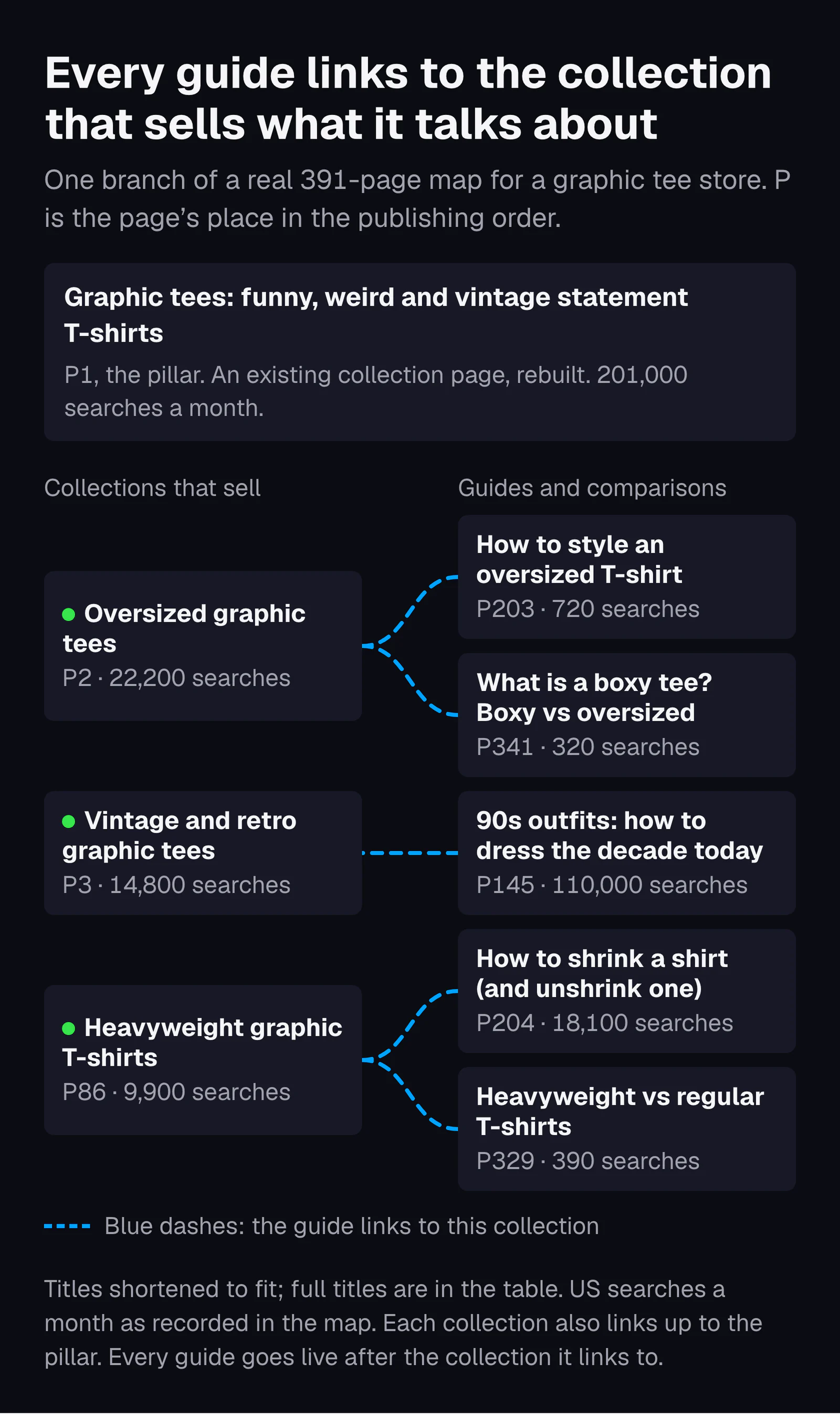
That second column is the store's whole idea. A reader who lands on a guide is one click from a page that sells, and the link is about the same thing the reader was just reading.
What goes live first
Collections go first. P1 to P4 are collections, and the guides in this branch start at P145. Every guide in the excerpt goes live after the collections in the excerpt that it links to, so those links work on its first day. The excerpt does not show P5 to P82; the women's and heavyweight collections come after them.
Search volume does not set the order. The 90s outfits guide has the second biggest search in the excerpt, 110,000 a month, and goes live 145th. The two comparisons, at 390 and 320 searches, go live 329th and 341st of 391, close to the end. The order logic has its own lesson on publishing order.
What to copy from Map 1
Copy the also-links-to column. For every guide on a store map, write down the collection that sells what the guide is about. If you cannot name one, the guide has no job on a store's map. The rest of the store pattern is in Topical maps for ecommerce stores.
Map 2: a water and fire damage restoration company
Map 2 is a 173-page US English map for a restoration company that fixes water and fire damage for homeowners, with insurance claims as a strong second theme. The excerpt follows the water damage branch.
What the map is about
The central entity is the damage and its repair: water in the house, and what it takes to get it out and put the house back. Two words were changed to keep the business private. Its name became [brand] and its US state became [state]. Nothing else in the rows was changed.
| P | Page | Type | Role | Main search | Searches | Feeds | Existing |
|---|---|---|---|---|---|---|---|
| 3 | Water Damage Restoration in [state] | [brand] | service | hub | water damage restoration | 90,500 | Water, Fire & Storm Damage Services | [brand] | Yes |
| 4 | Water Damage Cleanup in [state] | [brand] | service | cluster | water damage cleanup | 2,900 | Water Damage Restoration in [state] | [brand] | Yes |
| 5 | Flooded Basement Cleanup in [state] | [brand] | service | cluster | flooded basement cleanup | 1,600 | Water Damage Restoration in [state] | [brand] | No |
| 6 | Burst Pipe Water Damage Cleanup in [state] | [brand] | service | cluster | burst pipe cleanup | 1,000 | Water Damage Restoration in [state] | [brand] | No |
| 8 | Does Homeowners Insurance Cover Water Damage? | blog | support | does homeowners insurance cover water damage | 1,600 | Water & Fire Damage Insurance Claim Help | [brand] | No |
| 10 | Water Damage Restoration Cost: What Drives the Price | guide | support | water damage restoration cost | 720 | Water Damage Restoration in [state] | [brand] | No |
| 15 | Water Damage Repair in [state] | [brand] | service | cluster | water damage repair | 9,900 | Water Damage Restoration in [state] | [brand] | No |
| 19 | Water Mitigation Services in [state] | [brand] | service | cluster | water mitigation | 5,400 | Water Damage Restoration in [state] | [brand] | No |
| 32 | How to Tell if a Pipe Burst in Your House | blog | support | how to tell if a pipe burst | 1,300 | Burst Pipe Water Damage Cleanup in [state] | [brand] | No |
| 77 | What Is Water Mitigation? Meaning and Examples | blog | support | water mitigation meaning | 390 | Water Mitigation Services in [state] | [brand] | No |
| 78 | Water Mitigation vs Restoration: The Difference | blog | support | water mitigation vs restoration | none recorded | Water Damage Restoration in [state] | [brand] | Yes |
| 107 | Flooded Basement: What to Do in the First 24 Hours | blog | support | flooded basement what to do | 1,000 | Flooded Basement Cleanup in [state] | [brand] | Yes |
| 127 | Dehumidifier for Water Damage: How Long to Run It | blog | support | dehumidifier for water damage | 6,600 | Water Mitigation Services in [state] | [brand] | No |
| 142 | Restoration Company vs General Contractor | comparison | support | restoration company vs general contractor | none recorded | Water & Fire Damage Reconstruction in [state] | [brand] | No |
What each kind of row is for
- Service pages take the calls. P3 is the hub for all water damage work. Under it sit cleanup, flooded basements, burst pipes, repair and mitigation (stopping the damage from spreading before repairs). Each service title names the state and the business.
- Question pages (blog posts and guides) answer what a homeowner searches before or during the job: does insurance cover it, what does it cost, how do I know a pipe burst, how long do I run a dehumidifier. Their titles name neither the state nor the business.
- The comparison (P142) answers a choice the homeowner makes once the water is out: a restoration company or a general contractor.
How the links run
Every question page feeds exactly one page, the one that can take the call the question leads to. The burst pipe question feeds burst pipe cleanup. The dehumidifier question feeds water mitigation. The cost guide feeds the restoration hub. The insurance question feeds the insurance claim help page, which leads the map's second theme.
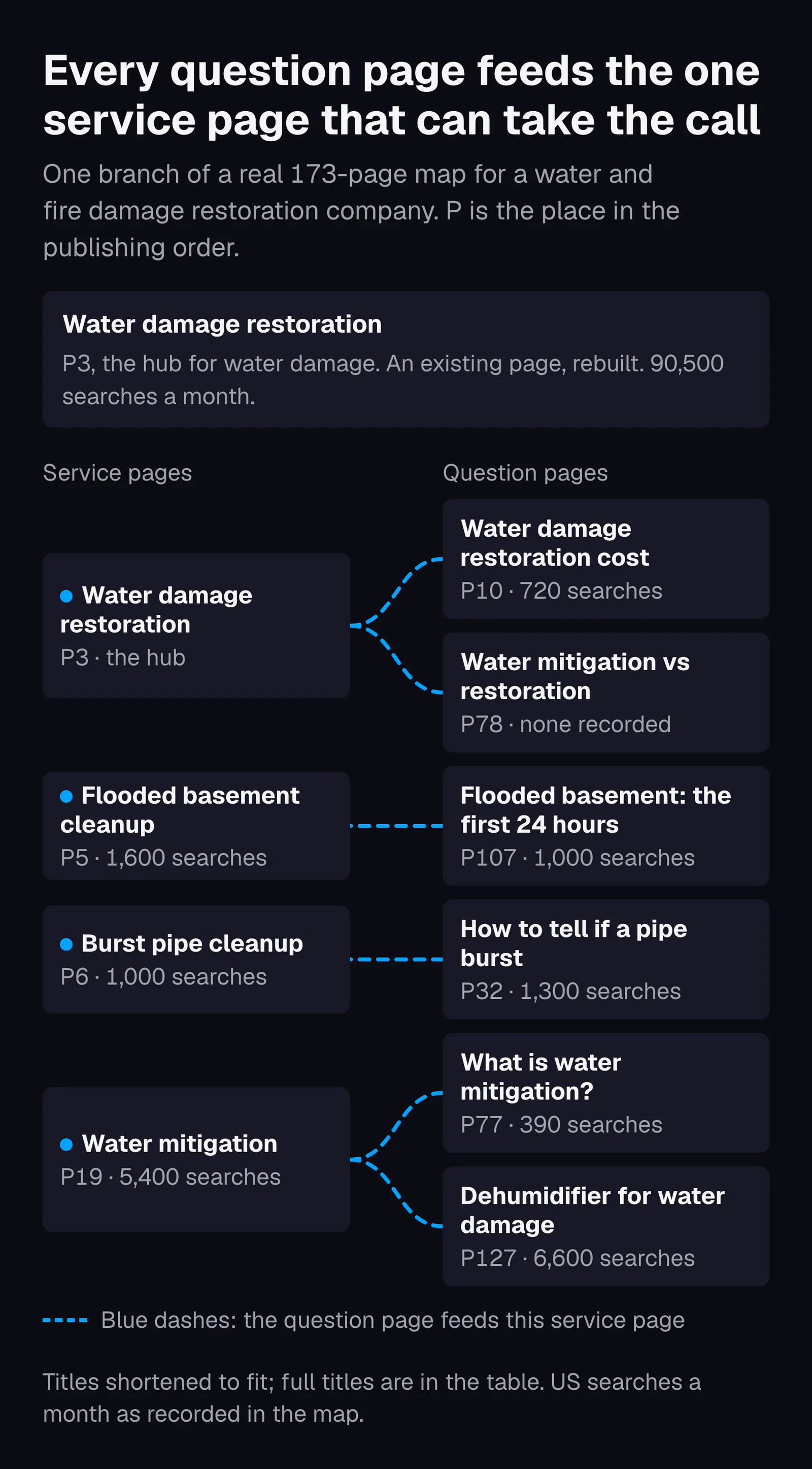
What goes live first
Service pages go first. P3 to P19 are almost all service pages. The exceptions are two question pages that come early: the insurance question at P8 and the cost guide at P10, which feeds the hub at P3.
The question with the most searches in the excerpt, the dehumidifier page at 6,600 a month, goes live 127th. Two pages have no recorded search volume at all, and both stay on the map: mitigation vs restoration (an existing page, P78) and restoration company vs general contractor (P142). Homeowners ask both. A blank in the volume column is not a reason to drop a page.
What to copy from Map 2
Copy the one-page rule for questions: each question page feeds one service page, and the map says which. Then decide which pages carry the place. Here the service pages do and the questions do not. The rest of that pattern is in Topical maps for local and service businesses.
Map 3: the map of this lesson library
Map 3 is the plan for this library, and it is public. Download it below, or open any lesson and check its links against its row.
What the map is about
The subject is topical maps, and the central entity is the topical map itself. The library has three categories: 18 lessons on topical maps, 9 on semantic SEO and 5 on using Claude for SEO. Most rows sell nothing. Each lesson has one main search and links to the lessons a reader needs next. Here are nine of the 32 rows.
| ID | Lesson | Category | Main search | US searches | Links in |
|---|---|---|---|---|---|
| L01 | What is a topical map? | Topical maps | topical map | 590 | 9 |
| L04 | How to build a topical map, step by step | Topical maps | how to create a topical map | 10 | 17 |
| L05 | Topical map examples (this lesson) | Topical maps | topical map example | 10 | 4 |
| L19 | When a search deserves its own page | Topical maps | one page per keyword | Not measured | 4 |
| L13 | Semantic SEO in plain words | Semantic SEO | semantic seo | 1,000 | 5 |
| L15 | Koray Tuğberk Gübür's topical map framework | Semantic SEO | koray topical map | Not measured | 8 |
| L16 | Source context, central entity and central search intent | Semantic SEO | source context seo | Not measured | 5 |
| C01 | Claude for SEO | Claude for SEO | claude seo | 720 | 4 |
| C02 | Build a topical map with Claude | Claude for SEO | topical map claude | 0 | 3 |
How the links run
The map plans 134 links between lessons, plus 13 links to the growth plan. 39 of the 134 cross from one category into another, and every lesson has at least one link in.
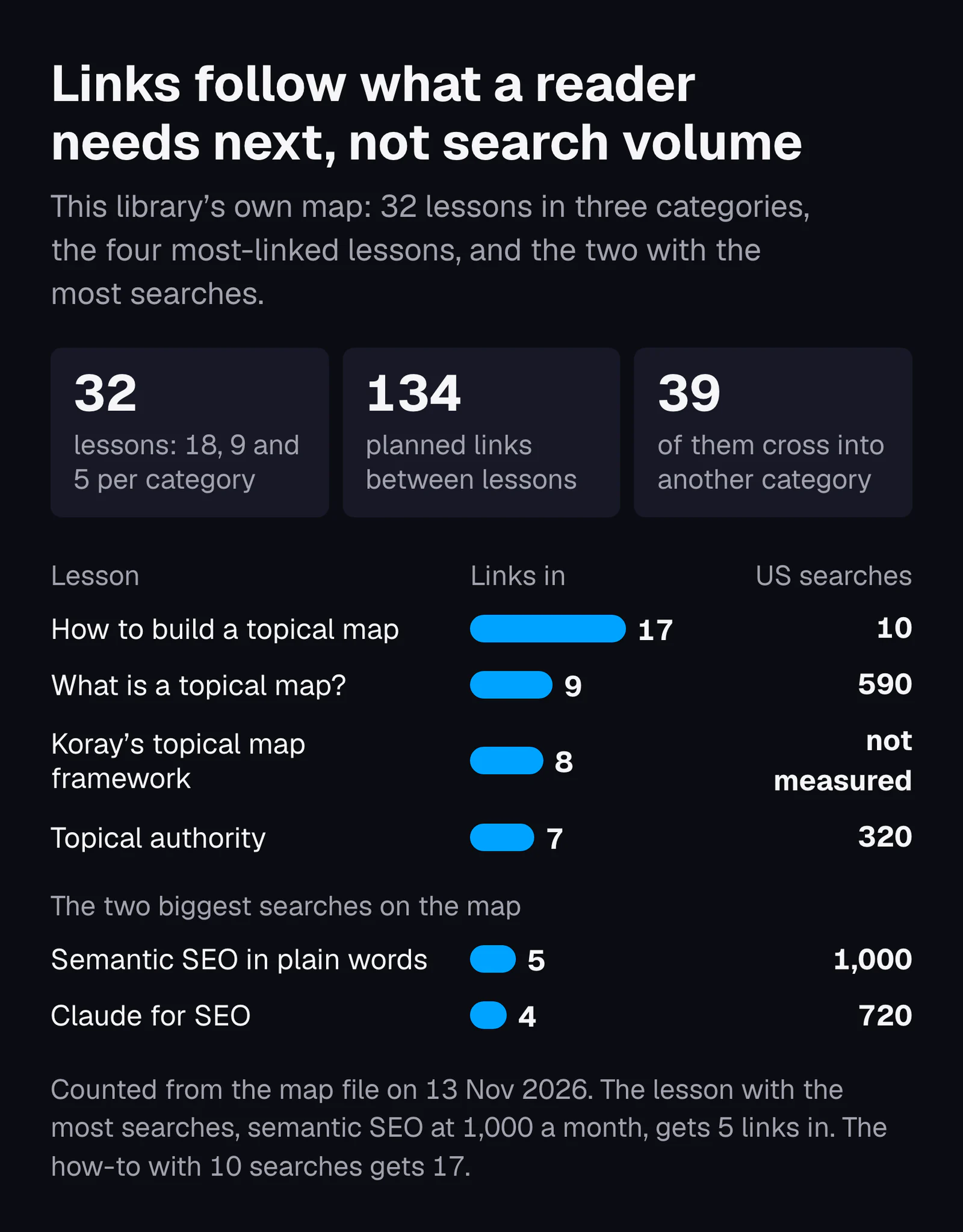
The most-linked lesson, How to build a topical map, gets 17 links in and has 10 searches a month. Semantic SEO, the biggest search on the map at 1,000 a month, gets 5. Links follow what a reader needs next, not search volume. Most lessons end where the reader wants to build something, so most lessons point to the build.
Rows with no search volume
17 of the 32 lessons have no measured volume (12) or a measured zero (5). They are on the map because a reader of the other lessons needs them. You cannot follow the lesson on core and outer sections without the one on source context, whatever a keyword tool says about either.
What goes live first
This map is the exception on order: all 32 lessons go live on the same day, so every link works from the start. A small library can do that. A 391-page store cannot.
The map also shows how a map grows. It had 19 lessons on 12 November 2026 and 32 a day later, after research turned up topics a reader needs that the first plan skipped. Among them: source context (what a site is for), the core and outer sections of a map, and cost of retrieval (how much work it takes a search engine to find and understand your pages). Growing a map after the first pages are live is its own lesson: Expanding a topical map.
What to copy from Map 3
Copy the links-in count. For each page on your map, count how many other pages plan to link to it. The pages at the top of that count are the ones the map depends on, so make them the best pages on the site. A page with zero has nothing pointing to it, and no reader will find it from inside your site.
Four case studies Koray Tuğberk Gübür has published
Koray Tuğberk Gübür, whose February 2021 case study put the topical map in front of the SEO industry, has published the shape and the result of several maps. Four of them, from his article How to Expand a Topical Map for Higher Topical Authority? (5 January 2023), line up with the three maps above. His framework, in plain words, is in Koray Tuğberk Gübür's topical map framework.
| Site and business | What the map did | What he reports |
|---|---|---|
| Encazip, energy price comparison (Turkey) | A map on energy and energy use, then new sections on credit and insurance. When he wrote, "only, 20%" of the credit map and "only 10%" of the insurance map were built. | From 10,000 to over 500,000 organic clicks, and 38,000 new ranking queries (the article gives no time period for the clicks) |
| TheCoolist, lifestyle publisher | Its old map was "distracted", in his word, "focusing on whatever is searched most". The homepage was changed to show the new subcategories, which he calls "Source Context Re-definition". | About 9,000 extra clicks a day on average, later over 30,000 a day |
| Snuffstore, German tobacco and e-cigarette store | The existing map "doesn't have nearly any informational content". Informational pages were added around the products. | 1,200% or more organic growth over 3 months, year on year, and 2,700% more impressions |
| BKMKitap, Turkish book store | A map that covered book genres for the store's own catalog. | From 750,000 clicks to 3,200,000 in one sentence and to 3,900,000 in another, in the same article |
Read against our three maps, each one teaches something:
- Encazip is how a map grows: new sections were added onto a working map, and the credit section was a fifth built when he wrote about it.
- TheCoolist is the failure the three maps avoid: a map that chased the biggest searches.
- Snuffstore is Map 1 seen from the other side: a store map with almost no guides.
What the three maps share, and where they differ
Maps 1 and 2 put the pages that sell ahead of the pages that answer side questions, and give every supporting page one page it feeds. Map 3 keeps the idea with a different center: every lesson points to the lessons a reader needs next. What changes is the page at the center.
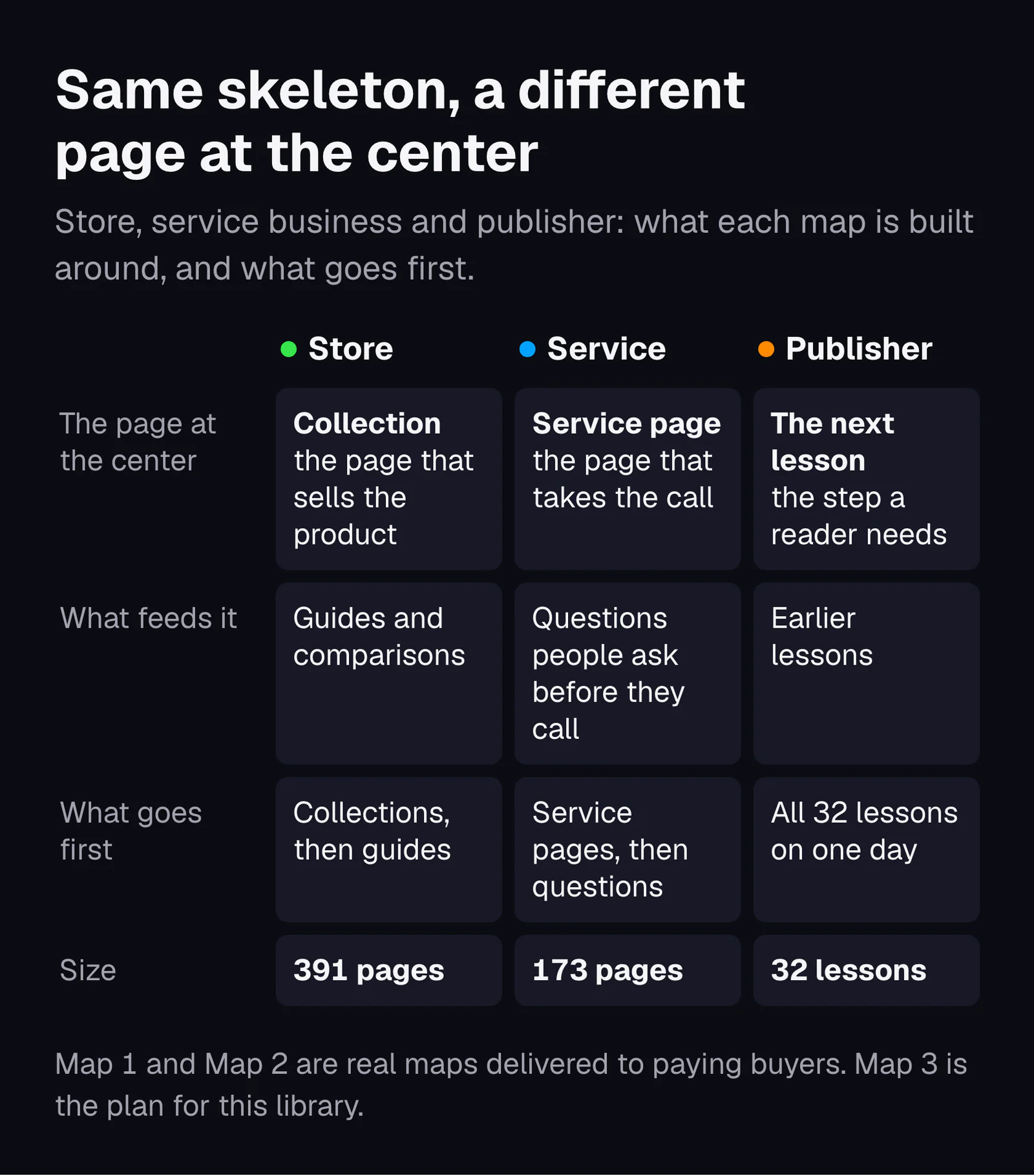
| Store (Map 1) | Service (Map 2) | Publisher (Map 3, this library) | |
|---|---|---|---|
| The page at the center | Collection | Service page | The next lesson |
| What feeds it | Guides and comparisons | Questions homeowners ask | Earlier lessons |
| What goes live first | Collections, then guides | Service pages, then questions | All 32 lessons on one day |
| Where the big searches land | The 110,000-search guide goes live 145th | The 6,600-search question goes live 127th | The most-linked lesson has 10 searches |
| Size | 391 pages | 173 pages | 32 lessons |
Three mistakes in maps buyers build themselves
When I look at maps buyers built themselves, the same three problems come up:
- The pages do not build on each other. In Maps 1 and 2 every row names the page it feeds. In Map 3 every lesson names the lessons it links to.
- Off-topic things that do not deserve to be there, when they could have been part of another post. Every row above serves the subject: tees, water damage or topical maps.
- A query that does not deserve its own page. Many searches are a section of a page, not a page. You do not see those in the excerpts because they live inside other rows. How to tell the two apart is in When a search deserves its own page.
A librarian draws the same subject another way
The Library of Congress keeps a subject heading for T-shirts, created in 1986. Its broader headings are Blouses; Shirts, Men's; and Underwear. Its one narrower heading is Advertising t-shirts, and "Tee shirts" is listed as another name for it.
That is a small topical map of the same subject as Map 1, built for a different job: finding books on a shelf, not selling a shirt. Same subject, different purpose, different map. Koray calls the purpose a site's source context (source context, central entity and central search intent), and it is why another site's map never fits yours as it is.
Read every link in a map as a sentence
Write every planned link as page, linking words, page. If you cannot fill in the middle, the link does not belong, and often the page does not either.
The test comes from concept mapping, a way of drawing knowledge that educators have used for decades. Joseph Novak and Alberto Cañas define it in The Theory Underlying Concept Maps and How to Construct and Use Them (2008). Ideas sit in boxes, joined by lines, and "words on the line, referred to as linking words or linking phrases, specify the relationship between the two concepts." Two ideas and their linking words make a statement you can read aloud.
They also name the failure. People find it hard to add linking words "because they poorly understand the relationship between the concepts". A topical map is a concept map with pages as the ideas, and the same failure shows up as a link marked only "related".
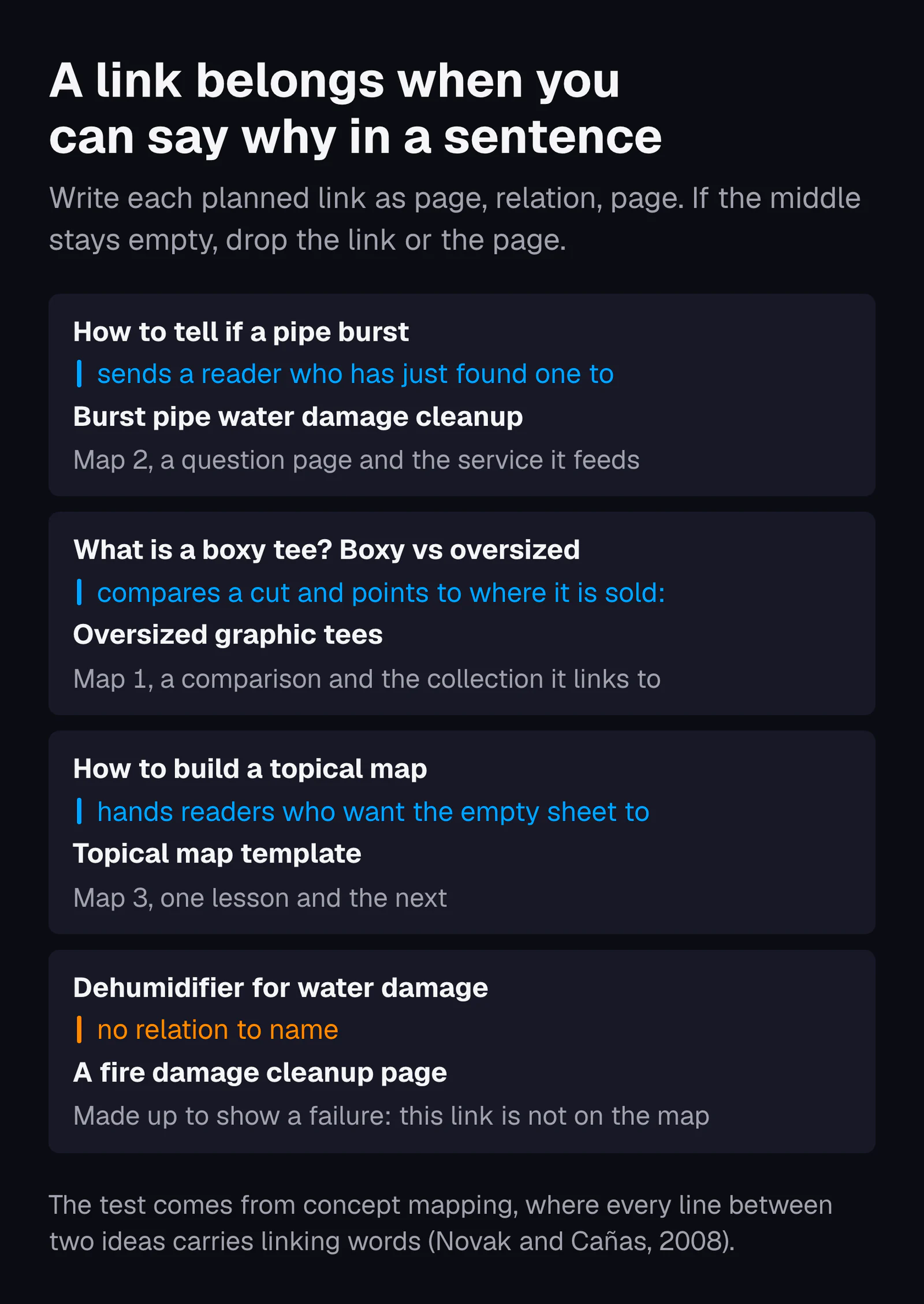
Every link shown in Maps 1 and 2 passes this test. A link you cannot put into words is a page that does not build on the others. The words you write in the middle are also a good first draft of the words around the link on the live page. More on that in Internal links inside a topical map.
What one split test says about these links
SearchPilot, an SEO testing company, ran a split test on one ecommerce site in 2021. Hub pages that went from two to four related article links gained 16% in organic traffic, at 95% confidence. The pages receiving the new links showed "no detectable impact". Taken together, the test came out at 11% with a 90% chance of a real gain, below the usual 95% bar. It is one site and one test. It fits how these maps use links, though: the link serves the reader on the page that carries it. Do not plan a guide's link expecting it to lift the collection on its own.
Why a copied example map can mislead you
"Topical map" sits right next to "topographic map", in Google and in keyword tools. A map built from keyword data alone picks up searches from people who want a map of the land.
On 13 November 2026 I pulled Google's US results for "topical map examples". 16 of the first 17 results were not about SEO at all: topographic maps, stock map images and one map projection. The singular, "topical map example", returns SEO pages, but its People also ask box still asks "What is a topographic map?"
Keyword tools inherit the mix. One topical map generator publishes an example map it built on 17 October 2026 for this very subject. Its first article, "What Is a Topical Map in SEO?", carries the searches "us topical map", "topical map of texas" and "topical map of california". Those are people looking for a map of the land in the US, Texas or California. A page written for them would answer nobody.
The older meanings of the words are a story of their own: topic maps, taxonomies and concept maps came first. That history is in Where the topical map came from.
Copy the structure with the three downloads
All three maps are yours to download. The two client excerpts share one set of columns. The library map has its own, with every lesson's links written out.
Download Map 1: the graphic tee storeCSV, 12 rows from a real 391-page map: publish order, page, type, role, main search, US searches, the page it feeds, the collections it links to, existing page. Opens in Google Sheets or Excel.
Download Map 2: the restoration companyCSV, 14 rows from a real 173-page map, same columns as Map 1, with the business name and state replaced.
Download Map 3: this lesson libraryCSV, all 32 lessons: category, reading order, slug, title, page type, main search, US searches, supporting searches, intent and the lessons each one links to.
Six questions to open any map
Use these on the three maps above, on any example you find, and on your own map before anyone writes a page:
- What is the one thing every page comes back to? Graphic tees, water damage, topical maps. If you cannot say it in two words, the map has no center.
- What sits at the center: what sells, takes the call, or teaches the next step? Name the page type, then check that most rows lead to one.
- Does every supporting row name the page it feeds? A blank in that column is a page with no job.
- Can every link be read as a sentence? Write the linking words. Drop the links that have none.
- Does the order follow the roles or the volumes? If the biggest searches go first and the pages they link to come later, those links point at nothing for weeks.
- What happens to the pages the site already has? Each one is rebuilt, kept, merged or redirected. In Map 1, 5 of the 12 rows are existing pages; in Map 2, 4 of 14.
Then use the files as a pattern, not as rows to copy:
- To set up your own sheet, start from the Topical map template, which has the same columns.
- To fill it, follow How to build a topical map, step by step.
- To have it built for your site, that is what our growth plan is.
Sources
- How to Expand a Topical Map for Higher Topical Authority?, Koray Tuğberk Gübür, Holistic SEO & Digital, 2023
- 3 Suggestions about Topical Authority, Koray Tuğberk Gübür, Medium, 2024
- The Theory Underlying Concept Maps and How to Construct and Use Them, Joseph D. Novak and Alberto J. Cañas, IHMC, 2008
- Library of Congress Subject Headings: T-shirts (sh85131768), Library of Congress, 1986